
The Caddie Era: Canvas and the First Carry Bags
Golf bags emerged in the late nineteenth century as the game spread: small canvas and leather carry sacks with a strap and a few pockets, built light because a caddie's shoulder — not a trolley — carried the load.
The first golf bags were a response to a transport reality: the caddie. As the game spread through Scotland and beyond in the late 1800s, clubs needed carrying, and the earliest dedicated carriers were simple affairs — canvas or duck-cloth sacks, top-loading, with a shoulder strap and perhaps one small pocket for the era's minimal accessories. The construction vocabulary of the era was borrowed from the softgoods of the day (the sail-making and luggage trades): heavy stitched canvas, leather trim and reinforcements at the wear points, riveted strap attachments — the same material logic that returns in today's waxed-canvas heritage executions, which is why those executions read as authentic rather than retro.
What the caddie era established that never left: the bag as a shoulder-carried softgood (not a box, not a trolley), the top opening as the primary interface (the era's small clusters grew into the divider logic of a century later), and the weight discipline that never stopped mattering — a caddie's bag was light because a caddie carried it, and the sunday bag of today is the direct descendant, stripped back to the era's essentials with a century of material science behind it. The next century of golf bag history is the story of what happened when the carrier changed — from the caddie's shoulder to the player's own back to the cart's bay — and every chassis on a modern spec sheet answers one of those carriers.

Between the Wars: Leather, Weight and Status
The early twentieth century brought the era the heritage brands still trade on: full leather bags, brass hardware, and the first real status coding in the category — the bag as a mark of the club class, with the big leather ball pockets and the fitted look that period photographs show lined up outside clubhouses. Construction-wise, the era refined the craft vocabulary: skived and stitched leather panels, riveted and re-enforced strap anchors (the ancestors of today's critical-class seams in the AQL guide), molded leather bases, and the pocket architecture (ball, apparel, accessory) that is still the default layout grammar of every modern bag.
What the leather era cost, and why the story turned: weight and weather. A full leather bag at mid-century dimensions carried its own kilogram load before a single club went in — tolerable for a caddie, punishing for the self-carrying player the democratizing game was producing — and leather's care demands (the maintenance guide's leather protocols are the living memory of the era) limited the climates and the care budgets the bag served. The interwar years built the category's identity vocabulary and its pocket grammar; the post-war years would rebuild its weight vocabulary entirely, because the carrier was about to change — first with legs, then with wheels.
The Post-War Stand: Legs Learn to Pop
The stand bag is a post-war invention in its commercial form: patents for self-standing legs appear through the late 1940s and 1950s, with the spring-loaded, automatically deploying legs — the click-stand mechanism that still defines the chassis — commercialized in the following decades. The construction problem the stand solved is the one every walker knew: the bag that must be leaned, laid or held while the shot is played. The engineering answer married the softgood to the mechanism: a hinge point at the base, legs that deploy by spring and retract by re-shouldering, and — critically for a B2B understanding of the chassis — a base structure and internal framing able to take the stand's loads without the shell collapsing, the load path that the stand bag guide's structural checkpoints still audit today.
Why the stand matters as a chapter rather than a footnote: it is the first mechanism in the category — the moment the golf bag stopped being pure softgoods and became a hybrid of textile and hardware, with the hinge hardware, the spring systems and the leg tubes that a modern spec sheet names as line items (the AQL guide's hardware classes audit exactly these components). Every stand bag shipped since — from the working weekenders of the 1960s to the modern engineered chassis — is a refinement of that post-war mechanism, and the buyers who understand the chassis as a mechanism (not just a bag with legs) are the ones whose spec sheets hold up in the field.
America Rides: The Cart Bag Arrives
The riding golf cart's spread through post-war American golf — the suburban course boom, the fairway fleets, the walking culture's long retreat — created the next chassis: the cart bag, engineered for the cart bay rather than the shoulder. The construction consequences were decisive and remain visible on every spec sheet: the strap system demoted (the cart bag's handles and its single orientation matter more), the base redesigned (flat or molded to sit the bay and the friction strip that holds it there — the cart bag guide's base geometry), the weight budget released (no shoulder meant the wall thickness, divider counts and feature sets could grow — the chassis that carries the 14-way tops and the full-featured pocket architectures today), and the top opened up for the club organization that cart life made comfortable.
The cart era's quiet legacy for every modern buyer: it split the category into transport-defined chassis for the first time — the walking bag and the riding bag as different engineering answers — and it taught the industry that features follow the carrier. The US market remains the cart-dominant geometry (the regional band shifts of the price-tier guide run on this fact), and the cart chassis is the default American club-channel product precisely because the era's course architecture (wide fairways, cart paths, the pace-of-life assumptions) built the carrier before the bag was built for it.
The Walking Renaissance and the Dual Strap
The 1990s dual strap — popularized in the early part of the decade — rebalanced a single load across both shoulders, and the walking renaissance it served turned bag weight from a luxury into the category's central engineering target.
The late 1980s and 1990s brought the counter-wave: fitness culture, the college game's walking tradition, and the European and Japanese courses where riding never dominated. The single strap — the caddie-era inheritance still standard on every bag — put asymmetric load on one shoulder; the dual strap, popularized commercially in the early 1990s, split the load across both, and the effect on the category was structural: the carry bag could now be engineered as a two-shouldered load system (the backpack's physics arriving at golf), the strap geometry became a spec line rather than an afterthought, and the modern ergonomic harness — padded, articulated, chest-strapped — began its development arc into the engineered systems on today's premium chassis.
The dual strap's B2B lesson is the chapter's point: a comfort innovation reset the entire engineering target of a chassis. Once the walking load was two-shouldered, every kilogram mattered proportionally (the player feels the second shoulder's relief as permission to notice weight at all), and the lightweight race of the following decade had its starting gun. The modern stand guide's weight-class tables — the sub-2-kilogram targets, the carbon-and-alloy leg options — are the direct continuation, and the walking channels (the women's market's weight sensitivity at 1.65–2.4 kilograms is the same physics) still price weight as the first spec line.
The Lightweight Race of the 2000s
The 2000s ran the weight race in earnest: lightweight nylons and advanced synthetics replaced heavier weaves on the carry chassis (the materials guide's tier system is the race's results table), leg materials moved to alloys and composites, base constructions thinned and molded, and the marketing language of the decade — the sub-3-pound carry bag — pushed the category's engineering vocabulary forward the way fuel economy redefined the car. The race had a discipline the earlier eras lacked: it was measurable (the scale was the spec sheet), which made it honest — a manufacturer could claim comfort, but the weight was a number, and the numbers dropped decade over decade.
The race's permanent contributions to the modern spec vocabulary: the weight-class table as a first-order spec line (every chassis guide on this site names its weight band before its pocket count — the stand guide's classes, the junior guide's age-band targets at 1.0–2.2 kilograms), the material substitutions that made the weights possible (nylon over polyester where the budget allowed, engineered foams over felts), and the trade-off discipline the race taught — because weight is bought with feature set, and the chassis that wins the scale loses pockets, divider runs and waterproofing budgets. Every modern bag's spec sheet is a position in that trade-off space, chosen for its carrier and its channel.
The Staff Bag Becomes Television
The staff bag's construction history is a status history: the big tour bag — the staff chassis — evolved through the television era into the visible flag it remains, engineered for the caddie-shouldered, camera-followed tour context: large panel real estate for sponsor branding, six-way-and-up club organization, the luggage-grade construction that survives weekly professional handling, and the pocket architecture that serves a tour player's actual round-day workflow. Its construction language is the leather era's craft vocabulary carried forward at scale — the reason the halo price band and the staff chassis coincide: the bag is built like premium luggage because it functions as premium luggage, in public, weekly.
What the staff bag's television chapter teaches the B2B buyer: visibility shapes construction economics. The staff bag's panels are media real estate (the logo placement guide's panel-value logic descends directly from tour broadcasting), its construction quality is publicly audited every weekend, and its influence on the retail category (the tour-proven halo that prices the consumer tier below it) is the anchor effect the price-tier guide describes — the flagship architecture that makes the mid-band products credible. The staff bag is the category's oldest chassis and its most modern marketing instrument, and the corporate channel's flagship-gift logic is the same story told in business development.
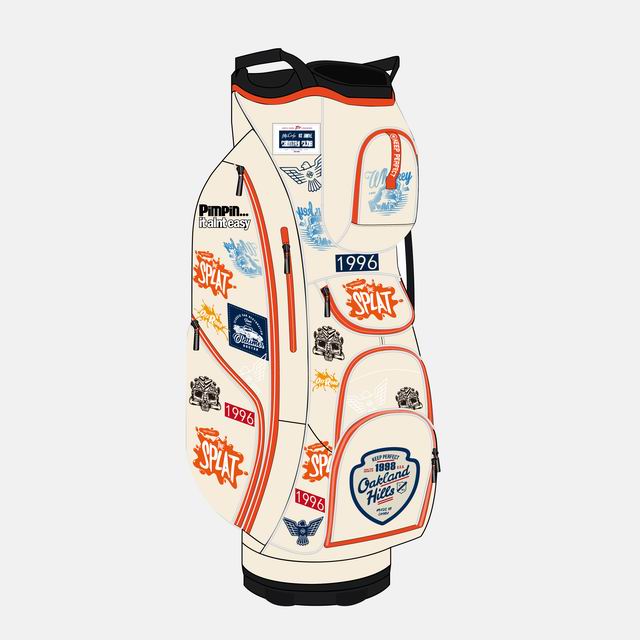
Graphite Changes the Top Opening
The graphite shaft's spread from the 1980s onward rewrote the bag's top: a graphite shaft scratched in a shared cavity is an expensive quiet failure, and the industry's answer was the divider architecture — first the simple sewn dividers separating the top into clusters, then the full-length divider run extending the separation the whole way down (protecting shafts from each other, not just organizing them), and finally the 14-way architecture giving every club its own full-length channel. The construction consequence concentrated at the top and ran the bag's full height: the top became a molded or multi-piece engineered component (the putter wells, the engineered rims of the modern stand guide's chassis tables), and the internal architecture carried the divider loads — the reason a 14-way full-length bag is a different chassis, not a feature option on a shared one.
The graphite chapter's broader lesson for spec discipline: a materials change in the equipment around the bag forced a construction change in the bag itself — the category follows its context. The modern equivalents are already running: rangefinders and phones forced the magnetic and lined accessory pockets (the valuables architecture of the premium band), the push-cart resurgence is forcing the cart-compatible base geometries (the cart chassis merging with the walking chassis), and the trend coverage's tech-integration directions will force the next construction chapter. The buyers who read the equipment context — not just the bag catalog — are the ones whose chassis choices age well.
Five Decades of Material March
The material history in one march: canvas and duck (the caddie era) → leather over canvas, then full leather (the status era) → vinyl and early synthetics (the mid-century mass-market turn — the material that democratized the bag, at the cost of the weight and the hand the leather era had established) → nylons and polyesters in coated and solution-dyed executions (the lightweight race's engine — the fabrics the materials guide still tiers by denier, coating and hand) → and the current wave of technical weaves, recycled-content fabrics and engineered hybrids (the sustainability stack's RPET chains and the trend coverage's premium hybrids at mid prices).
The march's pattern, for the buyer who wants history's compounding lesson: each material generation traded something and bought something — vinyl bought price and lost hand; nylon bought weight and lost the leather look (until the premium synthetics bought the look back); the recycled generation buys the story and pays the certification stack. The B2B discipline the pattern teaches: read a material claim as a trade, not an upgrade (the color discipline and the AQL consequences differ per material class), and spec the material for the channel's actual conditions — the waxed-canvas heritage story in a walking channel, the solution-dyed workhorse in a resort sun (the UV-and-chlorine reality), the coated workhorse where the budget rules.
Waterproofing Comes to the Bag
The waterproofing chapter is the category's ongoing negotiation with weather: the early bags assumed the caddie's shelter and the clubhouse's proximity; the modern bag assumes the rain round happens. The construction vocabulary built up over decades — coated fabrics and seam treatments (the taped and welded seams the premium band now specs), the rain hood (the original gesture, still standard equipment — the quick-deploy cover of the travel guide's protective logic in miniature), the waterproof valuables and apparel pockets (the lined, sealed, zipper-guarded architecture), and the full-system weather executions of the premium and specialist chassis (the trend coverage's directions and the band table's waterproofing row).
The waterproofing chapter's honest engineering note for spec writers: water management is a system, not a fabric spec — the shell fabric's coating, the seam construction, the zipper classes, the pocket linings and the base welding all participate, and the system is only as dry as its weakest seam. The maintenance guide's rain-protocol (the after-round handling that protects both the bag and its contents) is the consumer-side half of the same system, and the B2B spec sheet's weather lines should name the system's parts (fabric class, seam treatment, zipper grade, hood inclusion) rather than claiming a single waterproof number the construction cannot support. History's lesson in one line: the rain always wins eventually; engineering decides how long eventually is.
Specialization Splits the Category
By the 2000s the category had fully speciated into the chassis families a modern catalog names: the staff bag (the tour flag), the cart bag (the riding geometry), the stand bag (the walking engineering), the sunday and pencil bags (the minimalist descendants of the caddie era — the short-round and travel chassis), the hybrid chassis (the recent merge of walking and cart geometry), and the specialist branches (the travel cover family, the cooler constructions, the mini staff executions). The split followed the carriers and the use cases — each chassis an engineering answer to a transport reality, per the history this guide has walked.
The specialization's commercial consequence — the reason this site exists in its current form: the chassis families became brandable per channel (the private label programs of the modern B2B market pick their chassis for their channel's carrier), and the category's fragmentation became the custom market's opportunity. A specialty retailer brands the sunday chassis for the urban short-round channel; a resort brands the cart chassis for its fleet reality; a corporate program brands the staff chassis for its flagship gift — and the 130-year construction history is the menu they are ordering from, whether they know it or not. The buyers who know it spec with vocabulary the factory respects.
The Custom Era: From Embroidery to OEM
The customization history runs its own arc: the early decades' club crests and monograms (the leather era's personalization — initials in the same craft vocabulary as the bag itself), the embroidery era (the logo stitched onto the standard product — the techniques guide's most established method, the corporate channel's working default for decades), the print and transfer era (the full-panel coverage that the camo and pattern programs and the character programs run on), and the full OEM era — the buyer's own pattern, chassis and BOM, manufactured to their spec (the models guide's distinction, the design process this site documents, and the reason a 130-year-old category has a custom manufacturing industry at its current scale).
The custom era's enabling history matters to buyers pricing programs today: the embroidery machine's spread (the twentieth century's decoration infrastructure — the reason the logo placement vocabulary standardized around the ball pocket and the side panel, the placement guide's conventions), the digitization of patterns and cuts (the sample-to-production cycle the sample guide runs in six to ten days — a speed the embroidery era's buyers would not recognize), and the MOQ economics that made small-run custom viable (the low-MOQ structures the modern market runs on). The custom era is the construction history's commercial payoff: every chassis the eras built, available to a program's own spec.
What History Teaches a Buyer
Four lessons, each load-bearing for a modern program. First: the carrier defines the chassis — the caddie's shoulder, the player's back, the cart's bay, the airplane's hold built the category's families, and your program's channel contains a carrier; spec for it (the chassis guides on this site are the current answer set). Second: features follow the carrier's permission — the dual strap made weight matter, the cart made features grow, the walking renaissance made weight matter again; a feature budget is a carrier's physics, not a catalog's generosity. Third: materials are trades, not upgrades — every generation in the march bought something and paid something, and the spec sheet should name the trade it is making.
Fourth, and the one the history proves most quietly: the category compounds. The modern stand bag carries the caddie era's top grammar, the post-war mechanism, the 1990s strap physics, the 2000s material science, the graphite-era divider run and the current weather architecture — all in one product, all auditable on a spec sheet. The buyer who reads a bag's spec sheet as the history it is (the manufacturer checklist's construction audit, informed by a century of load paths) specs with the whole industry's engineering behind the decision — and the buyer who treats any single spec line (a denier number, a divider count, a waterproof claim) as the product, rather than as one chapter of a 130-year construction story, is the buyer the spec sheet was built to outrun.
Timeline in One View
The 130 years compressed to one table for the spec-writer's wall: the eras, the carriers that defined them, the constructions each introduced, and the modern spec-sheet lines each era still owns. Read it as a component genealogy — the divider count on today's RFQ traces to the graphite era; the strap spec to the 1990s; the weight class to the 2000s; the panel real estate to television; and the top's club-cluster grammar to the caddie era's sack opening. The table is also the fastest onboarding document a new program team can read: every chassis on the modern price list is one of these eras' constructions, continued.
Where the timeline points next, briefly (the trend coverage holds the full discussion): the integration era — tech-bearing constructions (the pocket architectures learning to carry the devices), the sustainability era (the recycled-content material generation and its documentation stack), and the customization era's continuation (OEM at ever-smaller MOQs, the drop structures running limited constructions the way the tour runs staff bags). The history's next chapter will follow the same rule every chapter has: the carrier changes, the construction follows, and the buyers who read the change first spec the chassis that answers it.
| Era | Carrier Reality | Constructions Introduced | Modern Spec Lines Owned |
|---|---|---|---|
| Late 1800s | The caddie shoulder | Canvas carry sack, strap, first pockets | Top opening grammar; sunday chassis descent |
| 1900s–1930s | Club-class status | Full leather, brass hardware, pocket architecture | Ball-apparel-accessory layout; heritage material stories |
| 1940s–1970s | Post-war walking | Spring-leg stand mechanism | Stand chassis; hinge and leg hardware; AQL structural classes |
| 1950s–1980s | Suburban riding boom | Cart chassis: flat base, feature growth | Cart base geometry; feature budgets; US channel defaults |
| 1990s | Walking renaissance | Dual-strap load system | Ergonomic harness specs; weight-class tables |
| 2000s | The weight race | Lightweight nylons, alloys, molded bases | Weight bands; material tiers; trade-off discipline |
| 2000s–2010s | Graphite protection | Full-length and 14-way divider runs | Top architecture; molded rims; internal framing |
| 2010s–now | Year-round play | Systematic waterproofing | Seam treatments; zipper grades; rain hoods |
| Now | Personalized equipment | OEM chassis at low MOQ | Full program specs; the custom era itself |
Frequently Asked Questions
When was the first golf bag invented?
Golf bags as dedicated carriers emerged in the late nineteenth century as the game spread — before that, clubs were carried in bundles or crude sacks. The earliest bags were canvas or duck-cloth carry sacks with a shoulder strap and minimal pockets, built light for the caddie who carried them. The leather era followed in the early twentieth century, bringing the craft vocabulary today's heritage executions borrow.
Who invented the stand bag?
No single name owns it: self-standing leg mechanisms were patented through the late 1940s and 1950s, with the spring-loaded, auto-deploying legs commercialized across the following decades. What matters for buyers is the engineering lineage — hinge, spring and leg tube hardware as spec lines, and the base and framing loads the mechanism introduced — which modern stand chassis audits still run on.
When did dual straps become standard on golf bags?
In the early 1990s, when the dual strap's commercial popularization met the walking renaissance — fitness culture, college golf and the walking-strong European and Japanese courses. The two-shouldered load split reset the carry bag's engineering target and made weight the category's central spec line, which is why every modern chassis guide leads with its weight class.
Why are staff bags so big?
Because their construction follows their carrier: the tour caddie's shoulder and the television camera. The large panels are sponsor media real estate, the club organization and pocket architecture serve a tour player's round-day workflow, and the luggage-grade build survives weekly professional handling. The retail halo tier below it borrows the same construction language for identity — the anchor effect the price-tier guide describes.
How did graphite shafts change golf bags?
They rewrote the top: graphite shafts scratched in shared cavities forced the divider architecture — sewn clusters first, then full-length divider runs protecting shafts the whole way down, then the 14-way channel giving every club its own space. The consequence concentrated the bag's engineering at the top opening and ran it the full height: a 14-way full-length bag is a different chassis, not a feature option.
What is the difference between a carry bag and a cart bag historically?
Carriers: the carry bag descends from the caddie-era sack through the stand mechanism and the dual strap — engineered for the shoulder, weight-disciplined; the cart bag emerged with the post-war American riding-cart boom, its base, orientation and feature budget engineered for the cart bay. The hybrid chassis is the recent merge — the walking-cart crossover the current trend coverage tracks.
When did waterproof golf bags appear?
Waterproofing accumulated rather than arrived: coated fabrics and the rain hood came first (the original gesture, still standard), then taped and welded seams, lined and sealed valuables pockets, and the full weather systems of the modern premium chassis. The honest spec discipline it teaches: water management is a system — fabric, seams, zippers, linings, base — and the system is only as dry as its weakest seam.
What were old golf bags made of?
Canvas and duck cloth for the earliest carriers, leather trim and reinforcement at the wear points; full leather in the status era (with brass hardware and riveted anchors); vinyl and early synthetics in the mid-century mass-market turn; then the nylons and coated polyesters of the lightweight race, and today's technical weaves and recycled-content fabrics. Each generation traded something and bought something — the material march's compounding lesson.
How has golf bag weight changed over time?
Downward, decisively, and in two jumps: the material march (canvas to leather to vinyl to nylon) moved the fabric weights, and the 2000s lightweight race made weight the headline spec — the sub-3-pound carry bag era, alloy and composite legs, molded bases. Today's weight bands by chassis — the stand guide's classes, the women's market's 1.65–2.4 kilogram sensitivity, the junior guide's age-band targets — are the race's results table.
Why do golf bags have 14 dividers?
Because the rules allow a 14-club maximum, and the graphite-era engineering logic extends that to one channel per club: full-length separation protecting each shaft the whole way down. The 14-way architecture is the premium construction's default — the divider run plus the molded top is a major share of the delta between the mid and premium price bands.
What is a Sunday golf bag?
The minimalist descendant of the caddie era: a light, small-top carry bag for short rounds, practice and travel — the name itself from the casual Sunday game. The modern sunday and pencil chassis carry a century of material science stripped back to the essentials — the chassis the urban short-round and travel channels now brand as their own.
When did custom logo golf bags become common?
The embroidery era made logos standard through the late twentieth century — club crests and corporate logos stitched onto stock products, the conventions the placement guide still uses. The full custom OEM era followed the digitization of patterns and cuts and the MOQ economics that made small runs viable — the buyer's own chassis, pattern and bill of materials, the custom manufacturing industry this site documents.
What construction era matters most for buying decisions today?
All of them, which is the point of the history: the carrier lesson (spec the chassis for your channel's carrier), the feature lesson (features follow the carrier's physics), and the material lesson (materials are trades). The buyer reading a modern spec sheet is reading 130 years of engineering — and the spec lines that name their era honestly are the ones that hold up in the field.
What will golf bags look like in the future?
The trend coverage holds the full discussion; the history gives the rule: the carrier changes, the construction follows. The visible directions — tech-bearing pocket architectures, the sustainability material generation with its documentation stack, OEM customization at ever-smaller MOQs, and the hybrid chassis merging walking and cart geometry — are the same pattern the category has run since the first canvas sack met the first caddie shoulder.