
What a Den Caddie Actually Is
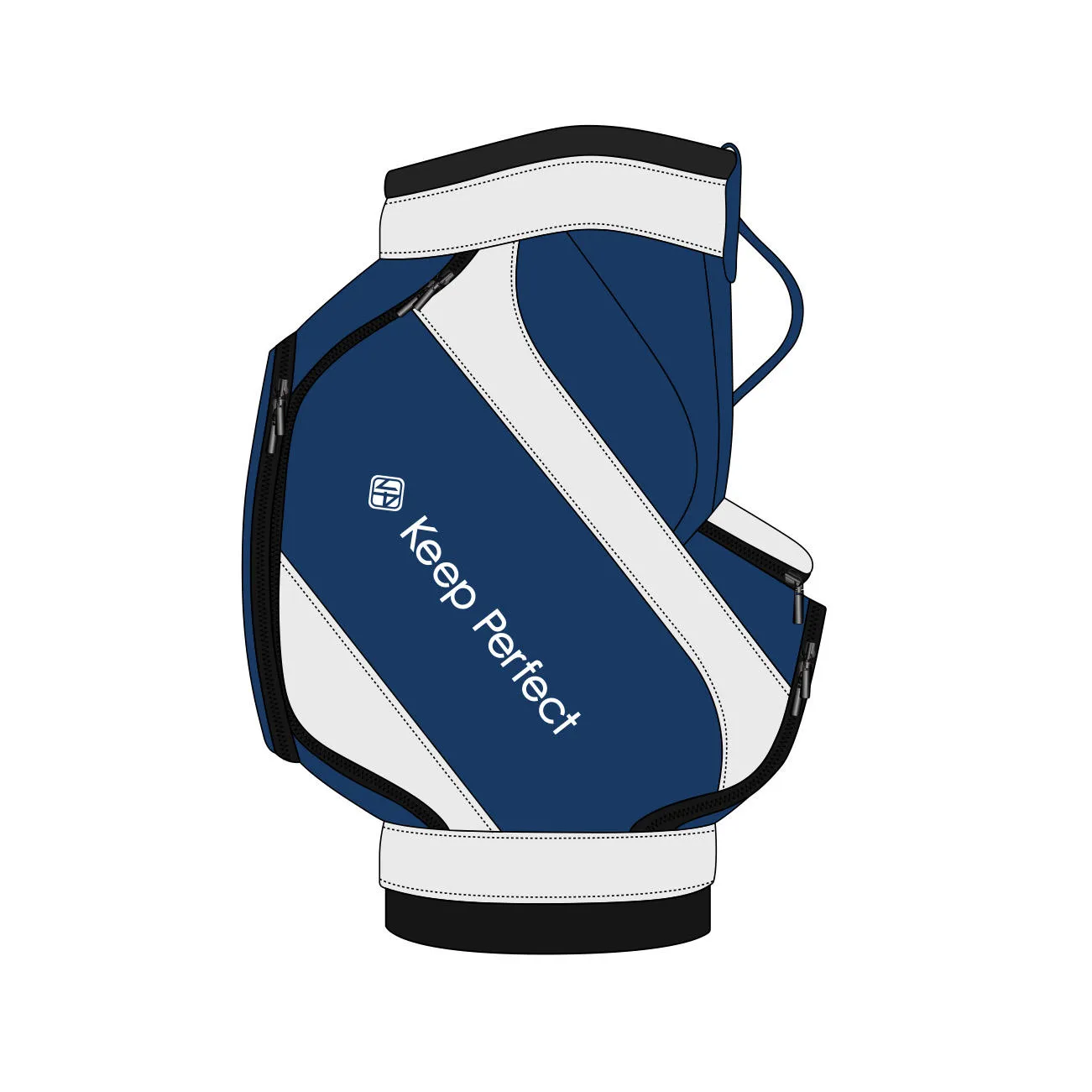
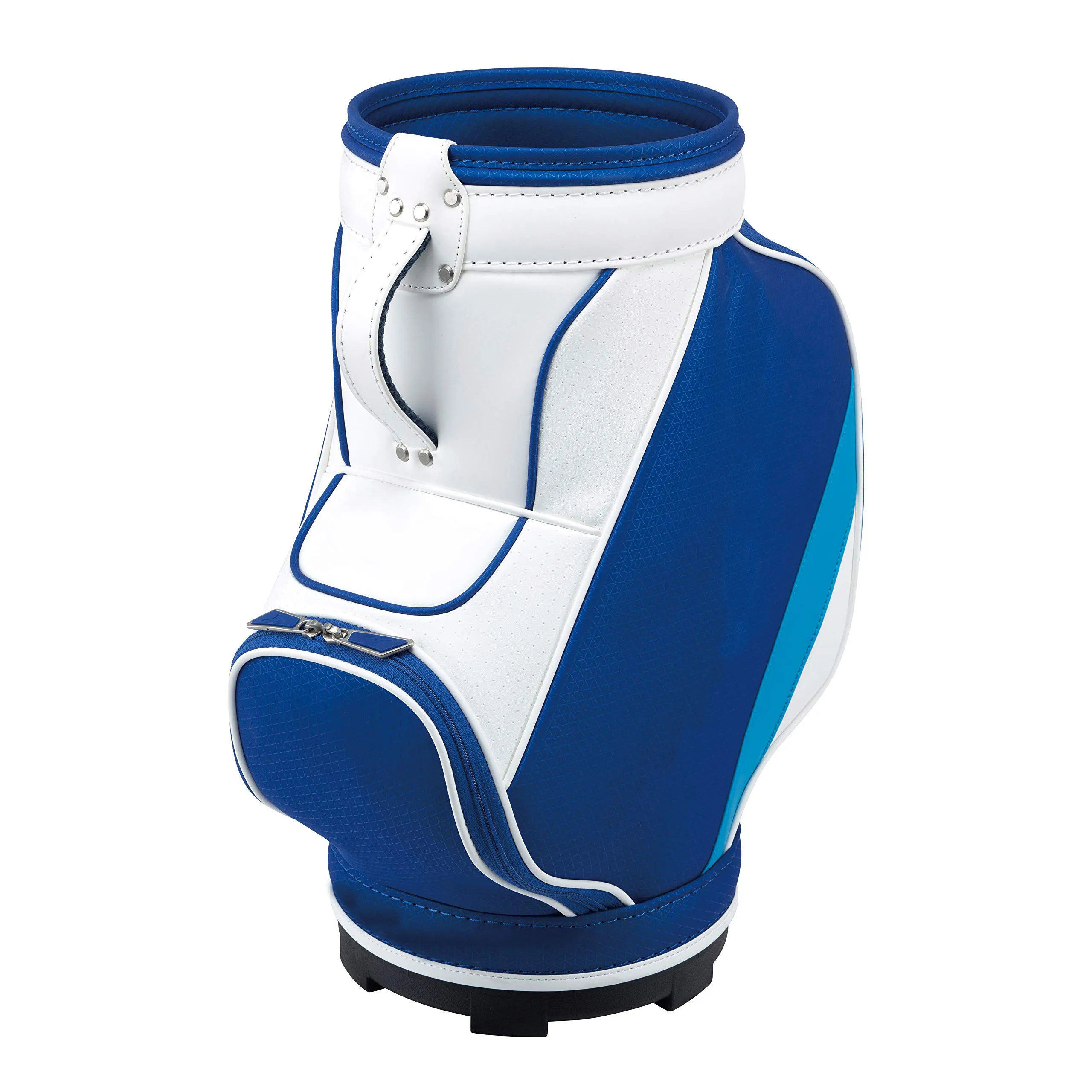
A den caddie is a fully-constructed miniature golf staff bag — real panels, real stitching, real branding — scaled to 40–55 cm: tall enough to hold pens, range balls, a few clubs or a countertop display, small enough to live on a desk. It is manufactured, not molded, which is why it reads as a product rather than a novelty.
The category confuses first-time buyers because it sits between product and merchandise. It is not a toy (construction mirrors full-size bags: fabric body, structured base, functional pockets, carry handle) and not a scale model (it performs jobs — pen holder, ball display, counter organizer, two-ball holder with tees). The buyers who understand it treat it as placeable branding: the only golf product whose natural habitat is the exact desk where purchasing decisions get made. The corporate gifting guide ranks it first on kept-rate for precisely this reason.
The Product in Numbers
Two numbers carry the business case: the 5–8× gap between factory cost and perceived gift value (a USD 6.50 den caddie presents as a USD 40 gift because recipients anchor on miniature staff bags they have seen priced at retail), and the freight efficiency (dense, light, nestable — den caddies ride inside a bag order's container space almost free). No other line item in a golf program improves its own economics by being added to the order.
| Spec | Standard den caddie | Notes |
|---|---|---|
| Height | 40–55 cm | 45 cm is the volume standard |
| Body diameter | 12–16 cm | Holds 3–6 clubs or ~40 pens |
| Materials | PU or 600–1680D polyester | Matched to bag-line fabrics |
| Branding area | Ball pocket panel ~12 × 12 cm | Plus collar and pocket options |
| Factory price (MOQ 200) | USD 4.50–9.00 | PU premium tier USD 7–9 |
| Perceived gift value | USD 30–60 | The 5–8× multiple is the point |
| Unit weight / carton | ~0.4 kg / 25–40 pcs | Cheap freight per unit |
Why Kept-Rate Beats Impressions
Golf gifting math usually runs on impressions — logo views per dollar. The den caddie runs on something stronger: tenure. A cap is worn a season; a towel is retired in a year; a desk object with a job (holding the pens a person actually uses) survives office moves, job changes and desk cleanouts. Kept-rate — the share of gifts still in use after 12 months — is where gifting ROI is actually decided, and desk furniture with a function sits at the top of every kept-rate survey the promotional products industry has run.
The branding implication: the logo on a den caddie accumulates impressions at a desk for years — thousands of views from the owner and everyone who visits that desk — from a single USD 4.50–9.00 placement. Compared to a USD 25 polo that leaves the rotation in eighteen months, the den caddie's cost per impression-year is roughly an order of magnitude lower. That is the arithmetic behind its reorder rates.
Construction Anatomy of a Quality Den Caddie
A den caddie that survives scrutiny is built like the bag it miniaturizes: a structured base (board or dense foam — the unit must stand planted, not lean), a body with real panel construction (two or three panels, piped seams in the premium tier), a functional top cuff (reinforced opening that holds its round shape), one to three pockets that actually open and close (miniature zippers are a known failure point — we spec the same coil quality as full-size), and a handle scaled to the body.
Materials follow the parent program: PU showcase panels for premium desk presence (the desk is a PU-natural environment — it reads as leather goods), 600D–1680D polyester for value programs, and fabric lots matched to the buyer's bag line when the den caddie runs as a collection companion. Weight is a quality signal here — a den caddie should feel dense in the hand; under-filled or single-layer constructions read cheap on the desk where the product lives.
Branding Surfaces on a Small Canvas
The primary branding surface is the ball-pocket panel — roughly 12 × 12 cm, which constrains artwork discipline: crests and wordmarks work beautifully; detailed illustration does not. Embroidery is the default technique (the desk context rewards the premium hand), heat transfer covers full-color artwork, and a woven label on the collar adds the finishing tier for premium executions. The sizing logic scales down from the placement guide's 55–70% rule: secondary marks at 60–70% of the primary.
The small canvas is a discipline advantage, not a limitation: one strong mark, perfectly executed, is what desk product branding should be. Programs that try to reproduce a full-size bag's six-position branding suite on a 45 cm body produce clutter; programs that place one 10 cm crest with a collar label produce desk furniture people photograph. Artwork adaptation for the scale is part of our standard design service — the file that works on a staff bag needs redraw, not shrink.
The Four Buyers of Den Caddie Programs
Tournament and event buyers use den caddies as the kept-rate hero of the goodie bag or the prize-table middle tier — the gift participants take home and keep, priced so a 144-player event gifts them for under USD 1,000. Corporate programs place them on client and executive desks directly — the highest-value real estate in B2B gifting, where a USD 7 object outperforms a USD 50 hamper in tenure. Pro shops and retail sell them at USD 29–49 as counter displays that merchandise themselves (a den caddie holding ball markers and divot tools is a display and a product simultaneously). Bag brands run them as collection companions — the miniature of your staff bag, sold or gifted alongside, extends the collection's price ladder downward without discounting anything.
The use-case decides the spec: event programs optimize cost at 200–500 units in polyester; corporate desk programs optimize presence at 100–300 units in PU; retail programs optimize margin (the USD 4.50–9.00 cost against USD 29–49 retail); collection companions optimize color-matching to the parent line. One chassis, four different right answers.
MOQ Economics for Small Soft Goods
Den caddies follow the same MOQ 200 logic as full-size bags — setup costs (pattern scaling, embroidery digitizing, line changeover) are chassis-independent — but the unit economics are friendlier to small programs: a 200-piece commitment is USD 900–1,800 total, inside even a single-event gifting budget. Below 200, pooled production applies the same way as bags: your branding on a shared run, 50–100 pieces at +15–25% unit cost, covered in the low-MOQ guide.
The cost drivers in order: material tier (PU adds USD 1.50–2.50 over polyester), branding complexity (a second position adds USD 0.40–0.80), construction extras (functional miniature stand mechanisms, zippered pocket counts), and packaging (individual gift boxes at USD 0.80–1.50 transform the presentation for corporate programs). The cost breakdown shows how these drivers compound on soft goods generally.
The Pairing Strategy: Den Caddies Inside Bag Programs
The highest-ROI use of a den caddie is as an add-on to a bag order. Three pairings dominate: the salesperson's sample (distributor reps carry the miniature, not the 5 kg staff bag — the den caddie demo costs USD 7 against USD 60 in sample freight); the pre-order gift (retail programs gift a den caddie with bag pre-orders — a USD 6.50 attachment that lifts conversion and never gets discounted); the collection photo (the miniature beside the full-size bag is the catalog image that communicates the whole line in one frame).
The pairing spec rule: same fabric lots, same thread, same lab dips. A den caddie that almost-matches the parent bag undermines both; matched lots make the pair read as one product family at two scales. Because both run on the same lines, lot-matching is a scheduling decision we make at production planning — request it explicitly in the brief and the pair ships visually identical.
Quality Control for Small Soft Goods
Small products fail differently than bags. The den caddie QC checklist: stand test (unit must stand planted on a level surface, no lean — base construction is the first inspection point), shape retention (the cuff must hold its round after compression in packing), miniature zipper cycles (the known failure point — 50-cycle function test on every inspected unit), embroidery registration at small scale (2 mm tolerance reads bigger on a 12 cm panel), and surface cleanliness (desk product is examined at arm's length daily — glue marks and thread tails that pass on luggage fail here).
Inspection runs the same AQL 2.5 protocol as bags — 32 units from a 200-piece lot under ISO 2859-1 — with the small-goods checkpoints added to the standard 40. The AQL guide covers the sampling tables; the discipline that matters most is the sealed approval sample, because at miniature scale the difference between approved and drifted is visible across a desk.
Packaging and Presentation
Desk product deserves desk-grade presentation. Three tiers: polybag-and-carton (standard, USD 0 — fine for event distribution), tissue-and-sleeve (USD 0.40–0.70 — the retail minimum), and rigid gift box (USD 0.80–1.50 — the corporate desk standard, and the tier where a USD 7 product completes its impersonation of a USD 40 gift). Custom-printed sleeves and boxes carry the brand story; the packaging guide covers the full system including retail compliance if the den caddie goes to shelf.
One presentation detail worth the pennies: a printed card inside the cuff (the product's story in four sentences — what it is, who made it, what it pairs with) converts the recipient's first question into your brand's first impression. Corporate programs add the recipient's name via the end-of-line personalization used on bags.
A Worked Program: 300 Den Caddies for a Member-Guest
A private club's 2026 member-guest: 300 den caddies as the participant gift, specced in the club's green-and-cream with the crest embroidered on the ball pocket and a woven collar label marking the event year. Quotation: USD 6.20 per unit in 600D polyester with PU trim, individual tissue-and-sleeve packing, USD 1,860 plus freight. Timeline: sampled in 8 days in March, produced in 34 days, delivered three weeks before the June event with margin to spare.
The outcome the club reported: participants photographed the gift more than any in the event's history (the desk-cute effect), the pro shop ordered 100 more for retail at USD 39 (sold through by season's end — the event gift became a retail product), and the 2027 committee budgeted the den caddie as the anchor gift before discussing anything else. That arc — gift to retail SKU to program anchor — is the den caddie's standard career when the first execution is specced properly.
Common Mistakes in Den Caddie Programs
Four recurring errors. Over-artworked panels: shrinking a detailed illustration onto a 12 cm panel produces mush — redraw for scale. Under-weighted bases: a den caddie that leans on the desk is a brand message you did not intend; the base spec is not the place to save USD 0.30. Mismatched pairing: ordering the den caddie separately from the parent bag line, in close-but-not-same fabrics — lot-matching must be requested at brief. Skipping packaging on corporate programs: a USD 7 product in a polybag reads as USD 7; the same product in a rigid box reads as USD 40 — the box is the cheapest perceived-value multiplier in the program.
The mistake underneath all four: treating the den caddie as merchandise rather than product. It is a manufactured soft good that will be examined at arm's length for years — spec it with the same seriousness as the bags it miniaturizes and it returns the favor for just as long.
Starting a Den Caddie Program
The brief is three sentences: the use case (event gift, corporate desks, retail, collection companion), the quantity and date, and whether it pairs with a bag program (for lot-matching). Through the quote form, the quotation returns with construction and branding recommendations priced at your volume — sample inside two weeks, production inside five. For programs pairing with bags, mention the parent order and the two run as one project with one color standard.
The gallery of executions and the rest of the small-goods range — pouches, valuables bags, cooler bags — is in the accessories guide; the den caddie is where most buyers discover that the smallest product in the catalog carries the largest ROI in the program.
Frequently Asked Questions
What is a den caddie?
A miniature golf staff bag — fully constructed at 40–55 cm tall with real panels, functional pockets and embroidered branding — used as desk furniture (pen and accessory holder), retail counter display, tournament gift or collection companion to a full-size bag line. It is manufactured like a bag, not molded like a novelty.
How much does a custom den caddie cost?
USD 4.50–9.00 per unit at MOQ 200, FOB Xiamen: polyester constructions USD 4.50–6.50, PU premium tier USD 7–9. Branding setup, standard packaging and AQL 2.5 inspection are included. Individual gift boxes add USD 0.80–1.50. Perceived gift value runs USD 30–60 — the 5–8× multiple is the business case.
What is the minimum order for custom den caddies?
200 pieces per design — USD 900–1,800 total commitment, inside most single-event budgets. Pooled production covers 50–100 piece needs at +15–25% unit cost. Den caddies added to a bag order share its production run and freight, which makes the add-on nearly freight-free.
What are den caddies used for?
Four dominant uses: tournament and event gifting (the kept-rate hero — nobody discards desk furniture), corporate desk placement (client and executive offices), pro-shop retail at USD 29–49 (counter displays that merchandise themselves), and brand collection companions (the miniature of your staff bag, sold or gifted alongside the full-size line).
Can a den caddie hold actual golf clubs?
Yes — the standard 45 cm body holds 3–6 clubs for display or range use, though most live as pen holders and countertop organizers. The top cuff is reinforced to hold its shape under either job. For pure club-carry use, a Sunday bag is the right product; the den caddie's home is the desk and the display.
What branding works on a den caddie?
One strong mark, perfectly executed: an embroidered crest or wordmark on the ball-pocket panel (~12 × 12 cm), optionally a woven collar label. Detailed illustration should be redrawn for the scale, not shrunk. Embroidery is the default; heat transfer covers full-color artwork. The small canvas rewards discipline — desk product is examined at arm's length for years.
How long does custom den caddie production take?
Samples in 6–10 working days; bulk production 25–40 days (shorter than full bags due to simpler construction), inspected to AQL 2.5 before pack-out. Paired with a bag order, den caddies run on the same production calendar and ship in the same cartons or container.
What materials are den caddies made from?
PU showcase panels for premium desk presence (reads as leather goods), 600D–1680D polyester for value programs, with structured bases and reinforced cuffs in all tiers. Paired programs use the same fabric lots as the parent bag line — lot-matching is requested at brief and scheduled at production planning.
Can den caddies match my existing bag line exactly?
Yes — same fabric lots, same thread, same lab dips, same embroidery files scaled for the panel. The pair reads as one product family at two scales. Request lot-matching explicitly in the brief; because both products run on the same lines, matching is a scheduling decision, not a sourcing problem.
Are den caddies good corporate gifts?
The best in the golf category by kept-rate logic: desk furniture with a function survives for years where wearables and consumables do not, at USD 4.50–9.00 against USD 30–60 perceived value. Add a rigid gift box (USD 0.80–1.50) and a story card inside the cuff, and the presentation completes the premium read.
What sizes do den caddies come in?
Standard is 45 cm tall, 12–16 cm diameter (holds 3–6 clubs or ~40 pens). Compact 40 cm and tall 55 cm variants are available; custom dimensions are an OEM development at the same MOQ. Weight around 0.4 kg each; cartons pack 25–40 units for cheap dense freight.
How are den caddies quality-checked?
Same AQL 2.5 pre-shipment inspection as bags (ISO 2859-1 sampling) plus small-goods checkpoints: stand test (no lean on a level surface), cuff shape retention after packing compression, 50-cycle miniature zipper tests, embroidery registration at small scale, and surface cleanliness at arm's-length scrutiny — measured against your sealed approval sample.
How do I order custom den caddies?
Three sentences through the quote form on this site: use case (event, corporate, retail, collection), quantity and date, and whether it pairs with a bag order. The quotation returns with construction and branding recommendations at your volume; samples inside two weeks, production inside five — Junyuan has manufactured small golf soft goods for export programs since 2014.