
The Answer in One Paragraph
One hero item (den caddie, cooler bag or shoe bag, USD 8–18), three to five supporting items (pouch, towel, tees, ball markers, hat clip), one logo standard applied consistently, kitted into a branded bag — USD 25–75 per player all-in, ordered 90 days before the event.
The failure mode of corporate golf gifting is well known: a plastic bag of forgettable trinkets, half of which never leave the locker room. The fix is not more budget — it is structure. One item the recipient will genuinely use (the hero), supporting items that are consumable or pocketable, and branding disciplined enough that the gift reads as a gift rather than a billboard. Get the structure right and a USD 40 bag outperforms a USD 90 one assembled by formula.
Budget Tiers and What Each Buys
The jump that matters is from tier one to tier two — that is where the hero item becomes something with a life beyond the event. A den caddie sits on an office desk holding pens for years; a logo pouch holds cables in a travel bag. Both carry your logo into daily life, which is the entire point of the exercise. Tier three suits client-appreciation events where the guest list justifies it; tier four is board-member and sponsor-principal territory.
| Per-player budget | Hero item | Supporting cast | Reads as |
|---|---|---|---|
| USD 15–25 | Logo pouch or valuables bag | Towel, tees, markers | Considered, modest |
| USD 25–45 | Den caddie or shoe bag | Pouch, towel, hat clip, tees | Genuinely useful |
| USD 45–75 | Cooler bag or premium den caddie | Pouch, towel, markers, divot tool, ball sleeve | Impressive |
| USD 75–150 | Sunday bag or duffel | Full supporting set plus apparel | VIP / client-tier |
The Hero Items, Ranked by Kept-Rate
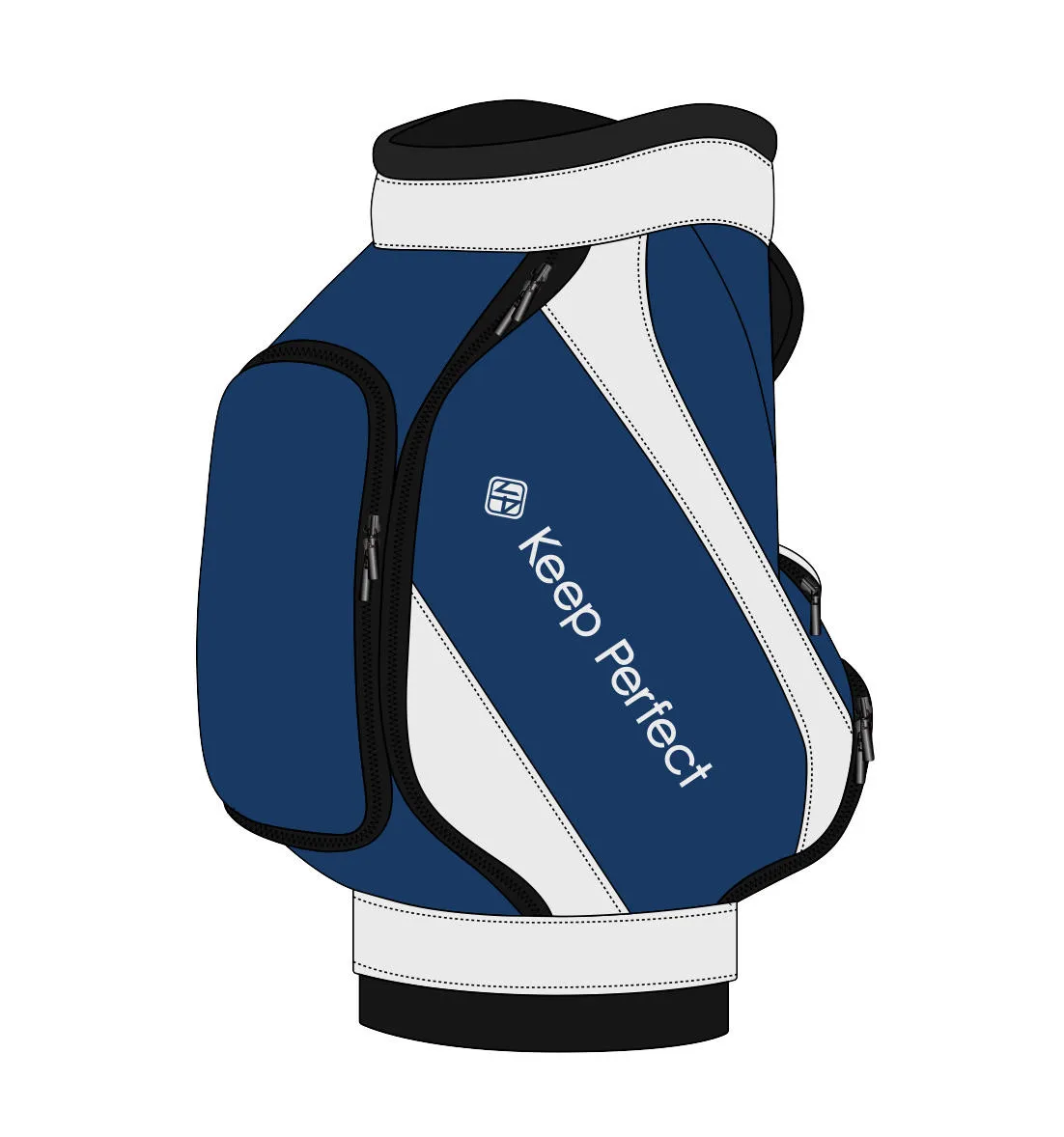
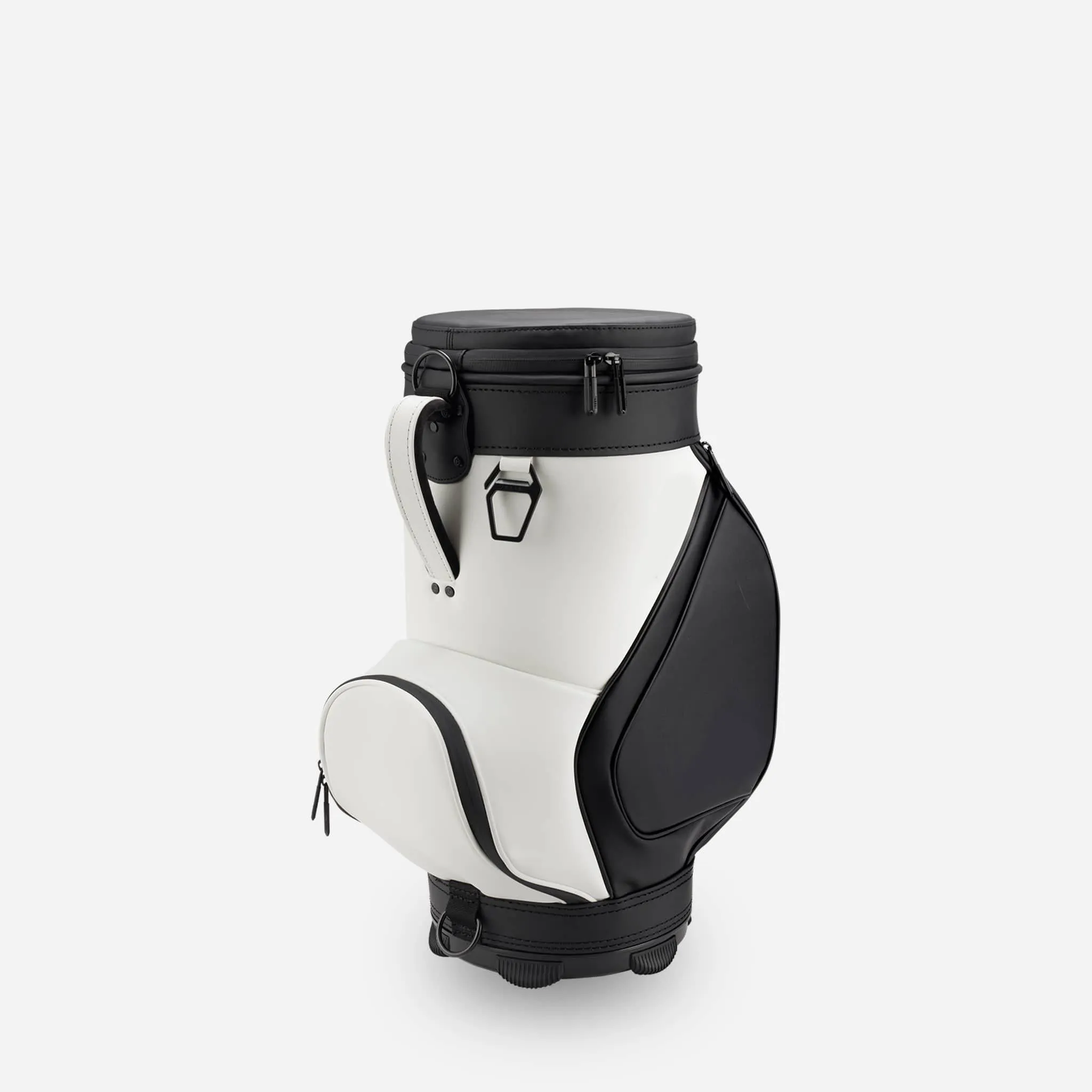
Kept-rate — the share of gifts still in use six months later — is the only metric that matters, and years of event feedback rank the candidates consistently. Den caddies (miniature staff bags, 40–50 cm) top the list: they are desk furniture with a logo, unmistakably golf, and impossible to throw away. Cooler bags follow: genuinely useful at every future round, picnic and beach day. Shoe bags third: every golfer needs one, few own a good one. Then valuables pouches, which live in the golf bag permanently. The accessories and pouches page covers the construction options across this whole family.
What ranks low: anything perishable-logo (water bottles with prints that peel), anything sized (apparel guesses wrong for a third of any field), and anything whose primary purpose is the logo itself. The kept-rate test is simple — would the recipient keep this if the logo were removed? If yes, brand it tastefully and it will carry the logo for years. If no, no amount of branding saves it.
The Supporting Cast: Five Rules
- Everything must earn its place by use. A pouch that holds tees and a phone earns; a stress ball shaped like a golf ball does not.
- Consumables are safe. Tees, ball markers, divot tools and ball sleeves always get used — they are the floor of the bag, not the ceiling.
- One textile maximum. A towel or a pouch, not both plus a headcover plus a shoe bag — textiles crowd each other out.
- Match the field. A charity scramble of occasional golfers wants different support items than a member-guest at a private club.
- Food travels badly. Unless the event handles catering-style logistics, skip edibles — melted chocolate in a July cart is the only impression that outlasts a good den caddie, and for the wrong reason.
Branding Discipline: the Two-Touch Rule
The most common branding mistake in event gifting is treating every item as a separate billboard — logo on the hero, logo on the pouch, logo on the towel, logo on the bag, plus the sponsor sheet. The result reads as a trade-show booth, not a gift. The discipline that works: two touches. The hero item carries the full logo treatment (embroidered crest or woven label, executed properly), and one supporting item carries a secondary mark. Everything else stays clean or carries tone-on-tone branding. The event name and year go on the hangtag or a woven label — dates on the main panel kill reusability.
Color discipline matters as much as count: execute the logo in one consistent colorway across all items rather than improvising per item. The logo placement guide maps position, size and technique rules that apply to gift items exactly as they do to retail bags.
Kitting: the Part Everyone Underestimates
A 300-player event means 300 bags each containing six to nine items — call it 2,100 touches of assembly labor, plus hangtags, plus any name personalization, plus cartonization by tee time or alphabet for the registration table. Done at the factory, kitting adds roughly USD 0.80–1.50 per bag and arrives as sealed, labeled units; done in your office, it consumes two staff-days and produces the inevitable 4 a.m. discovery that the markers never arrived. Specify kitting at the quote stage, with the contents list and the packaging level (polybag, gift box, or the hero item itself as the container — a den caddie holding its own supporting cast is the elegant solution).
Personalization deserves a special note: individual names on hero items transform the gift but transform the logistics with them. Names are added by heat transfer at the end of the line from a spreadsheet you supply; budget one extra week and proof the spreadsheet like a legal document, because a misspelled VP's name is the only thing anyone will remember.
The Event-Backward Timeline
The fixed anchors are sampling (6–10 days), bulk (35–50 days) and freight (14–35 days ocean, 5–8 air). The 90-day start builds in the approval window and one buffer week; the timeline guide details every phase, and the promotional ordering guide walks the buying process step by step for first-time event buyers.
| Days before event | Milestone | Owner |
|---|---|---|
| 90 | Brief sent: hero item, budget, quantities, logo assets, event date | You |
| 85 | Quotation confirmed, sample order placed | Both |
| 75 | Physical sample in hand, approval decision | You |
| 70 | PO placed, 30% deposit, bulk production starts | Both |
| 30 | Production complete, AQL 2.5 inspection, kitting begins | Factory |
| 21 | Goods ship (ocean) — or day 10 by air for rush programs | Factory |
| 7 | Delivered to venue or your office, carton check | You |
| 0 | Registration table, tee time | Everyone |
Worked Example: 240 Players, USD 38 per Bag
A regional bank sponsors a client-appreciation day: 240 players, budget USD 10,000 all-in. The structure: hero den caddie in the bank's navy with embroidered crest (USD 11.20 at 240 pieces), valuables pouch in matching fabric with woven label (USD 3.60), bamboo tee pack and two ball markers (USD 1.90 combined), kitting into the den caddie with a hangtag carrying the event name (USD 1.10), freight DDP to the venue city (USD 2.40 per unit amortized). Total: USD 20.20 per player — USD 4,848 — leaving half the budget for prizes and the longest-drive contest. The sample loop ran in June, PO placed July 1, goods arrived September 12 for a September 26 event. Kept-rate check the following spring: the bank's relationship managers reported den caddies visible in a third of client offices they visited.
The lesson in the numbers: the hero item was 55% of item cost and produced essentially 100% of the lasting impression. That ratio — spend on the hero, economize on the cast — is the single most reliable rule in event gifting.
Sponsor Branding Without the Clutter
Multi-sponsor events create a branding negotiation: title sponsor, presenting sponsor, hole sponsors — all expecting visibility. The clean resolution is zoning. The title sponsor gets the hero item's main panel; a presenting sponsor gets the secondary position or the pouch; hole sponsors get the tee gifts at their holes, not space in the shared bag. The hangtag carries the full sponsor roster — it is the program, not the gift. Events that let every sponsor onto every item produce bags nobody keeps, which serves no sponsor.
For the event organizer selling the sponsorships, the factory angle is a selling point: "the hero gift is a custom-manufactured piece, not catalog stock" raises the perceived value of the title package. Our team routinely supplies sample photography for sponsor proposals before the order exists — the gift and tournament page covers the event-side program structures.
Common Event-Gifting Mistakes
- Ordering by catalog, not by kept-rate. The cheapest item per unit is the most expensive per impression if it is discarded at the door.
- Dating the main panel. "2026 Member-Guest" embroidered large on the hero item ends its life on December 31. Dates belong on hangtags and woven labels.
- Late artwork. The logo arriving as a JPEG in week three compresses sampling into rush fees. Vector artwork belongs in the first brief.
- Skipping the sample. Approving from photographs to save ten days risks 300 gifts with a crest the wrong size. The USD 40–80 courier is the cheapest insurance in the budget.
- Office kitting optimism. Two thousand items do not assemble themselves the night before. Factory kitting at USD 0.80–1.50 per bag is always cheaper than the alternative once staff time is priced.
Sourcing the Whole Bag from One Vendor
Event gifting dies of vendor sprawl: the hero item from one supplier, the pouch from a second, the markers from a third, and the organizer kitting three deliveries in a parking lot. The structural fix is sourcing the full contents list from the factory that makes the hero: pouches and accessories come off the same lines, consumables (tees, markers, divot tools) are sourced and kitted at the factory, and everything arrives as sealed, labeled units on one invoice, one shipment, one accountable party. The unit economics improve too — factory-direct accessories at event quantities run 30–50% below promo-catalog pricing.
The single-vendor structure also fixes the quality conversation: one AQL 2.5 inspection covers the full contents list, one PSI report documents it, and one supplier owns any deviation. Multi-vendor goodie bags have a way of failing at the seams between vendors — the markers that never shipped, the pouch color that matches nobody's logo. One vendor means there are no seams.
Measuring the Event’s Return
The gifting budget defends itself better with numbers, and two are trackable without a research department. Kept-rate: three months after the event, sample ten recipients — how many still have the hero item in use? Den caddies and cooler bags run 60–80% on this measure; trinket bags run near zero. Second-order contact: for client-appreciation events, track how many gifted clients took a meeting or placed business in the following two quarters versus ungifted control contacts — relationship events routinely show the gift paying for itself on a single converted account.
There is also a procurement lesson in the retrospective: whatever the post-event survey says recipients actually used becomes next year's hero item. Events that run the same formula annually without asking are gifting by habit; the ones that ask are compounding.
Getting a Quote for Your Event
The brief takes five minutes: event date, player count, per-player budget, hero item preference (or ask us to recommend), and vector logo artwork. Quotations come back in 24 hours with per-unit pricing at your exact quantities, kitting options and the event-backward calendar. MOQ for event programs is 100–200 pieces depending on the item, sampling runs 6–10 days with the fee credited on the order, and DDP delivery to the venue city removes customs from your task list. Junyuan has supplied corporate and tournament gifting programs since 2014 — the quote form starts the 90-day clock.
Frequently Asked Questions
What should go in a corporate golf day goodie bag?
One hero item (den caddie, cooler bag or shoe bag at USD 8–18), three to five supporting items (valuables pouch, towel, tees, ball markers, divot tool), and consistent branding limited to two logo touches. Kitted at the factory, the package runs USD 25–75 per player depending on tier.
How much should we budget per player for golf day gifts?
USD 25–45 per player buys a genuinely useful package — a den caddie or shoe bag hero plus supporting items. Below USD 25 the hero disappears and the bag reads as trinkets; above USD 75 is VIP and client-principal territory. The reliable rule: spend on the hero, economize on the supporting cast.
What is the best corporate golf giveaway item?
The den caddie — a 40–50 cm miniature staff bag with your embroidered crest. It has the highest kept-rate in golf gifting because it becomes desk furniture: it holds pens in a client's office for years, carrying your logo into daily visibility. Cooler bags and shoe bags rank second and third.
How far in advance should we order golf day giveaways?
90 days before the event: brief and quote by day 90, sample approval by day 75, PO and deposit by day 70, production and inspection by day 30, delivery with a week of buffer. Rush programs can compress to 45–50 days using stock-fabric items and air freight at higher cost.
What is the minimum order for custom golf event gifts?
100–200 pieces depending on the item — 200 for sewn hero items like den caddies and cooler bags, lower for some accessories. Sampling runs 6–10 days at USD 80–150, credited back on the order. Event quantities of 100–500 are the normal band and price accordingly.
Should every item in the goodie bag carry our logo?
No — the two-touch rule produces better results: the hero item carries the full logo treatment, one supporting item carries a secondary mark, and everything else stays clean. Events that brand every surface produce bags that read as trade-show booths and get discarded accordingly.
Can gifts be personalized with individual names?
Yes — names are added by heat transfer at the end of the production line from a spreadsheet you supply. Budget one extra week, and proof the name list obsessively: a misspelled executive name is the only detail anyone remembers. Per-name personalization typically adds USD 1.50–3.00 per unit.
Do you kit the items into the bags, or do we assemble them?
Factory kitting: specify the contents list and packaging level at quote stage, and goods arrive as sealed, labeled, event-ready units at roughly USD 0.80–1.50 per bag — cartonized by tee time or alphabet if you wish. A 300-bag event is 2,100 assembly touches; factory kitting is always cheaper than office labor.
How do multi-sponsor events handle branding on shared gifts?
By zoning: the title sponsor takes the hero item's main panel, a presenting sponsor takes a secondary position, hole sponsors take their tee gifts, and the full roster goes on the hangtag. Every sponsor on every item produces clutter nobody keeps — zoning serves the sponsors better than ubiquity.
Should the event date go on the gifts?
On the hangtag or a woven label, never on the main panel. "2026 Member-Guest" embroidered prominently ends the gift's life in December; the same text on a label preserves it. The kept-rate of a gift is its value — dates on the panel are the fastest way to cut it.
Can we get samples of the gifts before ordering?
Yes, and you should: physical samples in 6–10 days at USD 80–150 per item, credited on the order. Approve the object in hand — embroidery size, fabric hand, construction quality — never photographs. The courier cost is the cheapest insurance in the event budget.
Can we mix different hero items in one event order?
Yes — a common structure is tiered gifting: premium heroes (cooler bags) for sponsors and winners, standard heroes (den caddies) for the field. Because both come off related lines, mixing tiers in one order adds little complexity; what it adds is per-tier MOQ discipline, so plan each hero at its own 100–200 piece floor. The quote should price each tier separately with kitting that keeps the tiers clearly cartonized.
What is the latest we can order for a fixed event date?
The honest emergency floor is 45–50 days: stock-fabric hero items, print-led branding (no lab-dip loop), a 48-hour sample approval with one named approver, production at the short end of 35–50 days, and air freight for at least part of the quantity. Below that, the answer is decorated stock from a local distributor — order the real program for next year and let this year be the lesson.
What happens if our event date moves after we order?
Tell the factory immediately — timing flexibility depends on the phase: before production starts, schedule shifts are usually free; during production, goods can be held at the factory or warehouse after completion for weeks at modest storage cost. The dangerous version is a date moved earlier — that triggers the rush playbook, so communicate the moment the date wobbles, not when it breaks.
Do you deliver directly to the golf course or event venue?
Yes — DDP delivery to the venue city or the venue itself is standard for event programs, with cartons labeled for the registration table. Confirm the venue's receiving rules (delivery windows, storage, a named contact) and we schedule against them. Ocean transit runs 14–35 days by route; air compresses to 5–8 for rush programs.