
Manufacturing
Golf Bag Manufacturing Programs
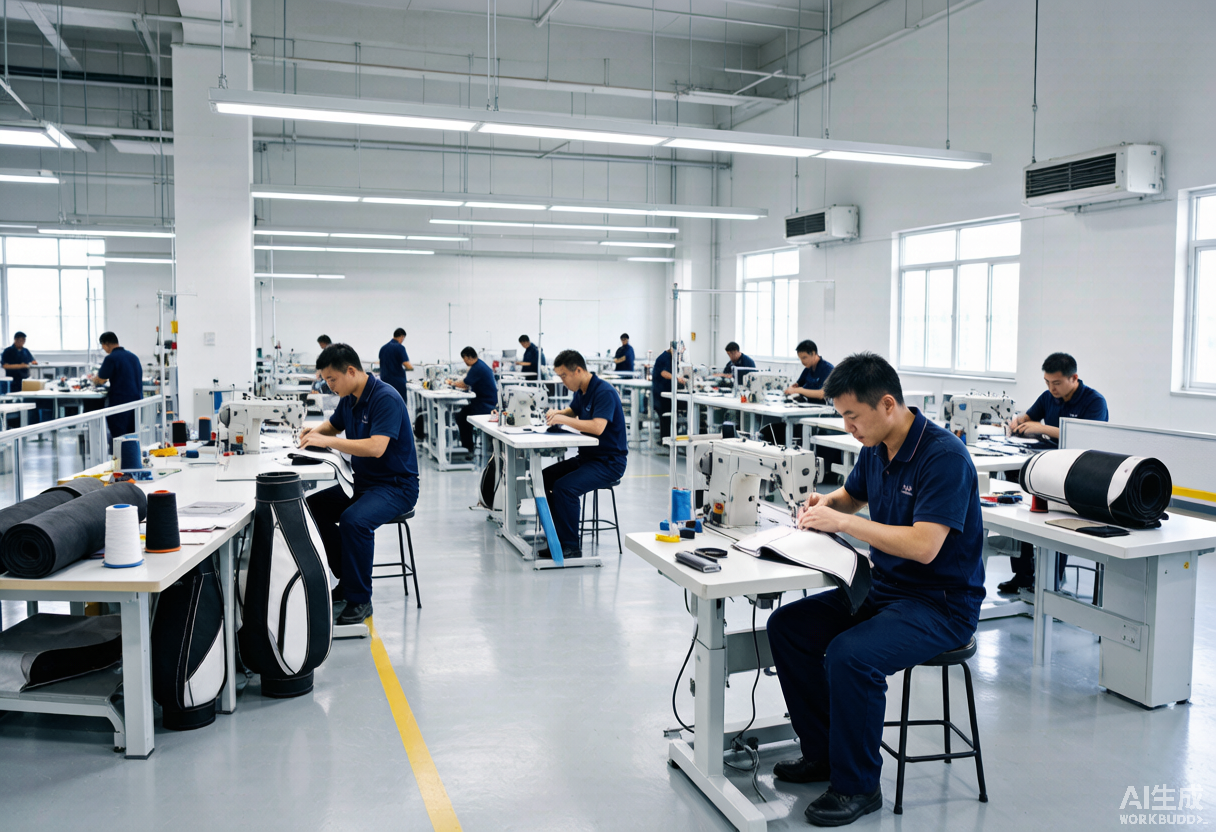
Five manufacturing programs cover every custom golf bag order: OEM (built to your tech pack), ODM (adapted from our chassis), private label (your brand on curated product), wholesale (finished goods for resale) and prototyping (samples and campaign pilots). MOQs run from 200 pieces; production runs through an SGS-verified production facility with 4,950 sqm, 7 lines and 149 machines.
The Five Programs
Unsure which fits? The program comparison walks the decision by ownership, MOQ and margin structure. For the full manufacturing picture in one long-read, the OEM & private label guide is the program bible.
| Program | You bring | MOQ | Best when | Page |
|---|---|---|---|---|
| OEM | Full tech pack & design | 500+ pcs | You own the design outright | OEM/ODM |
| ODM | Spec changes to a chassis | 200+ pcs | Proven platform, your options | OEM/ODM |
| Private label | Brand assets | 200–500 pcs | Retail line, curated chassis | Private label |
| Wholesale | Volume commitment | 500+ pcs | Resale finished goods | Wholesale |
| Prototyping | Concept & campaign | 1–200 pcs | Samples, pilots, crowdfunding | Prototyping |
What All Programs Share
- The same nine-step design process — spec sheet, tech pack, sampling, bulk, inspection.
- The same quality system: IQC, IPQC, PSI at AQL 2.5.
- The same factory: SGS-verified (March 2026), 4,950 sqm, 7 lines.
- The same commercial terms: T/T 30/70, FOB Xiamen / CIF / DDP.
- The same file discipline for reorders.
MOQ & Pricing Structure
Indicative ranges for typical specs — the MOQ & pricing guide explains the structure behind them: where fixed costs amortize, what quantity actually buys, and what does not change with volume.
| Quantity | Stand bag FOB (USD) | Sunday bag FOB (USD) | Staff bag FOB (USD) |
|---|---|---|---|
| 200 pcs | 26–34 | 16–22 | 52–60 |
| 500 pcs | 19–28 | 12–18 | 38–52 |
| 1,000 pcs | 17–25 | 10–16 | 35–46 |
| 2,000+ pcs | 15–23 | 9–15 | 32–42 |
From Design to Container: Nine Steps
Every programme, from a 200-piece private label line to a 1,000-piece OEM build, runs through the same nine steps, which are the backbone of the design process. The differences are in the depth of each step, not the sequence.
| Step | Duration | Output |
|---|---|---|
| 1. Brief and quote | 24 hours to 5 days | Indicative pricing, MOQ, programme shape |
| 2. Spec sheet and tech pack | 3–7 days | Versioned technical document |
| 3. Pattern and prototype | 6–10 days | First article for review |
| 4. Sample approval and seal | 2–5 days | Signed reference sample and measurement sheet |
| 5. Material sourcing and dye lots | 5–12 days | Fabric, hardware and trim booked to the line |
| 6. Pre-production sample | 5–7 days | Line-made sample in bulk materials |
| 7. Bulk production | 35–50 days | Programme at AQL 2.5 with photo checkpoints |
| 8. Final inspection | 1–2 days | Inspection report, pass or sort decision |
| 9. Booking and loading | 3–5 days | Container loaded, documents issued, vessel departed |
Steps three to six are where calendars slip, because they involve physical objects that have to be approved by someone else; the prototyping page breaks that block down day by day. Steps seven to nine are the most predictable, provided the slot was booked and the deposit paid on time.
Two steps are frequently skipped by first-time buyers and should not be: the tech pack at step two and the seal at step four. Without them, step seven is executed against an interpretation, and the inspection at step eight discovers the difference.
Everything after step nine — sea transit of 18–35 days, destination clearance, inland delivery — sits outside production and should be planned as a separate leg with its own buffer.
Where the Calendar Actually Goes
A programme takes 12–17 weeks from purchase order to arrival, and the distribution is uneven: production is the largest single block, but the pre-production approvals consume almost as much calendar as they appear to.
A worked calendar makes it concrete. Order placed 2 March. Tech pack confirmed by 9 March. First article on 19 March, comments closed 22 March, revised sample sealed 30 March. Bulk materials land 8 April, pre-production sample sealed 15 April, cutting starts 16 April. A 42-day run finishes 28 May, final inspection 29 May, container loaded 3 June, vessel departs 5 June, US West Coast arrival around 28 June.
That is seventeen weeks from order to arrival, of which 42 working days are production and the rest is approvals, materials, inspection and freight. Compressing it requires removing approvals, not hurrying the line: a programme that seals in one round rather than two saves ten days.
Three calendar hazards recur. The Lunar New Year shutdown removes two to four weeks from the production calendar in January and February, and its effect starts earlier as workers travel. Peak season from August to October tightens both production slots and vessel space. And a late deposit delays everything downstream by exactly its own length, because the slot is not held without it.
Working backwards from a retail date is the reliable method: subtract sea transit, inspection, production and sampling, then add two weeks of buffer. The date that emerges is the briefing deadline, and it is usually earlier than expected — the timeline walkthrough works the same arithmetic from the buyer's side of the calendar.
Four Quality Gates, One Standard
Quality is enforced at four points, and each catches a different class of defect. IQC catches bad inputs, IPQC catches bad process, FQC catches bad units, and the pre-shipment inspection catches bad lots.
| Gate | When | What is checked | Record |
|---|---|---|---|
| IQC — incoming | On material receipt | Fabric weight and shade against the approved lot, zip and hardware function, webbing strength, foam density | Material inspection log with lot references |
| IPQC — in process | During cutting and sewing | Cut dimensions, stitch density, seam allowance, logo placement, hardware attachment | Line check sheets at defined intervals |
| FQC — final | After finishing, before packing | Full function: stand cycle, zip run, pocket access, hardware security, cleanliness | Unit-level pass record and rework log |
| PSI — pre-shipment | When the lot is complete | AQL 2.5 sampling per ISO 2859-1, general inspection level II | Inspection report with photographs and defect classification |
The gates are cumulative, which is why a defect found at PSI is a process failure rather than a lucky catch. If IQC had rejected the off-shade fabric and IPQC had flagged the stitch density, the unit would never have reached the carton. The quality pages describe each gate in the sequence it actually runs.
Defects are classified in the standard way: critical (safety or function), major (visible or functional failure likely to reach the customer) and minor (cosmetic deviation within tolerance). AQL 2.5 applies to major and minor defects together at the specified limit; a critical defect is a rejection regardless of the count.
Photo checkpoints sit between the gates for remote buyers: cutting, first-off assembly, and finished goods before packing. They cost a day and frequently prevent a shipment that has to be sorted at destination, where rework is no longer possible.
AQL 2.5 in Practice
AQL 2.5 means the inspection accepts a lot when the number of defective units in the sample stays at or below the acceptance number, and rejects it above that. The numbers are fixed by ISO 2859-1, general inspection level II, normal inspection.
| Lot size | Code letter | Sample size | Accept | Reject |
|---|---|---|---|---|
| 151–280 | G | 32 | 2 | 3 |
| 281–500 | H | 50 | 3 | 4 |
| 501–1,200 | J | 80 | 5 | 6 |
| 1,201–3,200 | K | 125 | 7 | 8 |
| 3,201–10,000 | L | 200 | 10 | 11 |
Read the table as a buyer would. A 300-piece order is inspected on 50 units; three defective bags pass the lot, four fail it. A 1,000-piece order is inspected on 80 units with an acceptance number of five. The sample is drawn at random across the whole lot, not from the top cartons.
A rejection is not the end of the shipment, but it does change the schedule. The standard remedies are a 100 percent sort with defects removed and replaced, rework of the affected units, or re-inspection after correction. Each adds days, and a sort on 1,000 bags typically adds three to five. Where a lot is borderline on a material property rather than an appearance, a laboratory result against a recognised method — abrasion or seam strength to ASTM test methods, for example — settles the question faster than another visual pass.
Two practical refinements. First, buy the inspection report, not just the pass: photographs and defect classification show whether a lot passed narrowly or comfortably. Second, agree the standard before production, because retrofitting an AQL level into a dispute is a negotiation rather than a test. The AQL guide walks the same tables through a worked inspection.
For programmes sold into regulated markets, the inspection also touches labelling: care and content labels for the US under FTC rules, and material restrictions for the EU under REACH.
Booking Capacity Before the Season Turns
Capacity is booked by deposit, not by intention, and the practical rule is to secure a slot eight to ten weeks before the required ship date. Programmes that wait for a finished tech pack before paying a deposit frequently find the slot has moved.
The peak window runs August to October, when northern-hemisphere spring programmes and holiday gifting compete for the same lines and the same vessel space, and carrier schedules such as those published by Maersk show how quickly sailing frequency tightens in that period. A slot booked in that window can sit two to three weeks behind one booked in June for the same quantity.
Lunar New Year creates a second pinch. Production stops for two to four weeks, and the effective loss is longer because workers leave before the holiday and return after it. A programme that needs to ship in March must be cut in January.
Booking mechanics are simple but unforgiving: deposit received, slot allocated, materials ordered to that date, cutting scheduled. A delay in the deposit moves the slot, and a moved slot rarely returns to its original position in a busy month.
The useful discipline is to treat the calendar as a resource with a price. Splitting a 1,000-piece programme into two 500-piece releases can smooth capacity and cash, at the cost of two setups and two shipping legs. For seasonal products the single release is usually better; for a new brand testing sell-through, the split is often the shrewder choice.
Ten Mistakes First-Time Buyers Make
Most first programmes go wrong in the same ten places, and all ten are avoidable before the deposit is paid. The list is ordered by cost of discovery.
- 1. Specifying colour on a screen. A Pantone approved on a monitor can be two steps off on 600D fabric. Approve on the physical material.
- 2. No single sign-off owner. Four reviewers produce contradictory comments and an extra sample round.
- 3. Confusing sample and bulk timelines. Six to ten days for a sample does not mean six to ten weeks for 300 bags; bulk is 35–50 days.
- 4. Booking freight after production. Vessel space in August to October is not available on demand.
- 5. Ordering exactly to forecast. A 3–5 percent over-shipment tolerance exists for a reason; leaving no buffer means a short colourway at launch.
- 6. Skipping the tech pack. A reference photo is not a specification, and the difference surfaces at inspection.
- 7. Ignoring carton and pallet planning. Carton dimensions, marks and barcodes belong in the packing spec, not in a message after loading.
- 8. Not asking who owns the pattern. Ownership determines whether a reorder is a repeat or a redevelopment.
- 9. Assuming FOB is landed cost. Freight, duty under HS 4202 and destination fees are outside the quoted price.
- 10. Treating AQL as a formality. A 300-piece lot is judged on 50 sampled units; the report matters more than the certificate.
The common thread is optimism about time and ambiguity about specification. Both are cheap to fix on paper and expensive to fix in a container.
Worth adding as an eleventh, though it belongs to a different category: choosing a supplier on price alone. A two-dollar gap per bag on 500 pieces is USD 1,000, which is roughly the cost of one failed inspection and a rescheduled vessel.
How to Read a Golf Bag Quotation
A quotation is a specification document before it is a price, and the eight lines that matter are usually the ones buyers skim. Reading them in order prevents most of the surprises described above.
- Incoterm and port. FOB Xiamen means the price excludes ocean freight, insurance and destination charges. Anything else should be stated explicitly.
- MOQ basis. Per style, per colourway or per order — the three are very different numbers.
- Price validity. Sixty to ninety days is normal in this category, because fabric and freight both move.
- Over and under shipment. A tolerance of 3–5 percent is standard; confirm it rather than assume it.
- Sample fee and credit. Amount, per colourway or per style, and whether it is credited at bulk.
- Inspection standard. AQL 2.5 per ISO 2859-1 should be named, along with who arranges and pays for the inspection.
- Payment terms. T/T 30/70 — 30 percent deposit, 70 percent against the bill of lading copy before departure.
- What is excluded. Tooling, printing plates, carton printing, GS1 barcode registration, pallets, labelling and tests are the usual extras.
Two lines deserve a question each. If the quotation does not state a price validity, ask for one in writing, because a price without a date is a price that can move at cutting. If the inspection standard is described only as strict quality control, ask for the AQL number and the sampling plan, because strict is not a standard.
Finally, compare like with like. A quotation that includes cartons, labels and AQL inspection is not more expensive than one that excludes them; it is simply complete. The quotation request is the point at which these lines get fixed, and the FAQ covers the questions that recur most often.
Frequently Asked Questions
Which program do I need if I have my own design?
OEM — bring the tech pack or work with our design team to create one. See OEM/ODM programs.
Which program for my first branded line?
Private label on a curated chassis at 200–500 pieces, or the startup path on startup programs.
Can programs mix — OEM chassis with private label branding?
They always do in practice: OEM describes how the bag is designed, private label describes how it is branded. The five programs are entry points to the same production line.
How long does golf bag manufacturing take start to finish?
Twelve to seventeen weeks from purchase order to arrival: 3–7 days of tech pack work, 6–10 days of sampling, 35–50 days of bulk production, then 18–35 days at sea. Approvals and materials occupy most of the non-production time.
What are the four quality gates?
IQC on incoming materials, IPQC during cutting and sewing, FQC after finishing, and a pre-shipment inspection at AQL 2.5. Each gate catches a different defect class, and a defect found late indicates a process failure earlier.
What does AQL 2.5 mean in numbers?
For a 300-piece lot, 50 units are inspected and three defective bags pass while four fail. For 1,000 pieces, 80 units are inspected with an acceptance number of five, per ISO 2859-1 general inspection level II.
What happens if a lot fails inspection?
The standard remedies are a 100 percent sort with defects replaced, rework of affected units, or re-inspection after correction. A sort on 1,000 bags usually adds three to five days to the schedule.
When should I book a production slot?
Eight to ten weeks before the required ship date, secured by deposit. August to October is the tightest window, and a slot booked in that period can run two to three weeks behind one booked earlier.
Is FOB Xiamen a landed cost?
No. It covers the goods to the vessel at Xiamen, excluding ocean freight, insurance, duty under HS 4202 and destination charges. A 15-cubic-metre LCL shipment can add over a dollar per stand bag in freight alone.
What is the payment structure?
T/T 30/70: 30 percent deposit to book the slot and order materials, 70 percent against the bill of lading copy before the vessel departs. Terms are FOB Xiamen by default.
Can I combine different bag types in one order?
Yes. MOQ applies per style and colourway, and the binding constraint is container volume. A 40-foot high cube holds roughly 1,300 stand bags at four per carton, with room for accessories as filler.
What are the most common first-order mistakes?
Approving colour on a screen, having no single sign-off owner, booking freight after production, skipping the tech pack and treating AQL as a formality. All five are cheaper to fix before the deposit than after cutting.
Ready to spec your custom golf bags?
Send your logo, bag type and target quantity — we reply with a quote, MOQ and timeline within 24 hours.