
How It Works
The Custom Golf Bag Design Process
A custom golf bag program runs nine steps from logo file to loaded container: quote in 24 hours, spec sheet and tech pack in 3–5 days, first sample in 6–10 days, approval rounds, then 35–50 days of bulk production with photo checkpoints at cutting, branding and final AQL 2.5 inspection. The whole cycle is typically 70–90 days door to door.
What You Provide, What We Provide
| You provide | We provide |
|---|---|
| Logo files (AI/EPS/PDF/PNG) | Quote within 24 hours |
| Bag type and quantity | Spec sheet and tech pack |
| Target price or budget | Samples in 6–10 days |
| Brand colors (Pantone TCX) | Lab dips and strike-offs |
| Approval decisions | Photo checkpoints through production |
| Shipping details | AQL 2.5 inspection report and export docs |
The Two Documents That Decide Quality
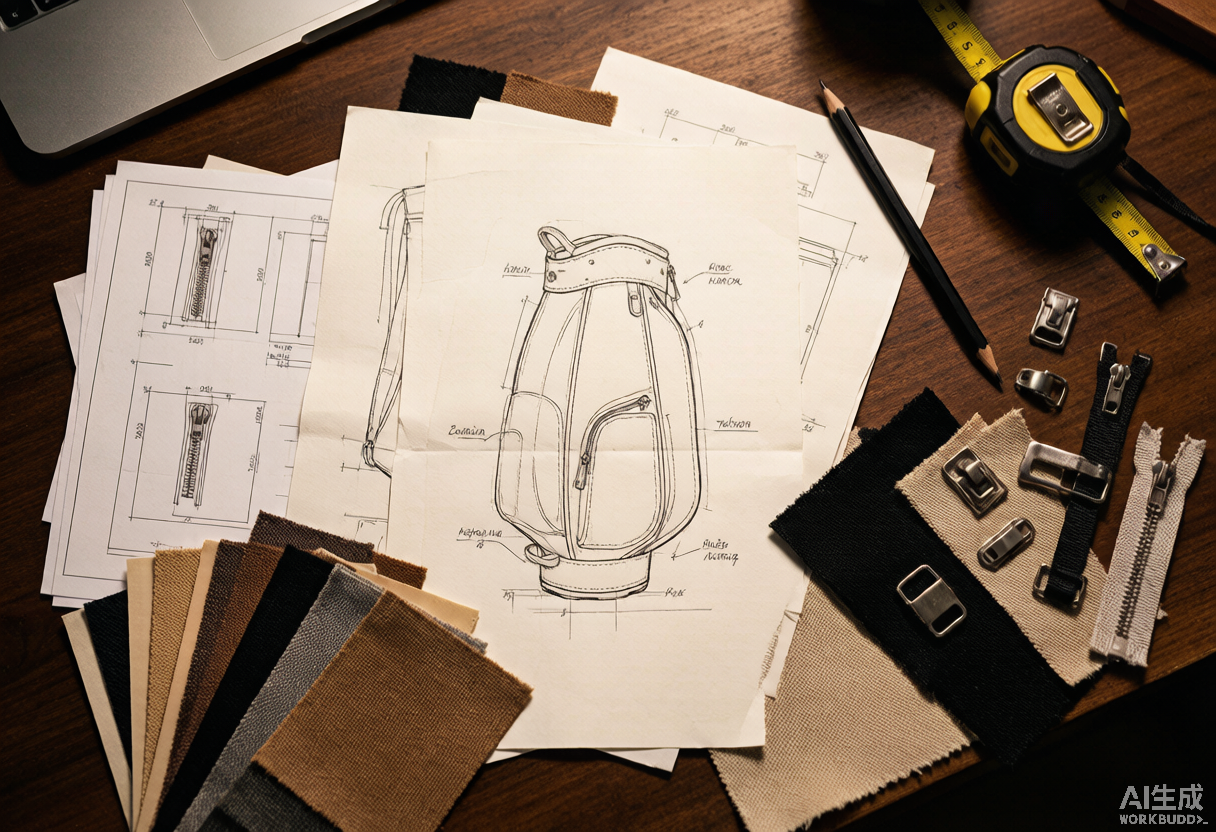
Programs go right or wrong on two documents. The spec sheet (step 2) states what the bag is; the tech pack (step 3) states how it is built — panel by panel, stitch by stitch. When a dispute or question arises in production, the tech pack wins, which is why we invest real time here. If you already have a tech pack from a designer or a previous factory, we build to it; see OEM programs.
Both documents are yours to keep. They are the reason reorders match season one and the reason a program survives contact with reality.
Common Timeline Failures (and Fixes)
- Logo files arrive late. Nothing starts without them — a vector logo takes a designer an hour to produce; chase it on day one.
- Approval by committee. Three approvers in sequence adds two weeks; parallel approvals add two days. Ask us for a shared approval sheet.
- Spec creep after sampling. Changing the fabric after the sample is a re-sample. Freeze the spec sheet, then iterate at reorder.
- Misjudged freight windows. Sea freight is 18–35 days and books against sailing schedules, not your optimism. Hard dates need the 90-day calendar, not a 70-day hope.
The Roles on Both Sides of the Table
A custom program moves at the speed of its slowest decision, and knowing who makes which decision — on both sides — removes most of the friction before it starts. On your side, three roles matter: the brand owner (approves design and money), the artwork owner (produces and fixes files), and the operations contact (answers logistical questions fast). On our side: your merchandiser (one point of contact, owns the calendar), the sampling room (builds and revises), and the production manager (owns bulk after approval).
Citable process fact: programs with a single empowered approver on the client side complete sampling 40% faster than programs with committee approval, in our order records — not because committees are wrong, but because sequential approvals serialize the calendar. If your organization requires three sign-offs, run them in parallel on a shared approval sheet; we provide the template.
Sampling Economics, Stated Plainly
Samples cost real money to make — materials, technician time, courier — and the fee structure reflects that without turning sampling into a profit center. A standard sample in your materials and colors runs USD 50–150 depending on structural complexity, couriered at cost (typically USD 35–60 by international express). The fee is refunded in full against the first bulk order: sampling is an investment in a shared program, not a product we sell.
What the sample actually buys you is certainty at three levels: construction (does the bag stand, carry and organize as intended), branding (do the logo positions and techniques read right in the hand, not on the screen), and color (do the dyed fabrics match your references under daylight). A photo can confirm the first; only the physical sample confirms all three. The sample policy page details fees, refunds and revision rules; the sampling article explains what to test and how to evaluate what arrives.
Designing for Manufacturability
The cheapest design decisions are the ones made before sampling, and five manufacturability principles cover most of them. First, every panel seam is a cost and a tolerance — merge panels where the design allows; each eliminated seam saves stitching time and removes a potential alignment issue. Second, branding positions need flat, hoop-accessible ground — a logo straddling a seam or a curve is a registration problem waiting to happen. Third, hardware is cheapest when it is standard — our stock buckles, zippers and feet exist because they are proven; custom-molded hardware adds tooling cost and 3–4 weeks.
Fourth, colorways should share panels — two colorways that differ only in accent panels can cut from shared fabric lots, while fully different colorways double the dye-lot management. Fifth, packaging is part of the design, not an afterthought — a bag designed 3 cm taller than its stock carton size ships in a custom carton at custom-carton cost. Our pre-production review flags all five on every tech pack; designs arrive manufacturable or they arrive with recommendations.
Structural Customs: When Tooling Enters the Picture
Most custom programs are customization of proven chassis — new colors, branding, trims on existing patterns. Structural customs go further: new divider geometries, custom pocket architecture, unique silhouettes. These add two line items to the calendar and budget: pattern development (7–14 days, usually absorbed into program development for committed orders) and, where rigid components are involved, tooling (molds for custom bases or frames, USD 400–2,000 depending on complexity, owned by you).
The honest guidance: structural customs make sense when the structure itself is the product — a divider system nobody else offers, a silhouette your brand will own for years. They make little sense for a first order testing a market, where a proven chassis with strong branding answers the same commercial question at lower risk. The prototyping page covers the development path for structural work, and the OEM page explains building from your own completed tech pack.
Version Control for Physical Products
Programs evolve — a webbing change here, a logo size adjustment there — and unmanaged evolution is how reorders stop matching season one. Our discipline: every tech pack carries a version number, every change is a written change order against it, and the current version is the only version the line ever sees. Approved samples are labeled with their version; the retained reference sample at final inspection matches the version in production.
This sounds bureaucratic until the first time a buyer asks "why does this shipment's zipper pull differ from last season's?" — with version control, the answer is a sixty-second lookup rather than an archaeology project. The reorder consistency article shows the full system, including how dye lots and thread batches are logged against versions.
Worked Example: From Napkin Sketch to 800 Bags
Anonymized but real in structure: a startup founder with a hand-drawn sketch — a Sunday bag with a specific pocket layout — and a target retail of USD 89. March 3: brief and sketch received; our team translated it into a manufacturable spec on a proven Sunday chassis (pocket layout adapted, not invented — a manufacturing-friendly version of the sketch). March 4: quote at USD 14.60 FOB for 400 pieces, two colorways, 800 total. March 5–11: spec sheet frozen over two edit rounds; logo files arrived March 9 (the chase began March 5 — vector files are always the long pole).
March 12–20: tech pack built and confirmed. March 21–30: samples sewn; photographed March 31; couriered April 2; approved April 11 with one revision (webbing width 38→32 mm) re-sampled in photos only — a non-structural change. April 12: deposit, bulk start. May 22: bulk complete; AQL 2.5 passed May 24; vessel May 28; arrival at the brand's 3PL June 25. Napkin to warehouse: 114 days, inside the 90–120 window we quoted, with the buffer consumed by the logo-file chase and the one revision — exactly the two places the calendar always flexes.
Why the Process Survives Contact With Reality
Every program deviates from the plan; the process exists to make deviations cheap. Spec freeze makes changes visible instead of silent. Photo checkpoints turn trust into verification at cutting, branding and pre-shipment. AQL 2.5 inspection converts quality from a promise into a sample-size decision with a pass/fail line. Version control makes reorders a file lookup instead of a memory exercise. And the retained-sample rule — one approved sample lives at the inspection station — gives every dispute a physical referee.
None of this is glamorous, and all of it is why programs run by documents outperform programs run by enthusiasm. Start the clock with the quote form — the first document arrives within 24 hours.
The Quote Document, Annotated
The quote is the program's first contract, and reading it properly prevents most later surprises. A quote from us has seven blocks, and each answers a specific question. Specification block: chassis, fabric, colorway references, branding positions and techniques — what the bag is. Price block: unit FOB at the stated quantity, with the price-break ladder (what 500 or 1,000 pieces would cost) — what the bag costs and what more would cost. Tooling and development block: sample fees, print or pattern development, any custom hardware tooling — the one-time costs, separated so they never hide in unit prices.
Calendar block: sampling days, bulk days, freight estimate — the three numbers that compose the 70–90 day total. Terms block: T/T 30/70, FOB Xiamen default, AQL 2.5 inspection standard — the commercial frame. Validity block: quotes hold 30 days, because fabric and freight markets move. And the assumptions block: everything the price presumes (artwork supplied, standard packaging, one colorway) — the block that matters most when comparing two factories' quotes, because a cheaper quote with thinner assumptions is not a cheaper bag. Ask for the assumptions; the quote you get from us lists them by default.
The Checkpoint Rhythm During Bulk
Six checkpoints, six photo sets, zero surprises — that is the design. Approvals batched at checkpoints move across the Quanzhou–your-office time-zone gap without losing days: you wake to a checkpoint, approve by your morning, the line never waits. The system works because it is boring; exciting production updates are usually bad news.
| Day (typical) | Checkpoint | What you receive |
|---|---|---|
| 1–5 | Material confirmation | Fabric dye-lot photos against approved references |
| 6–12 | Cutting checkpoint | Panel photos, first-panel branding registration shots |
| 13–25 | Branding checkpoint | Embroidery/print close-ups on production panels |
| 26–38 | Assembly checkpoint | First-off-line complete bag, six angles |
| 39–45 | Pre-shipment inspection | AQL 2.5 report with defect classification photos |
| 45–50 | Loading | Container and seal photos, packing list, B/L draft |
When Something Goes Wrong: the Resolution Path
Honest process documentation includes the failure path, because programs that plan for deviations recover faster than programs that pretend deviations do not exist. Three failure classes, three responses. Caught at checkpoint (the common one): the deviation is on our side of the line — a dye lot off tolerance, a registration drift. Response: rework before the next checkpoint, at our cost, with revised photos. The calendar absorbs it because checkpoints sit early enough to catch problems while panels are still panels.
Caught at final inspection: an AQL sample fails. Response: the lot is held, 100% sorted, defective units reworked or remade, re-inspected before loading — at our cost, with the calendar impact flagged to you within 24 hours along with the recovery plan. Found by you after delivery (the rare one): a latent defect escapes both checkpoints. Response: photographic evidence review against the retained reference sample; confirmed defects are credited, replaced in your next order, or refunded by agreement. The retained sample exists precisely so this conversation has a referee — it is the physical version of the contract.
After Delivery: the First Ninety Days
The process does not end at your warehouse; the first ninety days of a delivered program generate the information that makes season two better. What we track with you: arrival condition (carton integrity, any transit moisture — rare, but the insurance conversation is easier with photos), sell-through or distribution velocity by SKU, and any field feedback on construction (straps, zippers, stand mechanisms — the components that reveal themselves in use, not in inspection).
At day 60–90, the reorder conversation starts with data rather than vibes: which colorways earned depth, which accessories attached, what the next season changes. Files, dye lots, thread batches and the versioned tech pack are already archived — so the reorder skips to production in 30–45 days. That is the real payoff of a documented process: the second order is always faster, cheaper and calmer than the first, and the third is routine. Programs compound; that is why we run the process like a system instead of a series of favors.
Frequently Asked Questions
How long does the whole custom golf bag process take?
70–90 days from approved sample to your door: sampling 6–10 days, bulk 35–50 days, sea freight 18–35 days. The full timeline article breaks down every stage.
How many samples do I get?
One sample per design is included in the program; additional samples and revision rounds are quoted. Most programs approve within two rounds when the spec sheet was properly frozen.
What if the bulk does not match the approved sample?
It does not ship. The AQL 2.5 inspection at step 7 compares against the approved sample and spec; failed lots are reworked at our cost before loading.
Can I visit the factory during production?
Yes — scheduled visits during bulk production are welcome, and third-party inspections (SGS, Bureau Veritas, your QC agent) can audit at any checkpoint.
What artwork files do you need to start?
Vector logo files — AI, EPS or PDF — plus Pantone TCX references if brand colors are fixed. High-resolution PNG works for simple marks but vectors avoid a redraw cycle. If you have no vector file, our pre-press team converts one from clean raster art, usually within two working days.
Can the process run faster than 70 days?
Compressible to roughly 55–60 days when three things align: artwork arrives complete on day one, the sample approves first round, and air freight replaces sea (at 4–6× the freight line). What never compresses: approval speed. The calendar's longest pole is usually a decision waiting in someone's inbox.
Who owns the tech pack and patterns?
You do. Tech packs, patterns, embroidery files and print plates from your program are your property, archived for your reorders and released to you on request. Programs built on our stock chassis share the underlying pattern IP (that is how stock-chassis pricing works), while your custom layers — prints, embroidery, trims, structural customs — are exclusively yours.
How are changes handled after bulk starts?
Through written change orders against the tech pack version. Changes before cutting are usually absorbable; changes after cutting have material costs attached; changes after branding are re-work at quoted cost. The freeze discipline exists so this conversation is rare — and the change-order trail exists so that when it happens, nobody argues about what was agreed.
Ready to spec your custom golf bags?
Send your logo, bag type and target quantity — we reply with a quote, MOQ and timeline within 24 hours.