
Technical
Materials We Build Golf Bags From
Custom golf bags are built from four fabric families — polyester (600D value standard), nylon ripstop (420D lightweight performance), ballistic nylon (1680D staff-grade) and PU/vegan leather (premium trims) — plus EVA foam structures, metal or molded hardware, and lining choices. Fabric selection moves FOB price by ±30% and product positioning by much more; this page maps the options with real numbers.
Body Fabrics
Denier (D) measures yarn weight — higher numbers are heavier and more abrasion-resistant, not automatically "better." A 600D Sunday bag for gifting outperforms a badly-designed 1680D one at its job. Match fabric to use case, not to spec-sheet bravado.
| Fabric | Weight/grade | Character | FOB impact | Best for |
|---|---|---|---|---|
| 600D polyester | Standard | Value workhorse; prints well | Baseline | Teams, promotional, camo prints |
| 420D nylon ripstop | Light | Tear-resistant, light, technical look | +10–18% | Performance stand bags, DTC |
| 840D nylon | Mid | Balance of weight and abrasion | +15–25% | Premium stand bags |
| 1680D ballistic nylon | Heavy | Maximum durability, structured | +25–45% | Staff bags, rental, academy |
| PU-coated polyester | Standard+ | Water resistance, wipe-clean | +8–15% | Cart bags, wet-climate markets |
| Vegan leather (PU) | Trim-grade | Premium look on trim panels | Trim-priced | Premium retail, corporate |
Structure: Foam, Frames and Bases
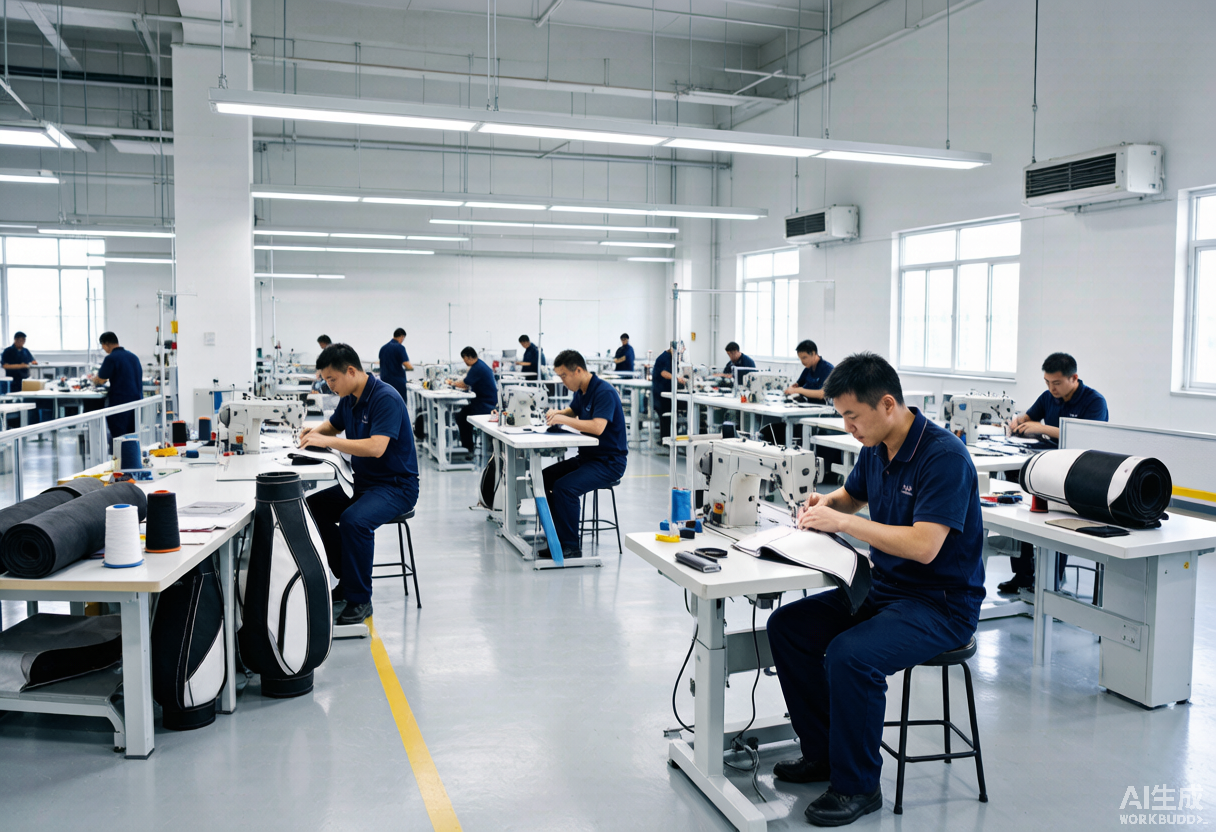
What gives a golf bag its shape: EVA foam (2–5mm sheets) between fabric and lining provides the structure in bodies and pockets; HDPE sheets stiffen base panels; spring-leg aluminum powers stand mechanisms; molded EPP/PP bases (replaceable on higher specs) carry the abrasion and water contact. The invisible quality markers: full-coverage foam (cheap bags foam only the front), sealed base seams, and strap attachments bar-tacked through the body, not the lining.
Hardware and Zippers
Hardware is where programs quietly upgrade or downgrade perceived quality. The options we stock, in ascending cost:
- Zippers: standard auto-lock (baseline) → branded YKK-style auto-lock with custom zipper pulls (+USD 0.40–0.90/bag) — the single most-felt upgrade at retail.
- Feet: molded plastic (baseline) → plated metal (+USD 0.15–0.30/set).
- Buckle/sliders: generic → name-brand webbing hardware (+USD 0.30–0.80/bag).
- Plating finishes: nickel, gun-metal, gold, rose-gold and matte-color on metal parts — matched to your palette via color matching.
Lining and Interior
Lining is the honest tell of build quality: full 210D polyester lining with bound seams (standard on our programs) versus partial lining with raw overlocks (the industry's cost-cut). Velvet-lined valuables pockets — where phones and watches live — are a USD 0.60–1.20 upgrade that retail lines feel at the shelf.
Choosing Honestly: The Matching Table
The materials × branding article extends this with how fabric choice constrains branding technique — the pairing decision most first-time buyers miss.
| Program | Body | Base | Hardware tier |
|---|---|---|---|
| School team stand bag | 600D polyester | Molded PP | Standard + metal feet |
| Corporate Sunday gift | 600D or PU trim | Molded PP | Standard, plated pull |
| DTC premium stand bag | 420D/840D nylon | EPP molded | Name-brand zippers |
| Retail staff bag | 1680D ballistic | EPP + full skirt | Top tier throughout |
| Rental / range fleet | 1680D + PU coating | EPP, replaceable | Top tier, minimal branding |
Denier: Linear Density, Not a Durability Score
Denier is the mass in grams of 9,000 metres of yarn, so it describes how heavy a yarn is — not how long a bag survives. Two fabrics both labelled 600D can differ by a factor of two in abrasion resistance once yarn tenacity, weave density, coating weight and finish are taken into account.
What denier does predict reliably is weight and hand feel at a given weave: a 420D shell sits at 155–190 gsm, a 600D at 220–280 gsm, an 840D at 300–360 gsm and a 1680D ballistic at 480–560 gsm. Those numbers drive freight, packability and how the bag carries on a shoulder.
Abrasion is measured rather than asserted. Wyzenbeek testing to ASTM D4157 counts double rubs to a defined end point, and Taber testing to ASTM D3884 reports mass or thickness loss after a fixed number of cycles; both are published by ASTM. On those tests a 600D shell with a tight weave and a 0.15 mm PU back-coating can outlast an open-weave 840D with a thin coat, and a heavily coated 1680D can lose abrasion resistance at fold lines because the coating cracks first. A spec sheet that states denier alone has said nothing about durability.
Read three lines together — fibre, construction and coating — and then a fourth: where the fabric sits on the bag. Wear concentrates at the base, the stand-leg contact patch and the cart-frame rub, so the useful question is which panels need the heavier cloth, not which denier the whole bag uses. The denier and GSM guide takes the arithmetic further, and the lab test methods explain a test report.
Nylon and Polyester at Each Denier
The fibre matters as much as the number in front of the D. Nylon 6.6 carries roughly 8–9 grams per denier of tenacity against 6–7 for polyester, so nylon wins on tear and abrasion per gram while polyester wins on cost and dimensional stability.
| Fabric | Fibre | Typical shell GSM | What it does well | Where it gives up | Cost index (600D polyester = 1.00) |
|---|---|---|---|---|---|
| 420D nylon ripstop | Nylon 6.6 | 155–190 | Grid arrests tears; light, technical hand | Lower mass against puncture; soft structure | 1.10–1.18 |
| 420D polyester | Polyester | 160–195 | Colour fastness, printability, price | Tear strength below nylon | 0.92–1.00 |
| 600D polyester | Polyester | 220–280 | Balance of price, print quality and strength | Hand feel; UV at bright shades | 1.00 |
| 840D nylon | Nylon 6.6 | 300–360 | Abrasion and tear per gram of weight | Cost; moisture regain of 4–4.5% | 1.15–1.25 |
| 1680D ballistic nylon | Nylon, two-ply basket weave | 480–560 | Structure, shape retention, abrasion | Weight, stiffness, cost | 1.25–1.45 |
| 1680D polyester | Polyester, two-ply | 470–540 | Cheaper staff-grade body with structure | Lower tear than the nylon equivalent | 1.10–1.22 |
| Recycled rPET 600D | Polyester, post-consumer | 225–285 | Same base specification, traceable content | Colour lot variance between batches | 1.03–1.10 |
| PU-coated 600D | Polyester plus PU | adds 25–40 gsm | Water resistance, wipe-clean surface | Coating ageing in hot storage | 1.08–1.15 |
Two notes on the table. A 1680D ballistic is two 840D yarns in a basket weave, so part of its abrasion gain comes from the weave rather than the yarn count. Moisture regain is the quiet difference: nylon takes up 4–4.5% of its weight in humid air against 0.4% for polyester, which shows up as dimensional movement in a coastal pro shop.
GSM Mapping by Chassis
Shell weight follows the chassis, not the other way round. A Sunday bag built from 1680D ballistic is heavier than its job requires and will not fold into a gift box; a staff bag in 420D will not hold its shape through a rental season.
| Chassis | Typical shell | Shell GSM | Lining | Indicative FOB Xiamen |
|---|---|---|---|---|
| Sunday / starter bag | 600D polyester | 230–260 | 210D polyester | USD 14–24 |
| Stand bag | 420D nylon or 600D polyester | 240–300 | 210D polyester, bound seams | USD 22–38 |
| Cart bag | 600D PU-coated or 840D nylon | 280–340 | 210D, velvet valuables pocket | USD 24–40 |
| Staff bag | 1680D ballistic nylon | 480–560 | 210D, full-length dividers | USD 38–60 |
| Travel cover | 600D or 840D, PU-coated | 260–320 | 210D, padded hood | USD 12–22 |
| Shoe bag | 600D polyester | 220–260 | Unlined or mesh vent panel | USD 4–8 |
Prices are indicative FOB Xiamen ranges at MOQ 200 pieces and move with hardware tier, decoration count and carton configuration. The mapping to watch is GSM against freight: every 40 gsm on a staff bag body adds roughly 30–45 grams finished weight, invisible on one bag and visible across a container. Chassis specifications sit on each bag-type page, for example staff golf bags.
Coatings: PU, PVC and What Water Resistance Means
Water resistance comes from the coating and the seam, not from the fabric name. Hydrostatic head, measured under AATCC 127 or ISO 811, states what a panel resists: an uncoated 600D polyester reads roughly 300–500 mm, a PU-coated shell 800–1,500 mm and a PVC-coated shell 2,000 mm and above, with seam sealing drawing the line between showerproof and genuinely wet-weather construction.
PU is the default on golf bags because it stays flexible at low temperature and bonds to nylon. Its weakness is hydrolysis: in hot, humid storage the coating absorbs moisture and separates, so a PU-coated bag has a shelf life of three to five years and should be stored below 30 °C and 60% relative humidity. A programme ordering in June for a following spring launch sits inside that window; one storing two seasons of stock does not.
PVC costs less per square metre, is heavier and stiffer, and resists chemicals better, which is why rental fleets sometimes specify it. The trade-offs are plasticiser migration, restricted phthalates under REACH Annex XVII at 0.1% by weight for DEHP, DBP, BBP and DIBP, and an awkward end of life; the restriction detail is on ECHA. Water-repellent finishes belong in the same conversation because PFAS restrictions are tightening — see the PFAS-free fabric note.
Ask for coating weight in grams per square metre and the test method behind any claim. “Waterproof” without a number and a method is a marketing word, and the difference between water-resistant and waterproof is worth settling before sampling rather than after the first complaint.
Material Cost Coefficients
Material choices move FOB in coefficients rather than flat amounts, because the same change costs more on a staff bag than on a pencil bag. Read the table as a multiplier on the material portion, which sits at 40–50% of FOB on a stand bag.
| Change | Effect on material cost | Typical FOB effect, stand bag |
|---|---|---|
| 600D polyester to 420D nylon ripstop | +12–18% | +USD 1.50–3.00 |
| 600D polyester to 840D nylon | +15–25% | +USD 2.00–3.50 |
| 600D polyester to 1680D ballistic nylon | +25–45% | +USD 3.50–6.00 |
| Add PU coating to the shell | +6–10% | +USD 0.80–1.60 |
| 210D lining to 300D ripstop lining | +5–8% | +USD 0.60–1.40 |
| Standard zipper to branded auto-lock with custom pulls | component | +USD 0.40–0.90 |
| Moulded plastic feet to plated metal feet | component | +USD 0.15–0.30 per set |
| Velvet-lined valuables pocket | component | +USD 0.60–1.20 |
A worked example makes the coefficients usable. A 300-piece stand bag is quoted at USD 28.00 FOB Xiamen and material is about 45% of that, or USD 12.60. Moving the shell from 600D polyester to 840D nylon adds around 22% to the shell cost, and the shell is roughly 60% of material: 12.60 × 0.60 × 0.22 gives USD 1.66, taking FOB to about 29.66. Adding PU coating on the lower panels and base costs another USD 0.90, and a velvet valuables pocket USD 0.80, which lands at 31.36 and is quoted at 31.40 once the price is rounded to a working figure. At a 2.4 times retail multiple the shelf price moves from roughly 67 to 75 — the number to test against the market before approving either change.
OEKO-TEX, REACH and What a Test Report Proves
OEKO-TEX Standard 100 is a limit-value system for harmful substances in textile articles, graded by product class I to IV, and it certifies a material at a production site rather than a finished bag. A test report is a single laboratory result on one submitted lot. Both are useful, and neither substitutes for the other.
REACH is the regulation behind most of the questions buyers ask. The candidate list of substances of very high concern is updated roughly twice a year and runs past 240 entries, with a notification duty above 0.1% by weight. Annex XVII restricts azo dyes that cleave to listed amines at 30 mg/kg, nickel release at 0.5 micrograms per square centimetre per week on items in prolonged skin contact, and the phthalates named earlier. Current lists sit on ECHA, and the OEKO-TEX limit values with OEKO-TEX.
Two consequences follow. The tested material has to be the material that goes into bulk, so a certificate on a swatch from another mill proves nothing about your roll — worth writing into the purchase order. Labelling has its own regime: fibre content and care claims in the United States follow the textile rules at ftc.gov, the EU General Product Safety Regulation adds a responsible economic operator to the label, and colour fastness comes from the ISO 105 series. Test scope and certificate validity by destination are set out in the sustainability documentation.
Six Ways a Material Spec Fails in the Field
Most material complaints trace to six failures, and each has a spec line that prevents it. All of them surface between six and eighteen months after delivery, which is why the spec sheet rather than the sample is the document worth arguing over.
- Coating delamination: PU on nylon takes up moisture in a hot warehouse and separates from the base cloth. Specify coating adhesion by peel test and a storage condition below 30 °C.
- Crocking on dark shades: wet-rub fastness below grade 3 marks light trousers, carts and car seats. Specify ISO 105-X12 grade 3–4 minimum on navy and black.
- UV fade on webbing: polypropylene webbing goes chalky within a single season in Australia and the Gulf. Polyester webbing costs a few cents more and holds colour.
- Foam collapse: 20 mm EVA compresses permanently below 25 kg per cubic metre density. Specify density rather than thickness, because thickness is what the drawing shows and density is what the bag feels.
- Thread abrasion at the cart frame: Tex 70 on a rub point loses strength quickly. Bar-tack the contact area and move to Tex 105 there.
- Zipper oxidation: plated sliders pit in coastal humidity and the pull stiffens before the teeth fail. Nickel-plated or moulded acetal sliders with an auto-lock spring avoid it.
Weathering methods and their pass criteria are covered in the UV and ageing guide, and construction differences in the waterproofing ratings guide. Both are worth reading before a specification is signed, because retrofitting either after bulk is a re-cut.
Frequently Asked Questions
What is the best fabric for a custom golf bag?
Match it to the use: 600D polyester for value programs, 420D nylon for lightweight performance, 1680D ballistic for staff-grade durability, PU/vegan leather for premium trim panels. There is no single best — there is a correct match.
Are your materials waterproof?
Fabrics are water-resistant (PU coatings standard on 600D+), with waterproof base panels and rain hoods included on most chassis. Fully waterproof seam-sealed construction is a specialty spec — ask in your quote.
Can I supply my own fabric?
Yes, with testing for sewability and color fastness before committing (your fabric or ours, the tech pack governs). Common for brands with proprietary recycled materials.
Do you offer recycled or sustainable materials?
Yes — rPET polyester from post-consumer bottles, solution-dyed fabrics (lower water use), and recycled webbing options. See sustainability programs.
Is 1680D always better than 600D?
No. Denier describes yarn weight, so 1680D is heavier and usually more abrasion-resistant, but it is also stiffer and costs 25–45% more on the shell. A 600D Sunday bag with good construction does its job better than an over-specified 1680D one that will not fold into a gift box.
What does the D in 600D actually measure?
Denier is the mass in grams of 9,000 metres of yarn. It says how heavy the yarn is, not how durable the fabric is. Abrasion resistance also depends on fibre type, weave density, coating weight and where the panel sits on the bag.
Which fabric weight suits a staff bag?
Staff bags are normally built on 1680D ballistic nylon at 480–560 gsm, with an EPP moulded base and full-length dividers. A 1680D polyester two-ply is a cheaper alternative at 470–540 gsm, with slightly lower tear strength than the nylon equivalent.
Should I choose PU or PVC coating?
PU is the default for golf bags: flexible, bondable to nylon and adequate at 800–1,500 mm hydrostatic head. PVC is cheaper, heavier and above 2,000 mm, but carries phthalate restrictions under REACH and a harder end-of-life story.
Can I supply my own fabric?
Yes. The material is tested for sewability, colour fastness and coating adhesion before bulk, and the tech pack governs acceptance. Brands with proprietary recycled or printed materials commonly supply their own, provided the roll lot is consistent across the run.
Are the fabrics waterproof or only water-resistant?
Water-resistant is the standard: PU-coated shells at 800–1,500 mm with waterproof base panels and a rain hood. Fully waterproof construction needs seam sealing and a higher-spec coating, and it is quoted as a specialty specification rather than assumed.
What does OEKO-TEX Standard 100 cover?
It sets limit values for harmful substances in textile articles, graded by product class I to IV. It certifies a material at a production site rather than a finished bag, so the certificate must match the mill and the lot that actually goes into bulk.
Do you offer recycled materials?
Yes: rPET polyester from post-consumer bottles, solution-dyed fabrics that use less water, and recycled webbing. Recycled shell typically costs 3–10% more than virgin 600D and can vary slightly between colour lots, which matters on a multi-SKU reorder.
Which zipper grade should I specify?
Standard auto-lock coil is the baseline. A branded auto-lock with custom pulls adds USD 0.40–0.90 per bag and is the upgrade retail buyers notice most. Metal sliders suit staff bags; moulded acetal resists coastal corrosion better.
How do I stop the bag body sagging?
Specify foam density rather than thickness: 25 kg per cubic metre or above for body panels, full-coverage rather than front-panel-only foam, and an HDPE sheet in the base. Sagging is almost always a foam density or coverage decision, not a fabric one.
How long does custom-dyed fabric add to a schedule?
Custom dyeing typically adds 15–20 working days to material lead-in, plus 2–3 days for lab dip approval. Printed camo or a first-time mill runs longer. Approving lab dips before the purchase order is placed keeps that time out of the critical path.
Ready to spec your custom golf bags?
Send your logo, bag type and target quantity — we reply with a quote, MOQ and timeline within 24 hours.