
Programs · Aesthetic Lines
Cute & Kawaii Golf Bags, Made for Your Brand
Cute and kawaii golf bags are a real B2B segment, not a gimmick: brands targeting women golfers, juniors and academy students order pastel and floral-print bags from a minimum of 200 pieces, with the aesthetic carried through fabric print, trim colors, hardware plating and packaging. Typical FOB pricing runs USD 14–26 depending on print coverage and trim level — a 15–30% premium over solid-color equivalents, which retail margin data shows the segment happily pays.
Why the Cute Segment Is a Manufacturing Story
Women are the fastest-growing participant group in golf, and junior academies are the fastest-growing institutional buyer — both buy aesthetics that the traditional industry catalog does not offer. That gap is the program: a brand that owns a cute or kawaii look in golf bags has a differentiated product line at standard golf bag margins.
The manufacturing reality behind the aesthetic: cute bags are a print-and-trim discipline, not a different bag. The chassis is the same proven Sunday, stand and pencil platforms we build year-round; what changes is fabric print, colorway logic and trims. That keeps pricing sane and quality identical to any other program we run.
The Four Looks That Sell
| Look | How it is manufactured | Popular chassis | FOB range (USD) |
|---|---|---|---|
| Pastel solid colorways | Pantone-matched dye lots — cream, blush, sage, powder blue | Sunday, stand, pencil | 13–22 |
| Floral print fabric | All-over print on polyester via digital print, then cut & sew | Sunday, Boston-style | 16–26 |
| Two-tone with contrast trim | Paired colorways with contrast webbing and zipper tape | All types | 14–24 |
| Plush & texture accents | Plush head covers and tassel trims paired with printed bags | Accessories, Sunday | 12–20 |
Design Rules We Recommend
Segment experience distilled — four rules that separate cute lines that sell from cute lines that discount:
- One hero print per collection. Print fabric carries a 15–30% cost premium; one strong print plus two solid colorways beats three weak prints at the same budget.
- Pair every print with its solid. Buyers mix; make mixing deliberate with a matching solid in the collection that shares trim colors.
- Hardware in the color story. Rose-gold and matte-cream plating on zippers and feet completes a pastel bag; standard nickel hardware quietly kills it.
- Photograph with the trims on. Plush covers and tassels photograph with the bag — the same factory program makes both. See cute head covers.
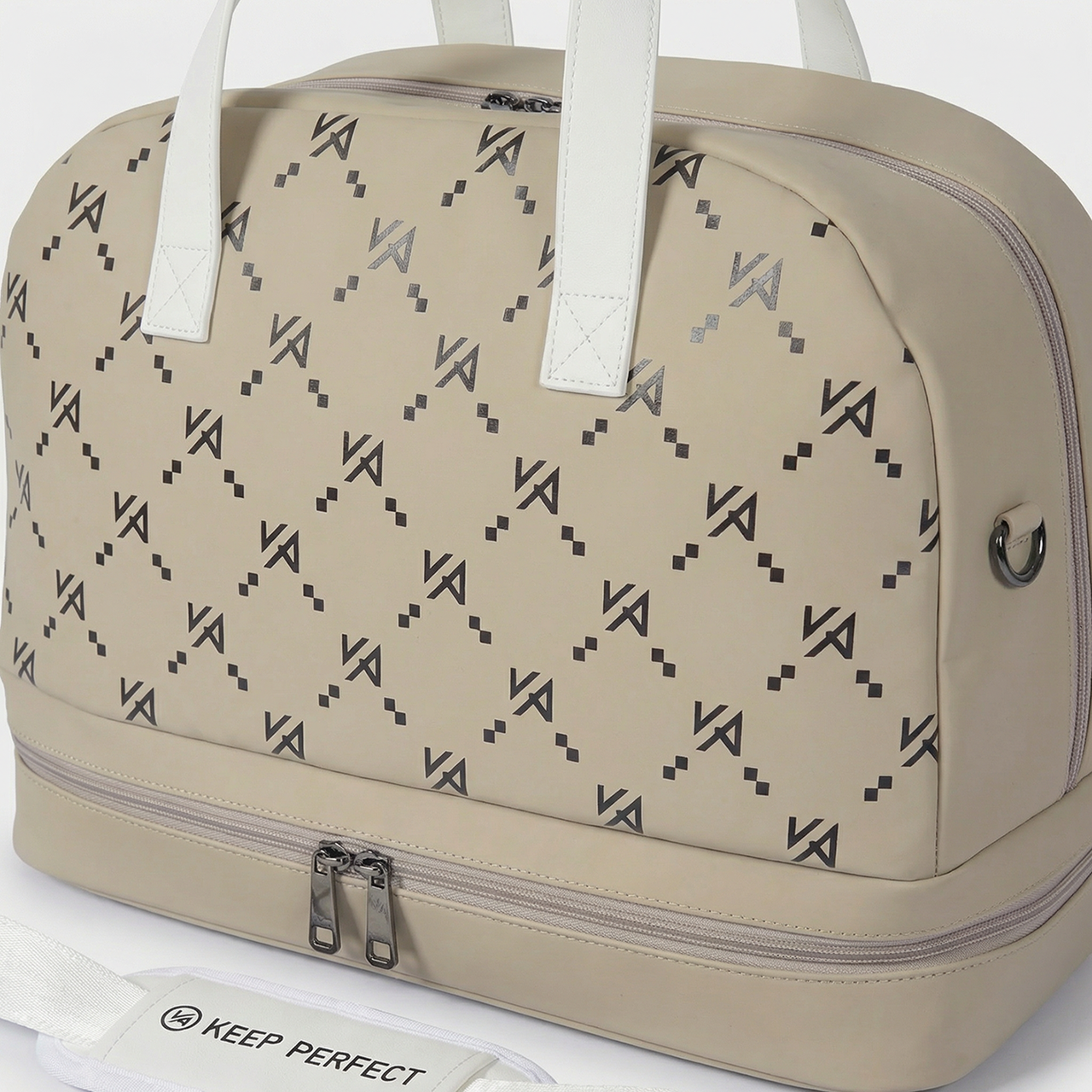
How a Cute Line Launches
The sequence is the same as any first program — 200 pieces minimum, 6–10 day sampling, 35–50 day bulk — with two additions specific to print fabric: a strike-off (printed fabric sample) approval before cutting, and print-repeat checks during bulk QC so pattern alignment stays consistent across bags. The kawaii segment trend guide covers the market data and product decisions in depth.
The Buyer Profiles Behind the Segment
The DTC profile dominates the segment's volume and sets its conventions: hero prints, matched solids, hardware in the color story, and packaging that survives an unboxing video. The other three profiles increasingly borrow the DTC playbook because it demonstrably converts browsers into buyers at retail too.
| Buyer type | Typical collection | Volume per year | What they optimize for |
|---|---|---|---|
| DTC women's golf brand | 1 hero print + 2 pastel solids, 3–4 SKUs | 800–2,400 pcs | Instagram-ready photography, margin |
| Junior academy chain | Bright solids + character covers | 600–1,800 pcs | Durability, reorder consistency |
| Gift & resort channel | Floral totes + pouch sets | 400–1,200 pcs | Perceived value at gift price points |
| Pro shop private line | Pastel solids with club crest | 200–600 pcs | Brand fit with the club identity |
Print Fabric: the Supply Chain Reality
Every cute program rests on one physical fact: printed fabric has its own minimums, independent of the bag MOQ. Digital printing on 600D polyester runs from about 300 meters per design — enough for roughly 220–260 Sunday bags — which is why 200 pieces per colorway is the honest floor for a custom print. Rotary printing (for very large runs) starts near 1,000 meters but drops the per-meter cost by 30–40%.
The strike-off is the control point. Before any panel is cut, you approve a physical piece of your printed fabric: color values under daylight, repeat alignment, hand feel. This is the moment to catch a print that is too pink, too dense, or repeating in the wrong direction — after cutting, the fabric is committed. We photograph and courier strike-offs as standard; approve from the physical piece, not a screen.
Print files need to arrive as vector artwork or high-resolution raster at final repeat size, with Pantone TCX references for every color in the pattern. Our pre-press team checks repeat geometry and flags colors that digital printing renders poorly on polyester — very light pastels on dark grounds and extremely fine lines below 0.4 mm are the two recurring traps. The color matching page explains how lab dips and strike-offs interlock.
Color Stories That Move Volume
Notice what the table implies: the print is one SKU in a story of three. Buyers who order a hero floral with its two matching solids outsell buyers who order three unrelated prints, because the collection merchandises as a wall in a shop and as a grid on a website. Build the story first; the print is its punctuation, not its sentence.
| Color story | Core palette | Trim & hardware | Strongest channel |
|---|---|---|---|
| Cream & blush | Cream body, blush panels, tan trim | Rose-gold zippers | DTC women's brands |
| Sage & ivory | Sage green, ivory accents, webbing in natural | Matte cream fittings | Resort & gift |
| Powder blue & navy | Blue body, navy contrast, white logos | Polished nickel | Academy & junior |
| Lavender fields | Lavender print, lilac solids, cream trim | Rose-gold or cream | DTC + social retail |
Sizing the Collection Correctly
A first cute collection should be three to four SKUs, not ten. The structure we recommend after watching dozens of launches: one hero print Sunday bag (the traffic driver), one pastel solid Sunday bag in the same story (the volume seller), one matching pouch or head cover set (the basket-builder), and optionally one stand bag in the hero print for the committed player. Total first order: 600–800 pieces across the collection, at a blended FOB of USD 15–21.
Why not more SKUs? Because a first collection is a test with inventory risk attached. Every SKU you add multiplies your size-and-color commitment while adding less information than the sell-through data from a tight collection gives you in ninety days. Season two, with data in hand, is when collections widen. The startup brands page walks through the full first-order math including reorder reserves.
Worked Example: a Kawaii Line From Brief to Launch
A real program shape, anonymized: a DTC founder with a watercolor floral print, targeting a spring launch. Brief received October 3: hero print Sunday bag, blush solid Sunday bag, matching pouch set — 240 pieces per SKU, 720 total. Quote returned October 4 at USD 16.80 blended FOB. Print file refined with our pre-press team October 5–10; strike-off approved October 24; full samples photographed November 6 and approved November 14 (one revision: zipper tape from white to cream).
Bulk ran November 15 to January 8 (35 working days, excluding the holiday pause we flagged in the calendar at quote stage). AQL 2.5 inspection passed January 10; FOB Xiamen loading January 15; arrival at the client's 3PL February 19 — three weeks before the March 15 launch, inside the planned buffer. All-in landed cost per blended unit: USD 21.30. Launch-week sell-through on the hero print: 61% — the number that justified season two's expansion to five SKUs.
Packaging for This Segment
Cute-segment buyers photograph their purchases, which makes packaging a marketing surface, not a cost line. The options, in ascending order of impact and cost: printed polybag with a branded insert card (USD 0.10–0.18 per unit), kraft gift box with one-color print (USD 0.80–1.40), rigid magnetic box for premium gift positioning (USD 2.20–3.60), and the full unboxing kit — box, tissue, sticker, thank-you card (USD 3.50–5.00).
Our standard guidance: DTC brands budget packaging at 6–10% of FOB cost; gift-channel programs at 10–15% because the packaging is part of the gift. Everything packs flat into the same container as the bags — packaging never justifies its own shipment. The customization hub shows how packaging combines with branding techniques across a program.
What the Segment Gets Wrong
- Designing for likes instead of carts. A print that wins Instagram polls but photographs poorly on a product page converts badly. Always sample the photography before committing to the print.
- Skipping the matching solid. Hero prints get attention; matching solids get reorders. Collections without a solid option cap their own repeat-purchase rate.
- Standard nickel hardware on pastel bags. One silver zipper undoes a hundred color decisions. Hardware plating is a USD 0.15–0.40 decision that changes how the whole bag reads.
- Ignoring the strap and handle. These carry the bag's color into the wearer's photos. Contrast webbing in the story palette is cheap and disproportionately visible.
- Treating season two as a new design problem. The winning move is usually colorway rotation on the proven chassis — new blush, new sage — not new prints. Rotate colors; archive prints.
Is Kawaii Durable, or a Fad?
Fair question for any buyer committing inventory. The evidence from our order book: the segment has grown every season for four years, but its center of gravity shifts — plush-heavy programs peaked two seasons ago, watercolor florals are the current hero, and quiet pastel solids never stop selling. The durable asset is not any print; it is the chassis-plus-colorway system that lets a brand refresh its look each season at sampling cost rather than development cost.
That is precisely how we recommend structuring programs: own a small set of proven chassis, and treat prints and palettes as seasonal layers. The brands that win this segment are not the ones that guessed the right print once — they are the ones built to change prints cheaply. Our trend guide tracks the shift with market data each season.
Retail Pricing Architecture for Aesthetic Lines
Notice the pouch and cover rows: their margin percentages look lower, but their absolute dollars per cubic meter of container space are the highest in the collection, and their attach rate (35–55% of bag buyers add one) is what lifts a launch's blended margin. Collections are margin systems, not margin items — price the system.
| SKU role | FOB (USD) | Landed (USD) | DTC retail (USD) | Gross margin |
|---|---|---|---|---|
| Hero print Sunday | 16–19 | 19.50–23.50 | 99–129 | 78–82% |
| Matching solid Sunday | 13–16 | 16.50–20.00 | 89–109 | 79–83% |
| Print pouch set | 5–7 | 6.50–9.00 | 29–39 | 72–78% |
| Cover set (driver+fairway) | 6–9 | 8–12 | 39–59 | 74–80% |
Season Two: Reading the Sell-Through Data
The first collection is a hypothesis; season two is where the data answers it. The metrics that matter, in the order buyers should read them: sell-through by SKU at 30/60/90 days (which silhouettes move), colorway velocity within silhouettes (which palettes move), attach rate of accessories (how strong the collection effect is), and return rate by SKU (where fit or expectation problems hide). A hero print with 60%+ ninety-day sell-through earns an expanded color family; a solid with under 30% earns a palette replacement, not a discount.
The reorder mechanics reward this discipline: proven prints and dye recipes are on file, so a season-two reorder runs 30–45 days with zero sampling cost — and the reorder consistency system guarantees the blush a customer buys in May matches the blush she bought in March. The brands that win this segment treat each season as an experiment with a manufacturing partner who keeps the lab notebook.
Working With Our Design Partners
Not every buyer arrives with print-ready artwork, and the design-partner track exists for exactly that case. The engagement runs three stages: a brief workshop (your references, target customer, price architecture — 48 hours to a creative direction), concept development (two to three print directions with colorways, presented on bag mockups — 7–10 days), and production artwork (the chosen direction engineered into repeat files with Pantone TCX callouts, ready for strike-off — 4–6 days). Fees run USD 300–800 by complexity and are credited against the first bulk order in most program structures.
What you keep: everything. The final print files are your property, archivable for reorders and extensible to future products — many clients' second product is the same print on head covers or pouches, where the print file drops straight in. Design you can reuse is design that compounds; that is why we structure fees as development investments rather than per-season services.
Quality Control Specific to Print Fabric
Print programs add three checks to the standard AQL 2.5 inspection, and each exists because of a failure we have seen. Repeat alignment: adjacent panels are checked for pattern breaks at seams — a floral that jumps 4 cm at a seam is a reject, and the cutting plan, not the sewing, is usually the cause. Color consistency across the run: digital print drifts between morning and afternoon calibrations, so every production lot is photographed against the approved strike-off under the inspection booth's D65 daylight lamps, not factory fluorescents. Print durability: a rub test on the AQL sample (twenty dry rubs, ten wet) catches under-cured ink before it reaches a customer's white trousers.
These checks run alongside the construction inspection every bag receives — seams, zippers, strap anchors, stand mechanisms. The reporting format is identical (photo-documented, defect-classified), so a print program's inspection file reads exactly like any other: boring, complete, and attached to your packing list. The quality page documents the full inspection architecture behind every program we ship.
Frequently Asked Questions
How do I know the print colors will match my brand?
Through the strike-off system: your print is produced on the actual fabric and couriered to you before bulk cutting, with Pantone TCX references checked under D65 daylight. Screen proofs are indicative only — the physical strike-off is the approval that counts, and bulk lots are checked against it at inspection.
Can the same print run across bags, covers and pouches?
Yes, and it should — one print file, one strike-off, one fabric run feeding multiple product types. Cross-product prints are the strongest visual signal of a designed collection, and they share the print minimum, which is how a three-product collection stays inside one 300-meter run.
What is the MOQ for cute custom golf bags?
200 pieces per style and colorway — same as all our programs. A print fabric plus two solid colorways is typically 600 pieces across the collection.
Can you print my own floral or character pattern?
Yes — you supply the print file (AI/PDF at repeat) and we produce a strike-off for approval before bulk cutting. Digital printing handles photographic and watercolor styles; print methods are compared here.
Do cute golf bags cost more to manufacture?
15–30% over solid-color equivalents at the same spec, driven by printed fabric and matched trims. The segment supports higher retail prices, which is why the program economics work.
Can you make matching head covers and accessories?
Yes — plush and fabric head covers, pouches and tassels in the same print run, one container. See cute driver head covers and accessories & pouches.
What print file format do you need?
Vector AI or PDF at final repeat size is ideal; high-resolution raster at 150+ dpi at final size works for watercolor and photographic prints. Include Pantone TCX references for every color — our pre-press team checks the repeat geometry and flags anything digital printing renders poorly before the strike-off stage.
How long does a print program take compared to solids?
Add 7–10 days to the standard calendar: the strike-off approval cycle is the extra step. Total timeline from brief to FOB runs 75–95 days for a print collection versus 65–85 for solids. The nine-step process maps where the strike-off slots in.
Can the print wrap the whole bag including the strap?
Yes — all-over print including straps and handle panels is standard. One caution from production: high-wear zones (strap undersides, base corners) show print wear first, so we often recommend solid panels at contact points — a design choice that extends the bag's photogenic life without changing the look at five paces.
Do you offer design help if I only have a mood board?
Yes — our design partners convert mood boards into print artwork and colorway specs for a development fee (USD 300–800 depending on complexity), credited against the first bulk order in most program structures. Many successful cute lines started as a Pinterest board and a target price.
What is the reorder MOQ on a proven print?
The same 200 pieces per colorway — but reorders skip the strike-off (the approved print file is on record), which cuts 7–10 days and the sampling cost entirely. Print files, dye recipes and color cards stay archived for the life of the program.
Can I mix bag types inside one print order?
Within limits. A Sunday bag and a pouch in the same print can share one fabric run; a stand bag in the same print usually can too. Mixing spreads the print's meter minimum across SKUs, which is exactly how smart first collections hit 200 pieces per SKU without overcommitting any single one.
Ready to spec your custom golf bags?
Send your logo, bag type and target quantity — we reply with a quote, MOQ and timeline within 24 hours.