
Customization · Branding
Heat Transfer Logo Printing on Golf Bags
Heat transfer prints your full-color logo — gradients, photographic detail, unlimited colors — onto golf bag panels from a single setup, costing USD 0.60–1.80 per bag at 500 pieces with no per-color screen fees. It is the technique of choice below 300 pieces for multicolor art, and for any logo too detailed to embroider. Durability is 3–6 years of outdoor use; premium PU transfers and sublimation on polyester push into year 8. This page covers the three transfer families, materials, parameters, testing and costs.
Three Transfer Families
HTV for simple multicolor marks (plotter-cut layers, no print resolution limits because there are no dots); digital transfer for photographic art; sublimation for all-over pattern fabric where the print becomes the cloth. The rest of this page works through each family's specifics.
| Method | How it works | Best for | Durability |
|---|---|---|---|
| HTV (heat transfer vinyl) | Colored vinyl cut by plotter, pressed on | 1–3 solid colors, sporty marks | 4–6 years |
| Digital transfer paper/film | Full-color print pressed onto panel | Gradients, photos, 200–500 pcs runs | 3–5 years |
| Sublimation | Dye turns to gas and bonds to polyester | All-over prints on light polyester | 6–8 years (dye is in the fabric) |
Why Teams Choose It
No per-color setup changes the math on small runs. A five-color logo costs the same to set up as a one-color one, and artwork can change between orders without new screens. For corporate event programs where the logo ships with a date or event name, that flexibility is the whole point — last year's transfer file updates and the program reruns.
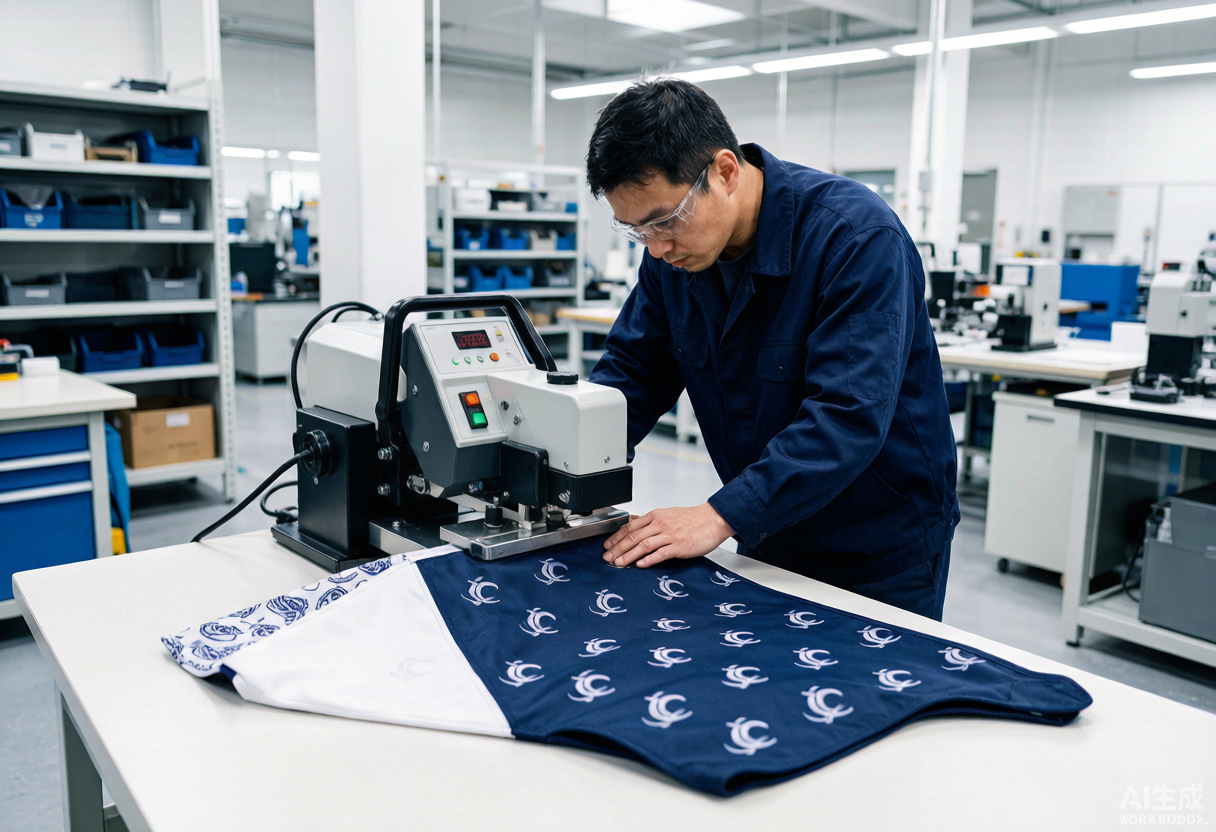
On the production floor, transfers are pressed on cut panels, like screen printing, so placement precision is millimeter-level and the press reaches full cure temperature before any bag is assembled. The press parameters — temperature, time, pressure — are logged per lot, which matters because transfer failure modes (peeling, cracking, discoloration) are all parameter failures, not material ones.
HTV Types: What the Vinyl Actually Is
On golf bags, PU is the default HTV: panels flex and fold, and the thinner film follows the fabric rather than fighting it. Glitter and flock ride aesthetic programs — kawaii lines use both — and reflective HTV shows up on travel-adjacent products where being seen is a feature.
| HTV type | Character | Outdoor life | Notes |
|---|---|---|---|
| PU (polyurethane) | Thin, stretchy, matte or gloss | 4–6 years | Premium; best on flexible panels |
| PVC | Thicker, stiffer, cheaper | 3–5 years | Value programs; avoid over-stretch zones |
| Glitter / flake | Embedded glitter particles | 3–5 years | Aesthetic programs; heavier hand |
| Reflective | Glass-bead reflective layer | 5–6 years | Safety-adjacent branding |
| Flock | Velvet-raised fibers | 4–5 years | Retro-premium texture |
| Holographic | Prismatic color shift | 3–5 years | Youth and fashion programs |
Press Parameters and Failure Modes
Every transfer failure traces to one of three parameters, and every parameter is logged per lot: temperature — typically 150–170°C measured at the adhesive layer; too cold and adhesive never activates (peeling at edges), too hot and the carrier discolors or scorch marks appear on light fabrics. Time — 10–15 seconds for most HTV and digital films; under-pressing under-activates adhesive, over-pressing embrittles it. Pressure — medium, even; light pressure leaves edge-lift on textured fabrics, and the press platen must be level across the panel or one side cures and the other does not.
The peel matters as much as the press: hot-peel and cold-peel films are different products with different finishes, and peeling at the wrong temperature is a classic first-article defect. All of this is why our transfers are pressed on flat cut panels by operators who run these families daily — transfer quality is process discipline, and the inspection system catches what discipline misses.
Sublimation Deep-Dive
Sublimation is the odd one out: not a layer on the fabric but dye that becomes gas at ~200°C and bonds permanently with polyester fibers. Nothing sits on the surface — there is no film to peel, which is why sublimated prints outlast every other transfer type (6–8 years, fading before peeling) and feel like nothing at all.
The constraints follow from the chemistry: it needs polyester (≥65% for strong saturation — blends print at reduced vibrancy), light base colors (dye is transparent; navy backgrounds swallow it), and it works on fabric by the panel, so all-over prints are panel-by-panel rather than one continuous wrap. On golf bags, sublimation is how camo prints, floral prints and full-coverage aesthetic colorways are manufactured: the fabric is sublimated flat, then cut and sewn like any panel.
Fabric Compatibility
Two edges surprise buyers: sublimation's polyester requirement (that "polyester feel" is the print technology, not cost-cutting), and 1680D ballistic rejecting surface films (heavy texture gives adhesives nothing flat to grip — embroidery patches own that fabric).
| Fabric | HTV | Digital transfer | Sublimation |
|---|---|---|---|
| 600D polyester | Excellent | Excellent | Excellent |
| 420D nylon ripstop | Good (with bonding layer) | Good | No — sublimation needs polyester |
| 1680D ballistic nylon | Patch only | Poor adhesion on texture | No |
| PU / vegan leather | Not recommended | Excellent on smooth PU | No |
| Canvas | Good | Good | No (unless poly-canvas) |
Artwork Prep for Transfers
Transfers are the most forgiving family for art, with three rules. First, vector for HTV (the plotter follows real edges — raster art gets traced with artifacts), raster acceptable for digital transfer at 300 DPI at final size. Second, account for layer order in HTV: multicolor marks are pressed in sequence, inner details first, and each layer's carrier is weeded by hand. Third, keep 0.5 mm between colors that touch in HTV (layers need breathing room) while digital transfer can butt colors seamlessly — the reverse of screen printing's trapping rules, which trips up designers who work in both.
Durability Testing
How transfer durability is actually measured, so the numbers above mean something: wash testing — domestic cycles to failure; HTV and digital transfers target 30–50 cycles without edge-lift, sublimation is effectively wash-proof (the dye is the fiber). Taber abrasion — rotary abrasion cycles to visible wear; prints on high-contact zones (strap pads, base edges) get tested because that is where bags actually abrade. QUV exposure — accelerated UV for outdoor fade; four-season outdoor life is the standard claim we will stand behind, sublimation longer.
In practice: a corporate event bag that lives one day and then a closet needs none of this. A retail line bagging four seasons of sun needs sublimation or embroidery, and the techniques comparison places that trade-off on one table.
Costs
Compare: the same multicolor logo in embroidery would cost 1.5–3× more, but last twice as long. This durability-versus-detail trade-off is the core of the decision.
| Order qty | Per-bag cost (USD), standard logo ≤15 cm | Setup |
|---|---|---|
| 200 | 1.10–1.80 | One film per design, USD 10–30 |
| 500 | 0.80–1.30 | Same |
| 1,000 | 0.60–0.95 | Same |
Worked Example: A Five-Color Club Logo at 250 Pieces
Where transfers earn their keep: a club wanted its full-color crest — gradient sky, five colors, fine text — on 250 stand bags for a member program. In screen printing, five colors means five screens (USD 100), five passes, five registration risks, and halftone dots visible at arm's length. In embroidery, the gradient is impossible and the text marginal. As a digital transfer: one film, one press, photographic fidelity, USD 1.55 per bag at 250 pieces, USD 417 all-in including setup. The program ran in 35–50 day bulk like any other, and the artwork updated the following season without touching a screen inventory.
That is the transfer story in one example: complexity is free, volume is optional, durability is good-not-great. Programs where the logo must outlive five outdoor seasons choose embroidery; programs where it must say everything at once choose this.
Combining Transfers With Other Techniques
Transfers combine naturally because they occupy the "full-color, flat-surface" niche other techniques cannot fill. The proven pairings: transfer + embroidery — full-color crest as transfer on the front, dimensional embroidered wordmark on the side; common on premium retail where the crest is photographic and the brand name is typographic. transfer + screen print — screen handles the massive single-color field, transfer handles the detailed secondary mark; volume programs with complex art do this to keep the big areas cheap. transfer + woven label — the interior tells the full-color story (care graphics, multilingual content) while the exterior stays dimensional.
Each technique runs on the same cut panel in sequence before assembly, which is why combinations cost their parts rather than a coordination premium — the scheduling is internal to one workflow, documented in the tech pack.
Care Instructions Worth Passing to Customers
Transfer longevity is partly a care behavior, so retail and gift programs benefit from passing it on: machine wash cold, inside out, gentle cycle; no bleach; no iron directly on the print (iron the reverse or use a pressing cloth); tumble dry low or hang. Heat is the enemy of every transfer family except sublimation — a 60°C wash or a hot iron is how a six-year print becomes a three-year one. Programs that print care symbols on the bag's care label see fewer claims and better logo life; it is a free durability upgrade that lives in the labeling spec.
Press Capacity and the Production Calendar
Transfers run on cut panels between cutting and assembly — the same mid-production slot as screen printing — and the press cycle is short: 10–15 seconds of dwell plus load and unload puts a single operator-press pair around 150–250 panels per hour on standard-size marks. A 500-bag program with two transfer positions schedules its pressing in two working days; capacity, like embroidery, is not the constraint. The constraint is sequence: art approval and film production must close before panels arrive at the press, because a panel batch with no film to press is a queue.
Lot behavior differs from screen printing in one way that matters to program design: transfers have no per-color setup, so color count is free, but each art change is a new film. Programs with per-bag variation (member names, event dates) or per-run variation (a sponsor change between two events) exploit this — the film swap costs minutes where a screen change costs a setup. That flexibility is the operational reason corporate event programs cluster on transfers.
The calendar risk to plan against is the same as every branding technique — late art. Film production is 1–2 days from approved art, and it can run in parallel with cutting; what it cannot do is run in parallel with itself being unapproved. Approve transfer art at sample stage and the technique is calendar-neutral inside the standard 35–50 day window.
Personalization at the end of the line follows the embroidery model: names and numbers on finished bags press individually after assembly, from your roster file, inspected against the roster. It is how 60 gift bags each carry a different name without the program carrying 60 risks.
One capacity note program planners ask for: transfer pressing scales linearly with presses, and our floor schedules transfer programs at the same priority as embroidery and print — a 2,000-piece program with four positions is still days of press time, not weeks. The number to remember is that transfers are never the bottleneck in a 35–50 day window; approvals are.
Transfers Versus DTG and UV Printing
Two technologies get asked about and deserve a straight answer. Direct-to-garment (DTG) inkjet prints beautifully on cotton — and on almost nothing a golf bag is made of: synthetic 600D and ripstop panels do not take water-based jet ink, the pretreatment chemistry is built for apparel knits, and the print sits on the surface without the adhesive system a bag's folding life demands. DTG belongs on the cotton tote add-on, not the chassis.
UV-curable flatbed printing is the inverse: it bonds hard to rigid and smooth surfaces — PU panels, logo plates, hardware inserts — and its ink cures to a hard film that does not survive being flexed at a fold. On golf bags that relegates UV to a niche: smooth PU trim panels away from fold lines, and rigid components. For full-color art on flexible fabric panels, transfers remain the correct technology — which is why our line uses each where it works and the techniques comparison maps the borders.
The reason the question matters: agencies quote "digital printing" generically and the spec that arrives can mean three different processes. When a brief says digital printing on bags, ask which — DTG (no), UV (only on rigid or smooth), or digital transfer (yes, and it is what we run). One question at spec stage saves a sampling round.
Sublimation's calendar is different and worth its own note: sublimated fabric prints before cutting — the roll is the print — so all-over print programs front-load the art approval even earlier than panel techniques. A camo or floral chassis sublimates at the fabric stage and then behaves like any other cut panel; the discipline is approving the printed fabric before the roll is committed.
Field Failures We Diagnose: Four Case Files
Transfer defects from other suppliers' programs cross our inspection benches often enough to keep a file, and four cases cover most of what goes wrong. Case one: edge peeling at month six on a corporate program — root cause, press temperature drifting 12°C below spec on one platen zone (a worn thermocouple, invisible to the operator, caught by our IR scan on arrival). The prevention costs nothing: parameter logging per lot, which is why we log.
Case two: cracking along the front pocket fold — root cause, budget PVC HTV specified across a flex zone because the art director wanted the logo bigger than the flat area allowed. The fix was spec-side: move the mark 20 mm onto the flat panel, or specify PU film that stretches with the fold. Both were free at design time and impossible after 800 bags were pressed.
Case three: yellow discoloration of a white HTV wordmark within a season — root cause, a generic film with no UV stabilizer, quoted to hit a price point. Premium PU films hold white through years of outdoor exposure; the per-bag difference is cents, and the replacement cost is a program.
Case four, the quiet one: transfers that looked perfect at delivery and dull at retail — root cause, matte-finish films peeled hot instead of cold (or the reverse; the film decides), trading away the surface finish the spec called premium. Hot-peel and cold-peel are different products with different finishes, and peeling discipline is on the operator card at every press. Small detail, visible consequence, zero-cost prevention.
The pattern across all four: transfers fail on process parameters and film grade, not on the technology — which is why our transfer spec names the film family and the logged parameters, and why AQL inspection checks adhesion, not just appearance.
Frequently Asked Questions
Will a heat transfer logo survive airline handling?
A cured transfer on a panel will withstand rain, abrasion and folding for 3–6 years of normal use. For travel covers that take heavy abuse, we recommend embroidery or oversized appliqué patches instead.
Can heat transfer do gradients?
Yes — that is exactly what digital transfers excel at, and what embroidery cannot do at all. Send your vector art; if it has more than four colors or any gradient, transfer or bust.
Is sublimation available on any golf bag?
Only on panels woven from polyester, and light colors show the best saturation. On dark 600D, digital transfer is the full-color alternative.
Why does my logo need to be "print-ready" for transfers?
HTV follows vector edges precisely; digital transfer needs 300 DPI at final size. Low-res raster art prints soft edges and jagged curves — the file quality is the print quality.
Which transfer type lasts longest on a golf bag?
Sublimation on polyester — the dye bonds into the fiber, so there is no layer to peel; it fades before it fails. For non-polyester fabrics, premium PU HTV is the durability pick.
Can you combine transfers with embroidery on one bag?
Yes, and it is a strong combination — embroidered crest plus a transfer event-name on the side panel is a common corporate spec. Each technique runs on the same panel before assembly, in sequence.
Do transfers crack over time?
Digital transfer films can crack at extreme flex points after years; HTV PU resists cracking better because it stretches with the fabric. Placing detailed art away from fold lines is the design-side mitigation — one reason placement strategy matters.
How small can a transferred logo be?
Smaller than embroidery — fine detail to ~10 mm holds in digital transfer. Below that, ink limits in the film itself soften edges.
Why do some transfers look glossy and others matte?
The film carries the finish: PU films come matte or gloss, digital transfer films set their finish in the formula, and flock reads velvet. Finish is a spec choice, not a side effect — name it in the tech pack and the sample proves it before bulk.
Can transfers go over seams or pockets?
On cut panels, art spans whatever the flat panel spans — including where a pocket will later be sewn. On finished bags, transfers avoid seams for the same reason prints do: the press needs a flat field. Oversize art that must cross seams becomes an appliqué program.
How do transfers behave in cold weather?
Cured films remain flexible below freezing, but extreme cold plus hard folding (a bag left in a car through a northern winter) embrittles budget PVC films faster than premium PU. Golf-season climates never notice; year-round travel programs should spec PU and store bags above −10°C.
What is the difference between a transfer and a decal?
A transfer is engineered to become part of the fabric — adhesive that crosslinks into the fiber and flexes with it. A decal sits on the surface and is designed to be removable. Golf bag branding needs the first; the second belongs on windows.
Can we see and test a transfer sample before committing the program?
Yes — the sample stage presses your actual art on your actual fabric with the exact film specified, and it is the only honest preview of finish, color and hand. Sampling costs run per the sample policy and credit back on bulk.
Ready to spec your custom golf bags?
Send your logo, bag type and target quantity — we reply with a quote, MOQ and timeline within 24 hours.