
Programs · Corporate & Promotional
Corporate and Promotional Golf Bag Programs
Corporate golf bag programs run backwards from an event morning. The spec that works is a value Sunday or pencil chassis, one bold logo position at 18–25 cm, corporate colors with high contrast, and DDP delivery quoted to the event city so landed cost is certain before the deposit. Minimum 200 pieces; per-bag all-in cost USD 8–30 by chassis and quantity; sampling 6–10 days; bulk 35–50 days. Order 75–90 days ahead and the program is routine. This page covers the event calendar, venue delivery, gift packaging, budget tiers and the corporate-gifting rules that decide what you should even put in the bag.
The Corporate Program in One Paragraph
A corporate program is 200–1,000 branded Sunday or pencil bags bought as gifts for a client golf day, tournament field, executive retreat or partner conference — one bold logo, a date that cannot move, DDP delivery to the venue city, and a per-bag budget set by what the event is worth rather than by what the bag costs to make.
The bag in a corporate program is a medium, not merchandise. It carries your mark in the hands of clients and partners for one memorable morning and then for years in their garages — which is why the spec optimizes for visibility and goodwill rather than durability and shelf premium. That single difference drives every decision on this page: the chassis gets cheaper, the logo gets bigger, the delivery gets more certain, and the packaging becomes part of the message.
And one honest framing before the detail: corporate programs are the tier where "good enough quality" is actually correct. A USD 60 staff chassis at a client golf day is a confused gesture — it reads as either too much or as trying too hard; a USD 14 Sunday bag with one beautiful logo position reads exactly as intended. The craft in this program is calibration, not escalation.
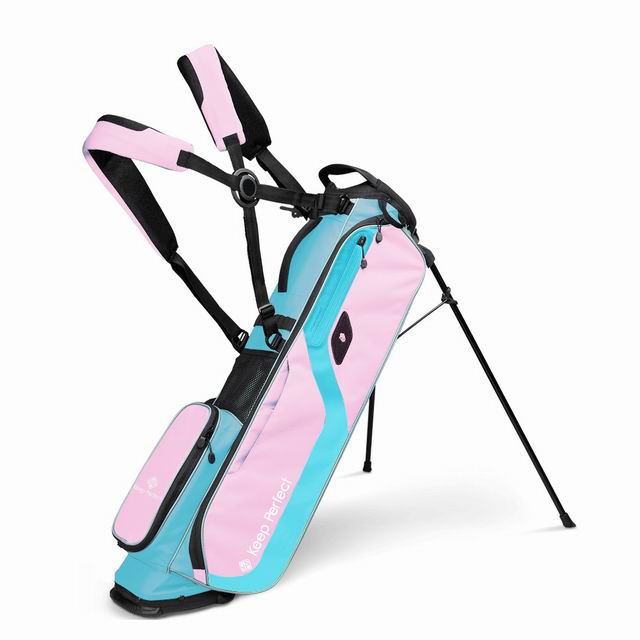
The Four Corporate Occasions
Four occasions cover corporate demand, and each calibrates the spec slightly differently:
Client golf days and hospitality
The classic: 80–300 guests, four-person scrambles, a tee gift at registration. The spec skews presentational — Sunday chassis in the event's palette, the logo paired with the event name and date, and gift packaging that photographs well when guests unbox at the hotel. Hospitality programs run annually or quarterly, which makes the file-reuse economics below real money by year three.
Tournament tee gifts
Sponsored tournaments buying for the full field — 200–1,000 bags, sponsor logos primary, event branding secondary, and value engineered per-player. This is the volume tier of corporate: single-position screen printing at 1,000+ pieces runs USD 0.15–0.30 per position, and the pencil-bag add-on covers junior flights and volunteer crews. See tournament gift programs for the full treatment.
Employee and executive gifting
Internal programs: milestone gifts, executive retreats, sales-incentive tiers. The spec skews premium rather than visible — better chassis, tone-on-tone branding, individual names for C-level recipients. Quantities run small (50–200), which makes this the crossover case where corporate meets personalization: the run stays at 200 pieces with a roster-style name pass for the executives.
Conference and partner kits
Bags as part of a welcome kit for partner summits and channel conferences — often the pencil or shoe bag format packed with other branded items. The bag is the container for the message, literally; spec emphasis is print quality on a flat panel and delivery timing to the hotel or venue loading dock, not the golf course.
The Spec That Reads as a Gift
The one-position rule is the discipline that saves corporate programs from themselves: one 20 cm logo on the front panel outperforms three positions in every metric an event team tracks — cost, legibility, and the perceived value of restraint. Add the event name and date as a small secondary mark and the bag becomes a keepsake; pile sponsor logos across every panel and it becomes a billboard that guests quietly leave in the hotel room.
| Component | Event spec | Why it works for this program |
|---|---|---|
| Chassis | Sunday bag (gift hero) or pencil bag (volume) | Gift-format value; bold panels; see Sunday bags |
| Logo | One position, 18–25 cm, high contrast | Readable from the next tee box — the whole point |
| Technique | Screen print at 500+; transfer below | Cost curve favors bold single-color at volume |
| Color | Stock colorways or one corporate dye lot | Contrast beats exact match for visibility |
| Event marking | Event name + date, secondary position | Turns the gift into a keepsake of the day |
| Packaging | Poly + insert, or gift box for VIP tiers | Presentation is part of the spend |
| Delivery | DDP to venue city, dated | Landed cost certain; the date is the product |
Managing Backwards From the Event Date
The corporate difference is what buffers protect: an event team cannot absorb a late bag the way a retail plan can shift a launch. So the structure buys certainty — a dated DDP quote with delivery to the venue city, a five-to-seven-day buffer between port and venue, and a pre-shipment photo set that your events team signs off before the container closes.
Rush events inside 60 days are quotable honestly: air freight at 4–6× cost, sampling and bulk compressed to the legal minimum (about 45 days total), and DDP by air courier to the venue. It works; it costs; the events that need it usually needed one earlier decision. The timeline article maps the compression limits per stage.
| Milestone | Date | Notes |
|---|---|---|
| Event morning | Fri Oct 9 | Bags on the first tee at registration |
| In venue city, unpacked | Mon–Tue Oct 5–6 | Buffer for customs and courier within the city |
| Arrival port / airport customs | Late Sep | Sea 24–32 days from Xiamen; air 5–8 days |
| Bulk complete + PSI | Sep 10 | AQL 2.5 passed, photo report to your events team |
| Sample approved, bulk starts | Late July | Physical sample with logo and packaging |
| Quote, spec, sampling | Early–mid July | 90 days ahead of the event |
Branding for Visibility, Not Shelf Retail
Event branding obeys different physics than retail branding. Distance: event logos are read across a fairway, at 15–30 meters, so 18–25 cm marks with heavy stroke weights win over refined small marks — this is the one context where bigger genuinely is better. Contrast: a white logo on navy or a navy logo on cream reads at distance in morning light; a tone-on-tone premium look that works on a retail shelf disappears at the third tee. Color count: one color, screen-printed, is the event standard because ink opacity beats subtlety outdoors — screen printing covers the ink systems and mesh choices.
Below 300 pieces with multicolor art — a corporate mark with a gradient, say — the technique switches to heat transfer, which prices flat regardless of color count and keeps the calendar identical. The branding decision tree for events is short: one bold color at volume → screen; multicolor or small run → transfer; executive-tier gifts where texture matters → embroidery at one refined position.
What event programs should not do: shrink the logo to make it "classy." Classy at an event is the bag, the packaging and the calibration — the logo's job is to be seen by the people holding it and the three groups behind them.
Delivery to the Venue, Not Just the Port
DDP for events means door-delivery logistics, and three practical realities make or break it. A receiver must exist: a hotel events manager, a venue loading dock, a local agency — someone with a name who signs for 40 cartons on a Tuesday. We ship DDP to an address, not to a hope; the quote asks for the venue, the contact and the delivery window. Timing windows matter: hotels can receive event freight only on weekdays, often only mornings, and a Monday delivery for a Friday event is the safe pattern — the calendar above builds that in.
Split shipments are the event programmer's tool: 500 bags to the venue DDP, and 50 to the regional office for the sales team's follow-up kits — same program, same container, two DDP legs. Storage is the quiet cost: venues charge for early arrivals held more than a few days, which is another reason the buffer is five days and not three weeks. Our program management coordinates the forwarder, the venue and your events lead as one thread, because delivery is the last mile of the event's credibility.
The Unboxing: Packaging for Gifting
Presentation is a spec line, and there are three honest tiers. Poly bag + printed insert card (USD 0.20–0.35 per bag): the standard for field gifts — clean, protective, branded with the event mark, unboxed at registration. Gift box (USD 1.20–2.50 per bag): a printed rigid or folding box for VIP and executive tiers — the difference between handing someone a bag and giving them a present. Premium suite (USD 2.50–4.00): box + tissue + a printed card, for C-level hospitality where the unboxing is part of the event design.
Two details that photograph: the insert card is where the event's story lives — date, hole sponsorship, a thank-you from the host — and it costs cents; and the hangtag is where event programs go wrong, with barcodes and retail copy that belong on merchandise, not gifts. Event packaging says one thing well; retail packaging says many things adequately. The packaging guide covers both grammars.
Budget Tiers That Work
Read the tiers as calibration tools, not price brackets: the right tier is a function of what the event is worth per guest, not of what the budget happens to be. The decision that matters most in this table is the first one — pencil versus Sunday chassis — because it sets the perceived value band; everything after it adjusts within the band. Event programs that buy one tier above the calibration are remembered; programs two tiers above are remembered for the wrong reason.
| Tier | Qty | Chassis + branding | All-in per bag (USD) |
|---|---|---|---|
| Field value | 1,000+ | Pencil bag, 1-color screen | 5.50–8.50 |
| Standard tee gift | 300–800 | Sunday bag, 1-color screen + event mark | 12.00–19.00 |
| Premium hospitality | 150–400 | Sunday bag, transfer + gift box | 22.00–32.00 |
| Executive | 50–200 | Upgraded chassis, embroidery, premium suite | 35.00–60.00 |
Corporate Gift Policies and Value Caps
The compliance topic nobody blogs about and every event planner lives with: many corporations and government agencies cap the value of gifts their people may accept — commonly USD 25–100 by policy, sometimes lower for public-sector guests. A tee gift that lands above a guest's cap creates an awkward return or a quiet declension, and the event's goodwill gesture becomes its compliance problem.
The practical guidance: know your field before you pick the tier. Public tournaments with municipal or regulatory guests run the value tier deliberately; private client events with no caps run the premium tier freely. When a program must stay under a cap, the money moves from chassis to presentation — a USD 19 all-in Sunday bag with a beautiful box and a printed card reads far above its number, which is exactly the calibration this page keeps recommending. We are a manufacturer, not your compliance officer; we price the tiers so your events team can place the program inside whatever policy governs the guest list.
Worked Example: A 500-Bag Golf Day
A real program, anonymized: a financial services firm hosting a client day for 124 guests — 500 Sunday bags covering the field, spares, staff and follow-up kits — with one bold two-color mark, the event name and date as a secondary position, a gift box for 60 VIP guests and poly-plus-insert for the field. Order placed July 8 for an October 9 event. Sample approved July 22; bulk complete September 9; PSI passed September 11; vessel September 13; customs cleared September 28; DDP delivered to the venue hotel Monday October 5 — four days of buffer. All-in per bag: USD 16.40 field, USD 24.10 boxed tier.
The full story — including the late sponsor-logo addition that was absorbed by the transfer film change, and the spares decision that saved the follow-up program — is on the golf day case study page. The program's own summary line was the one worth keeping: the bags outlived the quarter's ad spend by years.
Recurring Events: The Annual Program
Annual events are where corporate programs quietly become brand programs. Year one builds the files — the logo separation, the chassis spec, the packaging print plates, the DDP delivery playbook. Year two runs the same event with a date change and a sponsor swap: the film or screens update in days, everything else pulls from record, and the reorder runs 60–90 days instead of the first program's 90. Year three adds the tiered structure — field bags plus a boxed VIP layer — without a new spec conversation.
The economics compound: setup fees are one-time, quantity tiers deepen as the event grows, and the calendar compresses because approvals are verification rather than development. Programs running their fourth year with us spend their spec meeting on what to improve, not on what happened last time — which is the entire argument for treating even a first golf day as a program rather than a purchase. The reorder consistency article covers the file discipline that makes it true.
Starting an Event Program
Send it to the quote form. The reply lands in 24 hours with the spec priced FOB, CIF and DDP to your venue city, the calendar worked backwards from the event date with buffers shown, and the tier recommendation if you asked for one. From there: sample, approval, bulk, delivery — and the event gets its bags with the credibility intact.
- The event date and the venue city — the calendar builds backwards from these.
- Quantity: guests, plus spares (10% is the norm), plus staff and follow-up kits.
- The tier calibration: field gift, hospitality or executive — or "advise us" with the guest profile.
- Logo vector file, and the event name and date as they should appear.
- Colors: corporate references, or the event palette.
- Packaging tier and any VIP sub-tier, so the all-in number is honest from the first quote.
Frequently Asked Questions
What is the minimum order for corporate golf bags?
200 pieces per style. Event programs under 200 guests usually bridge with spares and follow-up kits to reach the minimum — or run the pencil-bag format, where 200 units is a smaller spend than it sounds.
How fast can you deliver for an event?
75–90 days is the routine lane with sea freight and buffers. Inside 60 days is quotable with air freight at 4–6× cost and a compressed 45-day window. Inside 30 days, honest answer: the program is a domestic stock-bag branding job, not manufacturing — and we will say so.
Can you deliver directly to the hotel or venue?
Yes — DDP to the venue city with a named receiver, a weekday delivery window and a Monday-pattern buffer before a Friday event. Split shipments to a regional office run as separate DDP legs on the same program.
How do we brand on a tight budget?
One color, one position, stock colorway chassis, screen-printed at 500+ pieces: USD 5.50–8.50 all-in at the pencil format, USD 12–15 at Sunday. The budget table above runs each tier; the calibration advice is spend it on one bold position and a clean box, not on three small positions.
Do you offer gift boxes and individual names for VIPs?
Both. Gift boxes run USD 1.20–2.50 per bag at tier quantities, and a name pass for executive gifts runs like a roster: USD 0.60–1.20 per bag, embroidered or transferred on the finished bag, inspected against your VIP list.
Can we add a second sponsor logo after the order starts?
Before branding runs, usually yes — and transfer programs absorb it cleanly because a new film costs days, not setups. After the panels print, it is a re-run of the affected panels. The case study below shows a late sponsor addition absorbed exactly this way.
What quality should we expect versus typical event giveaways?
These are manufactured products, not printed promo stock: 600D chassis, real zippers, AQL 2.5 inspection, packaging that photographs. The honest calibration point is that the bags will outlive the event by years — guests use good Sunday bags; they do not use cheap polypropylene totes.
Can we change the artwork between annual events?
Yes — that is the normal pattern. The chassis, colors and packaging pull from the year-one file; the event name, date and sponsor marks update as new films or screens, adding days rather than setups to the reorder.
What if we need a few bags for last-minute VIPs?
The spares line exists for this: 10% overrun is the norm and ships with the program. Truly last-minute additions after loading run as a small air-freight follow-on, quoted separately — one more reason the 10% is cheap insurance.
Can the bags carry our employees' names too?
Yes — name passes run on finished bags exactly like team rosters, priced per name and inspected against your list. Programs typically name the executive and VIP tier and run the field unnamed.
How do we handle guests with corporate gift-value caps?
Know the caps before choosing the tier — public-sector and regulated guests commonly cap at USD 25–100. When the program must stay under a cap, presentation carries the value: box, insert card and calibration do the work at a compliant number. The section above covers the mechanics.
How many colors can the event logo carry?
As many as the art wants — but event physics reward restraint: one bold color reads farthest and prints cheapest. Two-color marks are the practical ceiling for screen-printed field gifts; multicolor and gradient art run as heat transfers at the same calendar. The calibration rule: color count follows the mark's job, and the job is being seen across a fairway.
When should we order for a June event?
March. The 75–90 day lane with sea freight and venue buffer lands a June event ordered in mid-March; April orders still work with thinner buffers; May orders are the air-freight conversation. The calendar section above runs a worked example for an October event — same math, shifted.
Ready to spec your custom golf bags?
Send your logo, bag type and target quantity — we reply with a quote, MOQ and timeline within 24 hours.