
Programs · Events
Golf Gift Bags & Tournament Swag Programs
Golf gift bags are the container an event's personality ships in: a custom tote, Sunday bag or drawstring shell at USD 3.50–14.00 FOB, filled with the tournament's swag kit and handed to every player at check-in. We manufacture the shells from 200 pieces and can kit them with towels, pouches and head covers from the same floor — one program, one container, one arrival date before the event.
Gift Bag Shells That Work
| Shell type | FOB (USD) | Best for | Kitting |
|---|---|---|---|
| Drawstring pouch | 3.50–6.00 | Member-gift budgets; standard goodie shell | Stuffs flat, ideal for kitting |
| Zip tote | 5.00–9.00 | Club events, charity days | Rigid structure, premium feel |
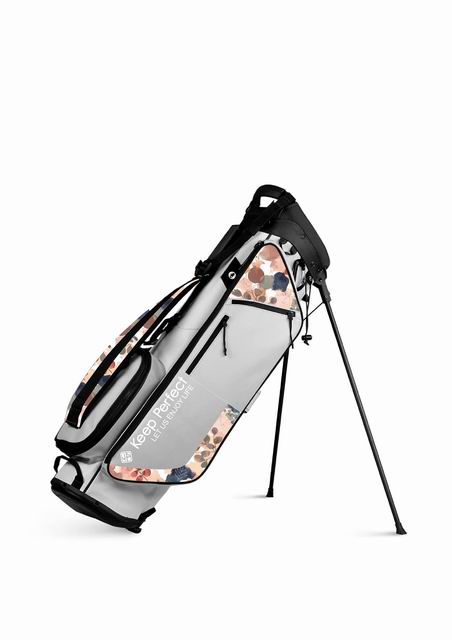
| Mini Sunday bag | 12.00–18.00 | Tournament tee gifts, corporate golf days | The gift itself, not just the shell |
| Pencil bag | 8.00–14.00 | Youth and academy events | Usable all season after the event |
What Goes In (and What It Costs)
The shell is a third of a swag budget; contents are the rest. Programs we manufacture pair the shell with items from the same floor — embroidered towels, ball-pouches, head covers — plus logoed balls and tees from specialist suppliers. A worked budget for a 300-player charity day:
A 300-player event at this spec lands near USD 5,600–6,300 FOB — under USD 21 per player for a tee gift that is used all season, not binned on the way to the car.
| Item | Spec | Cost per player (USD) |
|---|---|---|
| Drawstring shell | 600D, single-color print logo | 4.20 |
| Embroidered towel | Cotton velour, 40×70 cm | 3.80 |
| Ball pouch | Printed fabric, 3-ball | 1.90 |
| Logoed balls | 3-pack, via golf supplier | 6.50–9.00 |
| Head cover | Fabric, embroidered event mark | 2.20 |
| Total kit | 18.60–21.10 |
Event Date Management
Gift bags are the most date-critical program we run: they are worthless the day after the event. We manage that with a locked-backwards calendar (see corporate programs — the same 90-day discipline applies), AQL 2.5 inspection before loading, and a two-week delivery buffer to the event warehouse. The tournament swag guide includes the planning worksheet event directors use with us.
Gift Ideas Beyond Events
Gifting is bigger than tournaments: retirement presents, member milestones, corporate holiday gifts and client thank-yous all run the same manufacturing at smaller scale — 200 pieces supports a season of gifting for a club or agency, with personalization (individual names) as the differentiator. See personalized golf bags for the name-and-date workflow.
The Tournament Director's Calendar
Every event program we run is planned backwards from a fixed date, and the calendar has non-negotiable waypoints. Day -90: program confirmed, artwork received, deposit paid. Day -80: samples approved (this is the latest safe approval date; every day later eats the freight buffer). Day -75 to -25: bulk production. Day -25 to -10: AQL 2.5 inspection and any rework. Day -10: vessel departure or airfreight booking. Day -5 to 0: customs clearance and ground delivery to the venue or its hotel. Day 0: the event happens, with a planned buffer of four to seven days already absorbed by the schedule.
Two waypoints cause most failures. The first is sample approval drifting past day -80 — usually because three stakeholders approve in sequence rather than in parallel. The second is freight optimism: sea freight quotes port-to-port days, but door-to-door reality adds export haulage, customs and final delivery. Our corporate programs page shows the same calendar with the full buffer math.
Kitting: the Unseen Half of a Swag Program
A swag bag is not finished when it is sewn — it is finished when it is filled, and kitting is a logistics discipline in its own right. On our floor, kitting runs as a numbered operation: each item has a bin, each bag a checklist, each carton a count. A 300-player kit at five items per bag is 1,500 picks; error rate targets are under 0.5%, and every carton is weighed against its theoretical weight as a final check — a missing towel changes a carton's weight by 90 grams, and the scale catches it.
Outside-supplier items (logoed balls, tees, ball markers) ship to our floor two weeks before the kitting date, with counts verified on arrival. The alternative — shipping shells to your kitting warehouse — works when you have local kitting capacity and want to spread freight cost; we pack shells compressed and labeled by size and colorway for fast filling at destination. Both models are routine; the tournament swag guide has the decision matrix.
Tiers of Tee Gifts
Events with mixed guest lists need tiered gifting, and the manufacturing handles it as one program with sub-batches. A proven structure: a field tier (everyone gets the drawstring shell with towel and pouch), a sponsor tier (sponsors' guests get the mini Sunday bag, embroidered with the event mark), and a VIP tier (the top twenty guests get a personalized Sunday bag with their name, in a gift box). Three tiers, one artwork family, one container — the tiers differ in chassis and packaging, not in design language.
| Tier | Contents | Per-guest cost (USD) | Who receives it |
|---|---|---|---|
| Field | Shell + towel + pouch | 9–12 | All players |
| Sponsor | Mini Sunday + towel + balls | 22–30 | Sponsor guests |
| VIP | Personalized Sunday bag, boxed | 35–48 | Top 20–40 guests |
Branding That Survives the Event
The branding decision on gift product is different from retail product: the event name and date go on, which means the item memorializes a day rather than carrying a brand. Two schools of thought, and we manufacture both. The commemorative school puts the event name and date large — the item becomes a keepsake, used at future events, photographed with nostalgia. The utility school keeps event marks small and subtle — the item gets used weekly because it does not advertise a date that has passed.
Our data point from reorders: clubs running annual events increasingly choose the utility school for the field tier (small chest logo, no date) and the commemorative school for the VIP tier (large crest, full date, gift box). The logo placement guide maps which positions read commemorative versus subtle on each shell type.
Worked Example: A 500-Player Charity Classic
Anonymized but real in structure: a charity classic with 500 players, 24 sponsor foursomes, and 30 VIPs. Program confirmed February 2 for a May 18 event. Field tier: 500 drawstring shells (USD 4.10) with towel (USD 3.60) and pouch (USD 1.80) — USD 9.50 per player. Sponsor tier: 96 mini Sunday bags with embroidered event mark (USD 15.20). VIP tier: 30 personalized Sunday bags, gift-boxed (USD 41.00 including box). Total FOB: USD 7,596. Kitting on our floor: USD 0.85 per kit.
Timeline: samples approved February 20 (one revision — towel embroidery moved from corner to center); bulk February 21 to April 10; AQL passed April 13; outside-supplier balls arrived April 18; kitting April 20–24; vessel April 28; venue delivery May 11, seven days of buffer. Post-event, the club reordered 60 VIP-tier bags the following January for member milestones — the reorder took 32 days because every file was on record.
The Budget Conversations Worth Having Early
- Cost per player versus cost per impression. A USD 9.50 tee gift used for three seasons beats a USD 4 trinket binned at the car park. Frame the budget in use-cycles, not unit price.
- Kitting versus self-assembly. Volunteers stuffing bags the night before is a tradition and an error rate. Factory kitting costs USD 0.70–0.95 per kit and ships cartons labeled by flight or table.
- Sponsor logo placement fees. Sponsor logos on the gift itself are a revenue line for the event — we have manufactured shells carrying four sponsor marks that paid for the entire field tier.
- Overage planning. Order 5–8% over registration: late signups, lost cartons, and the committee members who "forgot to order one for themselves." Overages of a proven design always find a use; shortages are emergencies.
- The second life budget. Leftover stock priced into the program becomes pro-shop inventory or next year's member gift — a planned second life beats a storeroom of regret.
Seasonality of Event Manufacturing
Event calendars cluster, and so does our event-program production. Spring events (March–May) order in December–February; autumn events (September–November) order in June–August. The practical consequence: February and August are our highest-load months for date-critical programs, and programs confirmed in those windows should treat the early waypoints — artwork, sample approval — as hard gates with no slack. Book a fall event program in July and the calendar still works; book it in late August and airfreight becomes the only honest option at 4–6× the freight line.
The counter-move for event agencies running multiple tournaments: standardize a shell platform across the season. One drawstring design in four colorways, approved once in January, then event-specific embroidery per tournament. The platform approach cuts sampling to one cycle for the whole season and turns each event's order into a reorder — faster, cheaper, and with the calendar risk engineered out.
The Psychology of a Tee Gift That Gets Kept
Event swag succeeds on a single metric: is the item still in use ninety days later? The behavioral pattern across thousands of events is consistent enough to plan around. Items get kept when they are useful at the course every round (towels, pouches, Sunday bags), when they fit the recipient's identity (a club crest for members, a tasteful event mark for guests), and when their quality signals respect rather than budget. Items get binned when they are novelty-shaped, cheap-feeling, or over-branded — a foam ball with six sponsor logos is a car-park discard.
The design implication we give every event director: one quality item beats three fillers. A USD 9.50 kit built around an embroidered velour towel and a real pouch outperforms a USD 14 kit of six novelties, because the kept item generates impressions for seasons while the binned items generate nothing. The tournament swag guide includes the kept-versus-binned framework event committees use to defend budget choices to their boards.
Charity, Corporate and Member-Guest: Three Program Variants
The charity variant optimizes for sponsor visibility (logos everywhere, because sponsors paid), the corporate variant for brand impression per dollar (quality over quantity), and the member-guest for prestige (the gift is part of the event's reputation and next year's signup rate). Same factory, same techniques — three different briefs. Knowing which variant you are running changes everything from shell choice to packaging.
| Variant | Budget per player (USD) | Typical kit | Who pays | Planning horizon |
|---|---|---|---|---|
| Charity classic | 12–22 | Shell + towel + pouch + balls | Sponsors underwrite | 4–6 months |
| Corporate outing | 18–40 | Mini Sunday or Sunday bag, tiered VIP | Marketing budget | 3–4 months |
| Member-guest | 25–60 | Premium bag + personalized extras | Club / entry fees | 6–12 months (annual) |
Freight Windows for Date-Certain Delivery
The honest rule: if the calendar says airfreight, the calendar is telling you the program started late — and the freight premium is the price of that truth. Programs that book sea freight on day -10 to -20 (our standard) deliver at one-sixth the freight cost with the same certainty, because the buffer was budgeted in time instead of money.
| Mode | Transit to US/EU (days) | Cost multiple vs sea | Use when |
|---|---|---|---|
| Sea FCL/LCL | 18–35 port-to-port | 1× | 90+ days of calendar — the default |
| Sea-air hybrid | 12–16 | 2–2.5× | Calendar slipped to ~60 days |
| Full airfreight | 3–7 | 4–6× | Hard date inside 45 days |
| Express courier | 2–4 | 8–12× | Display stock and emergencies only |
Measuring the Return on a Swag Budget
Event swag is a marketing line, and marketing lines earn measurement. The framework sophisticated event marketers use with us: cost per retained item (program cost ÷ items still in use at 90 days, estimable by a simple post-event survey), impressions per retained item (rounds per season × foursome visibility), and sponsor value (what the logo placements would cost as standalone sponsorship inventory). A USD 9.50 kit retained by 70% of players for two seasons computes to cost-per-impression figures that compare favorably with any golf media buy — which is exactly the argument that gets next year's budget approved.
We support the measurement with the data we have: kit contents lists by event, retention-rate benchmarks by item type from client surveys, and — for annual events — year-over-year reorder patterns that reveal what recipients actually valued. Swag that gets measured gets funded; the worksheet is in the swag guide.
The Sponsorship Inventory on a Gift Bag
A gift bag is advertising inventory that sponsors pay for, and sophisticated events design the inventory before they design the bag. The positions, in descending order of sponsor value: front panel center (the presenting sponsor — largest logo, often the position that underwrites the entire field tier), side panels (co-sponsors, one per panel), strap or handle wrap (the every-photo position — sponsors who understand golf photography ask for it by name), and the interior (the delight position: a message or mark discovered when the bag opens, valued by sponsors selling services rather than products).
The pricing conversation this enables: events routinely sell the four positions for 3–8× the manufacturing cost of the bag itself, which is how "the gift was free to the event" happens. We lay out multi-sponsor artwork as one composite proof for all brand teams to approve, with logo-size hierarchy written into the proof notes — because the presenting sponsor's 15 cm and the co-sponsor's 9 cm is a contract term, not an aesthetic choice. The placement guide maps the visibility math behind each position.
Sustainability Options for Event Programs
Event swag faces a sustainability question retail product does not: it is manufactured for a single day, which concentrates the conscience of the whole program. The honest options, without greenwash: rPET shells (recycled polyester from bottle flake, GRS-certified supply chain, USD 0.40–0.90 premium per shell — the single most-chosen option), cotton canvas totes (natural fiber, higher footprint per unit but perceived as sustainable by recipients, which is its own value), and durability-first design (the greenest swag is the swag still in use in year three — which loops back to the kept-versus-binned framework).
What we will not claim: that any manufactured good is impact-free, or that a recycled shell offsets airfreight. Events that want the full accounting get it — material provenance certificates, freight mode emissions estimates — because a sustainability claim that cannot survive a sponsor's ESG questionnaire is a liability, not a feature. The sustainability page documents our materials and certification position across all programs.
Frequently Asked Questions
Can we see a physical sample of the exact kit before the event?
Yes — and for events, we recommend it: a fully kitted sample (shell, contents, packaging, insert card) couriered as one box, approved by the committee in one meeting. The kit sample costs the standard sample fee plus contents, refunded against the bulk order. Committees that approve a kitted sample have zero day-before-event surprises; committees that approve photographs occasionally do.
Do you handle insert cards and printed materials for the kit?
Yes — insert cards, welcome letters, course guides and sponsor acknowledgement cards print through our packaging partners and kit on our floor. Artwork arrives as print-ready PDF; we proof, print and insert. It removes the last outside vendor from most event programs.
What is the MOQ for golf gift bags?
200 pieces per shell style. Contents like towels and pouches share the program; logoed balls and tees come from specialist suppliers we coordinate with.
Can you fill and kit the bags before shipping?
Yes — kitting happens on our floor: shell, towel, pouch and cover packed per player, cartoned per event. Items from outside suppliers ship to us or to your kitting warehouse; both models work.
How early before the event should we order?
90 days. Gift bags that miss the date have zero salvage value, so the buffer is the program. The corporate timeline applies in full.
Can each bag be personalized with a player name?
Yes — names or numbers embroidered per bag at USD 0.60–1.20 each. Roster-driven personalization is standard for member events; see personalized bags.
What is the most popular golf tournament gift you manufacture?
The embroidered cotton velour towel — it is in over 80% of the event kits we produce, at USD 3.40–4.20 per piece with a 12–15 cm event logo. It earns its place because players actually use it, it displays the event mark every round, and it kits flat. Second place: the three-ball pouch with tees inside.
Can sponsor logos go on the same bag as the event logo?
Yes — the standard layout is event mark on the front panel and sponsor marks on side panels or the ball pocket, sized by sponsorship tier. We lay out multi-logo artwork for approval as one composite proof, so every sponsor's brand team signs off on their placement before production.
What happens if our registration grows after we order?
Call us immediately — before bulk cutting, adding 10–20% volume is usually a fabric-availability question with a one-to-two-day answer; after cutting, it becomes a second run with its own minimums. This is why we recommend ordering 5–8% over registration as standard: the overage costs little, the shortage costs the event.
Do you keep event designs on file for annual tournaments?
Yes — embroidery files, print plates, color cards and specs stay archived. An annual event reordering its proven kit skips sampling entirely and runs a 35–50 day reorder calendar. Many of our longest-running programs are annual events now in their fourth or fifth reorder.
Can the gift bags be shipped directly to the golf course or hotel?
Yes — DDP delivery to the venue or its receiving hotel is standard practice on event programs, including delivery-window coordination with the venue's receiving dock. Cartons arrive labeled by flight, table or tier as your event plan requires.
Ready to spec your custom golf bags?
Send your logo, bag type and target quantity — we reply with a quote, MOQ and timeline within 24 hours.