
Bag Types
Custom Golf Bag Types
Ten chassis cover every custom golf bag program: staff (tour-grade), stand (the volume chassis), cart (pro-shop standard), tour (premium travel-integrated), Sunday (minimalist and gifting), travel covers, junior, pencil, shoe bags and accessory pouches. FOB ranges run USD 8–60 across the line; every chassis carries the full customization program from 200 pieces.
The Ten Chassis
Weights are typical build ranges; every chassis is customizable within the six levers.
| Type | FOB range (USD) | Typical weight | Best for |
|---|---|---|---|
| Staff bags | 38–60 | 4.5–6 kg | Tour-grade retail, flagship programs |
| Stand bags | 19–34 | 1.8–2.7 kg | Teams, academies, retail lines |
| Cart bags | 24–42 | 2.8–3.8 kg | Pro shops, resort programs |
| Tour bags | 42–62 | 5–7 kg | Premium tour-look retail |
| Sunday bags | 12–22 | 1.0–1.8 kg | DTC brands, gifts, minimalism |
| Travel covers | 18–30 | 2.5–4 kg | Team travel, airline programs |
| Junior bags | 10–18 | 0.8–1.4 kg | Academies, youth programs |
| Pencil bags | 8–14 | 0.4–0.8 kg | Gifts, youth, add-ons |
| Shoe bags | 4–9 | 0.2–0.4 kg | Kit programs, retail add-ons |
| Accessories & pouches | 2–8 | 0.1–0.3 kg | Swag kits, upsells |
Choosing by Program
The chassis follows the program: team programs run on stand and junior chassis; corporate programs on Sunday and pencil; retail brands on staff, stand and tour; startups on Sunday and pencil for cost control. Mixed programs in one container are standard.
What Every Chassis Shares
- MOQ 200 pieces per style and colorway
- Full branding suite — embroidery, print, transfer
- Pantone color matching on fabric and trims
- AQL 2.5 inspection with photo documentation
- Reorder files kept — season two matches season one
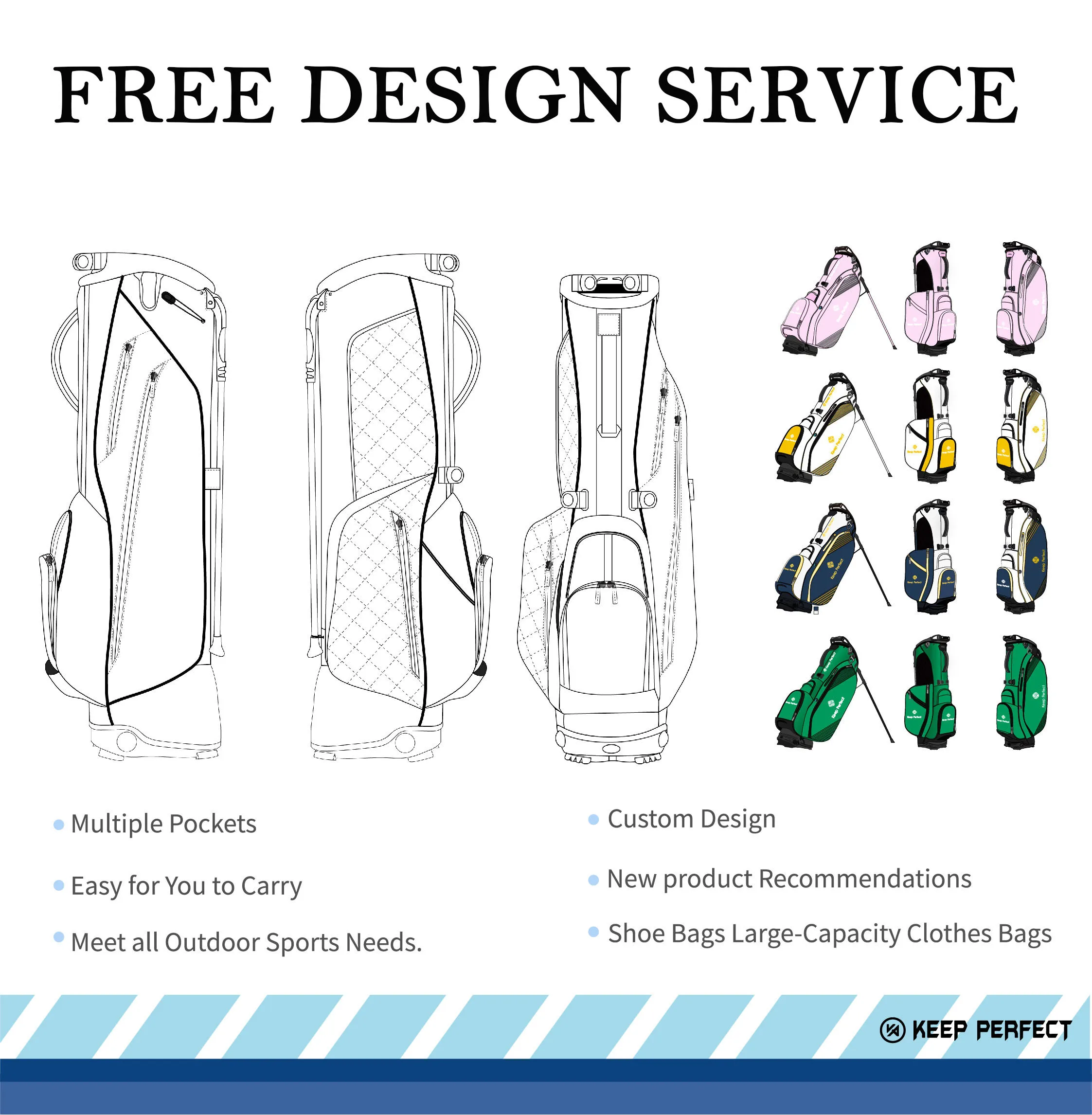
A Purchasing Framework for the Full Chassis Line
Every chassis decision reduces to three numbers: the FOB band your margin can absorb, the retail multiple your channel supports, and a decoration budget of roughly 8–15 percent of FOB per unit. Walking golfers, riding golfers and gift recipients impose three different sets of demands, which is why a single chassis cannot carry every program. The table restates the chassis catalogue as a buying framework, pairing each indicative FOB Xiamen range with the retail band a 4.5–5.5× multiple typically supports in pro-shop and DTC golf channels, plus the sweet-spot size of a first order.
| Chassis | Indicative FOB Xiamen (USD) | Retail band at 4.5–5.5× (USD) | Sweet-spot first order (pcs) |
|---|---|---|---|
| Staff | 38–60 | 175–299 | 200–400 |
| Stand | 19–34 | 89–159 | 300–500 |
| Cart | 24–42 | 115–199 | 200–400 |
| Tour | 42–62 | 195–325 | 200–300 |
| Sunday | 12–22 | 59–109 | 300–600 |
| Travel cover | 18–30 | 89–149 | 200–400 |
| Junior | 10–18 | 45–85 | 300–500 |
| Pencil | 8–14 | 35–69 | 500–800 |
| Shoe bag | 4–9 | 19–39 | 500–1,000 |
| Accessories & pouches | 2–8 | 12–39 | 500–1,000 |
Two cautions apply. Retail multiples compress for corporate gifting, where the end user never sees a price tag, and stretch for limited drops where scarcity pricing is normal. A chassis chosen purely at the low end of FOB usually ends up under-decorated, because panel size drives stitch count — plan embroidery placement against the silhouette before locking the platform.
Staff and Tour: The Flagship End of the Line
Staff bags (USD 38–60 FOB Xiamen, 4.5–6 kg) are the flagship retail chassis, while tour bags (USD 42–62, 5–7 kg) go one step further into the premium, travel-integrated silhouette that brands sell on a tour-look story. The staff platform rewards a heavy decoration budget: full-chest panels accept embroidery counts of 20,000–40,000 stitches, and premium builds lean on PU and coated-fabric finishes — including third-party verified material options such as OEKO-TEX STANDARD 100 textiles — that lift both price and perceived value. The tour chassis earns its premium through structure: reinforced bases, wraparound zippers and load-rated hardware. Structural modification requests belong early in the conversation, because new patterns and tooling become viable from roughly 500–1,000 pieces, while orders below that range are best served with cosmetic customization on proven platforms. Flagship programs also carry the longest sampling conversations; allow the full 6–10 working days for a staff or tour proto plus at least one revision round, because stitching faults on large logo fields are the most common reason a flagship sample is rejected.
Stand, Cart and Sunday: The Volume Chassis Explained
Stand bags (USD 19–34, 1.8–2.7 kg) carry the team and retail volume; cart bags (USD 24–42, 2.8–3.8 kg) are the pro-shop and resort standard; Sunday bags (USD 12–22, 1.0–1.8 kg) own the minimalist and gifting tier. The stand chassis is the most failure-prone of the three because its value sits in a moving part: leg deployment depends on hinge geometry and spring tension, and a bag that passes a cosmetic check but fails a function check is unsellable. That is why the QC process treats leg deployment, strap release and zipper travel as functional items inside the AQL 2.5 inspection plan, sampled under ISO 2859-1 methodology (ISO). The cart chassis trades legs for stability — 14-way dividers, putter wells and strap pass-throughs dominate its spec sheets, and its buyer cares more about trolley fit than carry weight. The Sunday chassis is deliberately simple, with single straps, canvas-look fabrics and two or three pockets, and it is where DTC brands and Q4 corporate gifting concentrate; gifting orders are therefore placed in August and September, an inverse of the retail calendar.
Travel Covers, Junior and the Small Formats
The small formats — travel covers (USD 18–30, 2.5–4 kg), junior bags (USD 10–18, 0.8–1.4 kg), pencil bags (USD 8–14), shoe bags (USD 4–9) and accessory pouches (USD 2–8) — exist to complete kit programs and add margin per carton rather than to lead a line. Travel covers ride with airline baggage systems, so the spec conversation is abrasion resistance, wheel quality and lockable zippers rather than pocket count. Junior programs prioritize weight discipline — a 1.2 kg bag for a nine-year-old beats a feature list — and academies typically order 300–500 pieces across two or three colorways. The economics of the small formats come from carton density: a pencil bag packs 60–80 pieces per export carton against four to six staff bags, so its freight share falls to roughly USD 0.30–0.60 per piece versus USD 4–7 for a flagship (indicative figures at current LCL rates). That density is also why pencil bags, shoe bags and pouches are the only chassis where air freight is routinely defensible when a deadline slips — the volumetric penalty is small enough that a 3–5 day air move does not destroy landed cost. Shoe bags and pouches round out swag kits and retail add-ons, where they function as basket-builders priced for impulse purchase at USD 19–39 retail.
The Buyer-Type Selection Matrix
Four buyer types anchor four different chassis strategies: retail brands build around staff, stand and tour; corporate and promotional buyers around Sunday and pencil; teams and academies around stand and junior; startup brands around Sunday and pencil for cost control. One buyer's flagship is another's over-spec, which is why the first question in any program conversation is who pays, who carries and who keeps the bag. The matrix shows how budget, quantity and decision criteria shift across the same production base.
| Buyer type | Anchor chassis | Typical first program | Decision driver |
|---|---|---|---|
| Retail brand (private label) | Staff, stand, tour | 200–800 pcs across 2–3 styles | Retail multiple, reorder consistency |
| Corporate & promotional | Sunday, pencil, pouches | 300–1,000 pcs, single event | Per-unit budget (USD 12–25 landed), delivery date |
| Teams & academies | Stand, junior | 200–500 pcs, seasonal | Carry weight, durability, name personalization |
| Startup brand | Sunday, pencil | 200–300 pcs, one hero SKU | Cash exposure, speed to first sale |
For teams and academies the decision driver is the player's back: a spec sheet that creeps from 2.4 to 3.1 kg during sampling is a program risk, because junior high and high school rosters walk 18 holes. Corporate buyers optimize the opposite variable — a Sunday bag at USD 16 FOB lands near USD 20 and still presents as a premium gift in retail-ready tissue. Retail brands preparing a pro-shop sell-in should specify GS1-compliant barcode and ticket artwork early (GS1), because relabeling at a destination warehouse costs more than printing the right ticket the first time. Startups should resist flagship temptation until reorders prove demand; the second production window (35–50 days bulk after a 6–10 day sampling cycle) arrives faster than most new brands expect.
Mixed-Order Strategy: One Container, Several Chassis
A mixed order is a single purchase order covering several chassis — for example 200 staff, 300 stand and 500 pencil bags — with the 200-piece MOQ applied per style and colorway, consolidated under one FOB Xiamen booking, one bill of lading and one clearance. The operational benefit is synchronization: sampling runs in parallel at 6–10 working days per style, bulk production aligns to a single 35–50 day window, and one vessel departure replaces three. Programs here are run by a sourcing and program-management company working with a dedicated production facility in Quanzhou, with partner capacity drawn on when mixed lines need parallel production to converge on one ship date. Packing rules matter as much as the order itself: heavy staff-bag cartons load at the container floor, pencil and shoe-bag cartons stack on top, and cartons are color-coded by style so a distributor's receiving team can sort a 40-foot container in under an hour. Below roughly 28 CBM the booking moves as LCL and pays a per-cubic-meter penalty, so most mixed programs aim for a full 20- or 40-foot container where the freight share per piece drops sharply — the blended load is precisely what makes the small formats viable.
Worked Example: A 1,200-Piece Mixed Line Budget
A worked budget makes the strategy concrete. Take a retail brand launching one flagship, one volume SKU and one gift SKU: 200 staff bags at USD 48 FOB equal USD 9,600; 300 stand bags at USD 26 equal USD 7,800; 200 Sunday bags at USD 16 equal USD 3,200; 500 pencil bags at USD 9 equal USD 4,500 — a goods total of USD 25,100. Embroidery digitizing across six design positions at roughly USD 45 each adds about USD 270, and LCL sea freight plus handling of about USD 2,400 spreads to USD 2.00 per piece, putting indicative landed goods cost near USD 23 per piece before duty and inland legs. At a 4.5× retail multiple the stand bag prices at USD 117, the Sunday at USD 72 and the pencil at just over USD 40, so the line supports roughly USD 113,000 in first-order retail revenue. Payment follows the standard T/T 30/70 structure — 30 percent deposit to open production, 70 percent against the B/L copy before vessel departure — and the AQL 2.5 inspection report is issued per style lot before booking, so all four chassis clear QC in the same 48-hour window rather than serially. The pencil bags are what subsidize the freight: they contribute 42 percent of the units on 18 percent of the goods value.
What Goes Wrong: Chassis Selection Failures
Most chassis failures trace back to a spec written for one buyer and handed to another. Five failure modes recur across programs, each with the correction that should have been made at the spec stage.
- Flagship overreach: a corporate program orders staff bags because the logo looks impressive, then discovers a USD 48 FOB gift blows the per-unit budget and a 4.5–6 kg bag is impractical to hand out at a golf day. A Sunday or pencil chassis fits the actual use at roughly a third of the cost.
- Weight creep: a stand bag specs at 2.4 kg, gains a rangefinder pocket, an insulated cooler sleeve and a double strap during sampling, and ships at 3.1 kg — past the walking-comfort line for junior and college rosters. Freeze the weight target and make every feature justify its grams.
- Colorway fragmentation: splitting a 200-piece order into two colorways at 100 pieces each falls below the MOQ per colorway. Commit 200 per colorway, or hold one body color and vary trims.
- Missed season windows: bulk at 35–50 days plus 24–32 days of ocean transit means a program that must be on shelves in March needs production booked by early November. Late orders arrive into a sale rack, or pay air freight on chassis too bulky to fly economically.
- Inspection misconception: AQL 2.5 defines the acceptance limit for a sampled lot under ISO 2859-1 plans — it identifies a failing lot before it ships, but it does not repair one. Programs that skip pre-shipment inspection to save USD 300–500 learn this at the destination warehouse; buyers wanting a second set of eyes engage independent firms such as Intertek on their own account.
Before signing off any chassis line, run a five-question check: Who carries the bag? What is the target retail? Which season window must it hit? Is every colorway at or above 200 pieces? Does the decoration plan fit the panel geometry? A spec that answers all five rarely fails in production.
Frequently Asked Questions
Can I order multiple bag types in one program?
Yes — mixed programs (e.g., 300 stand + 200 Sunday) ship in one container; MOQ applies per style.
Which chassis is the best seller?
By program count: stand bags (teams and retail), then Sunday bags (DTC and gifting), then staff (flagship retail). Your market position should drive the choice, not the popularity list.
Can chassis be modified structurally?
From 500–1,000 pieces — new patterns and tooling. Below that, cosmetic customization on proven platforms. See OEM/ODM.
How does the 200-piece MOQ apply to mixed orders?
The MOQ applies per style and colorway, not per container. 200 staff, 300 stand and 500 pencil bags can travel in one booking, provided each style and colorway individually reaches 200 pieces.
Which chassis has the lowest landed cost per unit?
Pencil bags, shoe bags and pouches. Carton density of 60–80 pieces per carton cuts the freight share to roughly USD 0.30–0.60 per piece against USD 4–7 for a staff bag, so the gap between FOB and landed cost stays narrow.
Which chassis suits a first-time private label brand?
Stand or Sunday. Both ride proven platforms with cosmetic customization, retail multiples near 4.5×, and first orders of 200–500 pieces that keep cash exposure low while proving sell-through before any flagship commitment.
Can staff or tour bags be air freighted?
Rarely. At 4.5–7 kg in bulky cartons, volumetric air cost per piece typically runs to several times the FOB price. Air freight suits pencil, shoe and pouch chassis, where a 3–5 day move adds only a few dollars per unit.
How much should decoration add to a chassis budget?
Plan 8–15 percent of FOB. Embroidery digitizing runs about USD 30–60 per design position, and large panels such as staff-bag fronts push stitch counts to 20,000–40,000, which raises per-piece run cost more than logo count does.
Are junior and pencil bags held to the same MOQ?
Yes — 200 pieces per style and colorway across the line, matching the rest of the program. Junior and pencil runs are often placed as add-on lots inside a mixed container so they share freight with a larger chassis.
What does AQL 2.5 inspection cover on a mixed order?
Each style lot is sampled separately under ISO 2859-1 plans against the AQL 2.5 acceptance limit — cosmetic checks on the sewn body plus functional checks such as stand-bag leg deployment, zipper travel and strap release, with photo documentation per lot.
How long does a mixed chassis order take end to end?
Sampling runs 6–10 working days per style in parallel, bulk runs 35–50 days once the bulk spec is approved, and ocean transit adds the lane-specific days — so a typical mixed program lands 90–110 days after design freeze.
Can corporate and retail programs share one chassis?
Yes, and the Sunday chassis is the usual overlap. It presents as a premium corporate gift at USD 12–22 FOB while supporting a USD 59–109 retail band for a DTC or pro-shop line, with the same sewn construction serving both.
Can a program start with one chassis and expand later?
Yes — reorder files are kept so season two matches season one on patterns, colors and trims. Brands commonly launch on a stand or Sunday platform, then add flagship staff or tour pieces once sell-through justifies the 500–1,000 piece tooling conversation.
Ready to spec your custom golf bags?
Send your logo, bag type and target quantity — we reply with a quote, MOQ and timeline within 24 hours.