
Programs · Teams & Academies
Custom Golf Bags for Teams and Academies
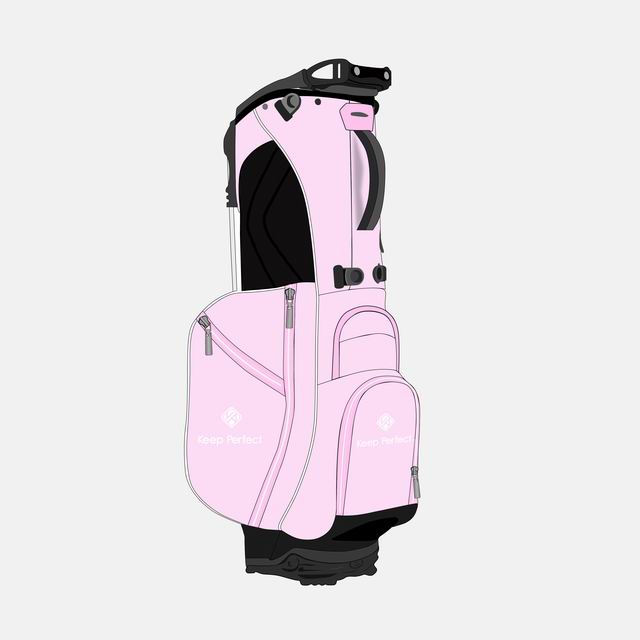
Team and academy golf bag programs run on one hard date: the first practice. The spec that works is a 600D stand chassis in school colors, a crest embroidered on the front pocket, and player names and numbers on the side panel — roster personalization runs at USD 0.60–1.20 per bag inside the order. Minimum 200 pieces; sampling 6–10 days; bulk 35–50 days; AQL 2.5 inspection. Order 90+ days before the season starts and the program is routine; order inside 60 days and the calendar, not the factory, becomes the risk. This page covers the full spec, the booster budget split, the worked calendar and the reorder discipline that keeps season two matching season one.
The Team Program in One Paragraph
A team program is 200–500 custom stand bags in school colors, crest on the front pocket, roster names and numbers on the side panel, ordered once per season against the first-practice date, funded by athletic budgets and booster clubs together, and reordered from files so season two matches season one.
What makes team programs different is not the bag — it is the date and the roster. The bag must be in players' hands on day one of practice, every name must be spelled correctly, and the crest must read as the institution from across a fairway. Everything on this page optimizes for those three requirements.
And one more requirement sits underneath all three: the chassis must survive a season of daily team use — range sessions, travel racks, rain, being thrown in and out of vans. Team bags are the hardest-working custom golf bags made, which is why the spec conversation starts with durability and ends with identity, not the other way around.
Who Orders Team Bags
Four buyers run these programs, each with a slightly different funding structure and spec emphasis:
School teams and booster clubs
High school and secondary school programs, usually funded jointly by the athletic department and a booster club. The spec skews durable and simple: one colorway, crest, roster. Booster-funded programs often add a sponsor position — a local business logo on the side pocket that paid for half the order — which is a legitimate and common structure, and the sponsor position belongs in the original spec, not added after cutting.
College and university programs
Athletics departments buying for competitive teams, with stricter institutional identity rules — official Pantone references, licensed crest files from the university brand office, and sometimes dual-marking rules (institution crest plus conference mark). Quantities run larger (250–500 per season across squads), and reorder cadence aligns with roster turnover: names change every year, crests do not. See the 320-bag college season case study for the worked numbers.
Academies and teaching studios
Coaches and academies buying bags for junior programs and camps — the hardest use case in the line. Youth-scaled chassis, heavier wear, parents as the audience. The spec that works: 600D at minimum, bar-tacked stress points, and player numbers sized for roster visibility. Academy programs reorder annually as cohorts grow, which makes the file discipline below worth real money over a five-year relationship.
Club member programs
Golf clubs and country clubs equipping member teams for interclub leagues — the crossover case between team and corporate programs. The bag carries the club identity rather than a school crest, quantities run 100–300, and the spec leans premium (the bag is a member perk, not equipment). These programs often add shoe bags and pencil bags as matched kit pieces.
The Spec That Works for Daily Team Use
Two deliberate omissions in the typical team spec: structural custom (pocket layouts stay catalog — structural changes start at 500–1,000 pieces and teams do not need them) and retail packaging (a poly bag and an insert card; the bag is equipment, not shelf product). Teams that want the retail tier are running a merchandise line, which is a private label program layered on top.
| Component | Team spec | Why it matters for this program |
|---|---|---|
| Chassis | 600D polyester stand bag | Survives daily range use; 420D ripstop is for retail, not teams |
| Fabric structure | EVA foam body, HDPE stiffeners | Keeps shape after a season of being thrown in vans |
| Crest | Embroidered, front pocket, 8–12 cm | Institution identity readable at distance; see embroidery |
| Roster | Names + numbers, side panel | Per-bag personalization inspected against the roster file |
| Color | One colorway, school Pantone TCX | Dye-lot fee once; identity consistent across seasons |
| Strap and base | Reinforced bar-tacks, abrasion base | The two failure points on team bags; both spec-able |
| Zippers | Auto-lock, name-brand optional | The most-felt hardware upgrade at +USD 0.40–0.90 |
Roster Personalization: Names and Numbers
Roster work is the part of team programs that factories get wrong and that this program treats as its own production discipline. Mechanics: you send a spreadsheet — one row per player, name and number, formatted exactly as it should appear. We run personalization as a mini-program at the end of the bulk line, after bags are assembled: each side panel is hooped individually, the name and number stitch from the approved thread color, and the lot is inspected row by row against your file — not against a sew-out, against the roster itself.
The cost runs USD 0.60–1.20 per bag by name length and stitch count, quoted in the original spec so the booster budget sees it day one. Spelling risk is managed by the format: we embroider exactly what the spreadsheet says, so the file is proofread before it is sent — the one hour a coach or team parent spends checking spellings is the cheapest quality control in the entire program. Names longer than the panel width size down automatically; numbers stay constant height for visual alignment down the roster.
Rosters change late — players join, quit, transfer in August. The structure that absorbs this: bulk bags run without personalization in the standard 35–50 day window, and the roster pass runs against finished bags in the final week, so a roster updated a week before ship date still lands correctly on every bag. Send the final roster as late as 10 days before loading; earlier versions run as verification passes.
The Season Calendar, Worked Backwards
Read the table as the 90-day rule: September seasons order in June, March seasons order in December. Fall and spring teams both get the same math — the mistake we see is spring teams ordering after the holidays, inside 75 days, when freight buffers are already half-consumed.
Air freight exists as a rescue at 4–6× cost and is worth knowing about honestly: it saves a program once, at a price that funds most of the next order. Programs that plan to the table above never buy it; programs that compress the front of the calendar always wonder why it costs so much. The full timeline article runs the same calendar for every program type.
| Milestone | Date guidance | What happens |
|---|---|---|
| First practice | September 1 | Bags in players' hands — the hard date |
| Delivery to school | Mid-August | Bags landed, unpacked, roster distributed |
| Vessel sails from Xiamen | Early August | Sea freight 24–32 days to US West Coast |
| Bulk complete + PSI | Late July | 35–50 day production window closed, AQL 2.5 passed |
| Sample approved, deposit, cutting | Mid-June | Physical sample signed off, bulk starts |
| Quote, spec, sampling start | Late May / early June | The order you place today for September |
Budget and the Booster Split
The split that funds it varies by institution: athletic-department-funded programs carry the whole number; booster-funded programs often divide it — chassis from the department, crest and roster from boosters, sponsor position from a local business at USD 1,500–2,500 for a side-pocket logo that covers the branding block entirely. Per-player framing helps parent-facing programs: at 300 bags and a 20-player squad buying for three seasons, the annual per-player cost of equipment-grade custom bags reads as reasonable next to the rest of a season's budget — and the framing is honest because the bags genuinely last multiple seasons when specified as above.
Freight and duties are the missing lines, deliberately: they are destination-specific, quoted at order time, and budgeted at 12–18% of FOB for US programs by sea. The pricing article covers the full landed-cost anatomy.
| Line | Unit (USD) | × 300 bags | Notes |
|---|---|---|---|
| 600D stand chassis, school color | 21.00 | 6,300 | Catalog chassis, one colorway dye lot |
| Crest embroidery, 8 cm, ~7,000 stitches | 1.20 | 360 | Digitizing USD 45 one-time, in year one |
| Roster names and numbers | 0.90 | 270 | Mini-program at end of line |
| Woven main label + care label | 0.18 | 54 | Label MOQ 1,000 covers reorder |
| Poly bag + insert card | 0.22 | 66 | Equipment packaging, not retail |
| Sample fee (credited on bulk) | — | 150 | Refunded at bulk invoicing |
| Program FOB total | — | 7,200 | ≈ USD 24 per bag all-in FOB |
Durability Choices That Survive a Season
Team bags fail in four places, and all four are spec decisions made before cutting. Strap anchors: where the dual strap meets the body, the spec is bar-tacked stitching through reinforcement webbing — the single highest-stress seam on a stand bag carried daily. Base: abrasion from cart racks and van floors, answered by a molded or heavily-coated base panel rather than bare fabric. Zippers: daily cycling on the apparel pocket, answered by auto-lock sliders on a mid-tier or name-brand chain. Dividers: full-length at 4–6 way for team use, because club chatter in transit is the difference between equipment and equipment damage.
The honest durability statement: a correctly specified 600D team bag survives 3–5 seasons of institutional use with cleaning and minor repair — strap re-stitching after year three is normal and cheap. A 420D bag specified to save USD 3 per unit fails inside one season of team use; that is not a fabric-quality judgment (420D ripstop is excellent at its job — see our sister site golfstandbagfactory.com for the lightweight engineering angle) but a use-case mismatch. Team programs are the one category where we will push back on a spec that saves a dollar per bag and costs the roster's season.
What Teams Add to the Core Spec
The additions team programs actually use, priced honestly so the booster conversation includes them from the start. Coach bags: one or two staff chassis in the same identity, carrying the program look while serving different duty — common at 4–8 units, priced at staff-chassis rates with the same crest file. Matching kit pieces: shoe bags and pencil bags in the same fabric and dye lot, which amortize the colorway across more units and complete the look for travel days. Travel covers: for teams that fly to invitationals, padded covers with the crest, ordered as a 20–40 unit add-on to the same program and container.
What teams ask for that we talk them out of: individual player color choices (roster management becomes a per-bag spec — the compromise is one chassis color with player-colored zipper pulls), and oversized back-panel roster lists (a full roster embroidered across a back panel reads as a phone book from ten feet; names belong on the side panel where they identify the bag's owner at a glance).
Worked Example: A 320-Bag College Season
The numbers from a real program, anonymized: a university athletics department, 320 stand bags across men's and women's squads and a development squad, ordered June 3 for a September 8 first practice. Spec: 600D chassis in the university's navy TCX reference, institutional crest front pocket (digitized from the brand office's vector file), roster pass on 287 bags (coaching staff bags carried titles instead of numbers), insert cards with the season schedule. Calendar: sample approved June 19 after one thread-color revision; bulk complete August 12; PSI passed August 14 at AQL 2.5; vessel sailed August 16; delivered to the athletics complex August 30 — nine days of buffer intact. Roster update on August 22 (two transfers added, one departure removed) absorbed by the end-of-line personalization pass without touching the schedule.
The full story with the failure that almost happened — a crest file that arrived as a 72-DPI JPEG and the three days it cost — is on the college team season case study page. The program reordered the following June at 60-day lead with zero re-approval, because every file from year one was on record.
The Reorder: Roster Changes, Crest Stays
Team reorders are the proof of a well-run first program. What stays on file: the digitized crest (embroidery re-runs with zero setup), the dye formula (the mill pulls the archived reference, and the navy in year three matches the navy in year one within ΔE 2.0), the pattern set, the hardware spec and the label inventory (the 1,000-piece label MOQ covers multiple seasons). What changes: the roster — new names, new numbers, graduated players removed — which is exactly the part the structure isolates as a late, fast, spreadsheet-driven pass.
The reorder calendar runs 60–90 days instead of 90+ because sampling is verification rather than development: a pre-production sew-out confirms the crest file still runs clean, and bulk starts. Programs that kept their year-one paperwork complete reorder in one email; programs that changed suppliers mid-stream re-litigate the crest, the color and the spec, and lose three weeks discovering that the new factory's "same navy" is a different dye chemistry's opinion of navy. The reorder consistency article documents the file discipline behind this.
Coordinating the Whole Team Identity
The bag is the anchor, but team programs read best when the identity covers the kit: shoe bags and pencil bags in the same fabric and dye lot, travel covers for flying squads, and a coach chassis carrying the same crest. The economics improve with each addition — the dye lot and digitizing amortize across every unit type — and the container consolidates: one program, one document set, one delivery to the athletics complex.
Identity consistency is also a compliance topic at institutions: brand offices license exact color references and crest artwork, and programs that pull the crest "from the website" discover the athletics logo they embroidered was a deprecated mark. Our spec process asks for the brand office's asset pack up front — vector crest, official TCX references, dual-marking rules if any — which costs one email to the athletics department and prevents the one error that requires re-production.
Starting a Team Program
Send them to the quote form. The reply prices the chassis, crest, roster pass and kit additions as one program, with the calendar worked backwards from your season date and the freight options quoted FOB, CIF and DDP so the athletics office sees landed cost, not factory cost. Sampling starts on approval; the season gets its bags.
- The season date — first practice, match or camp start — worked into the calendar above.
- Quantity by squad, with youth/adult sizes noted (sizes count toward one style).
- Crest vector file from the brand or athletics office (AI, EPS or PDF).
- School colors as official Pantone TCX references.
- The roster format: names and numbers as they should appear, proofread.
Frequently Asked Questions
What is the minimum order for team golf bags?
200 pieces per style, with youth and adult sizes counting toward one style. Teams below 200 usually split the difference: 200 bags across the current roster plus the incoming class, or a combined order with the boosters' merchandise line.
How much does a team program cost per bag?
USD 20–26 FOB for a 600D stand chassis with crest, roster and school color at 300 pieces — USD 7,000–8,000 program total. Freight and duties add 12–18% by destination. The budget table above runs a full worked example.
How early should we order for a fall season?
June — 90+ days before September practice. Spring seasons order in December. Inside 75 days the program is still possible but the freight buffer is half-consumed and air freight risk rises; inside 45 days, honest answer: it is a next-season or air-freight conversation.
Can players or parents pay individually?
We invoice the program (department, booster club or academy), not individuals — one entity, one deposit, one balance. Programs that collect per-player funds handle collection on their side; several booster clubs run exactly this structure against a single bulk order.
What if a name is spelled wrong or a player joins late?
Late roster changes are absorbed by the end-of-line personalization pass: final roster as late as 10 days before loading. Spelling errors in the file embroider exactly as sent — proofread the spreadsheet before it ships to us; we embroider what it says and inspect against it.
Can we see a sample before the full order?
Yes — sampling is 6–10 days with crest and color, and the sample fee (USD 150–250 for a team spec) credits back on bulk. Approve the physical sample, not photos of other programs' bags; the sew-out and the dye lot are the two approvals that protect the season.
Can you match our school colors exactly?
Within ΔE 1.5–2.0 against official Pantone TCX references, approved by physical lab dip before bulk. Institutions without official references can mail a physical sample — a flag or an existing uniform piece — and we match to the swatch. See color matching.
What logo file do you need for the crest?
Vector (AI, EPS or PDF) from the brand or athletics office. A JPEG pulled from the website costs days of redraw and loses the fine marks that make a crest read as official. Digitizing from vector is USD 25–80 one-time and stays on file for reorders.
How durable are the bags for daily team use?
A correctly specified 600D team chassis survives 3–5 seasons of institutional use with cleaning and minor repair. The durability section above covers the four failure points — strap anchors, base, zippers, dividers — and the spec answers for each.
Can we mix bag sizes for youth and adult squads?
Yes — youth-scaled and adult chassis count toward one style at the 200-piece minimum. Mixed-size programs keep one crest and one colorway, and the roster pass sizes names to each panel.
Can we add coach bags and kit pieces to the order?
Yes, and they belong in the original spec: 4–8 coach chassis, shoe and pencil bags, travel covers — same dye lot, same crest file, same container. Additions after cutting are re-orders; additions at spec are line items.
When should we place the reorder?
At the moment year-one inventory proves out — typically ordering the next season's quantity 90 days before its start, on a 60–90 day lane because the files are on record. Reorders without re-approval are the reward for complete year-one paperwork.
Ready to spec your custom golf bags?
Send your logo, bag type and target quantity — we reply with a quote, MOQ and timeline within 24 hours.