
The Numbers Up Front
MOQ: 200 pieces per style (private label) · 300 (cosmetic OEM) · 500 (full OEM). Price at 500 pcs, branding suite included, FOB Xiamen: Sunday/pencil USD 14–22 · stand USD 19–34 · cart USD 24–42 · staff USD 38–65 · travel covers USD 16–28 · shoe bags and pouches USD 4–9. Sampling: 6–10 days, fee credited on first order. Bulk: 35–50 days. Inspection: AQL 2.5. Payment: T/T 30/70.
Those numbers are the whole pricing conversation in one paragraph, and any factory whose quote sits far outside them deserves a hard question in either direction — an implausibly low number usually means the branding suite, packaging or fabric spec has quietly shrunk, while a number far above the band usually means the factory is brokering your order to someone else and adding a margin for the pass-through.
Everything else in this guide explains where those bands come from, what moves a quote inside them, and how to structure a program so the numbers work at your volume. If you already know your chassis and quantity, the custom manufacturing page has the program-level view and the quote form turns your spec into an exact number within 24 hours.
Why 200 Pieces Is the Minimum
The 200-piece minimum is not a sales policy — it is where the physics of production stops losing money on both sides. Three operations set the floor. First, custom fabric: dyeing or printing body material to your colorway requires a minimum run at the mill, and below 200 bags the surcharge per yard erases any saving from the smaller order. Second, embroidery digitizing: your logo must be converted to a stitch program once, at USD 25–60 per design, whether it sews 200 bags or 20,000. Third, line changeover: setting a production line for a new style — patterns loaded, machines re-threaded, workflow balanced — takes the same two to four hours regardless of run length.
Spread those fixed costs across 200 units and they add roughly USD 1.50–2.50 per bag; spread them across 50 units and they add USD 6–10, which is why genuine factories quote small runs at prices buyers find insulting and why the "no minimum" offers that do exist are almost always stock bags with a heat-pressed logo, not manufactured product. If your program genuinely needs 50–150 pieces, the honest path is covered on the startup brands page: stock-chassis branding with realistic pricing, not a fake MOQ.
| Fixed cost | At 200 pcs | At 50 pcs |
|---|---|---|
| Fabric custom run surcharge | USD 0.60–1.00 / bag | USD 2.40–4.00 / bag |
| Embroidery digitizing | USD 0.13–0.30 / bag | USD 0.50–1.20 / bag |
| Line changeover | USD 0.50–0.90 / bag | USD 2.00–3.60 / bag |
| Total fixed overhead | USD 1.50–2.50 / bag | USD 6–10 / bag |
Price Breaks by Quantity
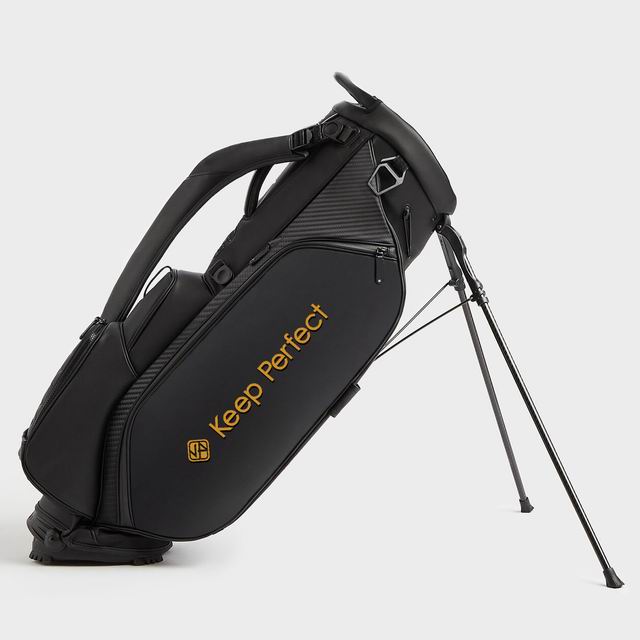
The practical move for a first program: quote your target style at 200, 500 and 1,000 simultaneously, then decide with the per-unit deltas in front of you. Brands routinely discover that 500 pieces costs only 25% more cash than 300 while delivering 67% more product — the awkward quantities between price breaks are where budgets go to die.
| Quantity | Stand bag (600D, 1 embroidery) | Staff bag (PU trim, full suite) |
|---|---|---|
| 200 pcs | USD 26.50–31.00 | USD 52.00–61.00 |
| 500 pcs | USD 22.00–26.00 | USD 44.00–52.00 |
| 1,000 pcs | USD 19.50–23.00 | USD 40.00–46.00 |
| 3,000 pcs | USD 17.80–20.50 | USD 37.00–42.00 |
What Drives the Unit Price
Strip a golf bag quote to the chassis and five components do almost all the talking. Body materials account for 30–40% of unit cost — this is where denier and fabric type live. Labor runs 25–30% and is nearly fixed per chassis: a stand bag is a stand bag's worth of sewing minutes. Hardware — zippers, buckles, stand mechanisms, handles — takes 12–18%, and the gap between generic and branded hardware (SBS versus YKK zippers, for example) is USD 1.20–2.80 per bag. Branding execution adds 5–10% depending on technique count, and packaging plus export cartons close out the last 5–8%.
This decomposition matters because it tells you where negotiation actually works. Asking a factory to shave labor means asking them to sew faster or worse — neither ends well. Asking to re-spec hardware from YKK to SBS, or to move one branding position from embroidery to print, produces real, quality-neutral savings. The materials library lists cost deltas for every fabric and hardware option we quote.
Branding Costs by Technique
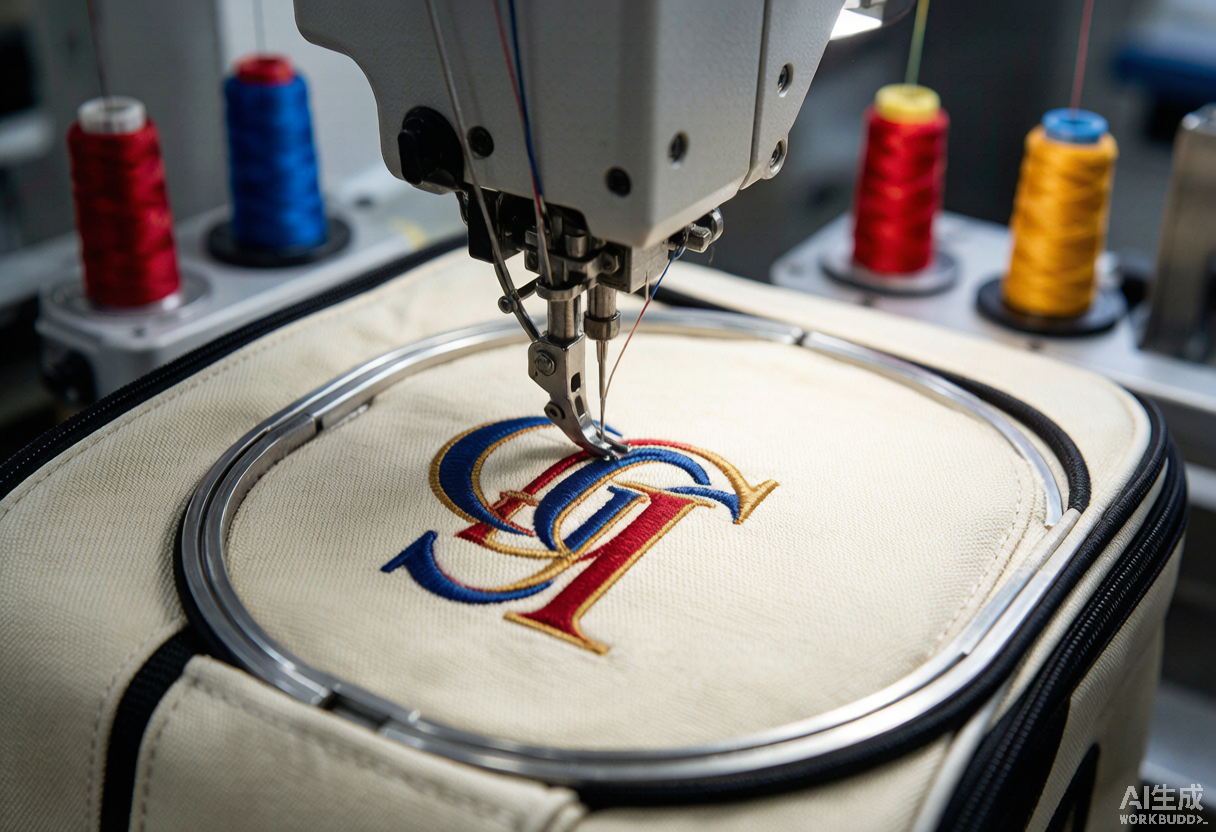
Per position, per bag, at 500 pieces: single-color embroidery up to 10,000 stitches USD 0.80–1.80 · screen printing USD 0.30–0.90 per color · heat transfer USD 0.60–1.50 · woven labels USD 0.25–0.45 · molded rubber badges USD 0.90–1.60 · metal logo plates USD 1.20–2.20. Digitizing is a one-time USD 25–60 per design; screens run USD 15–25 per color.
Technique choice is a brand decision before it is a cost decision. Embroidery reads premium and survives years of cart straps and trunk lids; it is the default for team crests and retail brands. Screen printing carries large, bold graphics at the lowest per-unit cost and is the workhorse for promotional volumes. Heat transfer handles gradients, photographs and short-run personalization the other two cannot touch. The technique pages — embroidery, screen printing, heat transfer — carry the full size limits, durability data and cost curves.
A working branding suite for a retail-bound bag — embroidered crest on the ball pocket, printed side graphic, woven main label, hangtag — lands at USD 2.30–4.50 per bag all-in. Corporate and tournament programs can strip that to a single print position at under a dollar when the bag itself is the message.
Material Choices and What They Add
On the same stand-bag chassis, body fabric alone swings the FOB price by USD 4–9. The baseline is 600D polyester — durable, printable, the correct answer for most team and promotional programs. Stepping to 420D nylon saves a little money and meaningful weight for carry-focused bags; 840D ballistic nylon adds abrasion resistance and a technical hand that retail customers can feel; 1680D in high-wear zones is tour-staff territory. PU and vegan leather sit at the top, adding USD 6–11 per bag and changing the entire shelf presence.
Lining, foam and webbing hide smaller deltas that add up: upgraded 210D lining over 190D adds USD 0.40–0.70; high-density divider foam adds USD 0.60–1.10; padded strap upgrades run USD 0.80–1.60. None of these are visible in a photograph, and all of them are visible the first time a customer picks the bag up — which is why retail programs spec them and promotional programs often don't.
Packaging, Labels and Extras
Bulk packing — each bag in a plain polybag, 2–4 bags per export carton — is included in every quote. Everything beyond that is a line item: printed belly bands USD 0.15–0.30, hangtags printed both sides USD 0.12–0.25, individual printed boxes USD 0.90–1.60, tissue and inserts USD 0.20–0.40, GS1 barcode stickers USD 0.05–0.10. A full retail presentation package typically adds USD 1.20–2.10 per unit.
The extras worth budgeting deliberately rather than discovering: rain hoods matched to the bag fabric (USD 1.10–1.90, and worth it on any bag sold to the UK, Ireland or the Pacific Northwest), embroidered player names at USD 0.60–1.20 per bag for team rosters, and custom-molded handles or zipper pulls for OEM programs at USD 0.40–0.90 per unit once the mold exists. The packaging and labeling guide goes deeper on retail-readiness — and until it publishes, the private label page covers the retail-ready suite.
Sampling Costs and How They Credit
Samples cost USD 80–150 for chassis-based private label work, USD 100–180 for cosmetic OEM, and USD 150–300 for full OEM — plus courier at USD 40–80 depending on destination. Every sample fee is credited against the first bulk order, which makes the sample effectively free in any program that proceeds; the fee exists to keep the sample queue serious, not to make money.
The 6–10 day sampling window covers chassis-based samples with your branding. Structural OEM samples run 10–15 days per round because patterns are cut fresh, and most OEM programs should budget two rounds — first for structure, second for refinement. Revision samples after minor tweaks re-run at reduced fees (typically 40–60% of the first sample) because digitizing and patterns already exist. Full terms are on the sample policy page.
Freight, Duty and Landed Cost
FOB Xiamen is the quoting baseline; the number that matters is landed cost per sellable bag. For a 500-piece stand-bag order — roughly 2.8 cubic meters and 620 kilograms — LCL ocean freight to the US West Coast runs USD 1,150–1,600 (USD 2.30–3.20 per bag) at 2026 rates; a 40-foot container holding about 4,500 stand bags drops that to USD 0.90–1.40 per bag. US import duty on golf bags under HTS 4202.92 is 17.6% of FOB value; the UK runs 12% plus VAT on the landed figure; the EU sits at 9.7% under the TARIC 4202.92 line; Australia duties are largely eliminated under ChAFTA but GST applies on arrival.
Worked end to end: a USD 22.00 FOB stand bag lands in Los Angeles at roughly USD 29–31 all-in (freight, duty, port and brokerage), in Felixstowe at USD 28–30 before VAT, and in Hamburg at USD 27–29 before VAT. The market pages — USA, UK, EU — carry the destination-specific duty, VAT and compliance detail for all eleven markets we serve, and DDP quotations price the entire journey into a single per-unit number if you prefer no customs exposure at all.
Payment Terms and Cash Flow
The standard structure is T/T 30% deposit to open production, 70% balance against bill of lading copy — meaning your final payment moves when the goods are on the water, documented, not before. Sample fees precede everything and credit back. For buyers, the cash-flow shape to plan around is: sample fee at week one, 30% at week three to five, 70% at week eight to ten, freight and duty at arrival.
Established relationships earn better terms — net-30 against documents is not unusual from the third order onward — but any factory offering generous credit on a first order is pricing the risk into the unit cost somewhere you cannot see. The unglamorous truth of cross-border soft goods: payment terms are a proxy for trust, and trust is built in exactly one way, by orders that go well.
How to Read a Factory Quote
- Find the spec before the price. Fabric denier, branding technique and position count, packaging level — a quote that doesn't state them isn't a quote, it's an advertisement.
- Check the Incoterm. FOB Xiamen, EXW and DDP numbers for the identical bag can differ by 40%. Comparing an EXW quote against a DDP quote is comparing different products.
- Confirm what's included. Digitizing, screens, hangtags, cartons, export documentation — ask for the inclusion list in writing and re-add anything missing before comparing factories.
- Check the validity window. Material and freight rates move; a quote older than 30 days is a draft, not a commitment.
- Look for the inspection line. AQL 2.5 pre-shipment inspection should appear explicitly. Its absence tells you quality assurance is a hope, not a system.
- Test the response, not just the number. The speed and precision of the quoting exchange is the cheapest preview of how the factory will behave when a problem appears mid-production.
Negotiation: What Moves and What Doesn't
What genuinely moves: quantity (the strongest lever — commit more units, or commit to a reorder schedule and ask for the next break's pricing now), branding simplification (one fewer position, print instead of the second embroidery), material substitution with quality-neutral alternatives (SBS for YKK zippers, 190D for 210D lining where it doesn't show), and delivery terms (consolidating to FCL freight at 4,000+ pieces saves more than most price negotiations ever will).
What doesn't move, or moves only at quality's expense: labor rates, AQL inspection, and the physical minimums that make 200 pieces the floor. A factory that agrees to a 25% price cut with no spec change has agreed to find the money inside your order — in thinner foam, looser bartacks, or a quiet fabric substitution. The programs that run well for years are the ones where both sides can see the math.
Getting an Exact Quote for Your Spec
Every table in this guide is a planning tool; your program's exact number depends on your chassis, quantity, materials and branding suite. Send three things — your bag type and target quantity, your logo artwork, and your destination — and a like-for-like quotation comes back within 24 hours: unit price at your volume, the full inclusion list, sampling cost, timeline and payment structure. If you are comparing us against another quote, send theirs too; spec-normalized comparisons are a service, not an imposition.
Frequently Asked Questions
What is the MOQ and pricing for custom golf bags?
MOQ is 200 pieces per style for private label, 300 for cosmetic OEM and 500 for full OEM. Pricing at 500 pieces FOB Xiamen with a standard branding suite: Sunday bags USD 14–22, stand bags USD 19–34, cart bags USD 24–42, staff bags USD 38–65, travel covers USD 16–28. Samples take 6–10 days and the fee credits back on your first bulk order.
Why do golf bag factories require a 200-piece minimum?
Three fixed costs set the floor: custom fabric runs at the mill, embroidery digitizing, and production line changeover. Across 200 bags these add USD 1.50–2.50 per unit; across 50 bags they would add USD 6–10. The minimum exists so neither side loses money — it is production physics, not sales policy.
How much does a custom logo add per golf bag?
Per position at 500 pieces: embroidery USD 0.80–1.80 (up to 10,000 stitches), screen print USD 0.30–0.90 per color, heat transfer USD 0.60–1.50, woven label USD 0.25–0.45, molded badge USD 0.90–1.60. A complete retail branding suite — crest, graphic, labels, hangtag — runs USD 2.30–4.50 per bag all-in.
What is the cheapest custom golf bag program?
A single-color screen-printed Sunday or pencil bag on 600D polyester at 200 pieces: roughly USD 15–18 per unit FOB Xiamen all-in. Below that price point you are buying stock bags with surface decoration, not manufactured custom product.
How much does it cost to ship 500 golf bags to the US?
500 stand bags (about 2.8 CBM, 620 kg) ship LCL to the US West Coast for USD 1,150–1,600 — USD 2.30–3.20 per bag — plus 17.6% duty on FOB value under HTS 4202.92 and roughly USD 300–450 in port and brokerage fees. A full 40-foot container cuts freight to USD 0.90–1.40 per bag.
Do sample fees come back?
Yes — every sample fee (USD 80–300 depending on complexity) is credited against the first bulk order. The fee filters the sample queue; it is not a profit center. Revision samples after minor tweaks re-run at 40–60% of the initial fee because digitizing and patterns already exist.
What are the payment terms for custom golf bag orders?
T/T 30% deposit to start production, 70% balance against bill of lading copy. FOB Xiamen is the baseline Incoterm, with CIF and DDP available for all eleven destination markets we serve. Repeat programs typically earn document-based terms from the third order.
Is it cheaper to order 1,000 bags instead of 500?
Per unit, yes — moving from 500 to 1,000 pieces saves 8–12% (a USD 22 stand bag drops toward USD 19.50–20.50). The question is sell-through: 500 bags sold in one season beats 1,000 bags warehoused for two. Quote both and decide with the per-unit delta in front of you.
What hidden costs should I watch for in a factory quote?
Four: branding positions excluded from the headline price, packaging above bulk polybag level, freight quoted at stale rates, and inspection absent from the document. Ask for the inclusion list in writing and check that AQL 2.5 pre-shipment inspection appears explicitly.
Can I negotiate the MOQ below 200 pieces?
Honestly, no — not for manufactured custom product. At 50–150 pieces the mill, digitizing and line-setup costs price the program out of sense. The realistic small-quantity path is stock-chassis branding, covered on the startup brands page.
How much does full OEM tooling cost?
New patterns, molds and tooling for a proprietary bag run USD 2,000–8,000 depending on structural complexity — at 500 pieces that amortizes to USD 4–16 per unit. Ownership of patterns and tooling should be contractually assigned to you; any factory that hesitates on that clause should not develop your bag.
When is DDP worth paying for?
When you have no customs broker, no appetite for duty paperwork, or a fixed delivery date at an event venue. DDP prices freight, insurance, duty and final delivery into one per-unit number — typically 25–40% above FOB for the US — and converts customs risk into a line item. First-time importers should take it.