
Programs · Startup Brands
Custom Golf Bags for Startup Brands
A startup golf brand's first collection is 200 pieces of one hero SKU — usually a Sunday bag — in one or two colorways, branded with one strong embroidery position and a woven label inside, sampled aggressively, and reordered on sell-through data. The worked cost example on this page lands that entire first order under USD 4,000 FOB. Minimum 200 pieces; sampling 6–10 days (budget two rounds); bulk 35–50 days; AQL 2.5; reorder lane 60–90 days when sell-through says go. This page is the honest economics of proving a golf brand without betting the company on it — what to spend on, what to skip, and the five mistakes that kill first collections before the second one.
The Startup Program in One Paragraph
A startup program is 200 pieces of one hero SKU in one or two colorways on a catalog chassis — one strong branding position, a woven label inside, stock or single-dye color — sampled in two rounds, sold through deliberately, and reordered from files at 60–90 days when the data says so.
The startup program exists because the golf bag market pays for focus. Brands that launch one product the market can name do better than brands that launch five products it cannot tell apart — and 200 pieces is the smallest quantity at which real manufacturing (real fabrics, real dye lots, real inspection) happens at honest per-unit cost. Everything on this page optimizes the first order for one job: proving that a second order should exist.
That framing decides the money. The first collection is not the business; it is the instrument that measures the business. Spending on instrumentation means sampling, photography and inventory — not on structural novelty, custom hardware or a colorway rainbow. The sections below run the spec, the worked cost example, and the reorder math that turns a good launch into a brand.
What a First Collection Should Be
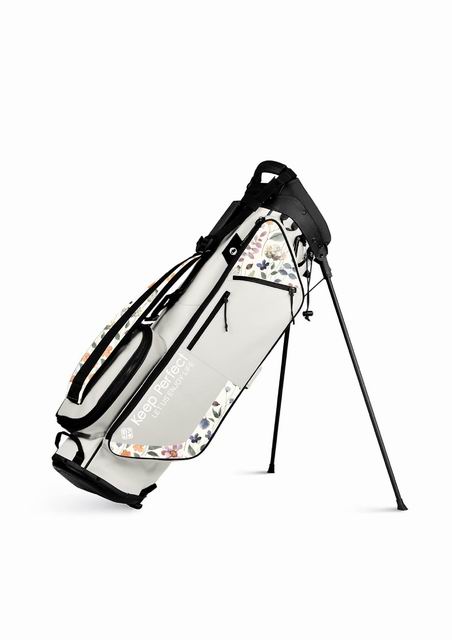
One hero SKU. In golf bags that almost always means a Sunday chassis: the lowest entry cost per unit, the strongest branding surface per dollar, and the format the direct-to-consumer golf market demonstrably buys from new brands. The alternatives are pencil bags (cheaper, but a gift format rather than a brand flagship) and cart bags (a pro-shop format that wants a retail relationship a first collection does not have yet). The Sunday chassis page carries the construction detail.
One or two colorways, not three. Every colorway is a dye lot below 500 pieces (USD 80–150), a separate inventory position, and a split of the reorder signal. The strongest first-collection pattern we see: one colorway the brand becomes known for, plus optionally a second in the same fabric that shares every trim — the decision that keeps component complexity at one while doubling shelf presence.
One branding position, executed well. A 10–12 cm mark on the front pocket, embroidered (it reads premium, survives outdoor life and the file is reorder-ready) or transferred (if the art is multicolor). The customization levels are documented elsewhere on this site; the startup rule is simpler than the full map — depth on one position beats coverage of five.
The Worked Cost Example: 200 Bags, Under USD 4,000 FOB
What the table excludes, honestly: freight and duties (quoted by destination — budget 12–18% of FOB by sea), the second sample round if used (USD 100–150), and any second colorway (dye-lot fee plus the same per-unit costs). Even with those added, a complete first collection lands well under USD 6,000 cash-in-program including freight — the actual threshold between "I have a golf brand" and "I have a golf habit" is smaller than most founders assume.
The two decisions that keep the number honest are visible in the first and last rows: the stock colorway (a curated mill color rather than a custom dye) saves the dye-lot fee and a calendar week, and the single branding position concentrates perceived value rather than spreading it. A first collection can spend more than this table — it cannot spend it better.
| Line | Unit (USD) | × 200 bags | Notes |
|---|---|---|---|
| Sunday chassis, 600D, stock colorway | 16.80 | 3,360 | Stock color avoids the dye-lot fee entirely |
| Logo embroidery, 10 cm, ~7,000 stitches | 0.95 | 190 | Digitizing USD 45 one-time, below |
| Woven main label + care label | 0.18 | 36 | 1,000-piece label MOQ — covers reorder |
| Poly bag + printed insert card | 0.25 | 50 | DTC packaging; upgrade to retail suite at reorder |
| Digitizing (one-time) | — | 45 | Stitch file on record for the reorder |
| Sample fee (credited at bulk) | — | 150 | Two rounds budgeted in the calendar |
| First-collection FOB total | — | 3,831 | USD 19.16 per bag, all-in FOB |
Why 200 Pieces Is the Honest Floor
The internet will sell you "no minimum" custom golf bags, and it is worth understanding precisely what that product is: either a middleman marking up stock bags with a print, or a factory quoting you the per-unit cost of a 200-piece run across 50 pieces of volume. Real manufacturing — mill dye lots, cut-panel branding, three-checkpoint inspection — has a floor where the economics of setup amortization stop working. Ours is 200 pieces per style, and it is not a negotiation position; it is where a sewing line's changeover cost stops being obscene.
The no-minimum article runs the full math, including what "low MOQ" resellers actually do to the price curve. The short version for founders: at 200 pieces you buy at manufacturing economics; below it you buy at markup economics, and the difference compounds through every future order you will ever place.
One honest extension: the floor is per style, not per program. A 200-piece first collection plus a 50-piece pencil-bag add-on for gifting and marketing is a 250-piece program — the pencil bags ride the same fabric, the same container and the same calendar at their own per-unit price, and the MOQ math treats the program, not the marketing plan, as the unit.
Sampling Aggressively on a Startup Budget
The sample budget is the one place a first collection should overspend. Two rounds, deliberately: round one proves the concept — chassis, color, logo placement, weight, the feel of the product in your hands photographed next to your brand's existing look. Round two proves the corrections — the placement moved two centimeters, the thread shade deepened, the insert card copy final. Each round is 6–10 days and roughly USD 150 at this spec, credited at bulk; the pair of them is the cheapest insurance in the entire program.
What to check with founder's eyes, beyond the QC checklist on the sample policy page: does the logo read at three meters (the distance your product photos will imply)? Does the colorway photograph the way the brand looks in your head — and if not, is that a fabric conversation or a photography conversation (they are different — see color matching)? Would you pay your own target price for this bag as a stranger? The sample round is when those questions cost USD 150 instead of USD 3,800.
The pattern that fails: founders who approve round one because the calendar feels late. A first collection has exactly one thing its market punishes irreversibly — a bad product — and the sample rounds are where bad products are caught. The calendar section below shows where the time actually comes from, and it is not the sampling.
Colorway Strategy Without Dye-Lot Fees
Custom dye lots (USD 80–150 below 500 pieces per colorway) buy exactly one thing: a color no other brand sells. That is worth real money when the brand's identity is the color — the sage-and-cream direct-to-consumer brands of the last three years built entire stories on non-stock palettes. It is worth nothing when the colorway is a preference. The founder's honest test: does the brand's name change meaning if this color changes? If yes, pay the dye lot and approve the lab dip. If no, choose from the mill's stock line and put the money into photography.
The two-colorway compromise that preserves both focus and shelf presence: the same fabric in a stock colorway plus one custom — shared trims, shared hardware, one dye-lot fee — giving the launch two facings and the reorder data two signals instead of one. The failure pattern is three-plus colorways at 200 total pieces: each colorway becomes 66 units of inventory, and the reorder signal drowns in noise.
Branding That Punches Above Its Budget
The branding stack for a first collection, ranked by perceived value per dollar: embroidery on the front pocket — USD 0.95 per bag in the worked example, and the single strongest premium signal available at this tier; the woven main label — USD 0.08–0.25, the mark that makes the product feel like a brand when someone opens the pocket; the insert card — cents, and the only place the founder's voice reaches every customer; a tone-on-tone secondary mark on the strap pad — USD 0.30–0.50, for the customers who notice details, which in golf is most of them.
What to skip at this tier, and why: custom hardware (molded buckles carry tooling MOQs in the thousands — catalog hardware in your finish is the identical look), retail boxes (DTC brands ship poly; the box matters when a retailer matters), and structural novelty (the structure level starts at 500–1,000 pieces for a reason — pattern engineering does not amortize at 200).
The one luxury worth violating the budget for: a great digitizing job on the logo. The USD 45 setup in the worked example is the difference between a mark that reads professional at three meters and one that reads homemade at one. It is the least money in the program with the most say in how the brand looks.
Sell-Through and the Reorder Decision
The reorder decision is the entire point of the first collection, and it runs on four signals: velocity (how fast the first 50 sold relative to plan), price resistance (did anyone hesitate at your price point), channel surprise (which customers you expected and which arrived), and returns or complaints (none, ideally, at AQL 2.5). A collection that sells 60% of its units in ninety days at full price has proven a reorder; a collection that sells 60% in a year of markdowns has proven a liquidation.
The reorder itself is a different product from the first order: 60–90 days, no re-approval, files on record — the stitch file, the dye formula or stock-color reference, the label inventory (the 1,000-piece label MOQ was quietly covering this since day one), the packaging print plates. The second order is where the program's economics actually turn profitable, because development costs are already paid and the quantity tier steps down at 500. The reorder consistency article documents the machinery.
The discipline that protects the decision: the reorder reserve. Hold 30–40% of the launch budget as cash instead of inventory, so that when sell-through says go, the reorder funds immediately instead of competing with the marketing plan. First collections that spend everything on units discover that their best month is when they cannot buy more; that is the most avoidable failure in this entire program.
Cash Flow and the Factory Calendar
The payment structure of a first collection, mapped to the calendar: 30% deposit at purchase order (covers fabric, hardware and branding setup purchased against your spec), 70% balance against shipping documents before the vessel departs, sample fee credited at bulk invoicing. On the worked example that is roughly USD 1,150 at order, USD 2,680 six weeks later — a cash curve a founder can plan around, with the freight balance at destination.
Two structural notes worth knowing. Crowdfunded programs: a funded campaign is simply a pre-sold order with a public date — we quote and run them, and the crowdfunded case study shows the calendar built around a campaign's delivery promise, including the buffer structure that keeps a public deadline safe. Air freight on small quantities: 200 bags air-freight at a price that shocks founders who last shipped phone cases — sea freight is the startup default, and the calendar above is built around it.
The China-production rhythm that surprises first-timers: Chinese New Year closes the coast for two to three weeks sometime late January to mid-February, and sampling scheduled into it absorbs the delay silently. Our quotes carry the CNY math; the founder's job is simply to know that a February launch ordered in November is a different program than one ordered in September.
Five Mistakes That Kill First Collections
Launching a range instead of a hero. Five SKUs at 200 total means 40 units each of products the market cannot tell apart — no signal, no reorder, no brand. The fix is the one-hero structure above. Custom-everything spending. Custom dye lots, custom hardware and structural novelty at 200 pieces buy the most expensive versions of decisions that catalog components answer free. The cheapest-quote trap. Two quotes with identical-looking specs differ in backing weight, zipper brand, foam coverage and inspection standard; the manufacturer checklist is the 40-question antidote. No reorder plan. Selling out with no reserve and no lane means the best month funds a competitor's sale instead of the second collection. Pricing without freight. A landed cost discovered after the container closes is a margin discovered after the market has set expectations.
The five share one shape: every one is a decision made confidently before the information existed. The startup program's structure — small, instrumented, reserved — is designed to make those decisions cheap to get right and cheap to correct when they are wrong.
From First Collection to Second
What changes at the second order, and what should not: the quantity tier (500 pieces steps the per-unit price down 10–14% — this is where the brand's margins begin to be real), the colorway depth (data says which color survives, and the second colorway joins on the winning fabric), the branding suite (the retail packaging upgrades when a retail channel appears), and, in the right season, the structure (the signature chassis becomes worth designing at 500–1,000 pieces — the private label program is where that conversation lives).
What should not change: the factory, the files and the hero. Brands that keep their first-collection factory through year two compound everything the first collection built — the reorder files, the tolerance history, the price tiers. The market's name for a brand that changes all three every season is "not a brand yet," and the market says it quietly, with its wallet.
Starting the Program
Send it to the quote form. The reply within 24 hours is a priced spec against this page's structure — the worked-example math with your numbers in it, the sampling calendar with two rounds, and the reorder lane priced at the quantity tier your sell-through will justify. First collections are the smallest programs we run and the ones we answer fastest; every brand we work with started exactly here.
- The hero SKU instinct — Sunday bag unless you have a reason, and the reason if you do.
- Quantity and colorway count — 200 and one is a complete answer.
- Logo vector file and the one position you believe in.
- Colorway: stock-color openness or the custom palette the brand owns.
- Target price — what you need the bag to land at, so we can work the stack honestly.
Frequently Asked Questions
Can we start with fewer than 200 bags?
Not at manufacturing economics — 200 pieces per style is where real production starts, and below it you are buying a reseller's markup on somebody else's 200. The no-minimum article runs the full math. What bends: the style count is one, and the colorway count is one.
How much cash does a first collection need, all-in?
USD 3,800–4,500 FOB on the worked example (including the credited sample), plus 12–18% of FOB for sea freight and duties by destination — under USD 6,000 cash-in-program with the second sample round and the reorder reserve held separately.
Do you work with crowdfunded brands?
Yes — a funded campaign is a pre-sold program with a public delivery date, and we quote against the campaign's math. The crowdfunded case study shows the calendar and buffer structure that kept a campaign's promise safe through production and freight.
Can we sample before committing the 200?
Yes — sampling is independent of the order: USD 100–150 per round at this spec, 6–10 days, and the fee credits back if you proceed to bulk. Budget two rounds and treat the second one as the decision point, not a delay.
Who owns the logo and design files?
You own your brand assets absolutely — logo, artwork, labels, packaging design. The stitch file we digitize from your art is your program's tool on record with us. Ownership is not the interesting question; reproducibility is, and the reorder files answer it.
What about our trademark?
Register before you launch — in your home market at minimum, and in any market you will ship to. We manufacture for the brand that owns its marks; programs asking us to reproduce third-party marks without authorization are declined (see how licensed programs actually work).
What if the first collection does not sell?
The structure exists so that answer is cheap: 200 units of one SKU, sampled and inspected, is an inventory position a golf brand can work through — marketplace, gifting, pro-shop consignment — without destroying its price integrity. The failure mode the structure prevents is the one that ends brands: five SKUs of unsold everything.
Can we air freight 200 bags?
Quotable at 4–6× sea cost — worth it for a launch event with a hard date, never worth it as a plan. Sea freight is the startup default; the calendar above is built around it with buffers.
What payment terms apply to a first order?
T/T 30% at purchase order, 70% against shipping documents, sample fee credited at bulk. L/C at sight is quotable but rare at this size; the deposit structure in the cash-flow section is the standard curve.
How fast can the reorder come?
60–90 days from order to goods — files on record, no re-approval, quantity tier stepped down at 500. This is why the reorder reserve matters more than launch inventory: the lane is fast, but only cash can enter it.
When do we outgrow the startup program?
At the moment sell-through justifies depth: a 500-piece reorder, a second colorway on the winning fabric, or the retail suite when a channel asks for barcodes — each is a natural graduation point, and the private label program is the next room.
Do you sign NNN agreements?
Yes — mutual NNNs on request before tech-pack disclosure. In practice the protection that matters is simpler: register the trademark, keep the brand assets yours, and work with factories whose reorder files are their reputation. Our OEM/ODM page covers the IP framework in full.
Ready to spec your custom golf bags?
Send your logo, bag type and target quantity — we reply with a quote, MOQ and timeline within 24 hours.