
The 12-Point Checklist Up Front
Print this table and score every candidate factory 0–2 on each line: 0 = failed or evasive, 1 = partial or undocumented, 2 = proven with evidence. Anything under 18 of 24 is a pass; 18–21 is a maybe that needs a sample to decide; 22–24 is a shortlist factory.
Twelve points looks arbitrary until you have run a few factory relationships into the ground; then it looks minimal. Each line exists because a real program failed there — bags that matched no sample, invoices that grew after the deposit, a "factory" that turned out to be a trading desk forwarding emails to an actual factory the buyer never got to name.
| # | Checkpoint | What "pass" looks like |
|---|---|---|
| 1 | Third-party verification | SGS, Bureau Veritas or TÜV report dated within 18 months |
| 2 | Bulk production evidence | Line photos of 50+ units, not sample-room turntables |
| 3 | Buyer references | Two contactable programs in your category or market |
| 4 | Chassis range | Stand, cart, staff, Sunday and travel covers in active production |
| 5 | Full branding suite | Embroidery, print, transfer, labels and packaging in-house |
| 6 | Materials library | Documented fabric and hardware options with cost deltas |
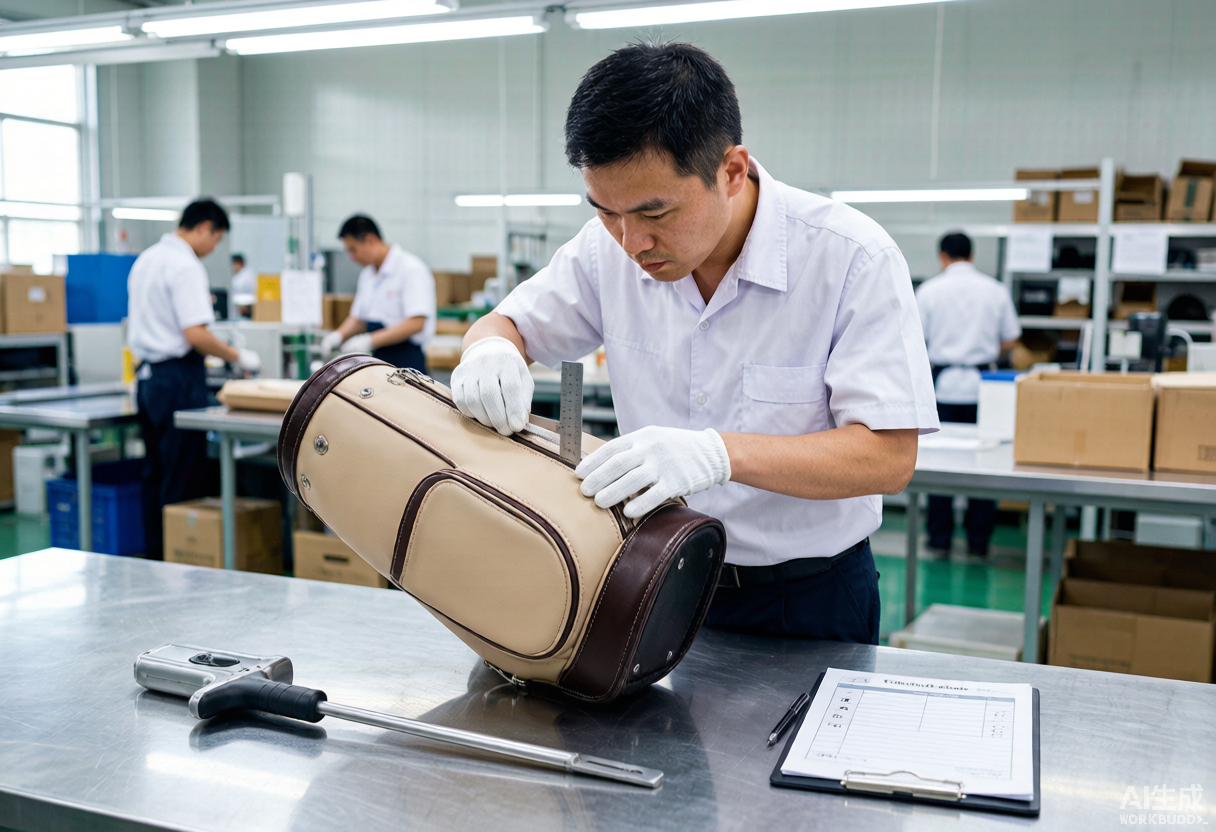
| 7 | Inspection system | IQC, IPQC and PSI to AQL 2.5, named and written |
| 8 | Defect policy | Written claim window and rework/credit rules |
| 9 | Sample discipline | 6–10 day samples with fees credited on first order |
| 10 | Pricing transparency | Spec, inclusions and Incoterm stated on the quote |
| 11 | Payment structure | T/T 30/70 against B/L copy — not 100% upfront |
| 12 | Pattern ownership | Contractual assignment to the buyer for OEM work |
Verification: Prove the Factory Before the Product
Point 1 — third-party verification — is the cheapest evidence in sourcing. SGS, Bureau Veritas and TÜV all audit factories against published protocols: premises, equipment, headcount, capacity, quality documentation. The audit costs the factory real money and expires, which is why the date matters — a 2023 report describes a factory that may no longer exist. Our own production partner was SGS-verified for Alibaba.com in March 2026: 4,950 square meters, 7 production lines, 149 machines, 137 staff and a monthly line capacity of 200,000 pieces. Whatever factory you vet, ask for the equivalent and check the date before anything else.
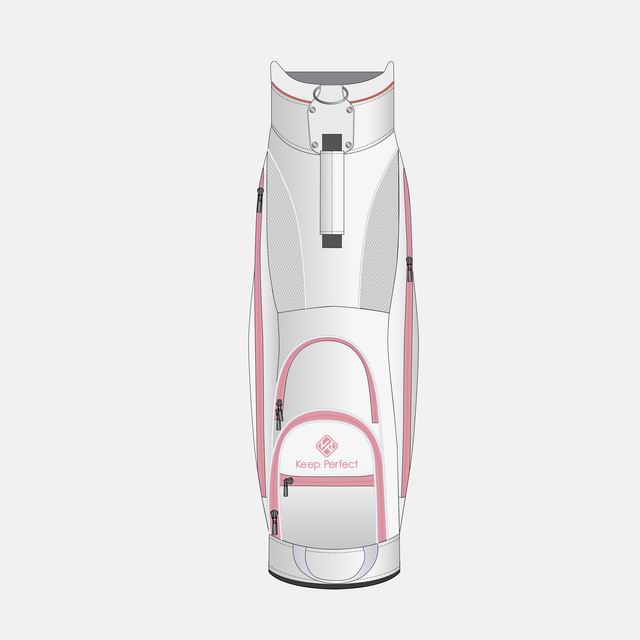
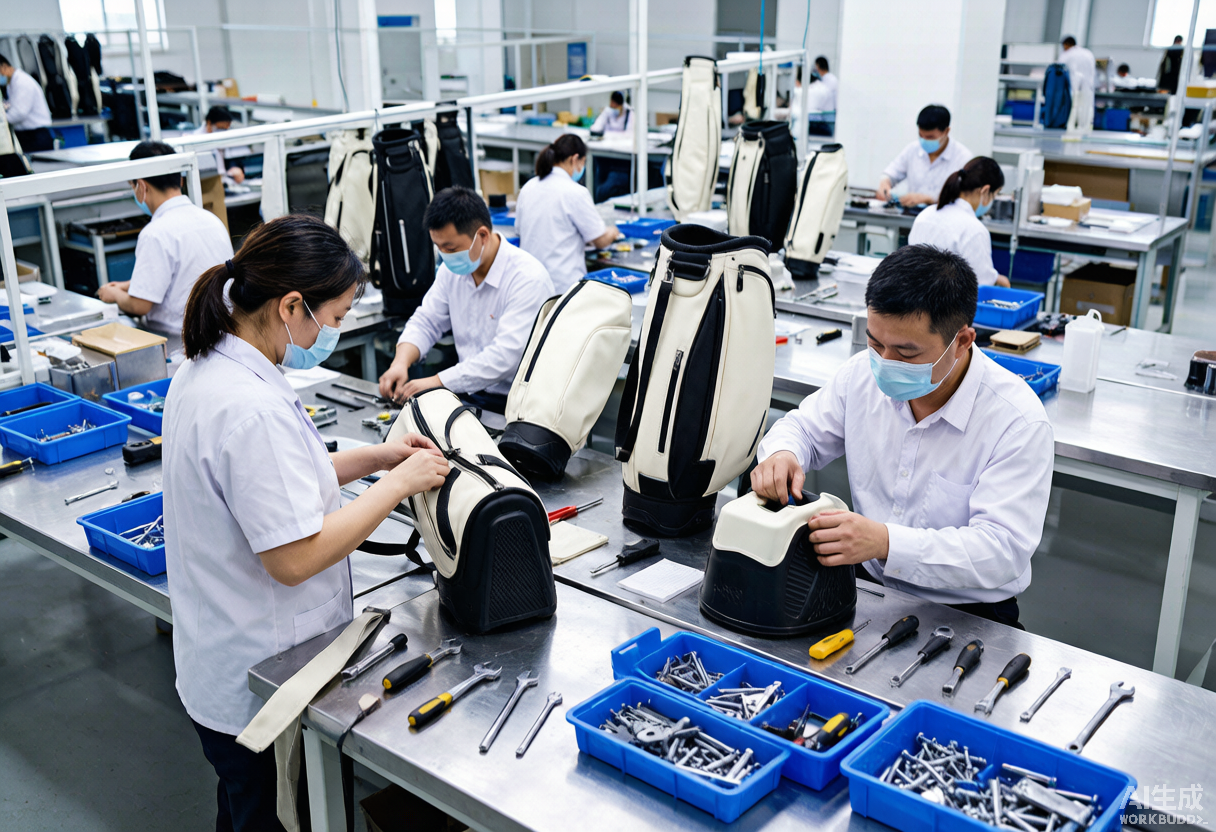
Point 2 — bulk production evidence — separates manufacturers from sample shops. Ask for dated photos or video of a current production run: workstations, WIP carts, fifty bags in one frame. Sample rooms are theater; production lines are fact. Point 3 — references — is the one buyers skip because it feels awkward. Two contactable buyers in your market will tell you in ten minutes what six months of email cannot: whether bulk matched sample, whether the defect policy got honored, whether you should proceed.
Capability: Can They Actually Build Your Bag?
Point 4 — chassis range — matters more than it appears. A factory producing stand, cart, staff, Sunday and travel chassis simultaneously has pattern engineering depth that a single-chassis shop does not, and depth is what you draw on when season two needs a line extension. Browse the ten chassis we build for a sense of what a full range looks like in specs.
Point 5 — the branding suite — should be in-house: embroidery machines, print tables and heat presses on the premises, not brokered to a decoration shop down the road. Outsourced branding adds a week, a freight leg and a quality handoff where logos get sewn crooked and nobody owns the rework. Point 6 — a documented materials library — tells you whether the factory specifies or improvises. Our materials page is public for exactly this reason: a factory that can show you 420D through 1680D with cost deltas has thought about your bag; one that answers "any fabric you want" has not.
Quality Systems: the Paper Trail
AQL 2.5 pre-shipment inspection under ISO 2859-1, three named checkpoints (IQC, IPQC, PSI), a written defect-claim window, and photographic inspection reports before balance payment — if any of the four is missing, quality at that factory is a hope, not a system.
Point 7 is the inspection system, and the vocabulary matters: IQC screens incoming materials, IPQC walks the line, PSI samples finished goods to AQL 2.5 — meaning a 500-piece lot passes with at most three major defects in a random 50-piece pull. Factories that inspect talk in these terms unprompted; factories that don't will promise "100% QC," which is not a thing in soft goods.
Point 8 — the defect policy — is the test of whether the inspection system has teeth. A written claim window (30 days from arrival is fair), defined defect classes, and rework-or-credit rules turn QC from marketing into contract. Point 9 — sample discipline — closes the loop: 6–10 day samples, fees credited on first order, and bulk production quoted against the approved sample. Our sample policy and quality page document both ends of that loop publicly so you can check our answers before you ask.
The Documents a Serious Factory Shows You
Paper trails separate managed factories from lucky ones, and five documents tell you most of what you need. The tech pack template shows whether engineering communication has a format or happens in chat threads. A redacted bulk inspection report — an actual PSI with defect counts against AQL 2.5, buyer name blacked out — proves the inspection system produces artifacts, not just claims. Lab dip records show how color approvals are documented between seasons, which is where reorder consistency lives or dies. A compliance file — REACH-aligned material declarations for the EU, CPSIA-adjacent documentation for the US — shows the factory knows which paperwork your market's customs and retailers will demand. And a production schedule with named milestones shows whether your 35–50 day window is a plan or a hope.
Ask for all five during the vetting week. Factories that run on documents produce them in a day; factories that run on improvisation produce excuses in a week. The response time is the sixth document, and it is free.
Commercial Terms: the Numbers Behind the Number
Point 10 — pricing transparency — means the quote states the spec (fabric denier, branding positions, packaging level), the inclusions (digitizing, screens, hangtags, cartons, documentation) and the Incoterm. A quote missing any of the three is not comparable to anything, including the invoice that will eventually follow it. Point 11 — payment structure — should be T/T 30% deposit with 70% against bill of lading copy. A factory demanding 100% upfront on a first order is telling you something about either their cash flow or their confidence; neither interpretation favors you.
Point 12 — pattern ownership — only matters for OEM programs, and then it matters absolutely. New patterns, molds and tooling cost USD 2,000–8,000; the only acceptable ownership clause assigns them to you. A factory that "keeps patterns safe for all customers" is keeping the option to sell your design to your competitor, and some exercise it.
Scoring the Checklist
Interpretation: 24–30 weighted is a shortlist factory, proceed to samples. 18–23 is conditional — proceed only if the weak group is capability or commercial, never verification or quality. Below 18, keep looking; the golf bag industry has enough capable factories that marrying a weak one is a choice, not a necessity.
| Group | Points | Weight | Max score |
|---|---|---|---|
| Verification (1–3) | 0–6 | ×1.5 | 9 |
| Capability (4–6) | 0–6 | ×1.0 | 6 |
| Quality systems (7–9) | 0–6 | ×1.5 | 9 |
| Commercial terms (10–12) | 0–6 | ×1.0 | 6 |
| Total | 0–24 raw | — | 30 weighted |
Red Flags That End the Conversation
- "We can do any quantity, even 20 pieces, fully custom." The production math in our MOQ and pricing guide shows why this promise means stock bags with decoration, not manufacturing.
- Refusal to name the inspection standard. AQL 2.5 is a five-second answer for any factory that runs it.
- Stock photos only. If every image on their site also appears on three other sites, you are looking at a trading desk.
- 100% payment upfront. Industry standard is 30/70 against shipping documents; anything more aggressive transfers all risk to you.
- No pattern ownership clause for OEM. Your design becomes their catalog item.
- A quote that never asks about your spec. Factories that quote before knowing your fabric, branding and quantity are quoting a number, not your bag.
The Vetting Process in 21 Days
Twenty-one days feels slow when a season is approaching. It is also roughly 1% of the time a bad factory relationship will cost you. The design process page shows what happens after day 21 — the nine steps from brief to delivered cartons.
- Days 1–3: Send the identical spec sheet to 4–6 candidates — chassis, quantity, materials, branding suite, destination. Identical input is what makes quotes comparable.
- Days 4–7: Score responses on the 12-point checklist. Request verification reports and bulk photos from the top three.
- Days 8–10: Reference calls with two buyers per finalist. Ask the three questions: did bulk match sample, did the defect policy get honored, would you reorder.
- Days 11–18: Order samples from the top two. Pay both courier fees; the physical comparison is the cheapest insurance in the entire process.
- Days 19–21: Score the samples against each other and against spec. Award the program to the factory whose sample, paperwork and references all agree — not the one whose price was lowest.
Why Buyers Stay with Good Factories
The economics of switching are brutal: new digitizing, new lab dips, new sample rounds, new line learning curves — realistically USD 2,000–4,000 and eight weeks to recreate what a good factory already knows about your program. That switching cost is why the first vetting deserves 21 days, and why factories that pass the checklist tend to keep buyers for years. Reorder consistency — same fabric lots, same thread colors, same bartack counts two seasons apart — is the quiet service that never appears on a quote and matters more than anything that does.
This is also why the cheapest-quote strategy fails in soft goods specifically. A 4% saving per unit dissolves the first time a reorder arrives in a different shade and the retail line has to be re-photographed. Buy the factory, then buy the bags.
The retention numbers across our own buyer base reflect the same logic: programs that pass a proper vetting and a first successful order reorder at rates above 80%, and the conversations in year two are unrecognizable from year one — shorter quotes, faster samples, lab dips approved from file, production slots reserved before the purchase order exists. Trust compounds like interest, and the only way to buy it is with a first order that goes exactly as documented.
Run the Checklist on Us
We wrote the twelve points because we answer them weekly. Verification: SGS-verified for Alibaba.com, March 2026 — 4,950 sqm, 7 lines, 149 machines, 137 staff, 200,000-piece monthly line capacity, plus two branch plants and audited partners for combined output around 150,000 pieces monthly. Capability: ten chassis in active production, full in-house branding suite, public materials library. Quality: AQL 2.5 with documented IQC/IPQC/PSI and photographic PSI reports. Commercial: MOQ 200 pieces, samples 6–10 days credited on first order, bulk 35–50 days, T/T 30/70, FOB Xiamen with CIF/DDP available, pattern ownership assigned contractually for OEM.
Junyuan, the trading company behind this site, was founded in 2014 in Quanzhou, Fujian, and is led by a founder whose bag industry experience dates from 2004. The about page carries the full disclosure. Score us against the checklist — then send your spec and score our 24-hour quote against anyone else's.
Frequently Asked Questions
What is the best custom golf bag manufacturer?
The best custom golf bag manufacturer is the one that passes a twelve-point vetting: current third-party verification (SGS or equivalent, dated within 18 months), bulk-production photo evidence, a documented AQL 2.5 inspection system with IQC/IPQC/PSI checkpoints, transparent quote inclusions, T/T 30/70 payment terms, and written pattern ownership for OEM work. Score every candidate on the same checklist and the answer stops being subjective.
How do I verify a golf bag factory is real?
Three proofs, in order: a third-party verification report (SGS, Bureau Veritas or TÜV) dated within 18 months; dated photos or video of an active production run with 50+ units in frame; and two contactable buyer references in your market. All three are free to request, and hesitation on any of them is itself an answer.
What is AQL 2.5 and why does it matter?
AQL 2.5 is the consumer-goods inspection standard under ISO 2859-1: for a 500-piece lot, an inspector pulls 50 units at random and the lot passes with at most 3 major defects. It is the enforceable line between factories that inspect and factories that hope — and the vocabulary your quality conversations should be conducted in.
Should I choose the cheapest golf bag quote?
No — choose the best-scoring factory, then negotiate within that relationship. A quote 15% below the band almost always reflects a smaller spec: lighter fabric, fewer branding positions, bulk packaging, or no inspection. Normalize the spec across quotes first; the price gap usually disappears, and what remains is rarely worth the switching cost later.
How many factories should I vet at once?
Four to six for the quote round, three for verification review, two for paid samples, one for the program. The funnel costs about USD 300–500 in samples and couriers and roughly 21 days — the cheapest insurance available against a multi-season mistake.
What questions should I ask a golf bag manufacturer?
Five: show me bulk production photos; what is your AQL and who inspects; what exactly is included in this price; who owns the patterns if we develop a new bag; and what happens when something goes wrong. The answers — and how fast and specifically they arrive — eliminate most of the field before you spend anything on samples.
Is a trading company or a factory better for custom golf bags?
It depends on the trading company's disclosure. Ours is explicit: Junyuan is the trading entity (founded 2014, Quanzhou), production runs through a named affiliated factory with current SGS verification plus two branch plants and audited partners. That structure gives you factory pricing with export documentation, QC accountability and multi-plant capacity. An undisclosed trading desk adds none of that — ask every candidate exactly who sews the bags.
What MOQ should I expect from a good manufacturer?
200 pieces per style for private label, 300 for cosmetic OEM, 500 for full OEM with new tooling. Factories promising full customization at 20–50 pieces are selling decorated stock, not manufacturing — the fixed costs of fabric runs, digitizing and line setup make genuine small runs uneconomic for everyone.
How long should factory vetting take?
About 21 days: one week for the identical-spec quote round, a few days for verification and reference calls, ten days for samples in hand, and two days to decide. Compressing it to save a week typically costs a season when the unvetted factory's bulk diverges from its sample.
What payment terms are safe for a first order?
T/T 30% deposit to start production, 70% balance against bill of lading copy — your final payment moves when goods are documented on the water. Avoid 100% upfront at any price. For added safety, commission a third-party pre-shipment inspection (USD 150–300) and release the balance only on a passed report.
Do I need a factory audit before ordering?
For orders under 2,000 pieces, the 12-point checklist plus third-party verification reports plus a physical sample is proportionate. At 5,000+ pieces or multi-season programs, a paid on-site audit (USD 800–1,500 via SGS or QIMA) is money well spent — you are validating a relationship, not an order.
Why do buyers stay with one golf bag factory for years?
Switching costs: recreating digitizing, lab dips, patterns and line knowledge at a new factory runs USD 2,000–4,000 and about eight weeks. A factory that delivers reorder consistency — identical fabric, thread and construction season after season — saves that repeatedly. That consistency is the quiet service that never appears on a quote and matters more than anything that does.
Can I vet a factory without visiting China?
Yes — remote vetting is the norm, not the exception. Third-party verification reports, live video walks of the production floor, bulk photo sets, reference calls with existing buyers and a physical sample in your hands cover everything a site visit shows, for about USD 500 instead of a week of travel. Reserve on-site audits for programs above 5,000 pieces or multi-year contracts.
What should the first order with a new factory look like?
Small enough to survive, big enough to test the system: 200–500 pieces of one style with your full branding suite. That size exercises every checkpoint — sampling, lab dips, production, AQL inspection, documentation, freight — without betting the season on an unproven partner. Scale the second order, not the first.
How do I compare two factories that both pass the checklist?
On the sample, the documents and the dialogue — never on the quote alone. Put both physical samples side by side and check bartack counts, stitch density, zipper action and branding placement against your spec sheet; the better sample almost always comes from the factory whose emails were more specific. Then choose the one whose weaknesses you can manage, because every factory has them.