
OEM vs Private Label: the Short Answer
Private label puts your logo, colors and packaging on a chassis the factory has already engineered — minimum 200 pieces, samples in 6–10 days, the lowest risk path for a first launch. OEM builds the bag itself to your drawings: new patterns, new tooling, structural changes — minimum 500 pieces and a longer development loop, but the product is exclusively yours. Most successful golf brands start private label, prove sell-through, then graduate their hero style to OEM.
The two paths are not competitors; they are stages of the same brand journey. Private label answers the question "will the market buy this?" at the smallest possible commitment. OEM answers "how do we make something nobody else has?" once the market has answered yes. Confusing the order is the single most expensive mistake new golf brands make — committing to OEM tooling before the first collection has sold through ties up USD 8,000–15,000 in patterns and molds that a private label program would never have needed.
There is also a middle path that experienced buyers use deliberately: cosmetic OEM. You take a factory chassis and change everything the customer can see and touch — fabrics, colorway, hardware finish, pocket layout graphics, branding placement — without touching the pattern. Minimums stay near 300 pieces, no new tooling is required, and the result photographs like a proprietary product. Every program quoted on this site can be structured any of these three ways, and the OEM/ODM manufacturing page breaks down the engineering side.
| Decision | Private Label | Cosmetic OEM | Full OEM |
|---|---|---|---|
| What is yours | Branding, colorway, packaging | Everything visible; chassis is shared | Design, patterns and tooling |
| MOQ | 200 pcs | 300 pcs | 500 pcs |
| Sampling | 6–10 days | 8–12 days | 2–4 rounds over 3–6 weeks |
| Bulk production | 35–50 days | 35–50 days | 45–60 days after approval |
| Tooling cost | None | None | USD 2,000–8,000 typical |
| Pattern ownership | Factory | Factory | You — contractually assigned |
| Best for | First collections, teams, corporate | Differentiated retail lines | Established brands, hero SKUs |
What Each Program Actually Includes
A private label program is a complete branding suite, not a logo stamped on a stock bag. The suite covers your logo executed in embroidery, screen print or heat transfer; a Pantone-matched colorway across body, trim and lining; woven labels and hangtags printed to your artwork; retail packaging from polybag to printed gift box; and GS1 barcoding if the bags are headed to retail shelves. What does not change is the engineering underneath — divider count, pocket architecture, strap systems and stand mechanisms remain the proven factory specification, which is exactly why the quality risk is low.
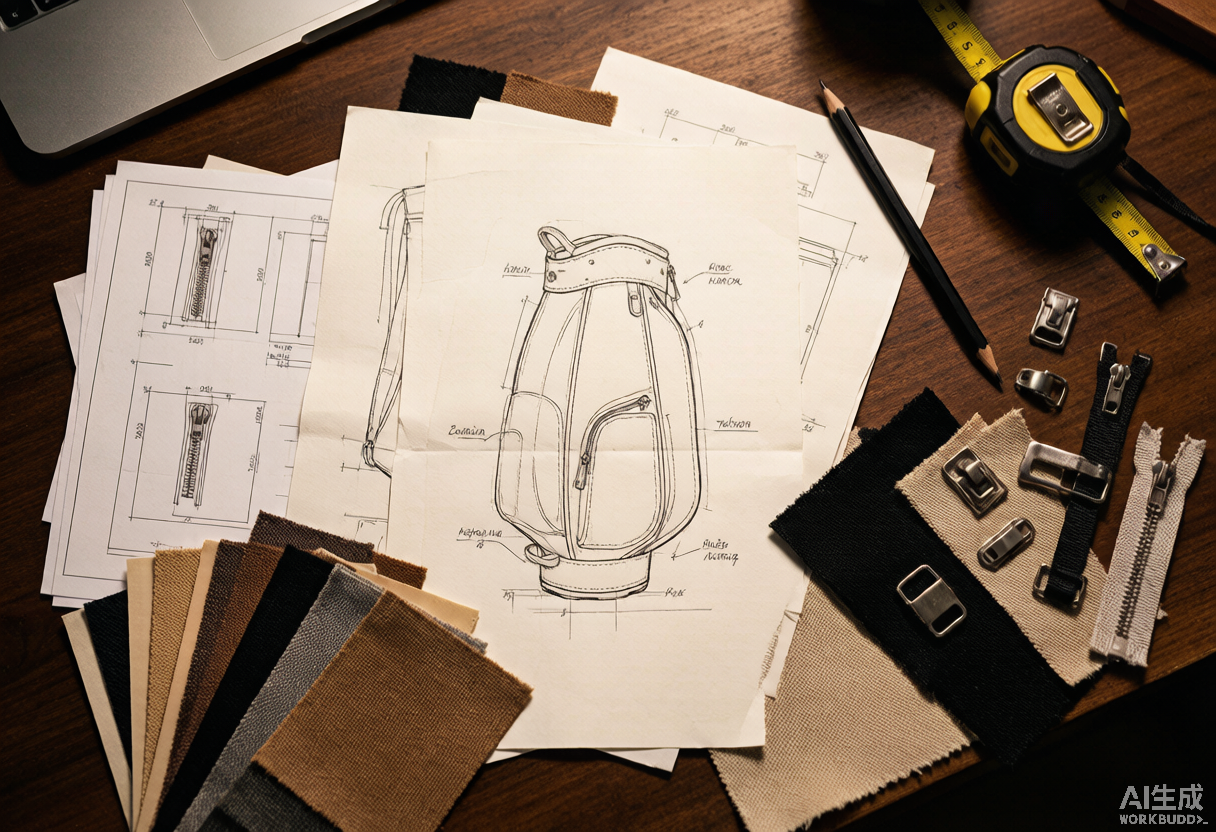
An OEM program starts one step earlier, with the bag itself. You supply a tech pack — dimensioned drawings, material callouts, stitch specifications, hardware references — or you commission the factory's pattern engineers to develop one from your brief. Every panel is then cut to your pattern, every divider to your count, every pocket where you drew it. The output is a product that cannot be sold to anyone else, protected by a tooling and pattern assignment clause that any serious manufacturer will put in writing.
Between the two sits the work most buyers actually need: adapting a chassis until it is unrecognizable as a shared platform. Swap 600D polyester for 840D ballistic nylon, re-spec the zippers from standard coil to water-resistant reverse coil, move the embroidery from ball pocket to side panel, add a custom-molded handle — and the bag that arrives at retail carries no visible relationship to the chassis it grew from.
Reference: the global golf equipment market context — the National Golf Foundation counts roughly 26.6 million on-course golfers in the United States alone (NGF, 2025 participation report), and every one of them carries, pushes or rides with a bag that someone specified, sourced and branded.
The Seven Decisions That Shape Your Quote
Every custom golf bag quotation, from any factory in the world, is built from the same seven decisions. Knowing them before you ask for a price turns a vague inquiry into a spec sheet that can be quoted in 24 hours — and lets you compare factories on like-for-like terms instead of comparing a 600D quote against an 840D quote and concluding the second factory is expensive.
- Chassis. Stand, cart, staff, Sunday, pencil or travel cover — the base engineering and the largest single cost driver. The bag types section specs all ten chassis we build.
- Quantity. Price breaks typically at 200, 500, 1,000 and 3,000 pieces; the drop from 200 to 500 is the steepest, usually 12–18% per unit.
- Materials. 420D nylon to 1680D ballistic, polyester, PU or vegan leather — material choice swings unit cost by USD 4–9 on the same chassis.
- Branding techniques. Embroidery, screen print, heat transfer, woven labels, molded badges — each adds USD 0.30–3.20 per position per bag.
- Colorway complexity. One body color plus one trim is standard; every additional panel color adds cutting time and fabric minimums.
- Packaging. Bulk polybag is free; printed boxes, hangtags and retail inserts add USD 0.40–1.60 per unit.
- Delivery terms. FOB Xiamen is the baseline; CIF and DDP re-price freight, insurance and duties into the unit number.
MOQ, Sampling and Production Numbers to Plan Around
The numbers that govern every program on this site: minimum order 200 pieces per style for private label, 300 for cosmetic OEM, 500 for full OEM; samples in 6–10 working days with the sample fee credited back on the first bulk order; bulk production 35–50 days after sample approval; inspection at AQL 2.5 before any carton is sealed.
These are not negotiating positions; they are the physics of a cut-and-sew production line. Two hundred pieces is the quantity at which fabric can be dyed to a custom Pantone without penalty pricing, embroidery programs can be digitized once and amortized sensibly, and a production line can be set, run and cleared in a single shift block. Below that number every operation still happens — the digitizing, the machine setup, the line changeover — but the cost lands on fewer units.
Sampling in 6–10 days is the window for a chassis-based sample with your branding; structural OEM samples take longer because patterns must be cut and graded first. The sample is not a courtesy — it is the contract made physical. Bulk production is quoted against the approved sample, and the inspection at the end of the line measures the bulk against that same sample. Our sample policy page documents the full loop including revision rounds, and the design process page maps all nine steps from brief to delivery.
| Parameter | Private Label | Cosmetic OEM | Full OEM |
|---|---|---|---|
| MOQ per style | 200 pcs | 300 pcs | 500 pcs |
| Sample lead time | 6–10 days | 8–12 days | 10–15 days per round |
| Sample fee | USD 80–150, credited on first order | USD 100–180, credited | USD 150–300, credited |
| Bulk production | 35–50 days | 35–50 days | 45–60 days |
| Inspection standard | AQL 2.5 | AQL 2.5 | AQL 2.5 |
| Payment | T/T 30% deposit, 70% against B/L copy | Same | Same |
What Custom Golf Bags Cost in 2026
FOB Xiamen unit prices at 500 pieces, standard branding suite included, sit in these bands: Sunday and pencil bags USD 14–22; stand bags USD 19–34; cart bags USD 24–42; staff bags USD 38–65; travel covers USD 16–28. Private label at the 200-piece minimum adds roughly 12–18% to those bands; quantities above 1,000 pull them down 8–12%. Full OEM adds tooling amortization on top — at 500 pieces a USD 4,000 tooling package adds USD 8 per unit, which is why OEM only makes sense for styles you expect to reorder.
The honest way to read any factory quote is cost per sold bag, not cost per ordered bag. A USD 24 stand bag that sells through at retail in one season is cheaper than a USD 19 bag that sits in a warehouse for two. Brands that plan reorder-on-sell-through economics — covered in detail on the startup brands page — routinely run healthier programs at higher unit costs than brands chasing the lowest FOB number.
Method note: bands are FOB Xiamen at mid-spec (600D–840D bodies, single-color embroidery suite, bulk packing), Q3 2026 material and labor rates. Cotton, nylon chip and ocean freight indices all moved in the last 12 months; quotes are always re-validated at order date.
How to Choose the Best Manufacturer for Custom Golf Bags
The best manufacturer for custom golf bags is the one whose sample matches their bulk, whose bulk passes AQL 2.5 inspection, and whose communication survives a problem — verified in that order. Ask every candidate the same five questions below; the answers, and how fast they arrive, eliminate 80% of the field before you spend a dollar on samples.
Verification beats claims throughout. Our own production runs through an affiliated factory that was SGS-verified for Alibaba.com in March 2026 — 4,950 square meters, 7 production lines, 149 machines and 137 staff, with a monthly line capacity of 200,000 pieces — supplemented by two branch plants and a vetted partner network for combined output around 150,000 pieces monthly. Whatever factory you choose, ask for the equivalent third-party verification and read the date on it.
- "Show me a bulk production photo set, not sample photos." Any factory can make one beautiful sample. Bulk line photos — fifty bags at a workstation, not one on a turntable — are the proof that matters.
- "What is your AQL and who inspects?" The answer should be a number (2.5 is the consumer-goods norm for this category), a named checkpoint system (IQC, IPQC, PSI) and an offer of third-party inspection at your expense if you want it. Evasion here ends the conversation.
- "What is included in the quoted price?" Branding positions, packaging, hangtags, export cartons — get the inclusion list in writing. Quotes that exclude the branding suite look 15% cheaper until you add it back.
- "Who owns the patterns if we develop a new bag?" For OEM work the only acceptable answer is "you do, contractually." Anything vaguer means your design can be sold to the next buyer.
- "What happens when something goes wrong?" Every factory has defects sometimes; the differentiator is the rework and credit policy. A written defect-claim window (30 days from arrival is fair) signals a partner, not a vendor.
The Branding Suite: Logo, Color and Packaging
Logo execution divides into three production-proven techniques. Embroidery — 8,000 to 12,000 stitches for a chest-panel crest — is the default for team, club and premium retail programs because it survives abrasion and reads as quality at arm's length. Screen printing carries larger graphics and gradients at lower cost per unit above 300 pieces, with plastisol inks cured to survive flex and rain. Heat transfer handles photographic detail and short-run personalization that neither of the others can. The embroidery page and screen printing page spec each technique's size limits, thread and ink systems, and cost curves.
Color is the second lever and the one buyers underestimate. A factory that dyes to your Pantone reference — matched under D65 lighting against the physical swatch, not a screen — gives you a colorway no competitor can walk into a shop and buy off a shelf. Two-panel colorways are standard; three and four panels are where a private label bag starts looking like a flagship. The color matching page covers the lab-dip process and approval loop.
Packaging closes the loop: woven main labels and care labels sewn in, hangtags printed both sides, polybag or printed box, and a GS1 barcode if the bags ship to retail. None of it is glamorous and all of it is what separates a product from a bag with a logo on it.
Materials and Construction Choices That Matter
Body fabric sets the bag's character and half its cost. The working range is 420D nylon at the lightweight end through 600D and 840D polyester to 1680D ballistic nylon for tour-grade abrasion zones; PU and vegan leather cover the premium shelf. Denier is not a quality score — it is a weight-and-hand trade-off, and the right answer depends on whether the bag walks (favor light), rides (favor structure) or poses for retail photography (favor hand and drape). The materials library lists every fabric, foam, webbing and hardware option with cost deltas.
Construction choices hide where customers never look: bartack counts at strap anchors (we spec 42-stitch bartacks where the industry norm is 28), divider lining that won't snag grips, waterproof base fabric that actually meets a hydrostatic head spec, and zipper garages that keep pullers from scratching club shafts. These details never appear in a product photo, which is exactly why they separate factories — they cost money only a confident factory spends.
Quality Control You Should Demand
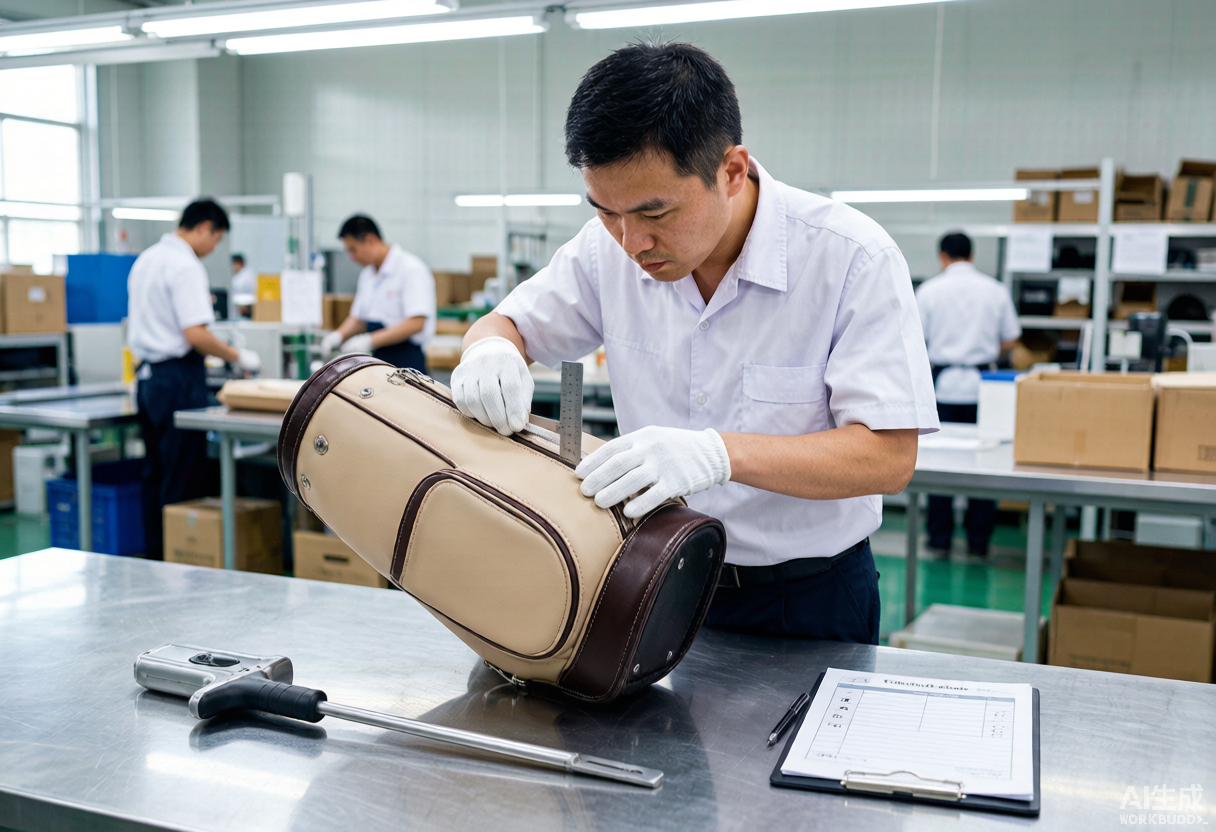
Serious golf bag QC runs on three named checkpoints, and you should hear all three in any factory's answer. IQC — incoming quality control — rejects off-shade fabric and out-of-tolerance hardware before it reaches the line, because a defect caught at the roll costs cents and the same defect caught at the carton costs dollars. IPQC — in-process control — walks the line checking stitch density, seam allowance and branding placement against the approved sample while correction is still cheap. PSI — pre-shipment inspection — samples the finished bulk to AQL 2.5 under the ISO 2859-1 sampling standard, with photographic reports you receive before the balance payment moves.
AQL 2.5 in practice means: for a 500-piece lot, the inspector pulls 50 bags at random and the lot passes with at most 3 major defects. It is not zero-defect manufacturing — nothing in soft goods is — but it is the enforceable line between a factory that inspects and a factory that hopes. The quality page documents our checkpoint system, defect classes and rework rules in full.
Standard reference: ANSI/ASQ Z1.4 (ISO 2859-1) sampling procedures — the inspection framework used across consumer soft goods, and the vocabulary your QC conversations should be conducted in.
A Worked Example: 500-Piece Private Label Launch
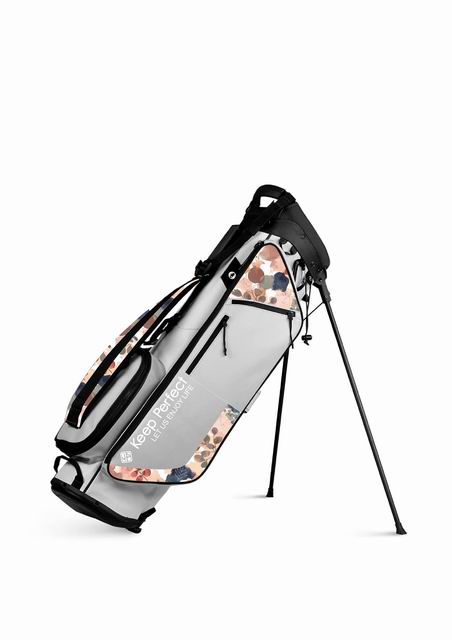
A direct-to-consumer brand briefs a floral-print Sunday bag: 500 pieces, 600D body with custom print, single-color embroidered crest, woven labels, printed belly band packaging. The quote comes back at USD 21.40 per unit FOB Xiamen — USD 10,700 total. Add the sample (USD 120, credited), ocean freight for 500 bags at roughly 2.8 cubic meters and 620 kilograms (USD 1,150–1,600 LCL to the US West Coast at 2026 rates), and US duty at the 4202.92 line's 17.6% on FOB value, and the landed cost settles near USD 26–27 per bag.
At a USD 95 retail price the program carries a 3.5x markup before channel costs — healthy for the category. The collection sells through in eleven weeks, and the reorder at 1,000 pieces drops the FOB to USD 18.90 because fabric, digitizing and setup amortize across more units. That reorder economics curve — not the first order's margin — is where private label programs make their money. A comparable real program is documented in the private label retail case study, anonymized but with the actual numbers.
Timelines: from Tech Pack to Delivered Cartons
A realistic private label calendar runs 60–80 days end to end: days 1–3 for quotation and spec freeze, days 4–13 for sampling, days 14–18 for sample transit and approval, days 19–58 for bulk production, day 59 for PSI, and 14–35 days ocean transit depending on destination. OEM adds 2–4 weeks at the front for pattern development and one to two extra sample rounds. Brands that need bags for a fixed date — a season launch, a tournament, a corporate event — should work backward from the date and protect the sample-approval week, which is where calendars actually slip.
| Phase | Private Label | Full OEM |
|---|---|---|
| Quote & spec freeze | Days 1–3 | Days 1–5 |
| Pattern development | — (existing chassis) | Days 6–20 |
| Sampling | Days 4–13 | Days 21–35, 1–2 rounds |
| Approval & deposit | Days 14–18 | Days 36–42 |
| Bulk production | Days 19–58 | Days 43–88 |
| Inspection & balance | Days 59–62 | Days 89–92 |
| Ocean transit (US/EU) | Days 63–97 | Days 93–127 |
Mistakes That Cost Brands a Season
- Starting with OEM before product-market fit. Tooling a proprietary bag before the first collection sells locks capital into an unproven design. Prove with private label; engineer with OEM.
- Comparing quotes with different specs. A USD 19 quote on 420D and a USD 26 quote on 840D are not two prices for one bag — they are two different bags. Normalize materials, branding suite and packaging before comparing.
- Approving samples from photos. Photos hide hand-feel, zipper action and strap comfort. Pay the courier; approve the physical sample.
- Skipping the pre-shipment inspection. PSI at AQL 2.5 costs USD 150–300 via third party and is the only moment a defect problem is still the factory's problem.
- Planning the launch date from the quote date. Calendars slip at sample approval and at vessel booking, not at the factory gate. Buffer both.
- Ignoring reorder economics. The margin is in the second order. Spec fabrics and prints the factory can hold or re-source identically, or your season-two bags won't match season one.
Getting Your Program Started
The fastest path from this guide to a quoted program is three pieces of information: your target chassis and quantity, your logo artwork (vector preferred), and your destination market. With those, a like-for-like quotation — unit price, branding suite inclusions, packaging, timeline — comes back within 24 hours. If you are still choosing between private label and OEM, say so in the brief; we quote both paths on the same chassis so the trade-off is in numbers, not adjectives.
Junyuan — the trading company behind this site, founded 2014 in Quanzhou, Fujian, led by a founder whose bag industry experience dates from 2004 — has run these programs for teams, academies, corporate buyers and retail brands across the US, UK, EU, Japan, Korea, Australia and the UAE. Production runs through the affiliated, SGS-verified factory described above plus two branch plants and audited partners. The about page carries the full entity disclosure, and the quote form is where programs start.
Frequently Asked Questions
How to create custom golf bags for my brand?
Three steps: pick your path (private label from 200 pieces on a proven chassis, or OEM from 500 pieces built to your tech pack), spec the branding suite (logo technique, Pantone colorway, packaging), and approve a physical sample before bulk. Sampling takes 6–10 days, bulk production 35–50 days after approval. Send your logo and target quantity through the quote form and the same spec sheet comes back priced within 24 hours.
What is the best manufacturer for custom golf bags?
The best manufacturer for custom golf bags is the one whose bulk matches their approved sample, inspects at AQL 2.5 with documented IQC/IPQC/PSI checkpoints, answers the five vetting questions in this guide without evasion, and holds current third-party verification — ours is SGS-verified for Alibaba.com, March 2026. Verify claims in that order before comparing prices.
What is the minimum order for custom golf bags?
200 pieces per style for private label programs, 300 for cosmetic OEM (custom everything visible on a factory chassis), and 500 for full OEM with new patterns and tooling. Mixed programs — 300 stand bags plus 200 Sunday bags, for example — ship together with the MOQ applied per style.
How much do custom golf bags cost in 2026?
FOB Xiamen at 500 pieces with a standard branding suite: Sunday/pencil bags USD 14–22, stand bags USD 19–34, cart bags USD 24–42, staff bags USD 38–65, travel covers USD 16–28. The 200-piece minimum adds 12–18%; quantities over 1,000 reduce prices 8–12%. Full OEM adds tooling amortization of roughly USD 4–8 per unit at 500 pieces.
How long does the whole process take?
60–80 days end to end for private label: 3 days to quote and freeze specs, 6–10 days sampling, about a week for sample transit and approval, 35–50 days bulk production, then 14–35 days ocean freight. Full OEM adds 2–4 weeks of pattern development and one or two extra sample rounds at the front.
OEM or private label — which is right for a new brand?
Private label, almost always. It proves your market at 200 pieces with zero tooling risk. Graduate to cosmetic OEM when a style sells through, and to full OEM when you have a hero SKU worth protecting with proprietary patterns. Brands that reverse this order typically spend USD 8,000–15,000 on tooling for an unproven design.
Can I put my logo on a stock bag design?
Yes — that is exactly what private label means: your embroidery, print or transfer branding, your Pantone colorway, your woven labels and packaging, on a chassis the factory has already engineered and proven. Minimum 200 pieces, samples in 6–10 days, and no tooling cost because the patterns already exist.
What logo file formats do manufacturers need?
Vector artwork — AI, EPS or PDF — for embroidery digitizing and screen print separations. High-resolution PNG (300 dpi at print size) works for heat transfer. Include Pantone references if colors are critical; without them, colors are matched to the factory's closest stock thread and ink.
Do I own the patterns if we develop a new bag?
In a full OEM program, yes — pattern and tooling ownership should be contractually assigned to you, and any manufacturer unwilling to put that in writing should not develop your bag. In private label the underlying chassis patterns remain the factory's; your branding assets and colorway specifications are always yours.
How is quality controlled during production?
Three checkpoints: IQC screens incoming fabric and hardware against spec, IPQC walks the line checking stitching and branding against the approved sample, and PSI samples finished goods to AQL 2.5 under ISO 2859-1 with a photographic report before balance payment. Third-party inspection is welcome at buyer's expense on any program.
What are the payment terms?
T/T 30% deposit to start production, 70% balance against bill of lading copy. Sample fees (USD 80–300 depending on complexity) are credited back on the first bulk order. FOB Xiamen is the baseline term; CIF and DDP quotations are available for every destination market we serve.
Can I mix different bag types in one order?
Yes — mixed programs are standard practice. A typical container might carry 300 stand bags, 150 cart bags and 50 staff bags, with the MOQ applied per style rather than per container. Mixed chassis share one production window and one inspection, which keeps logistics simple and freight efficient.