
Customization · Color
Pantone Color Matching for Custom Golf Bags
Custom golf bags are color-matched to your brand palette through Pantone TCX lab dips: the mill dyes a small swatch to your reference, you approve it under daylight, then bulk dyeing follows the approved lab dip within a ΔE tolerance of 1.5–2.0. Thread, webbing, zipper tape and hardware plating are matched to the same reference. Minimum 200 pieces per colorway; a dye-lot fee of USD 80–150 applies below 500 pieces. This page covers the complete color discipline — process, tolerance science, dye chemistry, metamerism and multi-colorway strategy.
How the Color Process Runs
Your palette becomes physical in five steps: Pantone TCX codes convert to dye recipes, the mill dyes a lab-dip swatch, you approve it under controlled daylight, bulk fabric is dyed to the approved reference within ΔE 1.5–2.0, and every other component — thread, webbing, zipper tape, plating — is matched to the same reference. The approved swatch and formula stay on file so reorders match.
We keep the approved swatch and dye formula on file so reorders in 2028 match your 2026 launch — the single most common failure in offshore bag programs is skipping this step.
- You send your Pantone TCX codes (or a physical swatch; TPX/TPG codes are converted).
- The mill dyes a lab dip — a 10×10 cm swatch — within 5–7 days.
- You approve under D65 daylight or a light box; we photograph it next to your reference.
- Bulk fabric is dyed to the approved lab; a cutting swatch from bulk is kept on file.
- Thread, webbing, zipper tape, lining and plating are matched to the same reference.
What ΔE Tolerances Mean for Your Brand
ΔE measures the distance between two colors; values below 2.0 are generally imperceptible side by side. Contract manufacturing for retail brands typically specifies ΔE ≤ 2.0 on body fabric and ≤ 3.0 on trims. We quote and inspect against those limits by default, and tighter tolerances (ΔE ≤ 1.0) are available for programs where bags hang on a retail wall next to each other.
For calibration: ΔE 1.0 is the threshold where a trained eye starts to see a difference under good light; ΔE 2.0–3.0 is visible to most people side by side; ΔE above 5 is a different colorway. When a supplier promises "exact match" without a tolerance, they are promising a feeling, not a spec — the tolerance is the spec.
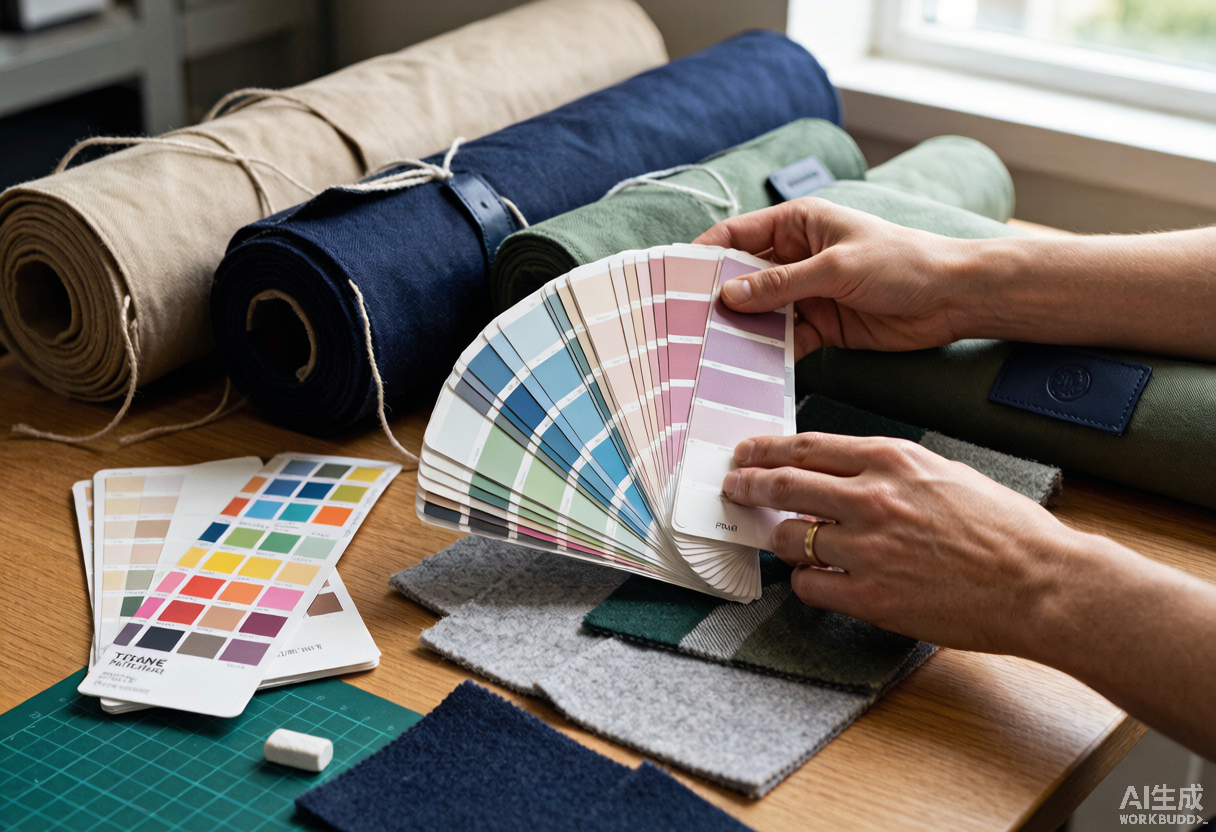
Metamerism: Why Colors Match in One Light and Not Another
The trap that catches even experienced buyers: two swatches match perfectly in your office and mismatch badly at the trade show. That is metamerism — dye chemistries with different spectral curves can agree under one light source and diverge under another. Office LED (cool white), store lighting (usually fluorescent TL84) and daylight (D65) each render dyes differently.
The professional protocol: approve under D65 primary and TL84 secondary, both in a light box or verified conditions, and photograph the swatch next to your reference under both. We run that protocol on every program because it costs minutes and prevents the classic "the bags look different in the retail store" claim that is really two light sources disagreeing.
Dye Chemistry, Briefly
The practical consequences: polyester (the golf bag workhorse) achieves the widest, most stable gamut; nylon saturates deeply but can shift with UV exposure over years (UV-stabilized dyes mitigate); and blends take the dye of their dominant fiber, which is why poly-ripstop panels match more predictably than blended weaves.
| Fiber | Dye family | Process | Color capability |
|---|---|---|---|
| Polyester | Disperse | High-temperature pressure dyeing | Widest gamut, best fastness |
| Nylon | Acid | Moderate temperature | Deep, saturated colors |
| Cotton / canvas | Reactive | Ambient with fixatives | Natural palette, good fastness |
| PU coatings | Pigment in coating | Coating process | Approximates references well |
The Parts That Are Hard to Match
The "Fair" rows are not failures — they are material physics: metal plating produces finishes (brushed, polished, tinted), not Pantone coordinates, and molded pigments approximate within a visible range. We approve physical chips for both before bulk so nothing surprises you at assembly.
| Component | Matchability | Notes |
|---|---|---|
| Body fabric | Excellent | Dyed to TCX, ΔE ≤ 2.0 |
| Thread & webbing | Excellent | Spun-dyed to same reference |
| Zipper tape | Good | Major-brand zippers offer TCX dyeing |
| Zipper metal / plating | Fair | Plating is matched by finish (gold, gun, nickel), not exact Pantone |
| Molded parts (feet, bases) | Fair | Masterbatch pigments approximate; approve a molded chip |
| Printed logos | Excellent | Ink mixed to TCX for screen print |
Approval Workflow Done Right
The 30-minute version of professional color approval: view swatches in a light box or by a north-facing window (never under office LED alone); compare against your reference at the same angle and distance; check both D65 and a warm light for metamerism; photograph the swatch on a neutral gray background next to the reference for the record; and approve in writing with the photo attached. That paper trail is what makes a reorder dispute resolvable and a season-two match routine. The Pantone matching article covers the same workflow with the failure stories that taught it.
Color Across Branding Techniques
A brand palette has to survive more than dye: the embroidery thread, the screen ink, the transfer film and the molded trim pigment all render the same Pantone reference through different chemistries. We manage that by matching every technique to the same physical reference (the approved lab dip), not to the Pantone book directly — thread dyed to TCX, ink mixed to TCX against the same chip. Programs with strict palettes get a "color bible" page in the tech pack showing each technique's rendering, approved once, applied everywhere.
Seasonal Color Management
Pantone TCX references get discontinued; new Fashion Color Report palettes arrive; your brand evolves. The discipline that protects you: archive the physical approved swatch (not just the code), record the dye formula with the mill, and re-approve against archived swatches — not the current book — on reorders. A discontinued code with a formula on file still dyes; a code without either becomes a re-development project. This is bureaucratic until the day it saves your best-selling colorway, which is why it is our default and part of the reorder file discipline.
Multi-Colorway Programs
Most retail programs launch with 2–3 colorways. The MOQ math: 200 pieces per colorway, meaning a 600-piece order can carry three palettes. Team and corporate programs usually keep one colorway and vary the branding instead.
One planning note from experience: dark colorways (navy, forest) hide soil and UV fade best for rental and academy use; light colorways (cream, sand) photograph better for DTC launch campaigns and cost the same to produce. And colorways that share trim colors (two bodies, one webbing) save component complexity that shows up in both cost and consistency.
Worked Example: A Two-Colorway Retail Launch
A retail brand launching a Sunday bag in sage and cream, with brass-plated hardware and the brand's own sage-derived logo thread. The color program ran: sage TCX reference from the brand's style guide; lab dip in 6 days, photographed against the reference under D65 and TL84; one revision (first dip skewed cool — the mill adjusted the formula toward yellow); second dip approved in writing with the photo attached. Cream came from a stock near-match that the brand approved as-is — no dye lot, no fee, a saving worth checking for on every secondary colorway. Bulk: sage panels dyed to the approved formula, thread spun-dyed to the same reference, brass plating approved from a chip. Reorder, 14 months later: the archived formula and swatch answered the question before it was asked.
Total color cost: one dye-lot fee (USD 120, under the 500-per-colorway threshold for the sage), one lab-dip revision cycle (6 days), and a threaded approval trail that made the reorder routine. That is what a color program costs when it is run professionally — and what it costs to not have the conversation when colors are assumed.
Common Color Failures and Their Fixes
Notice the pattern: every fix is a documentation fix, not a technology fix. Color chemistry is reliable; the failures live in the approval and record-keeping layer, which is why our process spends its discipline there.
| Failure | What it looks like | Root cause | Fix |
|---|---|---|---|
| Off-shade bulk | Bulk fabric visibly differs from approved sample | No approved lab dip on file; bulk dyed to standard stock | Lab dip + formula archived before bulk, always |
| Metameric mismatch | Matches in the office, differs in the store | Approval under office LED only | Approve under D65 + TL84 in controlled light |
| Trim drift | Body matches, trims read different | Trims matched by eye, not reference | One reference drives every component, chips approved |
| Reorder shift | Season two is "almost" season one | Dye formula not archived; re-development from code | Formula + physical swatch archived at first bulk |
Photography Versus Reality
One expectation to set honestly: product photography will not reproduce your bag's colors exactly, and that is physics, not a defect. Cameras render dye spectra imperfectly; screens render camera output imperfectly; and the same sage bag reads differently in golden-hour lifestyle shots versus neutral studio light. Brands managing launch campaigns handle this by color-matching campaign graphics to the product photography (not the dye reference) — so the website, the ads and the bag agree with each other in the medium customers actually see. The dye reference governs the physical product; the photography governs its digital shadow; conflating them creates disputes nobody can win.
For programs where the PDP must be color-exact (color-critical retail lines), we supply first-article photography against a gray card and recommend your studio shoot from the same first-article samples the container matches.
Lab Dips, Strike-Offs and Bulk Swatches: The Vocabulary
Each artifact answers a different question and none substitutes for another: the lab dip approves chemistry, the strike-off approves rendering, the bulk swatch proves the run. Programs that skip the bulk swatch discover dye-lot drift at retail; programs that treat a strike-off as a lab dip discover that ink on texture reads darker than the swatch that approved the dye. When your program runs color fabric plus printed logos plus embroidered marks, all three artifacts exist for the same reference, and the file that holds them is what makes a reorder identical.
Timing note: lab dips run 5–7 days, strike-offs 2–4 days after ink or film is briefed, and the bulk swatch exists on cutting day — so a full three-artifact color program adds about a week to the front of the schedule once, and nothing thereafter if the file is kept. Programs that need all three artifacts fast brief them in parallel, not in sequence; the mill and the print shop do not need each other's output.
Retention closes the loop: every approved artifact is archived with the formula and the photo record — see reorder consistency for how season two pulls the file instead of re-litigating the color.
| Artifact | What it is | Made by | What it approves |
|---|---|---|---|
| Lab dip | A 10×10 cm fabric swatch dyed to your reference, before bulk | The dye mill | The dye formula — the color itself |
| Strike-off | A print or transfer sample on your actual fabric and ink/film | The print shop | How branding renders the color on the real surface |
| Bulk cutting swatch | A swatch cut from the actual production roll | Taken at cutting | That bulk matches the approved dip (ΔE check) |
Colorfastness: The Tests Behind the Promises
Calibrating the numbers: blue wool 4 means visible fading to a trained eye after roughly a season of hard direct-sun exposure — adequate for a promotional chassis, marginal for a retail line claiming outdoor durability, and the reason premium programs specify 5+. Crocking matters on the course, not just in the lab: a wet crock rating below 3 is the "navy bag stained my white polo" claim, and dark saturated colorways (navy, forest, burgundy) are where it is earned or lost — the dyehouse runs the test because the difference is chemistry, not attitude.
Two practical notes. First, fastness and color matching trade off at the extremes: the most saturated deep dyes that match a vivid Pantone reference sometimes give up a half-point of light fastness to get there, and the honest supplier quotes the trade-off rather than promising both perfect. Second, test reports are per dye-lot and per formula — archive them with the program file, because "our bags faded" in year three is answered by the report for the lot that shipped, not by the mill's general claims.
Where fastness requirements are contractual — rental fleets, academy programs, uniform-adjacent specs — we quote the test matrix up front and the reports travel with the shipment. It is a paperwork habit, not a price tier.
| Test | Measures | Scale | Golf-bag target |
|---|---|---|---|
| Light fastness (ISO 105-B / blue wool) | Color loss under sustained UV | 1–8 | ≥ 4 for outdoor life; 5+ for dark colorways |
| Crocking (ISO 105-X12) | Color transfer by rubbing, dry and wet | 1–5 (grey scale) | ≥ 4 dry / ≥ 3 wet |
| Wash fastness (ISO 105-C) | Color loss and staining in washing | 1–5 | ≥ 4 |
| Sublimation / heat (ISO 105-P) | Color migration under heat and pressure | 1–5 | Relevant for storage and pressing zones |
How Color Lives in the Tech Pack
A color program is only as good as its documentation, so ours standardizes a color page inside every tech pack: the Pantone TCX reference codes; photos of the approved lab dip against the reference under D65 and TL84; the thread shade codes from the embroidery system; the ink formula reference for printed marks; the plating finish approved from chip for metal trims; and the ΔE tolerance the program inspects against. One page answers every color question the program will ever generate — at bulk inspection, at the reorder, and in the unlikely dispute.
The page earns its keep at three specific moments. At IQC, incoming fabric is checked against the approved dip, not against memory. At PSI, the AQL inspector compares bulk against the archived swatch — the physical reference, because screens lie. At reorder, the mill pulls the formula and the file answers the question the buyer has not asked yet. Documentation is not bureaucracy here; it is the technology that makes a color repeatable.
For brands, the same page doubles as your internal color bible: hand it to your photographer, your packaging printer and your web team so the campaign, the box and the bag sit in one palette in every medium — see the Pantone workflow article for how the references are built.
One honest limit to document at spec stage: color on the bag and color in your campaign photography will never be identical (see Photography Versus Reality above) — the tech pack's color page is the physical record, the campaign is its own medium, and writing that distinction into the program prevents the one dispute no amount of chemistry can resolve.
Frequently Asked Questions
Can you match my brand color exactly?
Within ΔE 1.5–2.0 against your Pantone TCX reference — visually indistinguishable in most light. Exact-match perfection is physically impossible across dye chemistry, which is why the industry works on approved lab dips rather than promises.
What is a dye-lot fee?
A charge of USD 80–150 to set up a custom dye run below 500 pieces per color. Above 500, the fee is absorbed. You receive the lab dip and a bulk cutting swatch for approval before anything is sewn.
My colors are CMYK, not Pantone — can you use them?
We convert CMYK references to the closest TCX and confirm with a lab dip. CMYK is a print color space and does not translate to dyed textiles directly, so the physical swatch is the real approval.
Do reorders match the original color?
Yes, when the dye formula and approved swatch are on file, which is our default. This is one of the pillars of our reorder consistency program.
Why did my sample look different in the store?
Metamerism — dyes that agree under one light source can disagree under another. Approving under D65 plus TL84 in controlled conditions is the countermeasure, and it is standard in our workflow.
Can the zipper metal match my Pantone?
Plating produces finishes, not exact colors: gold, gun-metal, nickel and rose-gold families approximate warm/cool tones. We approve a plated chip against your palette so the finish is deliberate.
How many colorways should I launch?
Two to three for retail programs (one hero plus supporting), one for teams and corporate. Each colorway carries its own dye lot and 200-piece minimum, so color depth is a budget decision.
What if my Pantone gets discontinued?
Nothing, if the program ran with us: the approved swatch and dye formula are archived, and reorders dye to the formula — the Pantone book is the starting point, not the record.
Do light colors cost more than dark?
No — same dye process. The real cost difference is prints versus solids (see print programs), not light versus dark.
How long does the whole color approval process take?
Five to seven days for the first lab dip, a day or two for your review, and a revision cycle of the same length if needed — so one clean approval adds a week, one revision adds two. Build the week into the calendar before bulk; it is the cheapest week in the program.
Can we approve colors remotely, or do we need to visit?
Remotely, with discipline: we photograph the swatch next to your reference under D65 and TL84 on a neutral gray card, and you approve in writing against the photo. Physical swatches travel by courier when programs need them — retail launches usually mail the approved dip both directions once.
What does a dye-house do differently for premium programs?
The same chemistry with tighter control: lab dips to ΔE 1.0 instead of 2.0, colorfastness tests quoted per lot rather than per dye family, and the retention file extended to thread, ink and plating chips. The premium is in the paperwork and the tolerance — the color itself is the same science.
Is color matching worth it for promotional programs?
Often no — stock colors from the mill's standard line cover most event and corporate programs, and the dye-lot fee buys nothing they need. Color matching earns its cost when the bag must match a brand palette, a team identity, or a retail line. The honest spec conversation separates the two early.
Ready to spec your custom golf bags?
Send your logo, bag type and target quantity — we reply with a quote, MOQ and timeline within 24 hours.