
Why Color Is the Brand
Because customers read color before they read logos: Tiffany blue, UPS brown, your club's exact green — color is the fastest brand signal there is, and a half-shade miss reads as counterfeit even when everything else is perfect.
In softgoods, color inconsistency is the most common brand-damaging defect — more visible than a crooked seam, more memorable than a late shipment. The mechanism is unforgiving: human color memory is poor, but human color comparison is excellent. Put two bags side by side and a Delta E of 2.0 is obvious; put season two beside season one and a different dye lot announces itself instantly. This is why color matching is a laboratory discipline with instruments, tolerances and approval documents — not a conversation about whether something looks "close enough."
The Four-Step Protocol
Every step exists because color fails predictably without it. The reference must be a code or a physical object — "our website blue" is not a reference (screens render color differently; a website hex is not a Pantone). The lab dip must be on your actual fabric — the same formula reads differently on 600D polyester, 1680D ballistic and PU leather because fiber and finish change how dye sits. And approval must be under standardized light, which is its own science, covered next.
| Step | What happens | Your role | Calendar |
|---|---|---|---|
| 1. Reference capture | Your Pantone code (Solid Coated) or physical swatch is logged as the target | Supply the code or swatch | Day 1 |
| 2. Lab dips | Dye house produces swatches on your actual fabric, 2-3 formula options | Receive by courier | Days 3–7 |
| 3. Approval under D65 | You compare dip vs target in a D65 light environment | Written approval of one dip | Days 8–12 |
| 4. Bulk dyeing | Single dye lot produced to the approved dip, spectro-verified | Nothing — IQC documents it | Bulk schedule |
D65: the Light That Decides
D65 is the international standard for average daylight — 6500K color temperature, defined in ISO/CIE standards — and it is the light under which color approvals are meaningful. The problem it solves is metamerism: two colors that match under one light source and visibly differ under another, because their spectral compositions differ. A dip approved under office fluorescent can miss badly in daylight; a dip approved under D65 holds everywhere, because D65 approximates the light the product will actually live in.
The practical protocol for buyers without a light booth: approve beside a north-facing window at midday, never under office tubes or warm home lighting. We photograph dips under D65 lamps and courier the physical swatch — the photo orients you, the swatch decides. Spectrophotometer readings (the instrument numbers) accompany every dip: L*a*b* values against target with the Delta E computed, so the approval is documented in numbers, not just in eyes. The color matching page documents this protocol as standard practice.
Delta E: the Tolerance That Means Something
Delta E (dE) is the computed distance between two colors in perceptual space: 0 is identical, under 1.0 is invisible to most eyes, 1.0–2.0 is detectable on careful comparison, above 2.0 is visible to anyone. Production color matching works to tolerances: our standard is dE ≤ 1.0–1.5 between approved dip and bulk fabric — the band where variation exists but is not commercially visible. Buyers should know the number because it converts "color matched" from a promise into a measurement.
Where tolerance gets consumed: different materials on one bag. Polyester fabric, nylon webbing, plastic zipper tape, mesh and PU trim each take dye differently, so each material is lab-dipped separately against the same target — five materials, five dips, one approved standard. The finished bag's color coherence is the sum of those five approvals, which is why "the bag is the wrong color" complaints are almost always "one material on the bag is the wrong color" complaints in disguise.
Thread, Ink and Label Color Systems
Fabric is only one color system on a branded bag. Embroidery thread matches to thread manufacturers' color charts (Madeira and Robison-Anton are the industry standards) — your Pantone is converted to the nearest thread shade, and where the nearest is not near enough, multi-brand thread sourcing or custom-dyed thread (at program scale) closes the gap. Print inks mix directly to Pantone Solid Coated formulas — screen printing matches Pantone most faithfully of any technique; heat transfers print to CMYK approximations with documented variance. Woven labels match yarn colors to the target with their own lab-dip equivalent (a woven strike-off).
The discipline across all three: every color-bearing component is matched to the same target and approved in the same loop, then checked at IQC against the approved standards when materials arrive. The embroidery page covers thread systems in detail; the principle here is that a bag carries four color systems — fabric, thread, ink, label — and brand color is only achieved when all four answer to one target.
Dye-Lot Control: the Season-Two Problem
A dye lot is one batch of dyed fabric, and no two lots are perfectly identical — chemistry, water, temperature and time all leave signatures. Within one lot, consistency is excellent; between lots, drift of dE 1–3 is normal without controls. For a single production run the answer is simple: one lot covers the whole run, cut nothing from another lot. The problem arrives at reorder, season two, when new fabric must match the bag your customers already own.
The controls, in order of strength. Forward buying: purchase both runs' fabric at PO one — the strongest fix, locking one lot across seasons; it costs working capital and is standard for programs with committed reorders. Retained standards: the approved dip and a bulk cutting are archived with the spec, and the reorder's lab dips match back to them (not to the original Pantone — to the approved reality). Spectro verification at IQC: the reorder lot measured against the retained standard before cutting, dE documented. Programs that skip these learn about metamerism from their customers' side-by-side photos.
What Custom Dyeing Costs and When It Is Worth It
Custom dyeing adds cost and calendar, and honesty about both serves the decision. Cost: dye-house setup and minimums spread across your fabric consumption — at 200 pieces, roughly USD 0.60–1.40 per bag depending on chassis fabric load; at 1,000 pieces it fades to noise. Calendar: 2–4 weeks added to materials lead time (dip loop plus dyeing plus delivery), which the timeline guide builds into custom-dyed programs from the start.
When it is worth it: brand-critical colors (your identity lives in the color — teams, clubs, licensed programs), colors outside stock card ranges (that specific coral, that exact forest), and programs where season-over-season consistency is contractual (retail planograms, team reorders). When it is not: programs near a stock shade (the stock card covers 40+ colors; PMS 286 C has a stock neighbor most buyers accept), first-run market tests (prove the product in stock navy; custom-dye the proven winner), and speed-critical orders. The stock-versus-custom decision is a quotation-stage conversation with costs explicit both ways.
Reading a Lab Dip Package
The dip package that arrives contains: two to three swatch options on your fabric (labeled with formula codes), the target reference (your Pantone chip or the standard you supplied), and the spectro readings per option. Evaluate in this order: first under D65-equivalent light (north window, midday) against the target; second at arm's length (the distance customers see); third beside any existing product it must match (last season's bag, your other merchandise). Then approve one option in writing by formula code — "Option B approved" — because that code is what bulk dyeing executes.
If nothing matches: say so, and the dye house iterates — a second dip round is normal for difficult targets (very saturated colors, fluorescents, some pastels are genuinely hard on certain fibers). The loop exists precisely so this conversation happens over swatches. What you should never do is approve a near-miss to protect the calendar: a season of slightly-wrong brand color costs more than a week of dip iteration.
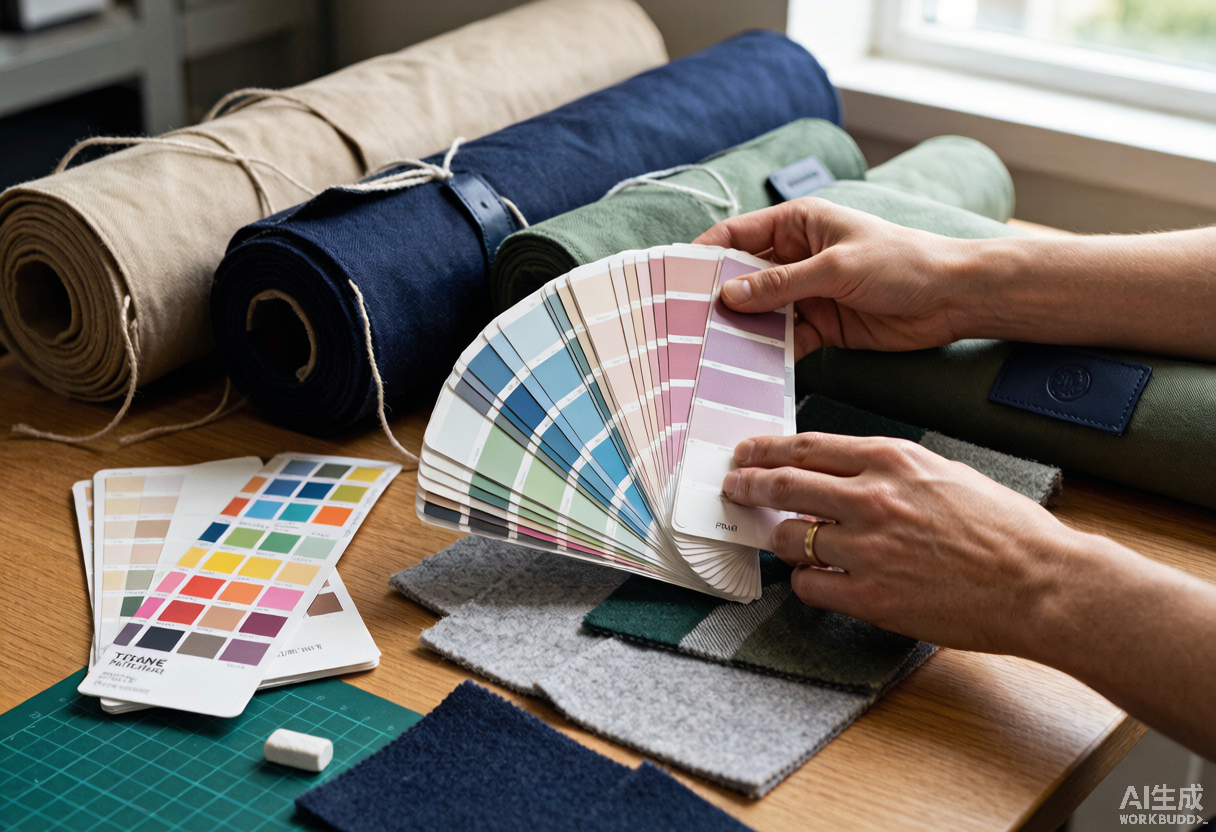
Color Behavior by Decoration Method
Each branding technique renders color with its own physics, and matching across techniques is a known discipline. Embroidery thread has texture — its shadows deepen perceived color, so thread shades are often chosen a half-step lighter than the flat target. Screen print ink sits on the surface — the truest Pantone reproduction available. Heat transfer prints through a CMYK process — gamut-limited at the extremes (very bright oranges, deep greens) and documented as approximation. Debossed and tonal branding uses no color at all — the material is the color, which is why tone-on-tone programs live and die on the fabric match alone.
For multi-technique branding (embroidered crest plus printed graphic), the approval set includes both executions side by side on your fabric — because the eye compares them, and the approval should too. The techniques comparison covers each method's color behavior alongside its cost and durability profile.
Where Color Programs Fail
- Reference by screenshot. A hex code from your website is not a Pantone; screens render color by device. Supply the Solid Coated code or a physical swatch.
- Approval under office light. Fluorescent approval fails in daylight; metamerism is the science of that failure. D65 or a north window.
- Dips on the wrong fabric. A dip on 600D says nothing about 1680D or PU; every material gets its own dip against the shared target.
- Season-two amnesia. Reorders must match the retained approved standard, not restart from the Pantone — lots drift, standards anchor.
- Calendar compression. Custom dyeing adds 2–4 weeks; programs that discover this at PO stage either slip or settle for stock. Decide at quotation.
- Thread as afterthought. The bag can be perfect while the crest is off; thread is its own color system with its own approval.
Color and the Inspection Report
Color verification runs through the full QC chain: IQC measures incoming fabric against the approved dip (spectro reading, dE documented); IPQC checks thread and print colors against approved standards at line side; PSI photographs branding color against references under controlled light and includes the readings in your report. A color deviation is therefore caught where it is cheapest — at the fabric warehouse, not in your customer's hands.
The photographic PSI report's color documentation has one honest limit: photography approximates color. The numbers (spectro readings at IQC) are the objective record; the photos orient you to what the numbers say. When the two disagree, trust the numbers and ask questions — that is what they are for. The AQL guide covers the full report structure these readings sit inside.
Special Cases: Pastels, Camo and Metallics
Three color families demand extra discipline. Pastels: the least forgiving — a half-tone drift that navy hides is glaring in sakura pink, and pastels show soil and handling marks in transit (packing discipline becomes color discipline). Multi-color prints like camo: each print color is matched separately (a camo is four to six simultaneous color matches), with registration tolerance on top — the camo program guide covers the pattern-specific layer. Metallic threads and foils: they reflect rather than absorb light, so they match by effect approval under the lighting the product will face, not by instrument — test them at sample stage without exception.
All three share one rule: the approval loop is longer and the tolerance conversation happens earlier. Programs in these families should expect two dip rounds as standard and build the week into the calendar rather than discovering it.
Starting a Color-Critical Program
The brief adds one line to the usual five: your Pantone Solid Coated reference (or a physical swatch couriered to us). The quotation returns with stock-versus-custom options priced, the dip loop scheduled, and the tolerance standard (dE ≤ 1.0–1.5) stated in writing. Sampling includes your color execution on the actual chassis, and bulk carries the IQC spectro documentation. Junyuan has matched brand colors since 2014 — from club greens to licensed-character palettes — through the quote form. Your blue is safe here.
Frequently Asked Questions
How do factories match Pantone colors on golf bags?
By lab dips: your Pantone reference becomes a dye formula, swatches of your actual fabric are dyed in two to three formula options and couriered to you, you approve one under D65 standard daylight, and bulk fabric is dyed in a single lot verified by spectrophotometer to Delta E ≤ 1.0–1.5 against the approved dip. Thread, print ink and labels match to the same target through their own systems.
What is a lab dip?
A small swatch of your production fabric dyed to your target color — the physical proof of the dye formula before bulk. Two to three options arrive by courier with spectrophotometer readings (L*a*b* values and Delta E against target); you approve one in writing by formula code, and that code is what the bulk dye lot executes.
What is D65 and why does it matter for color approval?
D65 is the international standard for average daylight (6500K, per ISO/CIE). Approving colors under it prevents metamerism — pairs that match under one light and mismatch under another. Office fluorescent approval fails in daylight; D65 approval holds everywhere. Without a light booth, approve beside a north-facing window at midday.
What Delta E tolerance should I expect in production?
Delta E ≤ 1.0–1.5 between approved dip and bulk fabric — the band where variation exists but is not commercially visible (under 1.0 is invisible to most eyes; above 2.0 is obvious). The number converts "color matched" from a promise into a measurement, and it appears in IQC documentation for your order.
How much does custom fabric dyeing cost and add to the timeline?
Roughly USD 0.60–1.40 per bag at 200 pieces (dye-house setup spread over fabric consumption), fading to near zero at 1,000 pieces. Calendar: 2–4 weeks added to materials lead time for the dip loop and dyeing. Worth it for brand-critical colors and contractual consistency; stock shades serve most other programs from a 40-plus color card.
Why did my reorder arrive a slightly different color?
Dye-lot drift: no two dye batches are identical, and without controls, lot-to-lot variance runs Delta E 1–3. The fixes: forward-buy both runs' fabric at PO one, archive the approved dip and bulk cutting as the retained standard, and verify the reorder lot by spectrophotometer at IQC against that standard — not against the original Pantone.
How are embroidery thread colors matched?
Your Pantone is converted to the nearest shade on thread manufacturers' charts (Madeira, Robison-Anton), with multi-brand sourcing or custom-dyed thread closing gaps at program scale. Thread's texture deepens perceived color through shadow, so shades are often chosen a half-step lighter than the flat target — validated on the sample, not assumed.
Can you match a color from a photo or website?
Not reliably — screens render color by device, so a screenshot or hex code is not a color reference. Supply the Pantone Solid Coated code from your brand guidelines, or courier a physical swatch (an existing product, a fabric cutting, a printed standard). The matching protocol is only as good as the target it aims at.
How do multi-material bags keep one consistent color?
Each material — polyester body, nylon webbing, zipper tape, mesh, PU trim — takes dye differently, so each is lab-dipped separately against the same target: five materials, five dips, one approved standard. The finished bag's color coherence is the sum of those approvals, checked again at IQC when materials arrive.
Do pastel colors need special handling?
Yes — pastels are the least forgiving family: half-tone drift that dark colors hide is glaring in light shades, and light grounds show soil and handling marks. Expect two dip rounds as standard, single-lot bulk discipline, and packing protocols that treat scuff control as color protection.
How is color checked during quality inspection?
At three points: IQC measures incoming fabric against the approved dip by spectrophotometer (Delta E documented), IPQC checks thread and print colors against approved standards at line side, and PSI photographs branding color under controlled light with readings in your report. Deviations are caught at the cheapest checkpoint — before cutting, not after delivery.
What if none of the lab dip options match?
Say so — a second dip round is normal for difficult targets (very saturated colors, fluorescents, some pastels on certain fibers). The loop exists so this conversation happens over swatches, not over a production run. Never approve a near-miss to protect the calendar: a season of slightly-wrong brand color costs more than a week of iteration.
Can you match colors across different product runs and seasons?
Yes, with the retained-standard discipline: your approved dip and a bulk cutting are archived with your spec, reorder lab dips match back to them, and the new lot is spectro-verified at IQC before cutting. Programs with committed reorders often forward-buy fabric at PO one to lock a single lot across seasons — the strongest continuity available and standard practice for team and retail programs.
How do I start a color-critical program with your factory?
Add one line to the brief — your Pantone Solid Coated reference or a physical swatch — through the quote form on this site. The quotation returns with stock-versus-custom options priced, the dip loop scheduled, and the Delta E tolerance stated in writing; your sample carries the color execution on the actual chassis before bulk begins.