
The Timeline Up Front
Private label: 60–80 days door to door. Full OEM: 90–120 days. Reorders: 30–45 days because sampling, digitizing and lab dips are already done. The single biggest variable is not the factory — it is how fast you approve the sample.
| Phase | Private label | Full OEM | Reorder |
|---|---|---|---|
| Quotation | 1–3 days | 1–5 days | 1 day |
| Engineering | 3–7 days | 14–28 days | — |
| Sampling | 6–10 days | 10–15 days × 1–2 rounds | — |
| Approval & deposit | 3–7 days | 3–7 days | 1 day |
| Bulk production | 35–50 days | 45–60 days | 28–40 days |
| Inspection (AQL 2.5) | 2–3 days | 2–3 days | 2–3 days |
| Ocean freight | 14–35 days | 14–35 days | 14–35 days |
| Total | 60–80 days | 90–120 days | 45–80 days |
Week by Week: the Private Label Calendar
Week one is paperwork: your brief (chassis, quantity, branding, destination) becomes a spec-level quotation within 24 hours, and approval of that quote plus the sample fee opens engineering. Week two is sampling — digitizing, lab dips, the physical bag built and couriered. Week three is yours: the sample arrives, you check it against spec, you approve in writing and wire the 30% deposit. Weeks four through nine are bulk production, largely silent from your side except the mid-production photo set. Week ten closes it out: AQL 2.5 pre-shipment inspection, the photographic report, your 70% balance against the bill of lading copy, and the vessel sails.
Everything after week ten is freight — 14–18 days to the US West Coast, 22–32 to the East Coast, 28–40 to North Europe, plus 2–5 days of customs clearance with correct documents. A program briefed on September 1 lands in Los Angeles in the first week of November; the same program lands in Hamburg mid-November. The nine-step process map shows where each of these weeks sits in the full flow.
Why Sampling Takes 6 to 10 Days
The sampling window is four operations stacked, not one. Digitizing converts your logo to a stitch program (day 1). Lab dips match fabric to your Pantone under D65 light (days 1–3, parallel). The sample room cuts and sews the bag itself (days 3–7) — one bag built by a senior sewer, not a line. Branding is executed and the bag is finished, photographed and couriered (days 7–10). The range exists because branding complexity varies: a single embroidered crest sits at day 6; a four-position mixed-technique suite with custom-dyed fabric sits at day 10.
What the window does not include is indecision: revision requests reset the clock (revised samples run 4–7 days because digitizing and patterns exist). Full terms — fees, credits, revision pricing — are on the sample policy page.
Why Bulk Takes 35 to 50 Days
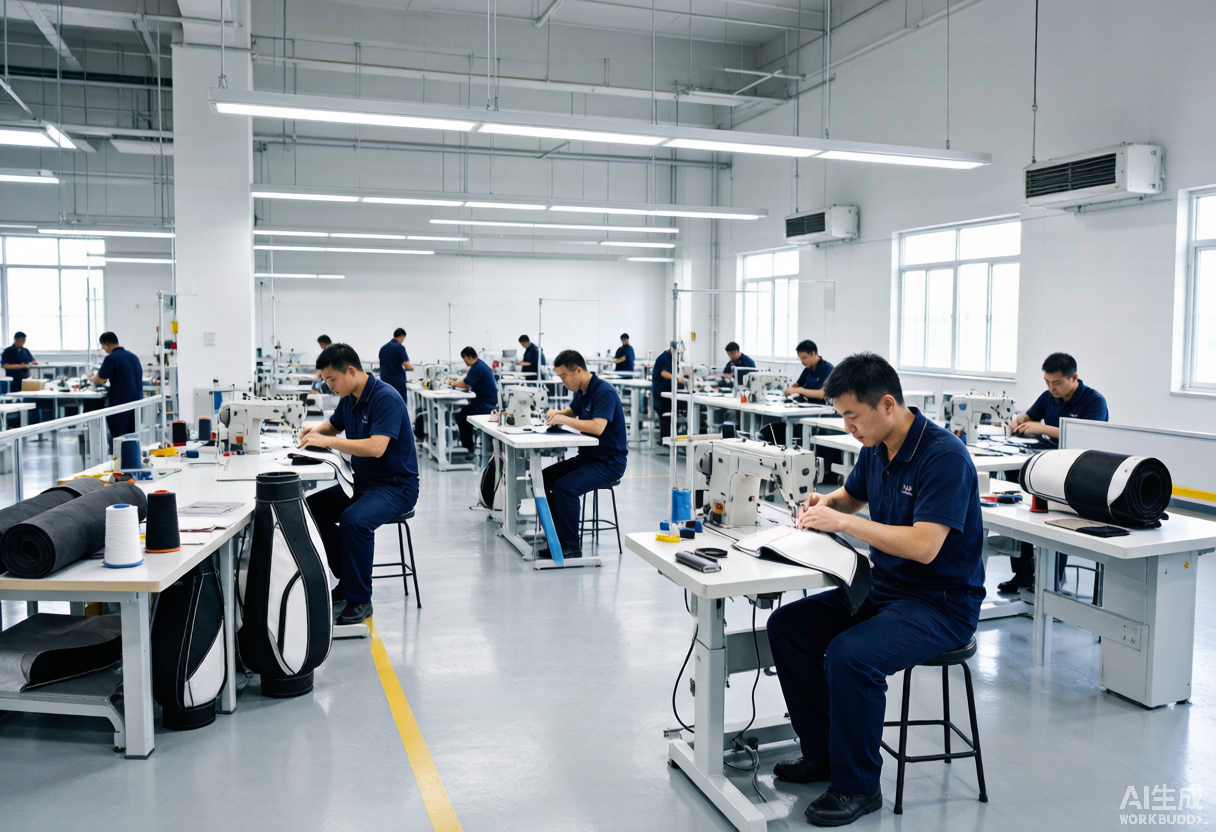
Bulk production is a materials pipeline before it is a sewing operation. Days 1–10 of the window are upstream: fabric and hardware purchasing against confirmed orders, custom dyeing if your colorway requires it, and incoming quality control at the roll. Days 10–15 are cutting — CNC and die-cutting of every panel to pattern. Days 15–40 are the line itself: embroidery and printing first (branding happens on flat panels, before assembly), then panel prep, then assembly, then finishing. Days 40–50 cover final inspection preparation, packing and documentation.
The 15-day spread (35 vs 50) is mostly quantity and complexity: 200 Sunday bags with one print position sit near 35; 1,000 staff bags with a full branding suite sit near 50. What the window never contains is your approval loop — production starts at deposit, and factories that begin ordering fabric before the deposit are financing your indecision with their cash flow, a favor you pay for somewhere else.
Freight Times by Destination
Ocean freight from Xiamen, port to port: US West Coast 14–18 days, US East Coast 22–32, UK 26–34, North Europe 28–40, Australia 12–18, Japan 4–7, Korea 3–5, UAE 14–20. Add 1–7 days for booking (longer in the August–October peak), 2–5 days for customs with correct documents, and 1–5 days for final delivery. LCL consolidation can add 3–7 days at origin against FCL — the price of shipping 500 bags instead of 4,500.
Air freight compresses transit to 3–7 days at 6–10 times the ocean cost per kilogram — economically irrational for bulk bags, entirely rational for 20–50 samples, press units or a small launch batch that makes a date the container cannot. Destination-specific duty, VAT and compliance notes live on the market pages: USA, UK, EU, Australia, Japan and six more.
The Booking Window Nobody Tracks
Between "production complete" and "vessel departed" hides a week that first-time importers never budget: booking lead time. Container space on the Xiamen–US lanes books 5–10 days out in normal months and 2–3 weeks out from August through October, when every retailer on earth is moving holiday inventory. A program that finishes production on September 25 without a booking doesn't ship September 26 — it ships whenever space exists, and in peak season that answer can be October 12.
The discipline that eliminates the window: book freight at production start, not at completion. The completion date is known within a few days once the line is scheduled, and forwarders happily book against estimated dates and adjust. This single habit converts peak-season freight from a lottery into a reservation, and it costs nothing except deciding early. DDP programs handle it for you; FOB buyers should make it a checkbox next to the deposit wire.
The OEM Timeline: What the Extra Weeks Buy
Full OEM's 90–120 days buy engineering that private label gets free from the chassis library: pattern drafting from your tech pack (week 2–3), grading and paper prototyping (week 3–4), a structural first sample (week 4–6), your structural feedback, and a refinement sample (week 6–8) before the standard bulk loop even begins. The tooling invoice — USD 2,000–8,000 for patterns, molds and cutting dies — is the financial expression of the same weeks.
The calendar discipline that keeps OEM at 90 days instead of 150 is consolidated feedback: one structured revision list per sample round, not a drip of daily emails. Every additional sample round costs 10–15 days; programs that arrive with a complete tech pack and decisive approvers routinely finish in two rounds, and programs that discover their opinions during sampling discover them at two weeks per opinion.
Rush Orders: What Compresses and What Doesn't
Compressible with money: fabric sourcing (stock colors ship immediately — custom dyeing is the first thing to sacrifice), air freight (weeks to days at 6–10x cost), and line scheduling (a rush slot inside existing capacity, typically a 10–15% production premium). Compressible with discipline: your own approval loop, which is free and worth more than any premium — a 48-hour sample approval saves more calendar than any rush fee.
Not compressible at any price: the physical sampling loop (couriers and sewing take what they take), fabric custom dyeing (the mill's minimum run is the mill's), and ocean physics (a container ship makes 17 knots regardless of your event date). Realistic floor for a stock-fabric, print-only private label rush: 45–50 days door to door. Anyone promising 30 days on manufactured custom product is describing a stock bag with your logo heat-pressed on — a different product with an honest name, and the startup page covers when that answer is actually the right one.
Season Planning: Working Backward from the Date
Take your must-deliver date, subtract 7 days of buffer, subtract destination freight (14–40 days), subtract 3 days inspection, subtract 35–50 days bulk, subtract 7 days approval, subtract 10 days sampling, subtract 3 days quoting. The remainder is your latest brief date — and for a fixed-date event, brief two weeks earlier than that.
Worked examples: a US corporate golf day on October 15 needs cartons by October 8 (buffer), which means sailing by September 20, production complete September 17, production started July 29, sample approved July 24, sample shipped July 14, brief delivered July 10 — call it July 1 for safety. A retail spring line targeting March 1 shelf-readiness in Germany briefs in mid-October of the prior year. The tournament and gifting page and the corporate programs page carry event-calendar planning for the two buyer types whose dates never move.
| Your date | Destination | Latest brief date |
|---|---|---|
| October 15 (fall event) | US West Coast | ~July 1 |
| December 1 (holiday retail) | US East Coast | ~August 20 |
| March 1 (spring line) | North Europe | ~October 15 prior year |
| June 1 (season start) | Australia | ~February 20 |
Three Programs, Three Real Calendars
The averages above sharpen when applied to real program shapes. Program one: a college team orders 120 embroidered stand bags in May for an August season start — below standard MOQ, so the program runs as a 200-piece mixed order with 80 spares for future rosters. Stock fabric, one embroidery position, no custom dyeing: quoted day 2, sampled days 6–13, approved day 17, bulk days 18–52, inspection day 54, ocean day 58–76 to the US West Coast. Cartons in the team room by mid-August with three weeks of margin.
Program two: a retail brand's 1,000-piece spring line with full branding suite and custom-dyed colorway for German retail. Custom dyeing adds a week upstream; the suite adds line time; North Europe freight runs 28–40 days. Briefed October 20, delivered early February — five days ahead of the February 10 retail reset, because the approval loop ran in 4 days instead of the budgeted 7.
Program three: a corporate golf day with 500 printed Sunday bags and a date that cannot move. The event is October 15 in Florida; the backward plan says brief by July 1. The buyer briefs July 22. The program still lands — print-only branding, stock fabric, rush line slot, and air freight for 50 day-of bags with the ocean balance arriving after the event at a warehouse. The premium cost USD 1,900: the price of three weeks of indecision, itemized.
The Approval Bottleneck Nobody Budgets For
Ask any production manager what delays the most orders and the answer is not machines, fabric or vessels — it is samples sitting on buyers' desks. The pattern is universal: the sample arrives, the buyer is mid-season or traveling, three stakeholders each want to see it, a committee convenes, and two weeks evaporate from a calendar that had none to spare. The factory cannot invoice the deposit, cannot order fabric, cannot book the line — and the delay is invisible in every status report because production has not technically started.
The fix costs nothing: one named approver with authority, a pre-agreed 5-business-day approval window, and a decision rule written down before the sample ships (approve, or list every deviation in one structured revision). Buyers who run this discipline routinely land programs in 55–65 days; buyers who don't are the reason the averages say 60–80.
Timeline Promises That Should Worry You
- "Samples in 3 days." Physically possible only for stock chassis with stock branding — a showroom bag with your logo sticker, not a production-representative sample.
- "Bulk in 20 days." Either the fabric pipeline is being skipped (your custom colorway becomes "closest stock"), or the promise becomes a renegotiation at week three.
- "We can start without the deposit." Factories that finance production informally recover the risk somewhere — usually in materials you didn't spec.
- "Freight takes a week to the US." That is air freight pricing presented as ocean planning. Ask which mode the number assumes.
- No inspection step in the timeline at all. A calendar without PSI is a calendar where inspection happens never, not fast.
Plan Your Program's Calendar with Us
Send your target date and destination with your chassis and quantity, and we return the backward-planned calendar with the quotation — latest approval dates, production window, sailing target, delivery window — within 24 hours. Fixed-date programs (tournaments, corporate events, retail resets) get the buffer math included by default. MOQ 200 pieces, samples 6–10 days, bulk 35–50 days, inspection AQL 2.5, and a calendar you can plan a season around.
Frequently Asked Questions
How long does a custom golf bag take to make?
60–80 days door to door for private label: 1–3 days quoting, 6–10 days sampling, about a week for sample transit and approval, 35–50 days bulk production, 2–3 days AQL 2.5 inspection, then 14–35 days ocean freight depending on destination. Full OEM runs 90–120 days; reorders compress to 45–80 days because all setup already exists.
How long does sampling take for custom golf bags?
6–10 working days for chassis-based samples with your branding — digitizing, lab dips, sample-room construction and branding execution stacked. Full OEM structural samples run 10–15 days per round because patterns are cut fresh. The sample fee (USD 80–300 by complexity) credits back on your first bulk order.
How long is bulk production for 500 golf bags?
35–50 days after written sample approval and deposit: roughly 10 days of fabric and hardware pipeline, 5 days cutting, 25 days of branding and assembly, and final days for packing and documentation. Simpler programs (200 bags, one print position) sit near 35; complex ones (1,000 bags, full branding suite) near 50.
What is the fastest possible custom golf bag order?
45–50 days door to door: stock-color fabric, print-only branding, private label chassis, 48-hour sample approval, rush line slot (10–15% premium), and air freight for a small launch batch with the balance following by ocean. Below that, you are buying decorated stock bags, not manufactured custom product.
How long is ocean freight from China to the US for golf bags?
Port to port from Xiamen: 14–18 days to the West Coast, 22–32 to the East Coast, plus 1–7 days booking, 2–5 days customs and 1–5 days final delivery. LCL adds 3–7 days of consolidation at origin. August–October peak season stretches booking windows — reserve space at production start, not at completion.
Why do custom golf bag orders get delayed?
Five causes in frequency order: buyer approval indecision (samples sitting unapproved), late artwork, mid-production spec changes, peak-season vessel booking, and customs document errors. Four of the five are buyer-side and free to fix — one named approver, artwork in the brief, spec freeze at approval, freight booked early.
How long does a reorder take?
45–80 days door to door, and often faster: no sampling loop, no digitizing, no lab dips — production starts at deposit and runs 28–40 days. The calendar compresses precisely because the first order paid the setup tuition. Confirm fabric continuity and reorder pricing in writing to keep season three identical to season one.
When should I order for a fall tournament or event?
Work backward from your date: delivery buffer 7 days + freight 14–35 days + inspection 3 days + bulk 35–50 days + approval 7 days + sampling 10 days + quoting 3 days. For a mid-October US event, that lands at early July — and we recommend briefing two weeks earlier than the math says. Fixed-date programs get backward-planned calendars with their quotes.
Does air freight make sense for golf bags?
For bulk, no — 6–10 times ocean cost per kilogram makes it irrational above a few cartons. For 20–50 launch units, press samples or event-critical stock, yes: 3–7 days transit saves a date the container cannot. The standard play for tight launches is a small air batch for day one, with the ocean balance following.
How long does full OEM development take?
90–120 days: 2–4 weeks of pattern engineering and paper prototyping, one to two structural sample rounds at 10–15 days each, then the standard 35–50 day bulk loop plus freight. Consolidated feedback — one structured revision list per round — is what keeps OEM at 90 days instead of 150.
What happens to the timeline if the sample needs changes?
A revision round adds 4–7 days (digitizing and patterns already exist) plus transit. One revision round is normal and budgeted; two suggests the brief or the communication needs work. The discipline that protects the calendar is a complete, structured deviation list on round one — every issue, one document, one round.
Can production start before sample approval?
It should not, and any factory offering it is transferring their schedule risk onto your product. Fabric purchasing can legitimately start at deposit in rush programs (materials are returnable; sewing is not), but cutting and assembly before your written approval means the contract made physical — the sample — never existed.
How much buffer should I build into a custom bag timeline?
Seven days at destination plus two weeks distributed across the program for fixed-date events; a week total for flexible retail programs. The buffer belongs at the end — between arrival and your date — because that is where freight and customs variance lands. Buffers placed mid-program get consumed by approval drift and buy nothing.
Does Chinese New Year affect golf bag production timelines?
Significantly: factories close for two to three weeks around late January or February, and the surrounding month runs at reduced capacity as workers travel. Programs that would straddle the holiday should brief by mid-November to ship before closure, or plan to start production in March. The calendar effect is predictable — the mistake is discovering it in December.