
Technical
Quality Control: The AQL 2.5 Standard
Every custom golf bag order ships under AQL 2.5 inspection — the international acceptance-sampling standard that defines how many defects a lot may contain before it fails. In practice: statistically-sampled lots are inspected against your approved sample and spec sheet, at three production checkpoints with photo documentation, and a lot that fails is reworked before it loads — not argued about after it lands.
What AQL 2.5 Actually Means
AQL (Acceptable Quality Limit) is not a promise that bags are perfect; it is an agreed, measurable definition of acceptable. Under AQL 2.5, a sampled lot fails if defects appear at a rate that a 2.5% acceptance threshold does not tolerate — applied per lot, on a statistical sample, with every defect classified and counted. Major defects (functional failures, branding errors, color off-reference) and minor defects (cosmetic, non-visible) carry different limits (2.5 / 4.0).
Why it matters to buyers: AQL is the shared language of international trade QC. A factory that inspects to AQL 2.5 and documents it can be audited; a factory that promises "good quality" cannot.
The defect classes are defined in your spec sheet before production — the same document that defines what "correct" looks like.
| Lot size | Sample size | Reject at (major 2.5) | Reject at (minor 4.0) |
|---|---|---|---|
| 201–320 | 50 | 3 majors | 7 minors |
| 321–500 | 80 | 5 majors | 10 minors |
| 501–1,200 | 125 | 7 majors | 14 minors |
| 1,201–3,200 | 200 | 10 majors | 21 minors |
Three Checkpoints, Not One Inspection
Final inspection catches problems too late to fix cheaply. Our quality system runs three checkpoints inside the design process, each with photo documentation to you:
| Checkpoint | When | What is checked | If it fails |
|---|---|---|---|
| IQC — incoming | Materials arrive | Fabric against approved lab dip; hardware; thread; trims | Materials rejected before cutting |
| IPQC — in process | During production | Cutting accuracy, branding quality, stitch density, seam strength | Line corrected before the next stage |
| PSI — pre-shipment | Finished goods | AQL 2.5 lot sampling vs approved sample; function; packing | Lot reworked and re-inspected before loading |
The Defect List We Inspect Against
Every program's spec sheet defines its own "correct," but the standard defect classes cover:
- Branding: logo position off-tolerance, wrong thread or ink color, distorted stitch density, print adhesion failures.
- Construction: skipped or broken stitches, seam allowances below spec, bar-tacks missing at stress points, strap attachment strength.
- Materials: color beyond ΔE tolerance, water-resistant coating failures, hardware plating defects.
- Function: stand mechanism action, zipper travel, divider alignment, base fit.
- Packing: poly bag, insert card, hangtag, carton marks and count accuracy.
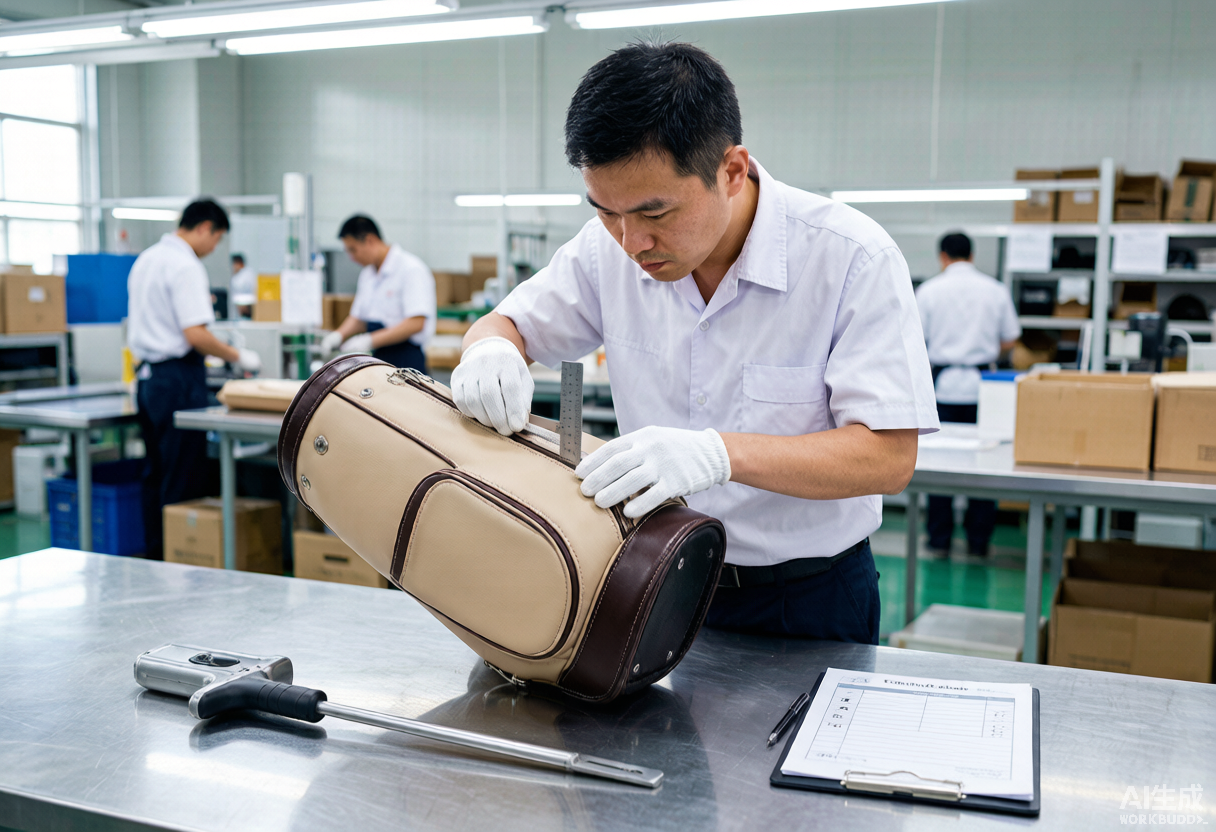
Third-Party Inspection Welcome
Our reports are thorough; your verification should not depend on them. SGS, Bureau Veritas, TÜV or your own QC agent can inspect at any checkpoint or at final PSI — the booking takes a day and the inspection happens on the same floor our QC works on. Programs shipping to retail chains typically book one external PSI per season; case studies describe how these programs run. The AQL guide teaches buyers to read sampling tables and reports themselves.
Frequently Asked Questions
What happens if my order fails AQL inspection?
The lot is reworked at our cost and re-inspected to the same standard before the container loads. A program ships when it passes — the inspection report is photographic, so you see what we see.
Can I use a stricter AQL than 2.5?
Yes. AQL 1.5 or 1.0 major is quoted for retail chains and premium programs; it raises inspection cost slightly because it tightens reject thresholds and usually adds in-process checks.
Do you inspect every bag individually?
No — AQL is statistical sampling by design; 100% inspection is slower, costlier and measurably less reliable than trained sampling (inspector fatigue introduces errors that statistics catch). If your program requires 100% checks (e.g., personalized rosters where every bag is unique), personalization programs run per-piece verification by necessity.
Who pays for inspection?
Our three-checkpoint system is included in FOB pricing. Third-party inspections are booked and paid by the buyer directly with the agency.
Ready to spec your custom golf bags?
Send your logo, bag type and target quantity — we reply with a quote, MOQ and timeline within 24 hours.