
Customization · Branding
Logo Embroidery on Custom Golf Bags
Embroidery is the default premium branding technique for custom golf bags: a digitized logo stitched directly into the fabric at 800–1,200 stitches per 10 cm², rated for 10+ years of outdoor exposure. Setup is a one-time digitizing fee of USD 25–80 per design; per-bag cost runs USD 0.40–2.50 depending on stitch count — and unlike printing, it does not fade, crack or peel on textured nylon and PU surfaces. This page covers the complete technique: stitch types, backing systems, thread chemistry, digitizing, troubleshooting and pricing.
How Golf Bag Embroidery Works
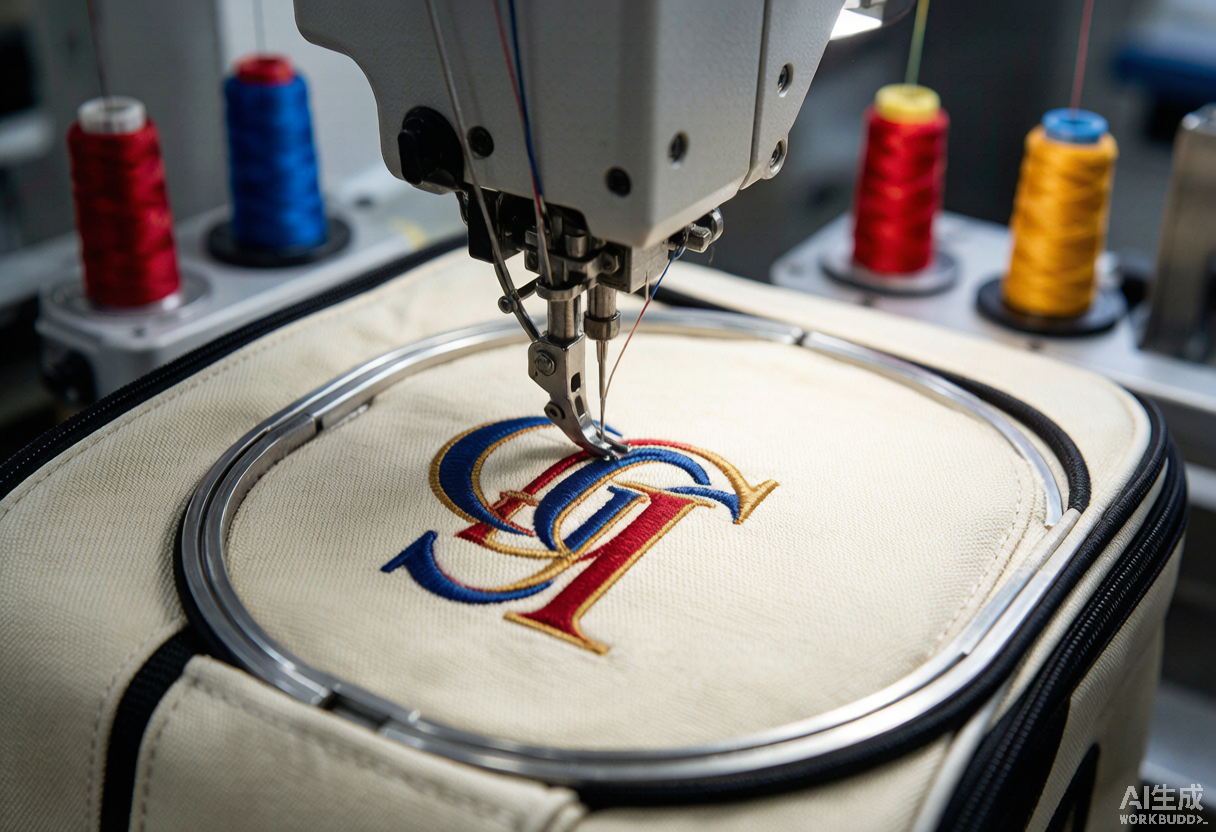
Your logo is converted to a stitch file (a process called digitizing), which tells the embroidery machine the path, density and stitch type for every section of the mark. Multi-head machines then stitch the design onto cut fabric panels before assembly — this is called panel embroidery and it is stronger than embroidering a finished bag, because the hoop can grip flat material with even tension.
For programs that brand finished goods or add personalization later, we also offer patch embroidery — the logo is stitched onto a fabric base, merrow-edged, then sewn onto the bag. Patches survive the heaviest fabrics including 1680D ballistic nylon, and they let fine marks hold detail that direct embroidery on texture would lose.
Flat, 3D Puff and Patch — When to Use Which
The choice follows the logo, not the budget. Flat embroidery handles the widest range of art — fine text, outlines, gradients rendered as tone shifts. 3D puff needs simple, bold shapes with clean edges because the foam underneath cannot follow fine detail; letters and geometric marks are its home turf. Appliqué patches carry varsity and academy looks, and solve the fine-detail-on-heavy-fabric problem by moving the stitching to a friendly base fabric first.
| Style | Look | Typical logo size | Cost vs flat | Best on |
|---|---|---|---|---|
| Flat embroidery | Classic, tone-on-tone or multicolor, low profile | 2–15 cm | baseline | All fabrics; corporate logos |
| 3D puff embroidery | Raised, dimensional, bold | 3–12 cm | +30–60% | Simple marks, staff bags, premium retail |
| Appliqué patch | Layered fabric patch, merrow edge | 5–20 cm | +20–50% | Heavy fabrics; varsity/academy looks |
| Woven label, sewn on | Fine detail, photo-like edges | 3–10 cm | Cheapest at volume | Interior branding, care labels |
Stitch Count, Density and Pricing
Density — stitches per unit area — is the quality variable hiding inside those numbers. Standard satin spacing runs 0.4–0.5 mm between needle penetrations; tighter spacing reads more solid but stiffens the fabric and risks puckering on lightweight panels. We digitize to the fabric: fuller density on stable 600D, slightly relaxed on lighter ripstops.
Across our 2025 programs, the median corporate golf bag logo ran 6,800 stitches and cost USD 1.24 per bag at 500 pieces.
| Logo complexity | Approx. stitches | Per-bag cost at 500 pcs (USD) | Notes |
|---|---|---|---|
| Left-chest mark, text only | 1,500–3,500 | 0.40–0.80 | Cheapest; great for gifts |
| Small crest with outline | 4,000–8,000 | 0.80–1.50 | Most common spec |
| Full front mark, 12 cm | 12,000–25,000 | 1.80–3.20 | Staff bag standard |
| 3D puff, 8 cm | 8,000–15,000 | 1.50–2.80 | Requires simpler art |
Backing Systems: The Invisible Quality Layer
When you approve a sample, flip the panel over: clean backing trimmed close, no fraying, no puckering around the stitch field. That is what 10-year embroidery looks like from behind.
- Cutaway backing — stays under the embroidery permanently, trimmed close. The stable choice for stretchy or soft fabrics; nothing distorts after washing. Our default for 420D ripstop and soft polyester panels.
- Tearaway backing — tears off cleanly after stitching. Faster for stable, dense fabrics where permanent backing adds unnecessary stiffness. Common on 600D polyester.
- Water-soluble topping — a film that dissolves with water, laid on top of textured fabrics so stitches sit on a temporary smooth surface instead of sinking into the texture. Non-negotiable on 1680D ballistic and heavy canvas — without it, logos look half-buried.
- Double backing at stress — bar-tack zones and heavy 3D puff get a second layer to stop distortion under load.
Thread: Chemistry, Sheen and UV
We default to polyester thread for golf bags for one reason: bags live outdoors. Rayon is prettier on day one and faded by season two; polyester holds color through years of sun, rain and cart straps. Metallic threads carry accents well but run slower and break more — budget 10–15% additional cost when a mark is metallic-heavy.
| Thread | Look | UV / outdoor life | Notes |
|---|---|---|---|
| Polyester (Isafil-type) | Slight sheen, vivid colors | Excellent — years of direct sun | The outdoor default; chlorine-proof |
| Rayon | High sheen, luxurious | Fades in sustained UV | Indoor-leaning premium looks |
| Cotton | Matte, natural | Good | Heritage aesthetics |
| Metallic | Reflective, decorative | Good | Breaks more; needs slower stitching |
Digitizing: Where Embroidery Quality Is Actually Made
The machine file format is DST (and its siblings by machine brand); your source vector (AI/EPS/PDF) is what we digitize from, which is why vector art matters. Digitizing takes 1–2 days and includes a sew-out photo for your approval — never approve embroidery from a screen; thread behaves differently on textured fabrics, and the sew-out is the only honest preview.
- Stitch types: satin stitch for borders and letters 3–12 mm wide (the smooth, lustrous columns); tatami (fill) stitch for large areas with texture; running stitch for fine outlines and detail lines below 2 mm.
- Underlay: a sparse first layer that anchors fabric to backing and locks the direction of the weave before the visible layer lands. Skipping underlay to save 10% stitch count is why cheap logos look flat and shift after washing.
- Pull compensation: stitching pulls fabric inward as it tightens — digitizers program shapes slightly wider and taller so the finished geometry comes out correct. Uncompensated marks come out pinched; over-compensated ones bubble.
- Pathing: the order sections stitch in — from background to foreground, from center outward, with color changes batched. Good pathing means fewer trims, fewer thread changes, cleaner finish.
Troubleshooting: What Goes Wrong and Why
Every one of these is diagnosable from a sample — which is the strongest argument for approving a physical sew-out rather than a photo of a different program's logo.
| Symptom | Usual cause | Fix |
|---|---|---|
| Puckering around logo | Backing too light for fabric; density too high; hooping too tight | Heavier or double backing; re-digitize density; re-hoop tension |
| Bird-nesting (thread loops under panel) | Upper thread path mis-threaded; no tension on take-up | Re-thread; check tension discs — a machine-side fix |
| Registration off between colors | Fabric shifted between stitch sections | More/stiffer backing; re-path digitizing to outline-then-fill |
| Letters fill in and lose definition | Text too small for satin; density too tight for letter width | Minimum 4 mm letter height in satin; simplify font weight |
Placement Zones That Matter
Our logo placement guide maps every usable zone across staff, stand, cart and Sunday bags with recommended sizes for each.
- Front pocket center — the default; visible in cart and on stand. Best for logos with text.
- Top crown / ball pocket — visible from above, where playing partners actually look.
- Side pocket — pairs well with a different technique on the front (e.g., print front, embroider side).
- Shoulder strap pad — subtle, premium; common for private label retail lines.
Files, Thread Colors and Approval
Send vector art (AI, EPS, SVG, PDF). If you only have a bitmap, we can redraw it for a small fee. Digitizing takes 1–2 days and includes a sew-out photo for your approval before bulk.
Thread is matched to Pantone or to a physical swatch you mail us. Polyester thread holds color through UV exposure far better than generic rayon, which is why we default to it for bags that live outdoors. For exact brand palettes, pair thread matching with fabric Pantone matching so the whole bag, not just the logo, sits in your palette. The Pantone article covers the color-side workflow.
Embroidery vs the Other Techniques, by Fabric
Full decision framework — durability, cost curves, detail limits — in the branding techniques comparison.
| Fabric | Embroidery | Screen print | Heat transfer |
|---|---|---|---|
| 600D polyester | Excellent | Excellent | Excellent |
| 420D nylon ripstop | Good (cutaway backing) | Good (bonding agent) | Good |
| 1680D ballistic | Excellent (topping + patch) | Poor on texture | Poor adhesion |
| PU / vegan leather | Patch only | Not recommended | Excellent on smooth PU |
| Canvas | Excellent | Good | Good |
Quality Benchmarks at Sample Approval
When your sew-out arrives, check five things: definition — letters and edges crisp at reading distance; registration — color sections aligned with no gaps or overlaps; backing — trimmed clean, correct weight for the fabric; hand — the panel drapes naturally, not board-stiff; reverse — thread runs and knots tidy. A sew-out that passes all five will run 500 identical pieces without drama, because bulk embroidery is repetition of a proven setup — the machine does not improvise.
Worked Example: A Crest From File to 500 Bags
A realistic corporate program end to end: a two-color crest (shield plus 9 mm lettering), vector AI file supplied, going on the front pocket of a 600D stand bag, 500 pieces. Day 1: file reviewed — lettering at 9 mm clears the satin minimum, one color layer flagged for pull compensation on the shield curves. Days 2–3: digitizing; sew-out photographed on the actual 600D panel with the actual backing plan (tearaway + water-soluble topping). Day 4: sew-out approved with one revision — the shield outline widened 0.5 mm to close a registration gap visible at reading distance. Days 5–6: revision sew-out approved. Bulk: crest runs as a color-change batch on multi-head machines, 6,900 stitches per bag, 1.5 seconds per thousand stitches of run time per head, inspected at IPQC against the approved sew-out. Total embroidery cost: USD 45 digitizing (one-time) + USD 575 across 500 bags (USD 1.15 per bag) — and the digitized file waits on record for the reorder at zero setup.
The numbers worth remembering from that story: setup cost is fixed and one-time (USD 45); per-bag cost is stable by stitch count (USD 1.15); and the approval loop added days, not weeks, because the file arrived as vector art. Every embroidery program is this same story with different logos.
Embroidery Across the Chassis Line
One planning note: light-colored lightweight Sunday bags show puckering more than any other chassis — the backing plan there is deliberately conservative, and logos run slightly larger and simpler to read clean at gift distances.
| Chassis | Primary zones | Backing plan | Notes |
|---|---|---|---|
| Staff bags | Front pocket 10–15 cm, top crown | Cutaway + topping on 1680D | Largest logo canvas in the line |
| Stand bags | Front pocket, side panels (roster) | Tearaway on 600D | The team workhorse |
| Cart bags | Three large panels, strap pad | Tearaway | Best branding real estate per panel |
| Sunday bags | Front, single side, strap | Tearaway; light density on light fabric | Bold single marks over fine detail |
| Travel covers | One wrap position | Cutaway; patch for fine marks | Large-scale, coarse-detail art |
| Pencil & youth | One small position | Tearaway | Minimum 4 mm lettering |
Managing Embroidery Cost Without Losing Quality
Four legitimate cost levers, ranked by how little quality they cost. Reduce logo area, not density — a 10 cm crest at correct density reads better than a 15 cm mark thinned out, and costs 30% less in stitches. Consolidate positions — one 12 cm mark beats three 6 cm marks in cost and in look on most programs. Simplify art at design time — removing fine outlines and tiny text drops stitch count by 20–40% before digitizing ever sees the file. Front-load volume — per-bag rates step down at 500 and 1,000 pieces, so a two-season commitment ordered once prices better than two half-orders. The lever that never works: asking for lower density on fine lettering — it produces fuzzy marks that fail at the first inspection.
Thread Color Cards and How to Choose From Them
Thread color is chosen from physical thread cards — shades arranged on their actual thread, under the same controlled-light protocol as fabric approval. Cards from the major polyester systems run past 400 shades, and the practical way to use one: shortlist three candidates per color, request a photo of all three stitched on your actual fabric (not on the card stock), and choose under your approved light. Thread on its card and thread on sage 600D are two different colors, and every experienced program learns this exactly once.
Sheen is part of the color decision. Polyester thread reads moderately glossy, which keeps navy navies and reds vivid; matte cotton thread reads flatter and more heritage; metallic reads lighter than its swatch because reflection does the brightening. When the logo must sit visually flush with a tonal fabric — tone-on-tone monograms on cream Sunday bags — choose the thread one shade darker than the fabric, because stitch density concentrates color and reads lighter at distance.
Across dye lots and seasons: polyester thread is spun-dyed, and the major systems hold batch-to-batch consistency tightly enough that reorders match without re-approval in practice. We still archive the thread shade codes in the program file alongside the fabric formula — a complete color record is one page of discipline that makes season two identical instead of close. See color matching for how the same reference drives fabric, thread and ink.
Two budget notes that surprise buyers: there is no per-color thread charge in embroidery pricing — color changes cost run time, not thread price, and the machine batches them across the lot — and specialty threads (metallic, variegated, glow) carry a premium of 10–15% because they run slower and break more. When a mark uses six colors where four would read identically at logo distance, the thread card conversation is where that simplification happens.
Embroidery in the Production Calendar
Where the embroidery work sits inside the 35–50 day bulk window decides whether programs ship on time, so the map matters: digitizing runs days 1–3 of sampling (the 6–10 day sampling window includes it), the sew-out approval closes before bulk cutting begins, and panel embroidery runs as a batch mid-production — after cutting, before assembly, because hooping flat panels is how quality stays even. A 500-bag program with two positions schedules its embroidery in 2–3 working days of machine time; capacity is essentially never the constraint. The constraint is approval latency: every day a sew-out photo waits unanswered in an inbox is a day of float consumed.
Name-and-number personalization runs at the end of the line, after bags are assembled, on the finished side panel — because rosters change and bags must not wait for them. It runs as a mini-program inside the program: your roster file arrives as a spreadsheet, each panel is hooped individually, and the personalization lot is inspected against the roster rather than a sew-out. This is how team programs put 14 different names on 14 identical bags without adding risk to the other 486.
The late-art failure mode is the one to plan against: embroidery cannot start on panels that are cut and waiting if the approved stitch file does not exist. Vector art at spec stage, digitizing during sampling, sew-out approved before bulk — that sequence is invisible in the calendar when it goes right and becomes the whole critical path when it goes wrong. The design process page shows the same sequencing for every branding technique at once.
Frequently Asked Questions
How much does it cost to embroider a logo on a golf bag?
A one-time digitizing fee of USD 25–80, then USD 0.40–3.20 per bag depending on stitch count and order volume. A typical 6,000–8,000 stitch corporate crest costs about USD 1.20 per bag at 500 pieces.
Is embroidery or printing better for a golf bag logo?
Embroidery for premium positioning, textured fabrics and small logos; printing for large bold marks and tight budgets. The full comparison — durability, cost curves, fabric compatibility — is in our branding techniques comparison.
Can you embroider names and numbers on each bag?
Yes. Name/number personalization runs on a separate mini-program: USD 0.60–1.20 per bag, same panel embroidery. Schools and academies use this for player rosters — see team programs.
Will embroidery survive 1680D ballistic nylon?
Yes, but heavy fabric needs a stiffer cutaway backing and slightly lower density to avoid puckering. Patch embroidery is an alternative when the mark is fine or the fabric is extremely dense — the patch is stitched first, then attached.
How small can an embroidered logo be?
Around 25 mm wide before text becomes unreadable and satin stitches lose definition. Below that, switch to woven labels or heat transfer.
What is 3D puff embroidery and when should I use it?
Satin stitching over foam that raises the mark off the fabric — dimensional, bold, premium-feeling. It needs simple shapes with clean edges (letters, geometric marks) and costs 30–60% more than flat. Best on staff bags and premium retail lines.
Why does my logo need digitizing if I already have vector art?
Vector art tells a machine how to draw the logo; a stitch file tells it how to sew it — stitch types, density, underlay, pathing, pull compensation. Digitizing is that translation, and its quality decides the embroidery quality. It is a one-time fee per design.
Can you match the logo thread to our exact brand Pantone?
Yes — polyester thread is dyed to Pantone references or matched to a physical swatch you send. Pair it with fabric dyeing to the same reference so logo and bag sit in one palette; see color matching.
How do I check embroidery quality on a sample?
Five checks: definition at reading distance, color registration, backing trimmed clean, natural drape (not board-stiff), and a tidy reverse side. The sew-out photo we send before bulk shows all five — approve from the physical sample, not the screen.
Does embroidery add weight to the bag?
Negligibly on most programs — thread and backing on a 12 cm crest add a few grams. On ultra-lightweight chassis where grams are the spec, patch embroidery moves the mark off the panel and keeps the lightest fabrics intact; the lightweight-engineering angle lives on our sister site golfstandbagfactory.com.
Can embroidery be removed or redone if the logo changes?
Removed, yes — stitches can be picked cleanly by a professional, though needle holes remain visible on close inspection. Redone on the same panel, no — perforations from the first run weaken the fabric field. Programs with evolving logos plan the mark on an appliqué patch, which replaces cleanly.
Ready to spec your custom golf bags?
Send your logo, bag type and target quantity — we reply with a quote, MOQ and timeline within 24 hours.