
Case Study
Private Label Retail Line
An established apparel brand extended into golf with a 1,500-piece line across two chassis — staff and stand — carrying full private label suites. Retail launch in three markets, delivered in 14 weeks from tech-pack approval to warehouse.
The Brief: a Retail Launch
A brand with an existing apparel footprint, no bag experience, and a retail buyer already lined up. The private label structure: curated chassis, brand-owned design language, full labeling suite, retail-ready packaging.
Line Structure
Every SKU carried the full suite: woven main label, flag label, care labels per market, hangtags with GS1 barcodes, printed PDP-ready insert cards. See packaging & labeling.
| SKU | Chassis | Colorways | Qty |
|---|---|---|---|
| Flagship staff bag | 1680D ballistic, vegan-leather trim | 2 | 300 |
| Core stand bag | 840D nylon | 3 | 900 |
| Travel cover (matched) | 600D PU | 1 | 300 |
Timeline and Outcome: 1,500 Bags to Retail
Tech pack built with our design team in 3 weeks (DFM review moved one pocket from structural to pattern work, saving USD 1,400 in tooling), sampling 10 days, bulk 48 days, delivery to a 3PL in three markets. The line sold through its first season; the reorder ran on file in 71 days.
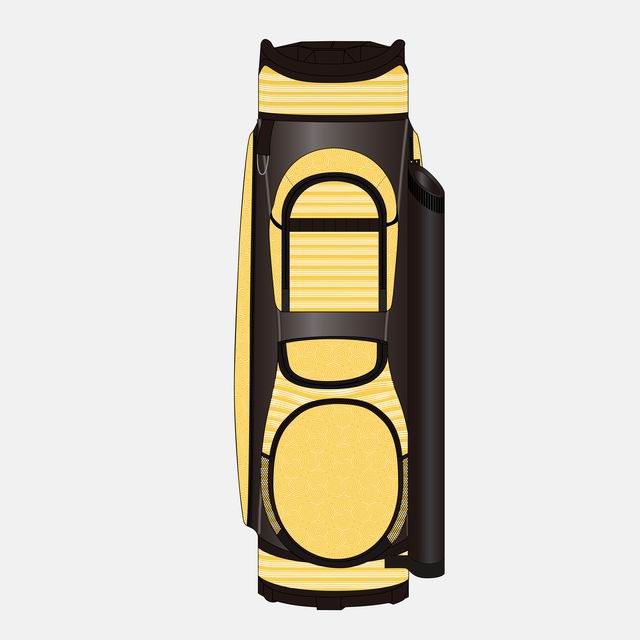
The Labeling Suite That Cleared Three Markets
Every one of the 1,500 bags carried the full private label suite — woven main label, flag label, market-specific care label, and a hangtag with a GS1 barcode — assembled per destination before cartons split to the three 3PLs. Care labeling is where market regimes diverge hardest: US care-label rules are enforced by the FTC, EU-market textiles answer to REACH substance requirements, and UK-placed goods fall under the GPSR framework documented on gov.uk. Label artwork was therefore approved per market during the 3-week tech-pack phase, not retrofitted after production. The retail-facing build-out is detailed in packaging & labeling for retail golf bag lines.
| Element | Function | Market dependency |
|---|---|---|
| Woven main label | Brand identity on every SKU | Shared across all markets |
| Flag label | Secondary branding, chassis code | Shared |
| Care label | Fiber content, care symbols, origin | Per-market rules (FTC, REACH, GPSR) |
| Hangtag with GS1 barcode | Retail scan and PDP linkage | GTIN format per market |
| Insert card | PDP-ready print content in box | Language per market |
Hangtags, Barcodes and PDP-Ready Inserts
Hangtags carried GS1 barcodes so retail scanners could ring the line up on day one, and the printed insert cards duplicated the e-commerce product page content in the box — one asset set serving both channels. GS1 company prefixes belong to the brand, so the barcode numbers were supplied by the client and locked into the tech pack before printing; tag artwork then passed a test-scan at the label vendor before the full run. The GS1 standard governs the GTIN structure behind those numbers. This is also the mechanism that keeps retail and DTC records coherent — one barcode, one product record, two channels — a theme expanded in retail account onboarding.
Dye Lot Consistency Across 1,500 Bags
Six colorways stayed visually consistent across 1,500 bags because the line was engineered around dye lots: the 900 core stand bags split into three colorways of 300 units — one dye lot per colorway — with the staff bag's two colorways and the travel cover's single colorway batched the same way. Every colorway was approved against a physical lab dip tied to the same Pantone references, the discipline described in color matching for custom golf bags. The failure mode this prevents is drift: fabric dyed in separate lots can shift a visible step in depth even at an identical Pantone number, and on a retail wall where two bags hang side by side, that step reads as a defect. Fastness context is in fabric colorfastness.
Reorder Cadence: 71 Days From Signal to Warehouse
The reorder ran on file in 71 days because nothing in the frozen package changed — a repeat order skips the 3-week tech-pack build that a new SKU pays for and goes straight to slot booking and bulk. For scale, an indicative 1,000-piece core stand bag reorder at USD 30 FOB Xiamen (the stand tier runs USD 22–38) is a USD 30,000 order: USD 9,000 deposit at confirmation, USD 21,000 balance against the B/L copy, with bulk in the 35–50 day window and the ocean leg plus 3PL intake filling the rest. The repeat-order mechanics are in reorder consistency for golf bag programs.
| Phase | Days | What runs |
|---|---|---|
| Signal to reorder PO | Day 0 | Sell-through data, quantity decision |
| Slot booking and deposit | ~7 days | T/T 30% — USD 9,000 on the indicative USD 30,000 order |
| Bulk production | ~43 days | Same tech pack, same dye lot references |
| Ocean leg ex-Xiamen | ~2 weeks | FCL, B/L documents, 70% balance of USD 21,000 |
| 3PL intake to shelf | ~1 week | Cross-dock on printed master cartons |
| Total | 71 days | Signal to warehouse, zero re-sampling |
Retail Packaging and the FCL Threshold
The line shipped retail-ready: individual polybags, insert cards, and master cartons sized per chassis — about 425 cartons that consolidated into a single 20-foot FCL out of Xiamen. The carton math: 300 staff bags at 2 per carton (150 cartons), 900 stand bags at 4 per carton (225 cartons), and 300 travel covers at 6 per carton (50 cartons), roughly 21 CBM packed — inside a 20-foot GP's usable volume, which is what made one FCL cheaper than three LCL legs. Printed master cartons carried SKU, colorway, carton count and barcode for the 3PL cross-dock, so the three-market split happened at the warehouse rather than before shipment. Private-label packaging scope sits on the private label manufacturing page, and floor-level presentation is covered in retail display and merchandising.
Three Failure Modes That Kill Retail Lines
The failures that most often end retail programs are dye-lot drift on reorders, barcodes that fail store scans, and care-label non-compliance — each cheap to prevent and expensive to fix after goods land. Dye-lot drift appears when a reorder is dyed without the original lab dips; the fix is keeping dip references on file, which is how this line's reorder matched its first season visually. Barcode failure surfaces at the retailer's first scan and stalls an entire delivery — hence the pre-bulk test-scan. Care-label gaps can block market entry outright under the regimes above. The last line of defense was final inspection to AQL 2.5 under ISO 2859-1 sampling, covering labeling placement and legibility alongside construction; when a batch issue escapes anyway, the containment sequence in batch defect crisis management applies. Production for the program ran through a dedicated facility in Quanzhou under a program-management team that books partner capacity for peak season — capacity insurance that matters most at retail launch windows.
A Retail Line Readiness Checklist
Score a retail golf bag line against these checkpoints before the tech pack freezes — each one gates a decision that is far more expensive to reverse after bulk starts.
- Launch calendar anchored to the buyer's season, with the 14-week tech-pack-to-warehouse lead time backed out from the on-shelf date.
- Care label artwork approved per market (FTC, REACH, GPSR regimes) during the tech-pack phase.
- GS1 prefix and GTINs assigned by the brand and test-scanned before label printing.
- One dye lot per colorway, with lab dips archived for the reorder.
- DFM review before tooling — on this line it moved one pocket from structural to pattern work and saved USD 1,400 and three weeks.
- Carton math checked against the FCL threshold — about 21 CBM justified a 20-foot container here.
- Final inspection to AQL 2.5 with labeling included in the checklist.
- A reorder file complete enough to run 71 days from signal to warehouse.
That is the case in one page: 1,500 bags, 14 weeks from tech-pack approval to warehouse, three markets, first-season sell-through — and a repeat order that never had to relearn any of it.
Frequently Asked Questions
What made this program work?
A frozen tech pack, DFM review before tooling, and launch-calendar discipline. The design team's pushback on one feature saved four figures and three weeks — the value of a factory that reviews manufacturability before quoting.
What labeling does each market require?
US placements need FTC-compliant care labels, EU placements must satisfy REACH substance rules, and UK goods fall under GPSR. This line carried one shared woven label set with market-specific care labels and market-language insert cards, all approved before bulk.
Who owns the barcodes on the hangtags?
The brand does. GS1 company prefixes are licensed to the brand, so the client supplied the GTINs, which were locked into the tech pack, and the label vendor test-scanned hangtags before the production run. GTIN structure follows the GS1 standard.
How is dye lot matched on a reorder?
Lab dips and Pantone references stay on file, so the reorder is dyed to the same approved standard. That is how this line's 71-day reorder matched its first season visually — 300-unit dye lots per stand colorway, repeated without drift.
What does retail-ready packaging include?
Individual polybags, hangtags with scannable barcodes, insert cards, and printed master cartons carrying SKU, colorway and carton count. At 1,500 bags the packing consolidated into one 20-foot FCL — about 425 cartons — before splitting at the 3PL.
What is the minimum order for a retail line?
200 pieces is the program minimum for golf bags, but retail lines run larger because every SKU and colorway needs shelf depth — this line's colorway cells ran 150 to 300 units each across six colorways.
How does AQL 2.5 inspection work on 1,500 bags?
Cartons and units are sampled per ISO 2859-1 plans at AQL 2.5, covering construction, labeling placement and print quality across every SKU and colorway. Sampling by lot also isolates any issue to a dye lot rather than the whole order.
Why was the reorder only 71 days?
The frozen tech pack never changed, so the reorder skipped the 3-week tech-pack build and DFM cycle entirely: slot booking, a mid-range bulk run of roughly 43 days, and the ocean leg from Xiamen filled the 71 days. Any spec change would have re-opened sampling first.
FCL or LCL for a 1,500-bag line?
FCL: 425 master cartons at roughly 21 CBM fits a 20-foot container, which is cheaper than three LCL legs and protects the retail launch window. LCL only makes sense below roughly two-thirds of a container's volume.
Can one care label serve several markets?
Sometimes, when fiber content, symbols and origin wording satisfy the strictest destination regime — but this program kept market-specific care labels to avoid ambiguity, and the marginal label cost is near zero at 1,500-unit scale.
Ready to spec your custom golf bags?
Send your logo, bag type and target quantity — we reply with a quote, MOQ and timeline within 24 hours.