
Bag Types · Travel
Custom Golf Travel Covers
Custom golf travel covers are the airline chassis: padded 600D–1680D bodies with lockable zippers, wheel-compatible bases and internal strap systems, branded from 200 pieces at USD 18–30 FOB. Programs serve team travel, touring brands and retail travel lines — and pair as matched sets with tour bags.
Specs That Matter on a Travel Cover
| Spec | Standard | Heavy-duty |
|---|---|---|
| Padding | 10mm EVA | 15–20mm EVA + cap |
| Fabric | 600D PU-coated | 1680D PU-coated |
| Base | Reinforced, wheel-ready | Hard-shell hybrid |
| Straps | Internal + external | Internal + external + ID window |
| Branding | One large panel | Two panels + webbing |
Who a Custom Travel Cover Fits
Travel covers serve team travel programs, tour-bag matched sets for retail, and airline/rental programs where durability economics dominate. Branding on travel covers favors large print positions — see screen printing.
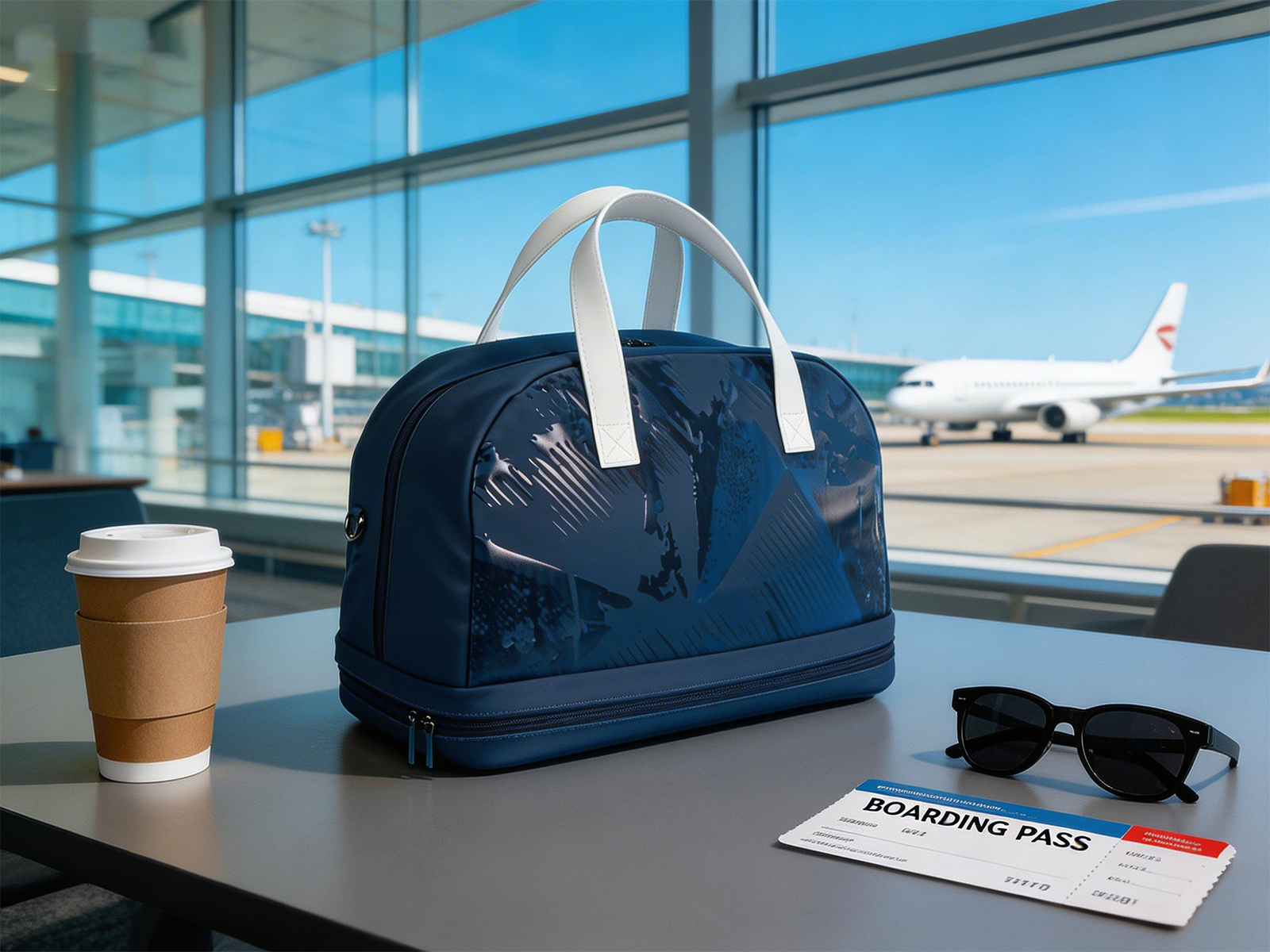
What an Airline Travel Cover Must Survive
An airline travel cover is a protective case first and a branded product second: it has to keep a 5–7 kg tour bag and 14 clubs intact through conveyor drops, oversize-belt transfer, 23 kg stacking and a 1.2 m tumble. Design targets therefore come from transport testing rather than from retail aesthetics.
Three loads drive the specification. Impact: a loaded bag dropped 1.2 m onto a corner transmits 8–12 g to the club heads if the cover has no cap. Compression: four covers stacked in a hold put 60–80 kg on the lowest unit, which is what splits a 10 mm EVA panel at the wheel housing. Abrasion: the towing geometry drags the base across kerbs and taxi ranks for 300–500 m per trip.
Test protocols that map to these loads are published by ISTA for packaged-product transport and by ASTM for distribution cycle conditioning. A programme does not need formal certification, but the drop height, orientation and stack load in those protocols give a defensible internal test card. The practical envelope — 23 kg per checked piece, 158 cm linear — is set by airline rules published through IATA.
Soft-Shell Versus Hard-Shell
Soft-shell covers win on packability and price, hard-shell hybrids win on impact resistance, and the right answer depends on how the cover travels rather than how it looks. Most programmes launch both: a 600D–1680D soft cover as the volume SKU and a hybrid as the premium tier.
| Attribute | Soft-shell | Hard-shell hybrid |
|---|---|---|
| Shell | 600D or 1680D PU-coated textile | Moulded EVA or PP panels over textile |
| Weight | 1.4–2.2 kg | 2.6–3.8 kg |
| Impact protection | Good with a 15–20 mm cap | Best, rigid cap over club heads |
| Folded volume when empty | About 0.02 CBM | About 0.09 CBM |
| Wheels | 2 × 50 mm inline | 2 × 60 mm or 4-wheel base |
| Indicative FOB Xiamen | USD 18–24 | USD 24–30 |
| Characteristic failure | Wheel housing tear-out | Shell or hinge cracking in cold |
The hybrid's weakness is temperature. A moulded PP panel becomes brittle below about minus 10 degrees Celsius and can crack on a first impact, which matters for programmes sold in northern markets with winter golf travel. The soft cover's weakness is the wheel housing, which is a USD 0.40 fix rather than a redesign.
Both pair with a tour bag as a matched set. The pairing should be dimensioned together, because a cover built to a nominal length loses 3 cm to seam allowance and will not close over a bag with a head cover fitted.
Padding Anatomy and Where It Goes
Padding is not uniform: most of the protective value sits in three zones, and spreading the EVA budget evenly across the shell wastes money. The club-head zone, the top cap and the wheel housing carry impact; the mid panel carries abrasion and needs far less foam.
| Zone | Standard build | Heavy-duty build | Bench test |
|---|---|---|---|
| Club-head zone, top 40 cm | 10 mm EVA plus 210D lining | 15–20 mm EVA plus moulded cap | 1.2 m corner drop at 12 kg |
| Top cap | 5 mm EVA band | Rigid PP cap | 40 kg static load |
| Mid panel | 5 mm EVA | 10 mm EVA | 500-cycle abrasion |
| Wheel housing | 3 mm HDPE plate, rivets | 5 mm plate, through-bolts | 500 m tow test |
| Base | 600D double layer | 1680D plus 3 mm plate | 200 m drag on concrete |
The most common under-specification is a 10 mm body with no cap. Foam alone does not stop a club head, because the load passes through the foam into the shell and then into the head; a rigid cap spreads the impact over 200 cm² instead of a grip-sized point. The cap adds 90–140 g and USD 0.85 at 200 pieces, and it removes the failure that produces the worst reviews.
Foam density matters as much as thickness. A 10 mm EVA at 45 kg per cubic metre absorbs less than a 15 mm at 30 kg, and thin high-density foam transmits impact rather than damping it. Ask for the density figure when comparing quotes.
Wheels, Base Plates and Towing Geometry
Wheel choice decides whether a cover survives a season of taxi ranks: 50 mm inline wheels on a 3 mm HDPE base plate with four through-bolted housings are the durable minimum, and 60 mm wheels on a 5 mm plate are the heavy-duty answer.
- Wheel diameter: 50 mm for paved surfaces, 60–75 mm where kerbs and gravel are routine.
- Housing attachment: rivets through 600D pull out at about 15 kg lateral load; through-bolts with 25 mm washers hold 40 kg.
- Base plate: 3 mm HDPE standard, 5 mm on hybrids; the plate must extend 30 mm beyond the wheel line.
- Towing handle: 25 mm webbing with a padded grip, bar-tacked at 8 stitches per inch, rated to 35 kg.
Geometry matters as much as hardware. A base sitting 40 mm off the ground with the handle at 95–100 cm tows without the bag dragging, while a shorter handle forces the traveller to lift, which is what tears housings. The load paths through the base are covered in the wheel systems guide. Replacement economics also favour standard parts: a 50 mm inline wheel on a common axle can be stocked as a spare and shipped with the programme, turning a warranty claim into a five-minute repair, while a proprietary moulded wheel cannot.
Retention is the other half of the towing system. Two internal straps hold a bag still inside the cover and a third at the top ring stops it sliding down until the club heads jam against the cap — the cheapest protection in the build and the one most often left off a quote. Specify 25 mm polypropylene webbing with a 40 mm side-release buckle rated at 45 kg, one strap at the bag base and one at hip height, anchors bar-tacked to a 1680D patch rather than to the lining, plus a 90 × 55 mm ID window on the side panel for airline tags. Without them a 6 kg bag slides 15–20 cm on every handling cycle, abrading its base and loading the cap on each drop; the third strap costs USD 0.55 at 200 pieces and removes the most common arrived-with-a-bent-club complaint.
Worked Example: A 300-Piece Team Travel Programme
A 300-piece programme at USD 23.00 FOB lands at USD 26.92 per cover before duty, shipped five per carton and consolidated as LCL from Xiamen.
- Goods: 300 × USD 23.00 = USD 6,900.00
- One-colour screen print on two panels: 300 × USD 0.65 = USD 195.00
- Screen set-up and pre-production sample: USD 210.00
- Freight: 60 cartons × 0.13 CBM = 7.8 CBM at USD 72 = USD 561.60
- Origin charges and documentation: USD 210.00
- Total USD 8,076.60, or USD 26.92 per cover
Volume rather than value is the constraint. At 300 pieces the order fills 7.8 CBM and shares an LCL consolidation; at 1,000 pieces the same build reaches 26 CBM, which is a 20ft container and a lower landed cost per unit. Team orders of 40–60 covers pool several squads into one 200-piece programme, which is why the team programme route prices inside the same band as a retail buy.
Sensitivity is worth running at quoting stage: a rigid cap and 15 mm EVA top zone add about USD 2.10 per cover, or USD 630 across the order, and move the landed cost to USD 29.02. For a squad that flies eight times a season that is cheap insurance; for a club that travels by coach it is unnecessary weight.
Caddie and Team Travel Procurement
Team and caddie purchases fail on fit rather than on quality: a cover bought for a 47-inch staff bag will not take a tour bag with a 10-inch ring, and a cover sized for a cart bag will not close over a full staff build. Six questions close most of the gap before a purchase order is raised.
- Loaded bag height and top-ring diameter, measured on the actual bag rather than taken from a catalogue.
- Covers per trip, and whether they stack in a van or fly as checked baggage.
- Colourway count, and whether names or numbers are printed per unit.
- Whether a lockable two-way zip or a TSA-accepted lock is required.
- Storage footprint: 60 covers occupy about 1.2 CBM folded.
- Repair path: wheel, zip and buckle spares held for the season.
Programmes with names and numbers need a data file with one row per unit and a proof sheet signed before print; the control process is the same as the one described in the personalisation data flow note. A 60-cover squad order typically ships in 12 cartons and arrives as one consolidated pallet, which is the right unit for a college or academy equipment room.
For touring operations the arithmetic is different: covers outnumber bags by roughly 1.2 to 1 because spares travel, and a caddie will drag a cover further in a week than a member will in a year. Specify the heavy-duty base in that case and budget for a wheel replacement set per season.
Failure Modes in Travel Cover Programs
Travel cover returns are dominated by five defects, all visible at pre-production sampling if the right checks are run with a loaded bag inside the cover.
- Zip burst at the top curve: a #8 coil zip on a 60 cm radius separates when the cover is over-packed; a #10 coil or a two-way #10 with a metal slider is the fix.
- Wheel housing tear-out: rivets through 600D at 15 kg lateral load; through-bolts on a 3 mm plate are the fix.
- Print adhesion on coated fabric: a surface print on PU-coated 600D fails a tape-pull test; specify a heat transfer or a corona-treated print surface.
- Sizing mismatch: a cover built to a nominal 48 inches loses 3 cm to seam allowance and will not close over a 47-inch bag with a head cover on.
- Handle separation: a single-row handle stitch fails at 30 kg; box-X at 8 stitches per inch in 138 nylon holds.
Each fix costs USD 0.20–1.10 per unit at the sampling stage, against a return that consumes the full landed value plus reverse freight. The claims process that follows a transit failure is covered in the cargo claims note, and the specific airline damage question is treated in the airline protection guide.
The fifth failure is quieter: a cover that is technically sound but too heavy. At 3.5 kg it eats into a 23 kg allowance that a player wanted for clubs, which is why soft covers outsell hybrids in most catalogues.
Transport Testing and AQL 2.5 Inspection
Transport testing on a travel cover does not need a certified laboratory to be useful: three bench tests reproduce most field failures. A 1.2 m corner drop with a 12 kg load, a 500 m tow across concrete at 4 km/h, and a 40 kg static stack held for 24 hours cover impact, abrasion and compression.
In production, inspection follows AQL 2.5 under ISO 2859-1 at general inspection level II. A 300-piece lot draws code letter H and a sample of 50 units, with zero acceptance on wheel housings, strap anchors and zip function under load, and a 4.0 level on cosmetic print defects. Functional checks at final inspection include a full open-close cycle with a loaded bag, a 20 m tow, and a zip reciprocity test around the top curve. The sampling tables sit at ISO, and an independent inspection report can be arranged on request for programmes that require third-party evidence.
Retain the tested units. A cover that passed the drop test is the reference for a warranty dispute six months later, and a photograph of the loaded bag inside the cover at inspection resolves most sizing arguments before they start.
Freight, Duty and Packaging Notes
Travel covers are cube-driven: at about 0.026 CBM per cover and 1.6–2.8 kg, a 200-piece order fills 5.2 CBM and roughly 480 kg, so freight is quoted on volume and the packing method matters more than the weight. Covers ship five per carton at 62 × 40 × 52 cm, folded with the wheel pair protected by a corrugated sleeve.
Classification follows the 4202.92 line for golf bags and similar containers with a textile outer surface; a hybrid with a moulded plastic shell can fall under 4202.99, and that distinction changes the duty rate. Importers should confirm the line with a customs broker against the current schedule at USITC before quoting a landed price to a buyer.
From Xiamen, transit runs 14–18 days to Los Angeles, 28–33 days to Rotterdam and 16–20 days to Sydney. LCL stays economical to about 12 CBM; above that a 20ft at 28 usable CBM is cheaper per unit. Cartons marked to GS1 conventions scan cleanly at retail receipt, and cover programmes paired with tour bags should ship in the same container to hold the freight component near USD 6 per unit. Production for orders of this profile is coordinated by a sourcing and programme-management team working with a dedicated production facility in Quanzhou, with partner capacity for peak-season volume.
Specifying a Cover: Five-Minute Checklist
Five measurements and four build decisions settle a travel cover specification, and none of them require a sample to be made first.
- Loaded bag length, measured to the top of the head covers, plus 4 cm clearance.
- Top-ring diameter, because a 10-inch ring will not pass a 9-inch opening.
- Bag weight when packed, which decides the carton count and the wheel grade.
- Trip profile: air, coach or van, which decides soft versus hybrid.
- Branding area: two panels for print, one for large-format heat transfer.
Then fix the build: padding by zone, cap type, wheel and base grade, and the zip class. A cover specified this way can be quoted in a day and sampled in 6–10 working days, with bulk production at 35–50 days and inspection at AQL 2.5. The one decision to avoid deferring is the cap, because it changes the pattern and cannot be added after the cutting table is set.
Frequently Asked Questions
What does a custom travel cover cost?
USD 18–30 FOB; hard-shell hybrid bases push the top. Freight matters more than for other chassis — covers are bulky; DDP quotes include the cube.
Can travel covers match tour bags as a set?
Yes — matched sets are one program, same colorways, same container. See tour bags.
What does a custom travel cover cost?
USD 18–30 per cover FOB Xiamen. Soft 600D builds sit at the bottom of the band, 1680D covers with a 20 mm cap in the middle, and hard-shell hybrids at the top.
Should I choose soft-shell or hard-shell?
Soft-shell for price, packability and coach travel; hybrid for repeated air travel with expensive clubs. Hybrids weigh 2.6–3.8 kg and can crack in extreme cold, so northern markets often stay soft.
How much padding does a cover need?
10 mm EVA body with a 15–20 mm club-head zone and a rigid cap is the practical minimum for air travel. Below that, a 1.2 m drop transmits enough load to bend a shaft.
Will a cover fit my tour bag?
Only if it is sized on the loaded bag. Measure the bag height to the top of the head covers, add 4 cm, and check the top-ring diameter against the cover opening. A nominal 48-inch cover loses 3 cm to seam allowance.
Are wheels included?
Yes, 50 mm inline wheels on a 3 mm base plate are standard, with 60 mm wheels on a 5 mm plate for heavy-duty builds. Through-bolted housings hold 40 kg against 15 kg for rivets.
Can a travel cover be locked?
Yes. A lockable two-way zip with #10 coil teeth is the usual specification, and a TSA-accepted lock can be fitted for US transit. Zip class matters more than the lock, because over-packing bursts a #8 slider.
What is the MOQ and lead time?
200 pieces. Sampling takes 6–10 working days and bulk production 35–50 days, with inspection at AQL 2.5 under ISO 2859-1. A 300-piece order typically runs 12–14 weeks to delivery.
How do travel covers ship?
Five per carton at about 0.13 CBM, folded with a corrugated wheel sleeve. A 200-piece order is 40 cartons and 5.2 CBM, which moves LCL; 1,000 pieces reaches 26 CBM and warrants a 20ft container.
How is branding applied to a cover?
Screen print on a large flat panel is the cheapest option, heat transfer handles multi-colour or photographic artwork, and embroidery works on the cuff band. Coated fabric needs a transfer or corona treatment for adhesion.
Do you run transport tests?
Yes — a 1.2 m corner drop at 12 kg, a 500 m tow and a 40 kg static stack, following the load cases described by ISTA. Independent third-party testing can be arranged on request.
What are the payment terms?
T/T 30/70: 30 percent deposit, 70 percent against the bill of lading copy before departure. Terms are FOB Xiamen, with CIF and DDP quoted on request for bulky orders.
Ready to spec your custom golf bags?
Send your logo, bag type and target quantity — we reply with a quote, MOQ and timeline within 24 hours.