
The Seven Steps in One View
Budget → Chassis → Artwork → Quote → Sample → PO → Delivery. Sixty to ninety days end to end; the buyer's real work is steps one, three and five, each of which takes less than a day.
Promotional buying differs from retail buying in one structural way: the bags are the message, not the product. That shifts every decision — toward imprint visibility over tour-grade features, toward unit cost over marginal upgrades, and toward logistics certainty because the event date does not move. This guide is written for that buyer: the marketing manager, event organizer or promo distributor sourcing bags whose job is to carry a logo well.
| Step | What you do | What it costs | Time |
|---|---|---|---|
| 1. Budget | Set per-unit ceiling and quantity | Nothing | 1 hour |
| 2. Chassis | Choose bag type for giveaways | Nothing | 1 hour |
| 3. Artwork | Vector logo + Pantone references | Usually nothing | 1 day |
| 4. Quote | Send brief, compare spec-level quotes | Nothing | 24 hours |
| 5. Sample | Approve physical sample | USD 80–150, credited on order | 6–10 days + courier |
| 6. PO | 30% deposit, production runs | 30% of order | 35–50 days |
| 7. Delivery | 70% balance against B/L, receive goods | 70% + freight | 14–35 days ocean |
Step 1: the Budget Math That Frames Everything
Promotional golf bags price in three honest bands. USD 6–12: Sunday-style carry bags and pouches — light, simple, ideal for large fields and tee gifts. USD 12–22: stand bags and den caddies with full branding — the sweet spot for client gifts and corporate days. USD 22–45: premium stand and cart bags with retail-grade construction — board-member and principal-sponsor territory. These are factory-direct ranges at 200–500 pieces; distributor catalogs typically show the same constructions 30–40% higher because you are paying for their inventory, their showroom and their margin.
Set the budget per recipient, not per project — "USD 15 each for 300" produces a comparable quote; "about five thousand total" produces a guess. And decide early whether freight belongs in the per-unit number (it should): a USD 12 bag plus USD 2.80 freight DDP is a USD 14.80 decision, and quotes compared without freight are fiction. The MOQ and pricing guide details the seven drivers behind every number.
Step 2: Choosing the Right Chassis for Giveaways
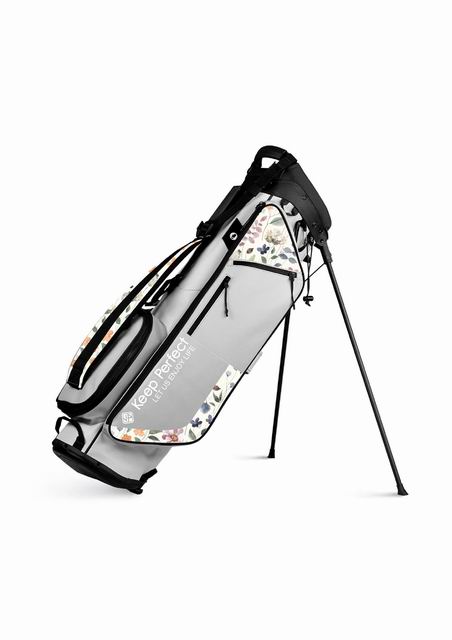
The promotional chassis hierarchy is about carried-context: where will this bag actually go? Sunday bags (light, 2–3 lbs, minimal structure) suit mass giveaways — they fold into a carton economically, suit occasional golfers, and put a large clean panel under your logo. Stand bags suit quality-tier gifts: they look and feel like real golf equipment because they are, and the recipient's regular foursome sees your logo for years. Den caddies (miniature desk staff bags) suit office audiences — no golf skill required to keep one. Cart and staff bags suit principal-tier gifting only; their freight bulk punishes large quantities.
One structural tip: for events, spec the bag in a stock factory colorway (black, navy, white) with your branding executed in your colors. Custom-dyed body fabric adds two to three weeks and a lab-dip loop that event timelines rarely need. The Sunday bag and stand bag pages detail the chassis options.
Step 3: Artwork Rules That Save a Week
Ninety percent of promotional-order delays are artwork delays, and they are all the same four problems. Send vector files (AI, EPS or PDF with outlined fonts) — a 400-pixel JPEG cannot be embroidered at any resolution. Include Pantone references for your brand colors; "our blue" is not a spec, PMS 286 is. State minimum sizes if your brand guidelines have them — embroidery holds detail down to about 5 mm letter height, below which print techniques take over. And send the version of the logo you actually want on the bag: full-color crest, one-color mark or wordmark, decided now rather than at sampling.
If your logo only exists as a JPEG, say so in the brief — redrawing to vector is a routine studio service (often free at program scale, USD 20–50 otherwise) and adds a day, not a week. What adds a week is discovering the problem at sampling.
Step 4: Getting Quotes You Can Compare
A quotable brief has five lines: chassis (or "recommend"), quantity, logo technique (embroidery/print — or "recommend"), destination, and deadline. With those five, any competent factory returns a spec-level quote in 24 hours: unit price at your quantity, what is included (digitizing, screens, labels, cartons), Incoterm (FOB Xiamen, CIF or DDP), payment terms (T/T 30/70) and timeline. Compare quotes line by line on inclusions — a USD 11.20 quote excluding screens and cartons is a USD 12.40 quote in disguise.
For promotional buyers specifically: ask for DDP pricing alongside FOB. DDP (delivered, duty paid) converts customs, duty and final delivery into one per-unit number — no broker to hire, no surprise invoices, and the event date risk shifts to the party managing the freight. US duty on golf bags runs 17.6% of FOB value under HTS 4202.92; in a DDP quote it is priced transparently rather than discovered at the border. The corporate and promotional page structures this whole path.
Step 5: the Sample — Approve the Object, Not the Photo
Sampling runs 6–10 days at USD 80–150 depending on construction, with the fee credited back on your bulk order. Pay the courier (USD 40–80) and put the physical bag in your hands: check the logo size against your expectation (measure it), the embroidery density (run a finger across it — gaps mean low stitch count), the zipper action (five full cycles), the strap padding, and the fabric hand. Photographs hide every one of these, which is why factories that push photo-approval are asking you to insure their quality.
If something is off, say so precisely and a revised sample re-runs at 40–60% of the first fee — cheap money against a 300-unit mistake. The full testing protocol is in the sample process guide, and commercial terms live on the sample policy page.
Step 6: the PO, the Deposit and the Production Weeks
The PO locks five things in writing: the spec (chassis, fabric, branding positions and techniques), the quantity, the unit price and inclusions, the timeline (bulk days, ship date), and the payment structure (T/T 30% deposit, 70% against bill of lading copy). With the deposit wired, bulk production runs 35–50 days: cutting, embroidery and printing, assembly, finishing. Your involvement during these weeks is three touches — fabric confirmation, a mid-production photo set around day 20, and the completion notice that triggers inspection.
Before the balance moves, the order passes AQL 2.5 pre-shipment inspection under ISO 2859-1 — 32 bags pulled at random from a 300-piece lot, passing with at most 2 major defects — documented in a photographic report you should actually read. Third-party inspection (SGS, QIMA, USD 150–300) is welcome on any order and sensible on first orders above 500 pieces. The quality page details the checkpoint system.
Step 7: Delivery Day and the Box Check
Ocean freight runs 14–18 days to the US West Coast, 22–32 to the East Coast, 28–40 to North Europe; air compresses to 5–8 days at roughly three times the cost — for events inside 60 days, air freight for at least part of the quantity is standard practice. On delivery, do the box check before signing: carton count against the packing list, carton condition (photograph damage before opening), and a two-unit spot check against the approved sample. Deviations reported within 48 hours with photographs are claims; deviations reported next month are archaeology.
Then the promotional logistics take over: if goods are event-bound, cartons should be labeled for the registration table (by tee time or alphabet); if they are program stock, note the reorder path now — the second run skips sampling entirely, ships in 30–45 days and costs 5–12% less.
Where Promotional Orders Go Wrong
- Shopping by unit price alone. The USD 9.80 bag with a peeling heat-transfer logo costs more per lasting impression than the USD 12.40 bag with proper embroidery.
- Approving from photographs. Ten days saved at sampling becomes 300 bags with an off-size crest. The courier fee is the insurance premium.
- Forgetting the freight line. Comparing ex-factory prices and discovering DDP reality later blows budgets. Decide the Incoterm at the brief.
- The event-date gamble. Ordering at day 55 for a day-60 event leaves zero buffer for the approval loop. Ninety days is the honest number; rush exists but costs.
- Sizing the logo by imagination. "Make it bigger" discovered at bulk is a change order. Dimensions in millimeters, agreed at sample stage, prevent the conversation entirely.
Promo Distributor vs Factory-Direct, Honestly
Distributors earn their margin on three services: holding stock for rush needs, one-invoice simplicity across mixed product categories, and local accountability. For orders under 100 units or under 30 days, use one — factory economics do not serve that scale. At 200+ units with 60+ days, the same margin buys you a third more product, direct control of the spec, and a sample loop with the people who actually sew the bag. Many distributors themselves source from factories like ours; the question is whether you want to pay for the middle chair at the table.
The hybrid that works well: distributors for the mixed trinket order (balls, tees, towels, shirts), factory-direct for the hero item where construction quality and branding execution carry the impression. The corporate giveaways playbook builds the full event package on that logic.
Rush Orders: the Honest Emergency Playbook
Every promotional buyer eventually faces the 45-day panic order, and there is a disciplined way to run it. Compress the front, not the back: stock-fabric chassis (no lab-dip loop saves 7–10 days), print-led branding (screens are faster than elaborate embroidery setups), artwork delivered as final vector files on day one, and a 48-hour sample approval window with one named approver scheduled before the sample ships. That discipline pulls the pre-production phase from three weeks to ten days.
Then buy time at the freight end, where it is cheapest: split the shipment — 30–40% of the quantity by air (5–8 days) for the event itself, the balance by ocean for program stock. The air premium on a partial shipment costs far less than the rush fees, expedite charges and stress of compressing production. What you should never compress is the approval loop and the AQL inspection: an uninspected rush order for a fixed-date event is a gamble where the event is the stake. If the honest math says the date is impossible, a good factory says so in the first call — the quote form answer you want is a calendar, not a promise.
Working With the Factory Design Desk
Promotional buyers rarely arrive with print-ready branding architecture, and they do not need to: the factory design desk converts your logo and one sentence of intent into a placement sheet — positions, sizes, technique per panel, colorway proposal. The service is free at program scale because it prevents the failure mode both sides fear: a sample that comes back wrong because the spec was a conversation instead of a document.
Use the desk early. The strongest promotional programs we ship started as "our logo, something golfers will actually keep, USD 15 each" — the chassis recommendation, the two-touch branding discipline and the colorway came out of the first exchange. Buyers who arrive with everything decided get exactly what they asked for; buyers who arrive with the outcome described often get something better.
Starting Your Order Today
Five lines in the quote form — chassis, quantity, logo technique, destination, deadline — start the seven steps today. Quotation in 24 hours, physical sample inside two weeks, bulk at 35–50 days, AQL 2.5 inspected, delivered DDP to your door or venue. Junyuan has produced promotional golf bags since 2014 from Quanzhou, through an affiliated SGS-audited factory network with 149 machines and a monthly capacity of roughly 150,000 pieces across the combined lines — scale that makes a 300-bag event order a routine Tuesday.
Frequently Asked Questions
How do you order promotional golf bags?
Seven steps: set a per-unit budget (USD 9–18 covers credible giveaway bags), choose a chassis (Sunday for mass events, stand for quality gifts, den caddies for offices), prepare vector logo artwork with Pantone references, get spec-level quotes at your exact quantity, approve a physical sample in 6–10 days, place the PO with 30% deposit, and take delivery after 35–50 days of production plus freight.
What is the minimum order for promotional golf bags?
200 pieces per style and colorway factory-direct — the threshold where cut-and-sew production economics work. Below 200, a promotional distributor with stocked blanks and local printing serves you better. At 200–500 pieces factory-direct pricing lands 30–40% below distributor catalogs for equivalent construction.
How much do promotional golf bags cost?
Factory-direct at 200–500 pieces: Sunday-style carry bags USD 6–12, stand bags and den caddies USD 12–22, premium cart and staff bags USD 22–45, plus USD 2–4 per unit ocean freight depending on destination. Distributor catalogs price the same constructions 30–40% higher.
How long does a promotional golf bag order take?
60–90 days end to end: 6–10 days sampling, your approval window, 35–50 days bulk production, then 14–35 days ocean freight or 5–8 days by air. Event programs should start 90 days out; rush structures exist but add cost and compress your approval buffer.
What file format does my logo need to be in?
Vector: AI, EPS or PDF with fonts outlined. Embroidery and print separations both start from vector art; a low-resolution JPEG must be redrawn first (a routine studio service at USD 20–50). Include Pantone references for brand colors — "our blue" is not a specification, PMS 286 is.
Embroidery or printing for promotional golf bags?
Embroidery for crests and wordmarks up to about 120 mm — it reads as quality and survives years of use. Printing (screen or heat transfer) for large panels, gradients and photographic art. The two techniques combined — embroidered crest, printed side graphic — is the retail standard and works equally well promotionally.
Can I get a sample before the full order?
Yes — 6–10 days at USD 80–150, credited back on your bulk order. Approve the physical bag: measure the logo, feel the embroidery density, cycle the zippers, check the strap padding. Photograph approval hides exactly the things recipients will judge.
What does DDP mean and should promotional buyers use it?
Delivered Duty Paid: the supplier manages freight, customs, duty and final delivery for one per-unit price. For promotional buyers without a customs broker, DDP is strongly recommended — it converts border risk into a line item and protects the event date. US duty on golf bags is 17.6% of FOB value under HTS 4202.92, priced transparently inside the DDP quote.
Can the bags be delivered directly to our event venue?
Yes — DDP to the venue is standard for event programs, with cartons labeled by tee time or alphabet for the registration table. Confirm the venue's receiving window and a named contact, and delivery is scheduled against them.
What if the bags arrive with defects?
Report within 48 hours with photographs: carton condition, the units affected, deviation against the approved sample. Orders ship only after passing AQL 2.5 pre-shipment inspection, so systematic defects are rare — but the 48-hour documented claim is the mechanism that resolves them. Photograph carton damage before opening anything.
Is factory-direct better than a promo distributor?
At 200+ units with 60+ days, yes: roughly a third more product for the same budget, direct spec control, and a sample loop with the people sewing the bag. Under 100 units or 30 days, use a distributor — their stock and speed exist for exactly that situation. Many buyers run hybrid: distributors for mixed trinkets, factory-direct for the hero item.
How do reorders work for annual events?
The second run skips sampling entirely — digitizing, screens and patterns all exist — shipping in 30–45 days at 5–12% lower unit cost. For annual events, lock the chassis and branding in year one and update only the hangtag date; reorders become a purchase order and a calendar entry, nothing more.
Can promotional bags be made in our exact brand colors?
Yes, two ways: stock fabric in a close match (fastest — no lab-dip loop) or custom-dyed fabric matched to your Pantone under D65 light (adds 7–10 days and is worth it when the color IS the brand). Branding threads and prints are matched to your Pantones in either case. The quotation should state which route is priced — the difference is both cost and calendar.
What quantity discount should we expect on larger promotional orders?
Factory pricing steps down at quantity breaks — typically 200, 500, 1,000 and 3,000 pieces — as setup amortizes and materials buy better. A stand bag at USD 16 for 200 pieces commonly prices near USD 13.50 at 1,000. Ask for the break table in the quotation rather than a single price: the right order quantity is often the next break up, and you cannot see that without the table.
How do we start an order with your factory?
Send five lines through the quote form on this site: chassis (or "recommend"), quantity, logo technique, destination and deadline. A spec-level quotation returns within 24 hours including DDP options; sampling starts on approval at 6–10 days; bulk runs 35–50 days with AQL 2.5 inspection before your balance payment.