
Defining the Hybrid: Crossover, Not Compromise
A hybrid golf bag combines a stand bag's legs and carry system with a cart bag's forward-facing pocket architecture, 14-way top and bracket-ready base — engineered so both postures work properly, not so one works and the other is tolerated. Done right it is a crossover; done lazily it is a stand bag with delusions.
The category exists because golfers' weeks are mixed: walk the twilight nine, ride the weekend eighteen, push a trolley at the away club. A dedicated bag per posture is a USD 300+ answer; the hybrid is the one-bag answer — and for brands, a single SKU that addresses the whole usage spectrum. The engineering question every hybrid spec must answer: when legs and cart features conflict (weight, pocket placement, base shape), which posture wins? The programs that answer deliberately get a credible crossover; the ones that never ask get a muddled one. The stand guide and cart guide define the two postures this article splits between.
The Dual-Posture Engineering Problem
Every hybrid decision is a negotiation between two masters. Legs add 300–500 g that the cart posture never uses; the 14-way top adds 150–300 g the walking posture resents; forward-facing pockets assume a spine-against-cart orientation the carry posture does not have; cart bases must be bracket-stable while stand bases must deploy legs on slopes. The chassis is solvable — the market proves it — but only by deciding each conflict explicitly rather than averaging it.
Our spec convention: the hybrid is a cart-leaning product. The walking posture gets a proper mechanism and honest straps (non-negotiable — a hybrid that carries badly fails its purpose), while the feature weight (14-way top, fuller pocket set, cooler sleeve) is justified by the cart posture that uses it most. The result lands at 2.6–3.2 kg: carried comfortably for nine, ridden without compromise for eighteen. Programs wanting carry-first should spec an ultralight stand bag instead — the hybrid is not that product.
Component Deep Dive: Where the Compromises Live
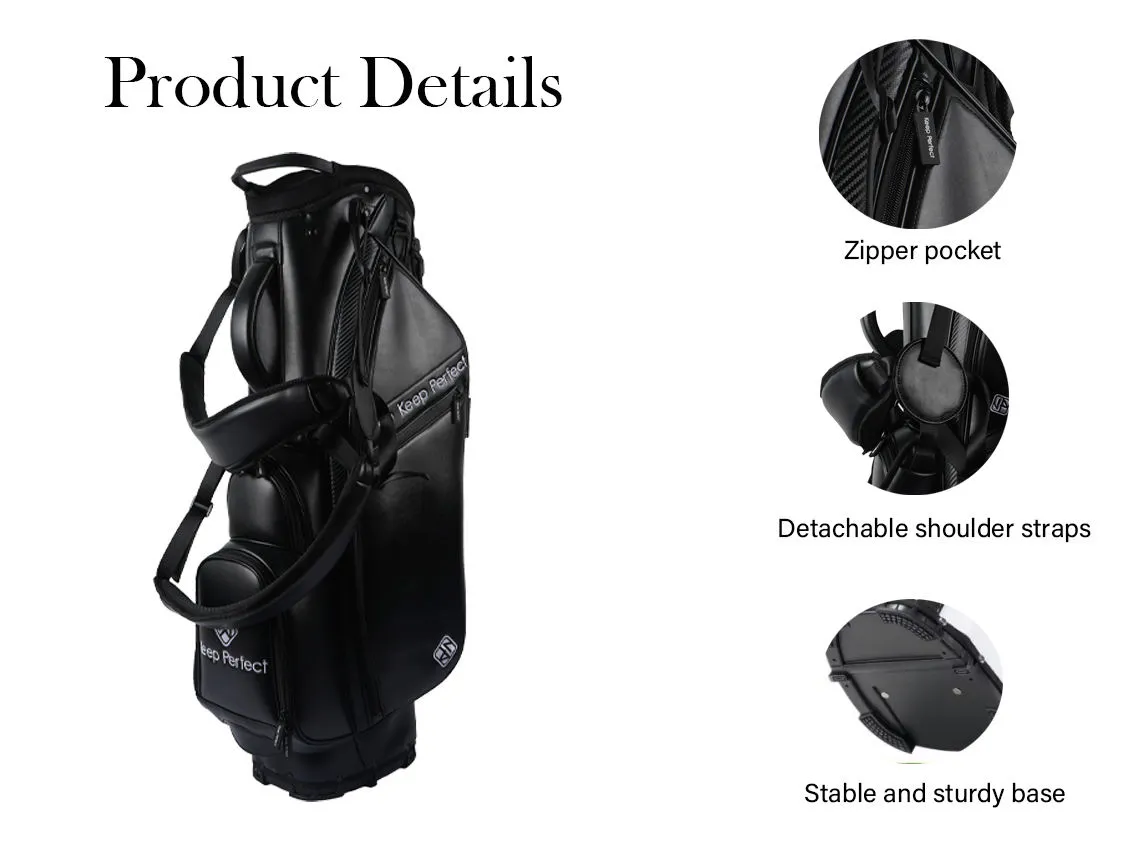
The two resolutions worth singling out: the dual-geometry base — a molded base carrying both leg hinges and a cart-bracket channel with anti-rotation pads (the part that makes or breaks the crossover; a base that wobbles in the bracket or rocks on slopes fails both postures), and the strap pass-through channel that works with the dual-strap system stowed — routing the cart strap without compressing pockets, with the backpack straps tucked cleanly rather than dangling into the mechanism. These two components are where supplier capability shows; both must be verified physically at sample stage.
| Component | Stand-bag instinct | Cart-bag instinct | Hybrid resolution |
|---|---|---|---|
| Legs | Full mechanism | None | Full mechanism, low-profile feet |
| Top | 4–5 way | 14 way + putter well | 14 way, full-length dividers |
| Pockets | 6, side-access | 8–11, forward-facing | 7–8 forward-facing, carry-reachable |
| Base | Legs + slope stability | Bracket + anti-rotation | Dual-geometry molded base |
| Straps | Dual backpack system | Single + pass-through | Dual with cart pass-through channel |
| Weight | 2.0–2.8 kg | 2.8–3.5 kg | 2.6–3.2 kg |
Who the Hybrid Actually Serves
Three customer profiles justify the chassis. The mixed-week golfer (the core): walks sometimes, rides sometimes, refuses two bags — the majority use-case in markets with both strong walking culture and cart fleets (the US suburbs, the UK, Australia). The push-cart golfer: trolleys pair naturally with hybrid architecture — legs for the range, cradle for the round — and the trolley segment's growth feeds hybrid demand directly. The one-bag minimalist: storage space, car trunks and budgets that say one bag, chosen to cover everything.
The profiles that do not fit: dedicated walkers (spec an ultralight stand — the hybrid's feature weight is dead grams on their shoulders) and dedicated riders (spec a pure cart bag — the legs are dead grams in their basket, and a true cart bag's pocket depth beats a hybrid's). Honest positioning matters here: the hybrid wins the mixed week and loses both purist segments, and programs should say so on the product page rather than promise universality.
Hybrid vs Dedicated Chassis: the Positioning Grid
Against the stand bag: the hybrid trades 300–600 g for cart architecture — worth it if the customer rides a third of rounds or more, wasted below that. Against the cart bag: it trades pocket depth and pure riding refinement for legs and straps — worth it if the customer walks at all. Against two dedicated bags: it trades optimization for economy and simplicity — the one-bag answer at one price.
For line planning, the hybrid is a third SKU, not a replacement: collections run stand (volume core) + cart (riding majority) + hybrid (the crossover customer between them), or — at tighter SKU counts — hybrid as the single carry-and-ride answer with a Sunday below and a staff above. The launch ladder discusses both architectures; the choice is a channel question (where do your customers actually play?) more than a product question.
Materials and Branding on the Crossover
Materials follow the line vocabulary: 1680D ballistic for the workhorse tier, hybrid PU showcase panels for premium (the 2027 mid-tier premiumization lands squarely on this chassis — the hybrid's big side panels are ideal PU stages), ripstop for the lighter-leaning executions. One hybrid-specific note: the base endures double duty (slope deployment plus bracket friction), so base materials spec up a grade — reinforced panels or rubberized contact zones where cheaper chassis use base fabric.
Branding follows the cart-bag logic (front panel primary for the golfer, side panels presenting outward) with the stand-bag caveat that the bag is also photographed standing open on fairways — both presentation contexts must read correctly. The placement hierarchy from the placement guide applies unchanged; the hybrid simply has to honor it in two postures instead of one.
MOQ Economics on the Crossover
Hybrid economics at MOQ 200: USD 18–24 standard tier (1680D, 14-way top, dual straps, cooler sleeve), USD 24–28 premium (hybrid PU panels, magnetic closures, integrated putter tube), FOB Xiamen. The hybrid inherits both chassis' cost drivers — mechanism and strap engineering from the stand side, pocket complexity and top engineering from the cart side — which is why it prices at the range's upper-middle. Quantity breaks follow the standard curve: 500 pieces saves 12–18%.
The retail math: USD 139–249 positions the hybrid against both parents, and its one-bag-for-everything story supports the premium over a stand bag (USD 20–40 more for the cart architecture) credibly. For tight-SKU lines, the hybrid's economics are attractive precisely because it covers two use-cases with one development cost, one MOQ, one inventory position — the cost breakdown shows the consolidated math.
Quality Control for a Two-Machine Product
The hybrid carries both chassis' machines, so QC doubles up: full leg-mechanism protocol from the stand side (5,000-cycle deployment tests, slope stability at 15 degrees, low-profile foot geometry verified), full cart protocol from the cart side (bracket fit on current cart systems, anti-rotation over bump courses, strap pass-through with pockets loaded), plus the hybrid-specific checks: dual-base integrity (the hinge-and-channel molding is the highest-stress part in the range — drop-tested loaded), strap stow-and-deploy cycles, and weight verification (the chassis's compromise story collapses if it ships over spec).
Inspection runs AQL 2.5 (ISO 2859-1) with both protocols layered — the 40-point checklist from the AQL guide plus the crossover items. Field-failure data concentrates on the dual base and the strap-stow geometry; both are sample-stage catches. The hybrid forgives nothing because it promises everything — the QC budget should reflect that.
When Programs Should Spec the Hybrid
Spec the hybrid when: your channel serves genuinely mixed golfers (suburban US, UK, Australian retail), your line needs one carry-and-ride SKU at tight SKU counts, your brand story is versatility ("one bag, every round" is a real positioning — the hybrid is its only honest chassis), or the push-cart segment is your growth bet. Do not spec it when: your market is cart-dominant (pure cart bags win on features and refinement), your positioning is ultralight walking (the hybrid's weight betrays the story), or your line already covers stand + cart credibly (the hybrid then cannibalizes both rather than extending either).
The decision belongs in the launch architecture, not the product page. Programs that add a hybrid as an afterthought get a SKU that answers nothing; programs that position it as the deliberate crossover — named, storied, priced between its parents — get one of the range's most durable sellers. The launch guide's ladder discussion covers the SKU-count trade-offs explicitly.
A Worked Program: UK Trolley-Brand Crossover
A UK trolley-accessory brand's 2026 bag line: 800 hybrids in two colorways (1680D with PU side panels, 14-way top, dual straps with stow channel, push-cart-optimized base pad) retailed at USD 169 through their trolley dealer network against a USD 21.60 landed cost. The positioning sentence was explicit: "engineered for the trolley golfer, honest for the walking nine." The brand's dealer channel sold the pairing — bag and trolley as the complete walking-system answer.
Season reporting: 71% sell-through, returns under 1% (the dual-base spec holding), and the pairing attach rate above 40% at dealers who displayed the bag mounted on a trolley. The program's lesson is the hybrid's channel truth: it sells best where the mixed posture is visible — mounted on a trolley in a shop, not flat in a catalog. For 2027 the brand added a lighter 2.7 kg variant after the walking-nine customers asked for one — the crossover earning a second SKU.
Common Hybrid Program Mistakes
Five recurring errors. Averaging the compromises: deciding nothing explicitly and shipping a bag that serves neither posture — every conflict needs a winner chosen in advance. Promising universality: marketing the hybrid as perfect for everyone — purists in both camps return it; position it honestly for the mixed week. Under-engineering the dual base: the hinge-and-channel molding is the range's highest-stress part — spec it up, test it loaded, or read about it in reviews. Dangling straps: dual straps without a stow channel tangle in mechanisms and cart brackets — the stow geometry is a feature, not an afterthought. Pure-cart feature loads: eleven pockets at 3.5 kg — the walking nine the customer bought it for becomes a penalty.
The meta-mistake: treating the hybrid as an easy line extension. It is the hardest chassis to spec well because it must be two products at once — and the most rewarding when specced deliberately, because the mixed-week golfer it serves is the market's silent majority. Crossover, not compromise: the chassis works when the program believes in the distinction.
The Push-Cart Connection: the Hybrid’s Native Habitat
No chassis pairs with the trolley segment as naturally as the hybrid. The logic is mechanical: trolley golfers walk (so they value straps for the parking lot and legs for the range) but roll the bag all round (so they use the cart architecture — forward pockets, bracket base, 14-way top — constantly). A pure stand bag on a trolley buries its pockets and wastes nothing but looks it; a pure cart bag on a trolley works but strands the golfer at the range; the hybrid serves the whole day. Trolley brands know this, which is why the segment's strongest bag programs are hybrid-led.
The spec details for trolley-first programs: base pad geometry matched to the major trolley cradles (two-prong support spacing verified per model year), a top handle positioned for trolley mounting (the lift onto the cradle happens every round), weight kept under 3.0 kg (trolley golfers still lift the bag in and out of the car), and leg feet that retract fully clear of the cradle zone. These are one-line spec items at brief stage and the difference between a trolley-ready product and a trolley-tolerant one — the cart guide's push-cart section covers the cradle standards in detail.
Starting a Hybrid Program
The brief: positioning sentence (who carries it, how their golf week looks), top and pocket spec, material tier, color story, quantity. Through the quote form, the quotation returns with the dual-posture engineering spec'd and priced at your volume — samples in 6–10 working days, production in 35–45 days.
For line builders, the hybrid's placement decision comes first: third chassis in a full line, or the single carry-and-ride answer in a tight one. The gallery shows current crossover executions. Junyuan has engineered dual-posture bags for export programs since 2014 — one bag, both postures, no apologies.
Frequently Asked Questions
What is a hybrid golf bag?
A stand-cart crossover: a working leg mechanism and dual carry straps combined with cart-bag architecture — forward-facing pockets, 14-way top, strap pass-through and a bracket-ready base — at 2.6–3.2 kg. It serves the golfer who walks some rounds and rides others: one bag that works properly in both postures.
How much do custom hybrid golf bags cost?
At MOQ 200, FOB Xiamen: standard tier (1680D, 14-way top, dual straps, cooler sleeve) USD 18–24; premium (PU showcase panels, magnetic closures, putter tube) USD 24–28. Retail positioning runs USD 139–249 — a credible USD 20–40 premium over stand bags for the cart architecture.
What is the minimum order for custom hybrid bags?
200 pieces per design — USD 3,600–5,600 total depending on tier. The hybrid inherits both parent chassis' engineering (mechanism plus cart architecture), so development cost is single-SKU while coverage is two use-cases: one MOQ, one inventory position, two postures served.
Hybrid vs stand bag: which should I choose?
Choose the hybrid if you ride a third of your rounds or more — the cart architecture (forward pockets, 14-way top, bracket base) earns its 300–600 g. Choose a dedicated stand bag if you walk nearly everything: the hybrid's feature weight is dead grams on a walker's shoulders, and an ultralight stand carries better.
Hybrid vs cart bag: which should I choose?
Choose the hybrid if you walk at all — legs and dual straps are the difference. Choose a pure cart bag if you ride exclusively: it offers deeper pockets and riding refinement without the 300–500 g of mechanism your cart never deploys. Honest programs say this on the product page rather than promising universality.
Does a hybrid bag fit both riding carts and push trolleys?
Yes, when the base is spec'd for it: the dual-geometry molded base carries leg hinges plus a cart-bracket channel with anti-rotation pads, and premium tiers add push-cart-optimized base pads. Trolleys pair especially naturally with hybrids — legs for the range, cradle for the round — which is why the trolley segment drives hybrid demand.
How heavy is a hybrid golf bag?
2.6–3.2 kg depending on spec — heavier than a stand bag (2.0–2.8 kg), lighter on features than a full cart bag (2.8–3.5 kg). The weight buys the dual capability; programs targeting carry-first customers should spec an ultralight stand instead. Weight is verified against spec (±5%) at pre-shipment inspection.
What should I test on a hybrid bag sample?
Both machines: the leg mechanism (fifty deployments, slope stability loaded) and the cart fit (strap it to a real cart — pockets accessible, pass-through clean, base stable over bumps), plus the hybrid-specific items: strap stow-and-deploy cycles and dual-base integrity under loaded drops. The chassis forgives nothing because it promises everything.
How are hybrid bags quality-inspected?
AQL 2.5 (ISO 2859-1) with both parent protocols layered: 5,000-cycle leg deployments and 15-degree slope stability from the stand side; bracket fit, anti-rotation and pass-through checks from the cart side; plus dual-base loaded drop tests, strap stow cycles and weight verification. Field failures concentrate on the dual base and stow geometry — both sample-stage catches.
When should a brand line include a hybrid?
When the channel serves genuinely mixed golfers (suburban US, UK, Australia), when tight SKU counts need one carry-and-ride answer, when the brand story is versatility, or when the push-cart segment is the growth bet. Skip it when the market is cart-dominant, the positioning is ultralight walking, or stand + cart already cover the line credibly.
Can a hybrid match my collection’s design language?
Yes — same fabric lots, lab-dipped color stories and hardware finishes as the rest of the line. Branding follows the placement hierarchy in both postures (front panel for the golfer, side panels presenting outward, and the standing-open fairway context). One hybrid-specific note: base materials spec up a grade for double duty.
How long does custom hybrid bag production take?
Samples in 6–10 working days; bulk production 35–45 days after approval; ocean freight 14–35 days. Line programs typically sequence hybrid third after stand and cart, or sample it as the single carry-and-ride SKU in tight-SKU launches.
How do I start a custom hybrid bag program?
Four details through the quote form on this site: positioning sentence (who carries it, how their golf week looks), top and pocket spec, material tier and quantity. The quotation returns with dual-posture engineering priced at your volume; samples inside two weeks — Junyuan has engineered dual-posture bags for export programs since 2014.