
Why the Stand Bag Owns the Market’s Center
The stand bag is the only chassis that serves every round type — walking with the legs deployed, riding with the legs locked, range sessions standing alone — which is why it holds the largest share of golf bag unit sales and why custom programs build their lines around it.
The versatility argument is decisive at retail: a customer unsure how they will play buys the bag that covers all cases. For brand programs this makes the stand bag the default first SKU (the launch guide's core tier), the chassis that carries the collection's color story in the most hands, and the product where engineering quality is felt most directly — legs that wobble, straps that dig, zippers that fight are experienced on every hole. The stand chassis page shows the constructions; this guide is the engineering beneath them.
Leg Mechanism: the Engineering That Defines the Chassis
The stand mechanism is a small machine: two legs, a hinge assembly, an activation system (foot-activated pedal or base-plate tilt), and a return spring — expected to deploy reliably 10,000+ times across years of rounds, in rain, sand and cold. The failure modes buyers should know: hinge slop (legs wobble laterally — worn pivots or underspecified bushings), spring fatigue (legs stop retracting fully), activation friction (the pedal fights back), and leg-foot slip on wet lies (inadequate foot geometry or rubber spec).
Our mechanism spec addresses each: sealed pivot bushings rated for 20,000 cycles, stainless return springs, low-friction activation geometry, and molded rubber feet with a wet-grip tread pattern. The QC validation is the cycle test — 5,000 deployments on sampled units, mechanism measured for slop before and after — plus slope-stability testing (bag loaded, deployed on a 15-degree platform, must hold). Mechanism quality is invisible in photographs and decisive in the hand; it is the first thing to test on any supplier's sample, per the 12-point protocol in the sample guide.
Weight Classes and Their Trade-Offs
Weight is the chassis's defining trade-off: every feature (pocket, divider, padding gram) costs carry comfort, and every gram saved costs structure or features. Ultralight constructions serve the walking renaissance (the 2027 compact direction) but demand honest engineering — ripstop tears propagate without bar-tacked stress points, and ultralight straps must be better, not thinner, because a bad strap on a light bag is worse than on a heavy one. The standard class remains the volume core for a reason: it is where feature completeness and carry comfort balance for the median golfer.
| Class | Weight | Construction | Price (MOQ 200) | Best for |
|---|---|---|---|---|
| Ultralight | 1.8–2.2 kg | Ripstop, simplified pockets | USD 14–18 | Walking-first brands, juniors, seniors |
| Standard | 2.3–2.8 kg | 600–1680D, full pocket set | USD 16–22 | The volume core — most programs |
| Premium | 2.6–3.2 kg | Hybrid PU, full features | USD 20–26 | Retail flagship tier, quiet premium |
Strap Systems: Where Comfort Is Won
The strap system is the second machine: dual-strap backpack systems dominate walking golf (load shared across both shoulders, hips stabilized), with single-strap convertibility for cart rounds. The spec points that separate systems: pad density (closed-cell foam 8–12 mm that does not bottom out), adjustability range (the system must fit a 160 cm junior and a 195 cm adult — strap travel of 40+ cm), self-balancing geometry (better systems level the bag automatically as it lifts), and quick-release buckles for cart transitions.
The comfort test that matters: 10 kg loaded (14 clubs, balls, water, rain gear — the real-world load), 5,000-cycle strap flex testing, and anchor pull tests at every attachment point. A strap failure mid-round is the stand bag's worst field report; the anchor engineering (boxed-X stitching into reinforced webbing beds) is where it is prevented. Premium tiers add ventilated pad channels and grab handles positioned for trunk lifts — details buyers notice in reviews, not spec sheets.
Divider Architecture: 4, 5 or 14 Ways
Divider tops organize the 14-club reality. 4-way (the walking standard): lightest, clubs group by type, grip tangle managed by full-length dividers in better executions. 5-way (the compromise): separates woods from irons more deliberately at +40–80 g. 14-way (the organization maximalist): individual slots per club, +150–300 g, the choice for customers who count clubs by slot — popular in the US market and with cart-hybrid users.
The engineering details that matter more than the count: full-length divider fabric (dividers that stop halfway let grips tangle below — the most common complaint in the category), velour or soft-touch top cuffs (club shafts and graphite finishes rub), and putter-well sizing (oversize putter grips need a dedicated wide slot in 14-way designs). Spec the divider system by customer, not by feature list: walking-first brands choose 4-way full-length; organization-led brands choose 14-way with a proper putter well.
Pocket Architecture: the Six-Pocket Logic
The standard six: apparel (full-length side), ball (front, the branding primary), valuables (fleece-lined, weatherproof zipper in premium tiers), accessories/tee (mid-front), beverage (insulated sleeve — the feature customers mention in reviews), and rangefinder/quick-access (top or hip). The 2027 design direction toward "six pockets, not eleven" applies here: disciplined pocket planning reads as sophistication, and every pocket earns weight.
Placement engineering follows the carry context: pockets must be accessible with the bag on the back (side-entry apparel zips, forward-facing valuables), must not interfere with leg deployment (a stuffed apparel pocket that blocks the mechanism is a design failure discovered in reviews), and must drain (mesh-bottomed ball pockets shed the water that collects on wet rounds). These are sample-stage verifications — the physical prototype reveals placement failures that renderings hide.
Branding the Volume Chassis
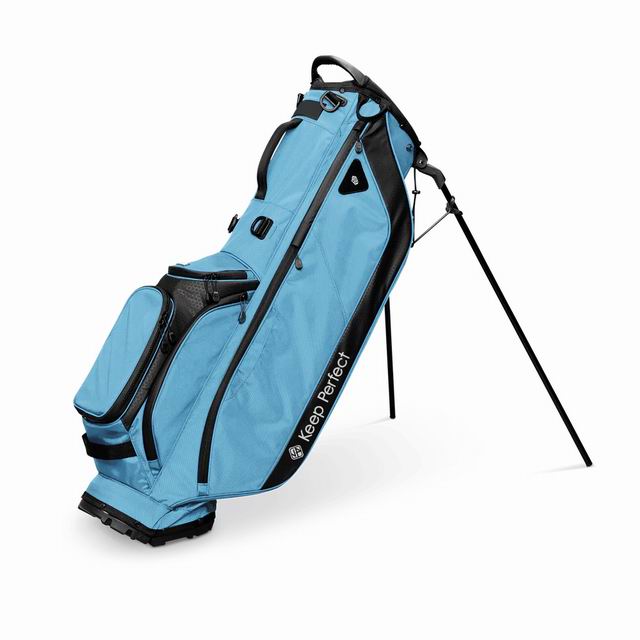
The stand bag carries the collection's branding to the most eyeballs, which makes its execution the line's reference standard. The architecture follows the placement guide: ball pocket primary (180–280 mm), apparel pocket secondary at 60–70%, spine and hip pad supporting, rain hood completing the set. Technique follows material and design language: embroidery for the crest tradition, heat transfer for the full-color and pastel executions, deboss on hybrid PU panels for quiet premium.
The volume-chassis consideration unique to stand bags: they are photographed constantly by customers (the standing bag is the round's permanent backdrop), which makes color-story discipline and detail-layer execution (color-matched zippers, custom pulls, the 2027 detail layer) worth more here than on any other chassis. The stand bag is where a collection's design confidence is judged — spec the details accordingly.
MOQ Economics on the Volume Core
Stand economics at MOQ 200: ultralight USD 14–18, standard USD 16–22, premium hybrid USD 20–26, FOB Xiamen. Price drivers in order: material family (hybrid PU adds USD 4–6), mechanism and strap tier (the premium strap system adds USD 1.20–2.00), divider architecture (14-way adds USD 0.80–1.40), pocket count and features (insulated sleeves, magnetic closures), and branding complexity. Quantity breaks follow the standard curve — 500 pieces saves 12–18%, 1,000 saves 20–28%, per the MOQ pricing guide.
The program math that makes the stand bag the line's engine: at USD 99–229 retail against USD 14–26 factory cost, the chassis sustains the channel margins (distributor 25–35%, retail 45–55%) that fund a brand's distribution, per the wholesale margin stack. Collections live or die on the stand bag's economics — the staff bag crowns the line, the Sunday enters it, but the stand bag pays for it.
Quality Control for Moving Parts
Stand bag QC centers on the machines: leg mechanism cycle testing (5,000 deployments, slop measured before and after), slope stability (loaded bag on a 15-degree platform), strap system validation (10 kg loaded carry cycles, anchor pulls), and zipper function under pocket-load. Beyond the machines: full-length divider integrity (grip tangle is a divider failure), seam and bar-tack inspection at stress points, weight verification against spec (±5% — a "2.4 kg" bag weighing 2.9 is a spec failure customers will weigh), and rain hood fit.
Inspection runs AQL 2.5 (ISO 2859-1) with the mechanism tests on sampled units — 32 bags from a 200-piece lot, 50 from 500. The stand bag's field-failure pattern concentrates overwhelmingly in mechanism, straps and zippers, which is why those three sit at the top of the 40-checkpoint protocol in the AQL guide. The chassis forgives cosmetic drift more than mechanical weakness; the protocol is weighted accordingly.
Program Roles: How Lines Use the Stand Bag
Three roles across program types. The brand core: the SKU that carries the color story to the most customers, priced at the line's center (USD 129–179), specced to the brand's positioning — the launch ladder's middle rung. The team and institutional issue: schools and academies issue stand bags as uniform equipment (the school programs guide covers the pooled economics), where durability and color-fastness outrank lightness. The retail volume driver: the pro-shop and big-box staple where sell-through is won on the carry-comfort try-on and the color story on the wall.
The spec conversation differs per role: brand cores optimize design language and detail layer; institutional issues optimize durability and reorder consistency (the reorder system matters most here — next year's team bags must match this year's); retail drivers optimize the try-on moment (strap comfort, mechanism feel, pocket access). One chassis library, three correct specs — brief the role and the spec follows.
A Worked Program: Regional Retail Chain Core SKU
A 14-store golf retail chain's 2026 private-label program: 1,200 stand bags across four colorways (standard class, 1680D with PU ball-pocket panel, 5-way full-length dividers, premium dual-strap, insulated beverage sleeve), retailed at USD 139 against a USD 19.80 landed cost. The chain's insight: their house-brand stand bag competed directly with national brands' USD 179–229 offerings — same construction depth, better color stories, USD 40–90 less.
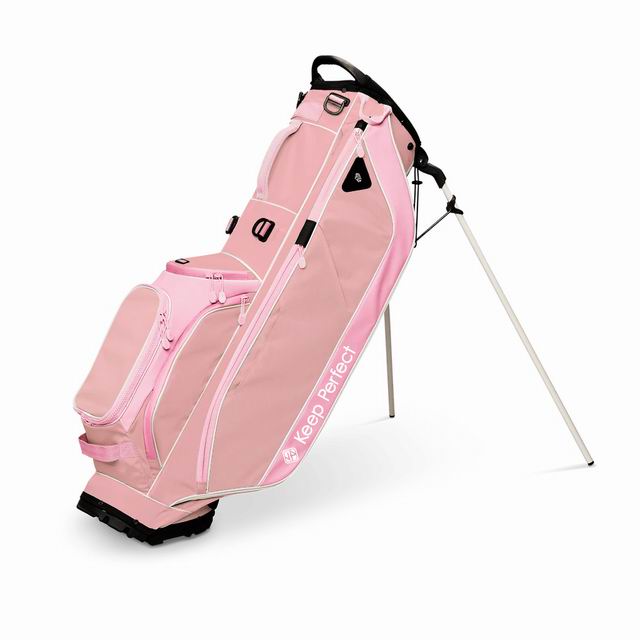
Season reporting: 78% sell-through chain-wide by October, the navy-and-cream colorway leading; return rate under 0.8% (mechanism and strap spec holding); and the stand bag's success funded the 2027 expansion — a cart bag on the same design language and a pastel limited run. The program's lesson is the chassis's central truth: the stand bag is where a private label proves it can build a real product. Win there and the line follows; the chain's buyer called it "the SKU that made the house brand believable."
Common Stand Program Mistakes
Six recurring errors. Mechanism by assumption: not cycle-testing the leg system at sample stage — the failure arrives at hole seven, month four. Feature accumulation: eleven pockets and every gadget at 3.4 kg — the walking customer the chassis exists for walks away. Underspec straps on ultralights: light bag, thin strap, worse carry than the heavy bag it replaced. Half-length dividers: grip tangle below the cuff — full-length or accept the reviews. Pocket-leg interference: a stuffed apparel pocket blocking deployment, discovered by customers. Weight drift: spec 2.4 kg, ship 2.9 kg — verified on the scale at PSI or litigated in reviews.
The meta-mistake: treating the market's most common chassis as the easiest. The stand bag is the most mechanically complex product in the range and the one customers use hardest. Its engineering is solved — but only for programs that spec the mechanisms honestly and test them physically. The chassis rewards rigor and punishes assumption, at the highest volume in the line.
Starting a Stand Bag Program
The brief: weight class, divider architecture, strap tier, color story, quantity and program role. Through the quote form, the quotation returns with construction specs — mechanism, straps, dividers, pocket plan — priced at your volume, samples in 6–10 working days, production in 35–45 days.
For new lines the sequencing is consistent: the stand bag samples first (its engineering decisions cascade to cart and Sunday), photographs second (after the staff flagship), and anchors the collection's volume plan. The gallery shows current executions across weight classes. Junyuan has engineered stand mechanisms for export programs since 2014 — the chassis the market is built on, built properly.
Frequently Asked Questions
What is a stand golf bag?
A carry bag with a built-in leg mechanism — 2–3 kg, legs that deploy when the bag tilts, dual-strap systems for walking, and full divider and pocket architecture. It is the market's volume core because it serves every round type: walking with legs deployed, riding with legs locked, and range sessions standing alone.
How much do custom stand golf bags cost?
At MOQ 200, FOB Xiamen: ultralight (1.8–2.2 kg) USD 14–18, standard class USD 16–22, premium hybrid USD 20–26. Quantity breaks: 500 pieces saves 12–18%, 1,000 saves 20–28%. Retail positioning runs USD 99–229 depending on tier — the chassis sustains full distribution margins at every rung.
What is the minimum order for custom stand bags?
200 pieces per design — USD 2,800–5,200 total depending on tier. The stand bag is the default first SKU of brand programs: its engineering decisions (mechanism, straps, dividers) cascade to the cart and Sunday lines, so it samples first in most collections.
How does the stand mechanism work and how long does it last?
Two legs deploy via a foot-activated or base-tilt mechanism with spring return. A quality mechanism runs sealed pivot bushings and stainless springs rated for 20,000+ cycles — years of regular play. Field failures concentrate in hinge slop, spring fatigue and activation friction; our QC validates with 5,000-deployment cycle tests and slope-stability checks on sampled units.
What weight should a stand bag be?
By use case: ultralight 1.8–2.2 kg for walking-first brands, juniors and seniors; standard 2.3–2.8 kg for the volume core (feature completeness balanced against carry comfort); premium 2.6–3.2 kg for flagship tiers. Every feature costs grams and every gram costs structure — the weight class decision belongs in the brief, verified on the scale at inspection.
Are dual straps or single straps better?
Dual-strap backpack systems for walking (load shared, hips stabilized, self-balancing geometry); single-strap convertibility for cart rounds. The spec points: closed-cell foam pads 8–12 mm, 40+ cm adjustability to fit all body sizes, quick-release buckles for cart transitions. Validated with 10 kg loaded carry cycles and anchor pull tests.
Should I choose a 4-way, 5-way or 14-way divider top?
4-way for walking-first brands (lightest, clubs group by type); 5-way as the compromise; 14-way for organization maximalists and the US market (+150–300 g, individual slots). Whatever the count, spec full-length dividers — half-length dividers let grips tangle below the cuff, the category's most common complaint — and a wide putter well for oversize grips.
What pockets does a stand bag need?
The disciplined six: full-length apparel, front ball pocket (branding primary), fleece-lined valuables, accessories, insulated beverage sleeve, and quick-access rangefinder. More pockets add weight and cost; the 2027 design direction favors "six pockets, not eleven." Placement must work on the back (side-entry zips), clear the leg mechanism, and drain on wet rounds.
How are stand bags quality-tested?
AQL 2.5 inspection (ISO 2859-1) weighted toward the machines: 5,000-cycle leg mechanism tests with slop measurement, 15-degree slope stability, 10 kg loaded strap cycles with anchor pulls, zipper function under pocket load, full-length divider integrity, and weight verification against spec (±5%). Field failures concentrate in mechanism, straps and zippers — the protocol starts there.
Can stand bags match my collection and custom colors?
Yes — full color stories with lab-dipped fabric, webbing and zipper tape matched to your Pantone references (Delta E 1.0–1.5), the same lots cascading across cart, Sunday and accessories. The stand bag is the collection's reference standard: its color-story discipline and detail layer (matched zippers, custom pulls) define how the line is judged.
How long does custom stand bag production take?
Samples in 6–10 working days; bulk production 35–45 days after approval; ocean freight 14–35 days by destination. Collection programs sample the stand bag first — its mechanism, strap and divider decisions set the engineering vocabulary for the rest of the line.
What price point should a private label stand bag target?
The proven ladder: house brands compete at USD 99–139 against national brands' USD 179–229 (same construction depth, better value); premium DTC lines position at USD 149–199 on materials and color stories; institutional issues optimize durability over features. At USD 16–22 factory cost, every rung sustains full channel margins.
How do I start a custom stand bag program?
Five details through the quote form on this site: weight class, divider architecture, strap tier, color story and quantity. The quotation returns with full construction specs priced at your volume; samples inside two weeks — Junyuan has engineered stand mechanisms for export programs since 2014.
What is the most important thing to test on a stand bag sample?
The leg mechanism: deploy it fifty times, check for hinge slop and spring return, then load the bag and stand it on a slope. Second, the straps — carry it loaded for ten minutes. These two machines decide the bag's reputation in the field, and both are free to test at sample stage, expensive to fix after production.