
What Makes a Cart Bag a Cart Bag
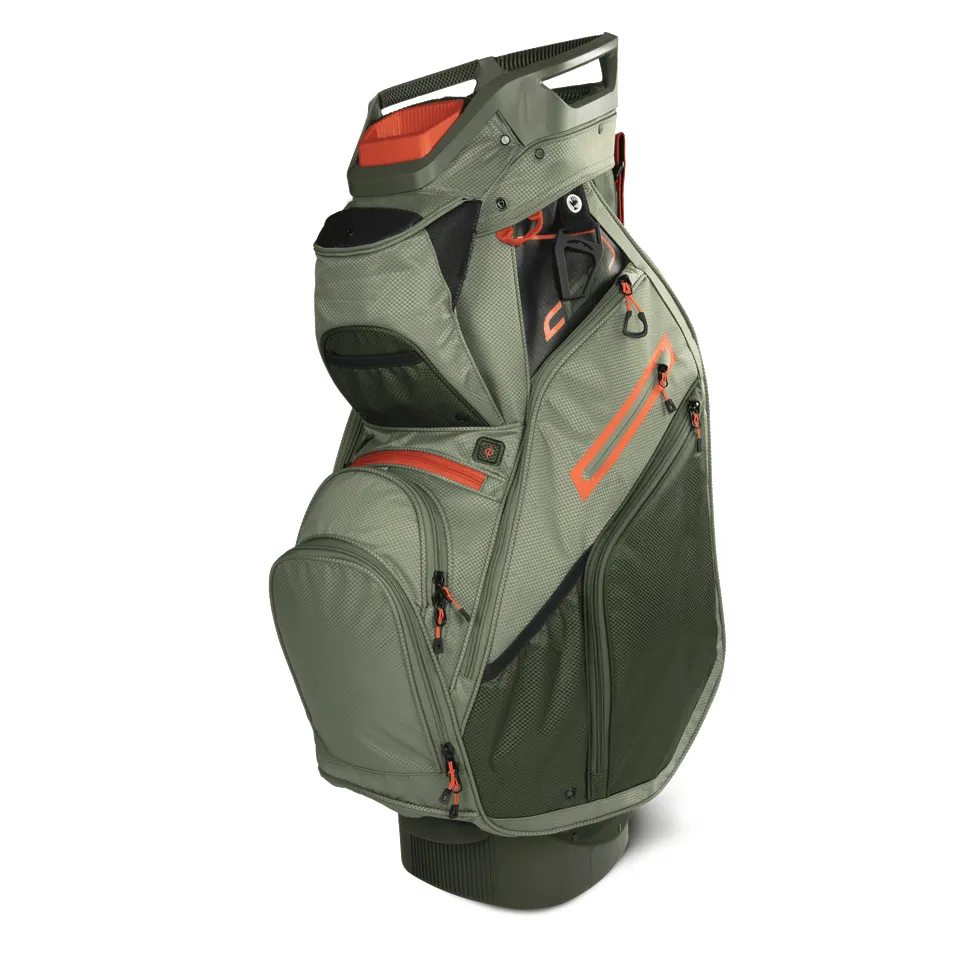
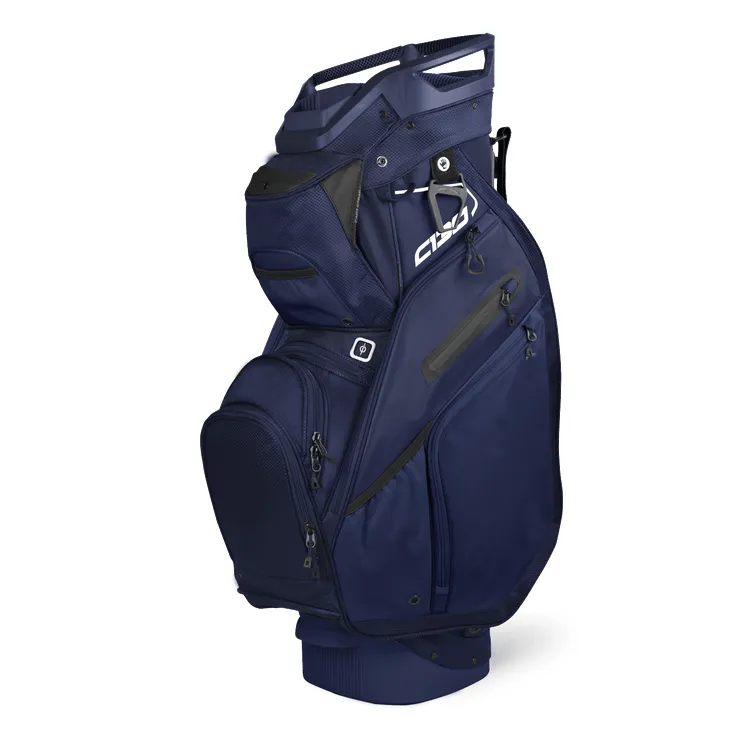
A cart bag is engineered for one posture — strapped to a riding cart or push trolley: every pocket forward-facing and accessible while secured, a 14-way organizer top, a strap pass-through channel, no leg mechanism, and a base shaped for cart brackets. It spends its weight budget on storage and organization instead of carry engineering.
The riding posture changes everything. A stand bag on a cart presents its pockets sideways, buries half its storage against the basket, and wastes 300–500 g on a mechanism that never deploys. The cart bag redesigns around the constraint: the spine faces the cart, the face serves the golfer, and every feature works while strapped. Buyers new to the chassis sometimes view it as a stand bag minus legs; the honest description is a different product answering a different round. The cart chassis page shows the constructions; this guide is the architecture.
The Riding Market Behind the Chassis
Cart prevalence is a market fact buyers should spec to: the majority of US rounds involve riding carts (resort, retirement, and daily-fee golf run cart-first), while the UK and European markets walk more but ride increasingly — and push-cart adoption has created a hybrid segment that demands cart-bag features in lighter packages. The 2027 trend analysis tracks the cart bag going visually quieter while staying feature-rich — the riding customer buys organization, and 2027 organizes with better pockets rather than more pockets.
The program implication: cart bags anchor the line in riding markets (a US-focused collection without a credible cart bag is missing its majority use-case), serve the premium feature tier everywhere (the chassis carries the most storage engineering in the range), and increasingly pair with push-cart compatibility as a stated feature. Lines typically sequence the cart bag second after the stand bag — the launch ladder places it as the completeness tier.
Forward-Facing Architecture: the Defining Discipline
The cart bag's signature engineering: all storage accessible from the front while strapped. In practice this means pocket openings oriented to the golfer standing beside the cart (zips running vertically along the bag's face), pocket depth planned so contents do not dive below reach, and nothing critical on the spine side (that face lives against the cart). The test is physical: strap the sample to a cart, and every pocket must open, reach and close without unstrapping — a verification that belongs in the 12-point sample protocol.
The second forward-facing discipline is the top: the 14-way organizer reads toward the golfer, with the putter well positioned at the front (integrated putter tubes in premium tiers) and irons arrayed behind — the layout the standing golfer actually sees. Tops that read beautifully in catalog photos but backwards on the cart are the chassis's most common design failure; they are caught in five minutes with a real cart and prevented forever by testing at sample stage.
Top and Divider Engineering
The 14-way full-length divider top is the cart bag's standard (individual club slots, full-length fabric preventing grip tangle), with the engineering concentrated in three details: the putter well (dedicated oversize tube or wide front slot for jumbo grips — the feature riding golfers check first), slot sizing (iron slots must accept modern game-improvement head profiles without fighting), and top-cuff durability (velour or soft-touch liners protect shafts; the cuff takes the daily abrasion of 14 clubs drawn and returned).
Weight note: the 14-way top adds 150–300 g over a 4-way, which the cart context forgives — the chassis's weight budget serves features, not shoulders. Some programs spec a 15th slot (the "every club plus trainer" layout) or integrated putter tubes with individual wells; both are available at standard tiers. The divider decision on a cart bag is simpler than on a stand bag: organization is the product promise, so the full organizer top is the default, not the upgrade.
Pocket Systems for the Strapped-Down Life
The cart bag carries the range's deepest pocket architecture — typically 8–11 pockets in three tiers. The front tier (most-accessed): ball pocket, tee/accessory pockets, magnetic rangefinder pocket (the feature riding golfers mention in reviews — one-handed access while seated). The side tiers: dual full-length apparel pockets (accessible from either side of the cart), insulated cooler pocket (draining, sized for a six-pack plus ice — the cart context's signature feature), valuables pocket (fleece-lined, weatherproof zip). The utility layer: towel carabiner, glove patch, umbrella sleeve, pen and scorecard slots.
Feature engineering follows use: cooler pockets must drain (meltwater exits through a grommeted base, not into apparel), magnetic closures must hold on cart paths (rated magnets, tested loaded over bumps), and rain hoods must deploy over the full 14-way top. The pocket plan is where cart bags differentiate at retail — the try-on in a pro shop is a pocket tour — and where spec discipline separates thoughtful architecture from feature accumulation. Every pocket should answer a named moment in a riding round.
Base, Strap and Stability Engineering
Three cart-specific structures. The base: molded geometry matching riding-cart bracket standards and push-cart cradles (verified against the major cart systems each season — bracket geometries drift between model years), with anti-rotation features (molded channels or rubberized contact patches that keep the bag from twisting on cart paths). The strap pass-through: a channel behind the pockets that routes the cart's securing strap without compressing pocket access — the detail that separates engineered cart bags from stand bags pretending. The top handle: integrated lift handles at the cuff (trunk-to-cart transitions happen 100+ times a season).
Push-cart compatibility deserves its own spec line: the cradle geometry differs from riding carts (two-prong supports, strap positions), and the hybrid segment expects the bag to ride both. Premium cart tiers add a dedicated push-cart base pad or adjustable cradle channels. The QC validation: mounting tests on current riding-cart brackets and push-cart cradles, rotation testing over a bump course, and strap pass-through function with pockets fully loaded — the physical checks that keep compatibility promises honest.
Materials and Branding on the Feature Chassis
Material tiers follow the range: 600–1680D ballistic for the value and volume tiers, hybrid PU showcase panels for the premium read (the cart bag's large side panels are PU's best stage in the range), and full color-story executions per the collection vocabulary. The cart context is gentler than carry (no shoulder abrasion, less ground contact), which lets premium materials shine longer — one reason hybrid constructions pay back visibly on this chassis, per the materials guide.
Branding follows the placement discipline with a cart twist: the primary face is the ball-pocket/front panel (visible to the golfer all round), but the apparel-pocket panels present to playing partners and the parking-lot context — the cart bag's branding is seen by everyone except its carrier. The placement guide's 55–70% hierarchy applies; the quiet-premium direction (debossed tone-on-tone on the PU panels) reads particularly well at cart scale, where the big panels carry restraint confidently.
MOQ Economics on the Feature King
Cart economics at MOQ 200: USD 18–24 standard tier (1680D, full pocket set, 14-way top), USD 24–30 premium (hybrid PU, magnetic closures, integrated putter tube, cooler drainage systems), FOB Xiamen. Price drivers: material family, pocket complexity (each engineered feature — magnets, drains, insulated liners — adds USD 0.40–1.20), top engineering, and branding execution. Quantity breaks follow the standard curve: 500 pieces saves 12–18%.
The retail math supports the feature investment: at USD 129–269 retail, the cart bag occupies the price band where riding customers shop deliberately (this is a researched purchase, not an impulse), and where feature completeness wins comparisons. The chassis sustains full channel margins per the wholesale stack, and its higher ticket absorbs freight better than lighter chassis — cart bags at USD 2.40–3.20 per-unit consolidated freight carry logistics comfortably inside their margin structure.
Quality Control for Feature-Dense Products
Cart bag QC audits features, not just construction: every pocket function-tested (magnets loaded over bump simulation, cooler drainage flowed, insulated liners verified), the strap pass-through checked with pockets full, base-to-bracket fit validated on current cart systems, anti-rotation tested over a bump course, top-cuff and divider integrity inspected (14 slots, full-length fabric, no twist), and zipper cycles across the full set — the cart bag carries more zippers than any other chassis and each is a failure point.
Inspection runs standard AQL 2.5 (ISO 2859-1) with the feature checklist layered on — the 40-point protocol in the AQL guide plus the cart-specific function tests. The chassis's field-failure pattern: magnetic closures under-spec'd, cooler drainage omitted, base geometry mismatched to a cart model year. All three are sample-stage catches, free at prototype and expensive in reviews.
Program Roles: the Line’s Second Pillar
Four roles across programs. The line's second pillar: completing a collection for the riding majority — a stand-only line in a cart market forfeits the use-case most customers play. The resort and club fleet: premium cart bags as club-issue and rental-fleet flagships, where durability and the club crest carry the program. The premium feature tier: the chassis where a brand's storage engineering shows off — the 2027 direction of better-pockets-not-more plays directly to cart strengths. The push-cart hybrid: lighter cart constructions (2.6–3.0 kg) targeting the trolley segment growing across Europe and walking US markets.
The spec conversation per role: second pillars optimize design-language consistency with the stand bag (same color stories, shared hardware, the line reading as one family); fleet programs optimize durability and reorder consistency; feature tiers optimize the pocket tour; hybrids optimize weight within cart architecture. Brief the role, and the chassis library answers with the right construction.
A Worked Program: Resort Fleet and Retail
A resort operator's 2026 dual program: 400 cart bags in the resort's navy-and-sand (hybrid PU panels, embroidered crest, 14-way top with putter tube, drained cooler pocket, magnetic rangefinder pocket) — 250 retailed at USD 189 in the pro shop, 150 deployed as the premium rental fleet at USD 15 per round uplift. Factory cost USD 26.40; the fleet units paid back in 11 rounds each at the uplift rate.
Season reporting: retail sell-through 64% by season's end (the fleet doubled as the demo program — guests rode the bag, then bought it); fleet units completed 6,000+ rounds with a 2.1% service rate (zippers and one base replacement); and the resort extended the design language to a staff bag for the clubhouse and a Sunday for the par-3 course. The program's lesson: on the cart chassis, retail and fleet are the same product wearing two hats — and the fleet hat sells the retail one.
Common Cart Program Mistakes
Six recurring errors. Stand-bag thinking: pockets that work standing but not strapped — the forward-facing discipline verified physically or not at all. Backward tops: putter wells and slot layouts reading away from the golfer — five minutes with a real cart catches it. No pass-through: cart straps compressing pocket access — the channel is engineering, not a slit. Feature accumulation without moments: twelve pockets answering no named need — every pocket should map to a round situation. Underspec magnets: rangefinder pockets spilling on cart paths. Ignoring push carts: riding-cart-only bases orphaning the trolley segment — dual compatibility is a spec line, not an accident.
The meta-mistake: treating the cart bag as a stand bag variant. It is the range's most deliberately engineered chassis — every surface answers the strapped-down posture — and the one where a week of physical testing on real carts replaces a season of review-reading. Spec the posture, test the posture, and the feature king earns its crown.
Starting a Cart Bag Program
The brief: program role, top engineering (14-way standard, putter tube options), pocket plan (the moments each pocket answers), material tier, color story, quantity. Through the quote form, the quotation returns with the forward-facing architecture spec'd and priced at your volume — samples in 6–10 working days, production in 35–45 days.
For line builders the sequencing follows the launch ladder: stand bag first (volume core), cart bag second (completeness), with shared design language across both. The gallery shows current cart executions. Junyuan has engineered cart architecture for export programs since 2014 — built for the riding game, tested on the carts it will ride.
Frequently Asked Questions
What is a cart golf bag?
A golf bag engineered for riding carts and push trolleys: forward-facing pockets accessible while strapped, a 14-way organizer top with full-length dividers, a cart-strap pass-through channel, no leg mechanism, and a base shaped for cart brackets. It spends its weight budget on storage and organization instead of carry engineering.
How much do custom cart golf bags cost?
At MOQ 200, FOB Xiamen: standard tier (1680D, full pocket set, 14-way top) USD 18–24; premium (hybrid PU, magnetic closures, putter tube, drained cooler pocket) USD 24–30. Retail positioning runs USD 129–269 — the chassis sustains full channel margins and absorbs freight comfortably at its ticket size.
What is the difference between a cart bag and a stand bag?
Posture. The stand bag serves walking (leg mechanism, carry straps, weight discipline); the cart bag serves riding (forward-facing pockets, 14-way organizer tops, strap pass-through, bracket-engineered base, no legs). A stand bag on a cart buries half its storage; a cart bag on a shoulder wastes its architecture. Programs in riding markets need both chassis.
What is the minimum order for custom cart bags?
200 pieces per design — USD 3,600–6,000 total depending on tier. Cart bags typically sequence second in a line after the stand bag, sharing design language, fabric lots and hardware across the pair so the collection reads as one family.
Do cart bags fit all golf carts?
Quality cart bags engineer their bases against the major riding-cart bracket standards and push-cart cradles, verified against current model years (bracket geometries drift between generations). Our QC validates mounting, anti-rotation over bump courses, and strap pass-through function — dual compatibility with riding carts and trolleys is a spec line, not an accident.
What is a 14-way divider top?
An organizer top with 14 individual club slots and full-length divider fabric preventing grip tangle — the cart bag standard. Key details: a dedicated oversize putter well (riding golfers check it first), slots sized for modern game-improvement heads, and velour-lined cuffs protecting shafts. Integrated putter tubes and 15-slot layouts are available at standard tiers.
What pockets should a cart bag have?
The three-tier architecture: front tier (ball, tee/accessories, magnetic rangefinder pocket for one-handed seated access), side tiers (dual apparel, drained insulated cooler, fleece-lined valuables), and the utility layer (towel carabiner, glove patch, umbrella sleeve). Discipline beats count: every pocket should answer a named moment in a riding round.
How are cart bags quality-tested?
AQL 2.5 inspection (ISO 2859-1) plus feature audits: magnetic closures tested loaded over bump simulation, cooler drainage flowed, strap pass-through checked with pockets full, base-to-bracket fit validated on current cart systems, anti-rotation tested, and zipper cycles across the full set — the cart bag carries the most zippers in the range and each is a failure point.
Can cart bags work on push carts and trolleys?
Yes, when spec'd for it: push-cart cradles differ from riding-cart brackets (two-prong supports, different strap positions), so dual compatibility is engineered into the base — adjustable cradle channels or a dedicated push-cart pad in premium tiers. The growing trolley segment makes this a standard line in our cart spec conversations.
What materials and branding suit cart bags?
1680D ballistic for volume tiers; hybrid PU showcase panels for premium — the cart bag's large side panels are PU's best stage, and the gentler cart context lets premium materials shine longer. Branding follows the 55–70% hierarchy: front panel primary for the golfer, apparel panels presenting to everyone else. Quiet-premium deboss on PU reads particularly well at cart scale.
How long does custom cart bag production take?
Samples in 6–10 working days; bulk production 35–45 days after approval; ocean freight 14–35 days. Line programs sequence the cart bag second after the stand bag, sharing fabric lots and design language — sampling both together saves a calendar round.
Who buys custom cart bag programs?
Four buyers: brands completing their line for the riding majority, resorts and clubs (retail plus premium rental fleets — the fleet doubles as the demo program), premium feature-tier programs showcasing storage engineering, and push-cart hybrid lines serving the trolley segment. Riding markets like the US make the cart bag a collection's second pillar, not an option.
How do I start a custom cart bag program?
Five details through the quote form on this site: program role, top engineering, pocket plan, material tier and quantity. The quotation returns with the forward-facing architecture spec'd and priced at your volume; samples inside two weeks — Junyuan has engineered cart architecture for export programs since 2014.
What is the most important thing to test on a cart bag sample?
Strap it to a real cart: every pocket must open, reach and close without unstrapping; the top must read toward the golfer with the putter well forward; the strap pass-through must secure without compressing storage. Five minutes on a physical cart catches the design failures renderings hide — and it is free at sample stage.