
The Cooler Bag’s Place in Golf Soft Goods
The cooler bag is golf's utility player: functional at the course (cart-mounted cold drinks for the round) and everywhere else (picnics, beaches, tailgates, work lunches) — which is why its kept-rate sits second only to the den caddie and its logo impressions accumulate across far more contexts than any on-course-only product.
Golf gifting splits into products used at golf (towels, gloves, tees — seen by golfers) and products used everywhere (the cooler, the den caddie — seen by everyone). The cooler's advantage is visibility breadth: it goes to the beach, the park, the job site, the sideline. The corporate gifting analysis ranks it second on kept-rate precisely because utility travels. For buyers building a gifting tier or a soft goods line, the cooler is the highest-utility-per-dollar item in the catalog — provided the insulation engineering is real, because a cooler that sweats or leaks is a brand message in the wrong direction.
Insulation Engineering: What the Specs Mean
The engineering fact buyers must understand: seams decide everything. Sewn linings leak at the needle holes — slowly, then on someone's car seat. Welded (heat-sealed) linings are watertight by construction. Every cooler we manufacture uses welded linings as standard; it is the single spec that separates a cooler from a bag with foil inside. Ice retention follows foam thickness plus the reflective layer: 5 mm EPE holds a typical load cold through an 18-hole round in summer (the use case that matters); 8 mm with foil extends to full-day retention for event and beach use.
| Component | Standard spec | Premium spec |
|---|---|---|
| Lining | PEVA food-grade, heat-welded seams | TPU, welded, antimicrobial |
| Insulation | 5 mm EPE foam | 8 mm EPE + reflective foil layer |
| Ice retention | 6–8 hours | 10–14 hours |
| Outer shell | 600D polyester | 1680D ballistic or PU trim |
| Zipper | Standard coil | Water-resistant reverse coil |
| Leak test | 24-hour inverted water test | Same + seam peel strength check |
Capacity Ladder: From Cart Pouch to Event Cooler
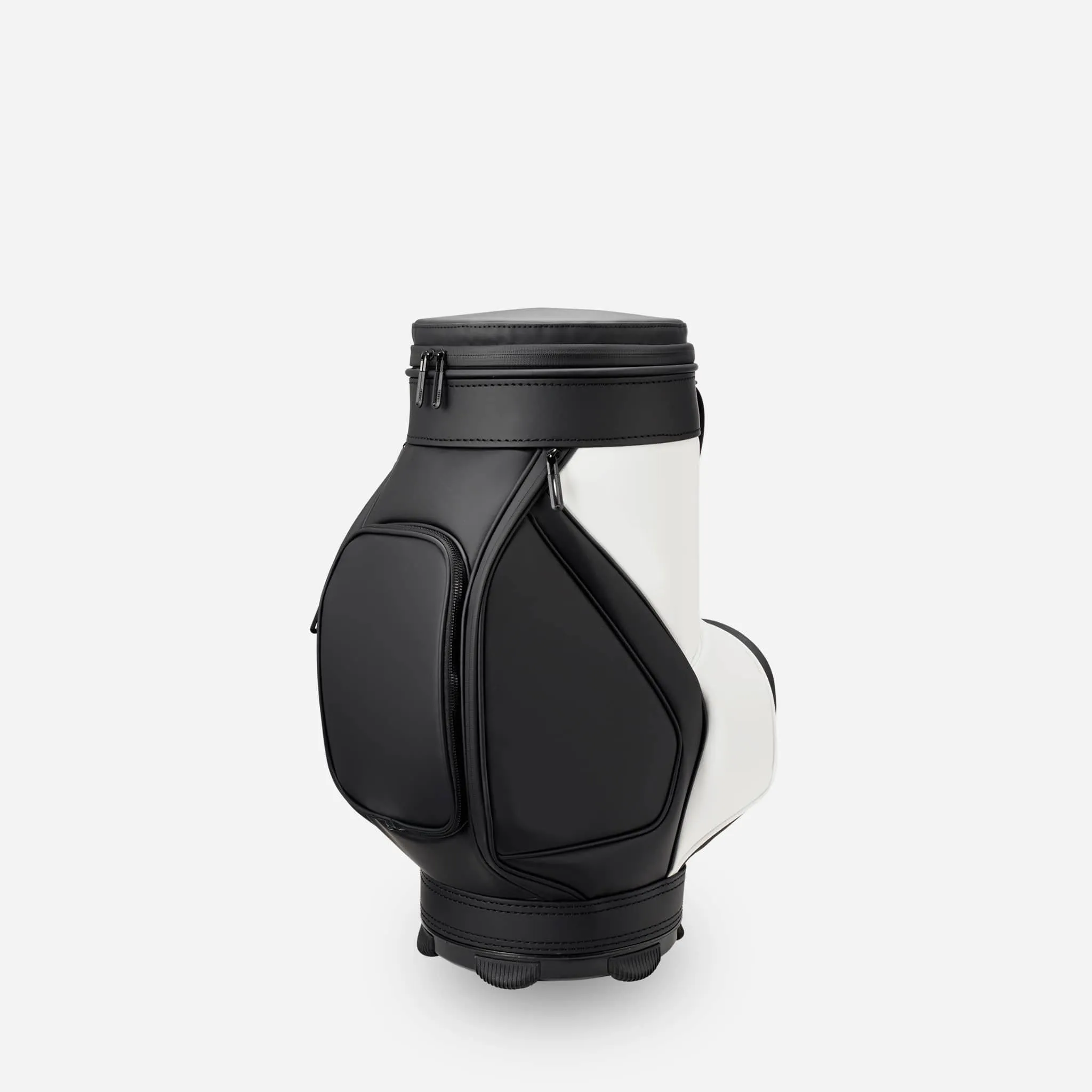
Four capacities cover the market. 6-can cart cooler (fits the cart's basket or cooler pocket, USD 5.50–7.50): the golf-native SKU and the volume leader for tournaments. 12-can shoulder cooler (USD 7–9.50): the all-rounder — golf, beach, lunch — with the largest branding panel relative to price. 24-can event cooler (USD 9–11): the premium gift tier, often cart-strap equipped. Backpack cooler (USD 11–16): the lifestyle crossover, strong for beverage-brand promotions and younger demographics.
Capacity selection follows use case, not aspiration: tournament gifting lives at 6–12 cans (the unit must go home in a golf bag's apparel pocket); corporate gifting peaks at 12 (the desk-to-picnic size); retail assortments ladder 6/12/24 as good-better-best; beverage promotions run 24 and backpack for visibility. Speccing 24-can units for a 144-player outing is the classic over-buy — half of them get left in cart baskets because they do not travel home easily.
Cart-Fit Design Rules
The golf-specific engineering: cart coolers must fit the geometries golfers actually use. Riding-cart baskets run roughly 40 × 30 × 20 cm; built-in cooler pockets on cart bags accept soft coolers to about 30 × 20 × 20 cm; push-cart consoles vary widely. Our 6-can chassis is dimensioned against the common basket and pocket standards (verified against the major cart brands' current models each season), with a low profile that does not block club access — a cooler that must be removed to reach a wedge is a cooler that gets left home.
Attachment is the second design decision: top handles for basket carry, trolley straps (the horizontal webbing band that slides over a cart handle or secures to a push cart), and cart-bag-matched colorways for collection programs. A cooler that visibly belongs to the cart setup — matched fabric, matched trim, secured properly — photographs like equipment rather than cargo, which is the difference between retail-grade and giveaway-grade perception.
Branding: the Biggest Panels in Golf Soft Goods
Cooler bags offer the largest uninterrupted print surfaces in the golf soft goods range — a 12-can's front panel runs 25 × 20 cm, double the den caddie's ball pocket. That surface rewards the techniques built for area: screen print for bold one-to-four color graphics (USD 0.40–0.90 per unit at volume), heat transfer for full-color artwork and photography, embroidery for the premium crest read on the lid or front. The techniques comparison prices each against artwork type.
The branding discipline unique to coolers: design for wet contexts. The logo will be photographed beside lake water, on pool decks, at tailgates — contexts where bright, high-contrast marks read better than subtle tone-on-tone. Beverage-adjacent branding (cold drinks, summer, outdoors) also licenses bolder graphics than on-course equipment. Corporate programs should still lead with the crest; event and promotional programs can push the artwork harder here than anywhere else in the golf range.
Leak Testing and Cooler-Specific QC
Cooler QC adds three checkpoints to the standard soft goods protocol. The 24-hour inverted water test: sampled units filled, sealed and inverted for 24 hours — any seam weep fails the lot to 100% testing. Seam peel strength: welded seams pulled to spec on the tester; weld temperature drift shows here before it shows in the field. Zipper-under-load cycles: the cooler's zipper works against foam compression every open-close — 100-cycle testing on samples catches underspecified coils. Standard AQL 2.5 sampling (ISO 2859-1) governs lot acceptance, per the AQL guide.
Food-contact compliance is the other QC dimension: linings must be food-grade (our PEVA and TPU linings carry FDA and LFGB food-contact documentation), and the compliance paperwork travels with the shipment for retail programs. A cooler marketed for food and drink without food-contact documentation is a liability most buyers never think to ask about — ask it, and keep the certificates.
Program Use-Cases: Who Buys Coolers and Why
Tournaments gift the 6-can cart cooler as the utility hero of the goodie bag — used at the event itself (a genuine same-day win: cold drinks through the round) and every round after. Corporate programs gift the 12-can for client entertainment and employee programs — the picnic-and-tailgate visibility carries the brand beyond golf. Retail and pro shops stock the 6/12/24 ladder as high-turn accessories at USD 24–59. Beverage and lifestyle brands run coolers as promotional product at scale — the golf context adds premium association to a promo staple, and 24-can/backpack formats maximize panel visibility.
The cross-sell logic for bag programs: coolers share fabrics, trims and colorways with the bag line, and a matched cooler completes the cart setup photograph that sells the whole collection. The accessories guide covers the bundle economics — the cooler is consistently the second product buyers add after the den caddie.
MOQ Economics and Pricing Architecture
Cooler MOQ follows the same 200-piece logic — welding setup, screen and digitizing costs, line changeover — with friendlier totals: a 200-piece 6-can program commits roughly USD 1,100–1,500. Price drivers in order: capacity (foam and fabric area), insulation tier (8 mm + foil adds USD 0.80–1.20), lining tier (TPU adds USD 0.60–1.00), branding complexity, and extras (bottle openers, trolley straps, hard liner inserts at USD 0.70–1.40). Quantity breaks follow the standard curve: 500 pieces saves 12–18% over MOQ pricing.
The freight note that surprises first-time cooler buyers: foam-filled coolers ship at their dimensional weight — bulky relative to value. Container economics still favor consolidation (coolers nest reasonably and can ride as the filler around bag cartons), but a standalone LCL cooler shipment prices freight at 20–30% of product cost. Pairing coolers inside a bag order's container, per the wholesale logistics logic, is the margin-protecting move.
A Worked Program: Beverage Brand Summer Promotion
A regional beverage brand's 2026 summer golf promotion: 1,500 12-can coolers in brand colors with a full-wrap heat-transfer graphic (can photography plus event marks), cart-strap equipped, for course-day activations and influencer seeding. Quotation: USD 8.40 per unit at 1,500 pieces, premium insulation (8 mm + foil — the brand's promise is cold, the product must keep it), rigid hangtag with the campaign URL. Timeline: sampled in 9 days (two graphic rounds), produced in 38 days, delivered two weeks before the first activation.
The reporting back: activation staff used the coolers as intended all summer (the brand's own people are the toughest QC), the full-wrap graphic photographed exactly as designed in social content, and the brand's agency reordered 2,000 for 2027 in October — adding the 6-can cart format after seeing where golfers actually kept them. The program's lesson is the cooler's standard career: the graphic gets the attention, the insulation gets the reorders.
Common Cooler Program Mistakes
Five recurring errors. Sewn linings to save USD 0.40: the leak arrives with the customer's first car seat — welded or nothing. Over-capacity gifting: 24-can units for walking events stay in the cart barn; match capacity to how the unit travels home. Ignoring cart geometry: a cooler that blocks club access is returned to the trunk permanently. Thin foam with big claims: ice retention is physics — spec 8 mm + foil before printing "all-day cold" on the hangtag. Standalone LCL shipping: dimensional-weight freight erases the margin; consolidate with bag orders.
The pattern: cooler failures are spec failures, not manufacturing failures. The product is mature and the construction is proven — the mistakes live in capacity choice, foam thickness and freight planning, all decided at the brief. Spec it for how golfers actually use it and the cooler is the most reliable reorder in the soft goods catalog.
Cooler Variants Beyond the Standard Four
Three specialty constructions extend the range for programs that outgrow the standard ladder. The cart-bag integrated cooler pocket — an insulated insert sized to the cooler pockets of the major cart bag models, converting a stock bag feature into a branded accessory (USD 4.50–6.50, the lightest-weight cooler SKU). The hard-liner hybrid — a removable rigid liner inside the soft shell (USD 1.20–1.80 upcharge), which survives being sat on at the tailgate and lifts out for cleaning; the construction for programs where durability is the brand promise. The tote cooler — open-top, farmer's-market styling (USD 6–8.50), the crossover SKU for lifestyle and women's collections where a technical cooler reads too utilitarian.
Variant selection follows the same use-case discipline as capacity: integrated inserts for equipment-channel programs, hard-liner hybrids for durability-led brands and rental fleets, totes for lifestyle collections. All three run at the same MOQ 200 on the same welded-lining lines — the variant decision is a merchandising decision, not a manufacturing constraint.
Seasonality and the Cooler Buying Calendar
Cooler demand is the most seasonal in the golf soft goods range: Northern Hemisphere programs land inventory in March–May for the summer selling season, which means POs in December–February and sampling in November–January — six to eight weeks ahead of the equivalent bag program, because every cooler brand in the world books the same insulation-material capacity for the same season. Southern Hemisphere and year-round warm-market programs (Australia, Southeast Asia, the Gulf) smooth the curve but not enough to change the planning rule.
The calendar consequence for 2027: programs briefing in spring for same-summer delivery are shopping the rush channel (+10–18% and compressed QC windows — the timeline guide prices the trade-offs honestly). Programs briefing in autumn for next summer get the standard calendar, the standard pricing, and first pick of line capacity. The 2027 program calendar maps the seasonal windows; for coolers specifically, subtract another month.
Starting a Cooler Program
The brief: capacity and quantity, insulation tier (standard or premium), use context (cart, event, retail, promotion), and whether it pairs with a bag or gifting program. Through the quote form, the quotation returns with construction specs, branding recommendations and food-contact documentation at your volume — samples in 6–10 working days, production in 30–45 days, leak-tested before anything ships.
For programs building a soft goods range, the cooler's role is settled: den caddie first for kept-rate, cooler second for utility visibility, pouches and valuables bags for the bundle tiers. Junyuan has welded cooler linings for export programs since 2014 — the seams hold, and so do the reorders.
Frequently Asked Questions
What makes a golf cooler bag different from a regular cooler?
Cart-fit geometry (dimensioned to riding-cart baskets and cart-bag cooler pockets, low profile that does not block club access), trolley straps and cart-matched colorways, golf-context capacities (6–12 cans dominate), and branding sized for golf programs. The insulation engineering — welded food-grade lining, 5–8 mm EPE foam — is the same discipline as premium outdoor coolers.
How much do custom golf cooler bags cost?
At MOQ 200, FOB Xiamen: 6-can cart coolers USD 5.50–7.50, 12-can shoulder coolers USD 7–9.50, 24-can event coolers USD 9–11, backpack coolers USD 11–16. Premium insulation (8 mm + foil) adds USD 0.80–1.20; TPU lining adds USD 0.60–1.00. Quantity breaks: 500 pieces saves 12–18% over MOQ pricing.
What is the minimum order for custom cooler bags?
200 pieces per design — roughly USD 1,100–1,500 total for a 6-can program. Welding setup, screens and digitizing are chassis-independent fixed costs, which is why the MOQ logic matches bags. Coolers added to a bag order share the production run and container, making the add-on nearly freight-free.
How long does a golf cooler keep ice?
Standard spec (5 mm EPE foam, welded PEVA lining): 6–8 hours — a full summer round. Premium spec (8 mm EPE plus reflective foil layer): 10–14 hours — full-day event and beach use. Ice retention is physics: foam thickness plus the reflective barrier decides it, and honest specs beat ambitious hangtags.
Do cooler bag linings leak?
Sewn linings do — needle holes weep slowly, then suddenly. Welded (heat-sealed) linings are watertight by construction, which is why every cooler we manufacture welds as standard and every lot passes a 24-hour inverted water test on sampled units. If a supplier will not state welded seams in writing, assume sewn.
Are cooler bag linings food-safe?
Ours are: PEVA and TPU food-grade linings with FDA and LFGB food-contact documentation, certificates traveling with the shipment for retail programs. Any cooler marketed for food and drink should carry this paperwork — ask for it by name and keep it on file.
What size cooler fits a golf cart?
Riding-cart baskets run roughly 40 × 30 × 20 cm and cart-bag cooler pockets accept soft coolers to about 30 × 20 × 20 cm — the 6-can cart chassis is dimensioned against these standards with a low profile that preserves club access. The 12-can rides in baskets; 24-can units are range-and-event product, not round product.
What branding works best on cooler bags?
The largest print panels in golf soft goods (a 12-can front runs 25 × 20 cm): screen print for bold 1–4 color graphics (USD 0.40–0.90 at volume), heat transfer for full-color and photographic artwork, embroidery for premium crests on lids. Design for wet, bright contexts — poolsides and tailgates reward high-contrast marks.
How are custom cooler bags quality-tested?
Three cooler-specific checkpoints plus standard AQL 2.5: the 24-hour inverted water test (any weep fails the lot to 100% testing), weld seam peel-strength checks, and 100-cycle zipper-under-load testing (the zipper works against foam compression every use). Lot acceptance follows ISO 2859-1 sampling per the AQL guide on this site.
Which cooler capacity should a tournament gift?
The 6-can cart cooler: it fits the cart at the event (same-day utility — cold drinks through the round), travels home in an apparel pocket, and prices at USD 5.50–7.50 so a 144-player field gifts for roughly USD 800–1,100. The classic over-buy is 24-can units, half of which get left in cart baskets.
Can coolers match my golf bag line?
Yes — same fabric families, trims, thread and lab-dipped colorways as the bags, so the cooler completes the cart setup visually. Collection programs spec the cooler as the line's second SKU after the den caddie; matched lots are scheduled at production planning when both products run together.
How long does custom cooler production take?
Samples in 6–10 working days; bulk production 30–45 days after approval; leak testing inside the QC window before pack-out. Ocean freight adds 14–35 days by destination — note that foam-filled coolers ship at dimensional weight, so consolidating with bag orders protects margin.
How do I start a custom golf cooler program?
Four details through the quote form on this site: capacity and quantity, insulation tier, use context (cart, event, retail, promotion), and any pairing with a bag program. The quotation returns with specs, branding recommendations and food-contact documentation; samples inside two weeks — Junyuan has manufactured insulated soft goods for export since 2014.
When should I order coolers for the summer season?
Northern Hemisphere summer programs: sample November–January, PO December–February, land inventory March–May. Cooler programs book six to eight weeks earlier than equivalent bag programs because insulation-material capacity fills industry-wide for the same season. Spring briefings for same-summer delivery shop the rush channel at +10–18% with compressed QC windows.