
The Junior Boom in Numbers
Youth participation in golf has grown every recent season, led by team-format leagues and family programming — and equipment supply, especially bag supply, has not kept pace with the program infrastructure.
The demand structure behind the boom is program-driven, not talent-driven: league formats (the PGA Junior League model and its regional analogues) turned junior golf from an individual lesson activity into a team sport with seasons, uniforms and gear; family programming (parent-junior events, resort academies, school partnerships) widened the funnel; and the same demographic wave lifting the womens category brings parents who play into the buying pattern for their kids. Equipment retail follows the program calendar — spring league sign-ups, summer camps, the fall academy season, holiday gifting — and the bag is the program-visible SKU (the junior wears the team shirt; the junior carries the bag).
The supply gap is structural: the category's junior offerings are dominated by licensed-character disposables (light on engineering, absent compliance stories) and downsized adult bags with the same shrink-and-pink failure mode documented in the womens guide. What program buyers — academies, leagues, family brands — ask for and rarely find is a serious junior chassis: weight-engineered, adjustable across growth, branded for the program, and compliant by document. That four-part brief is this guide's outline.
Carry Weight: the Governing Spec
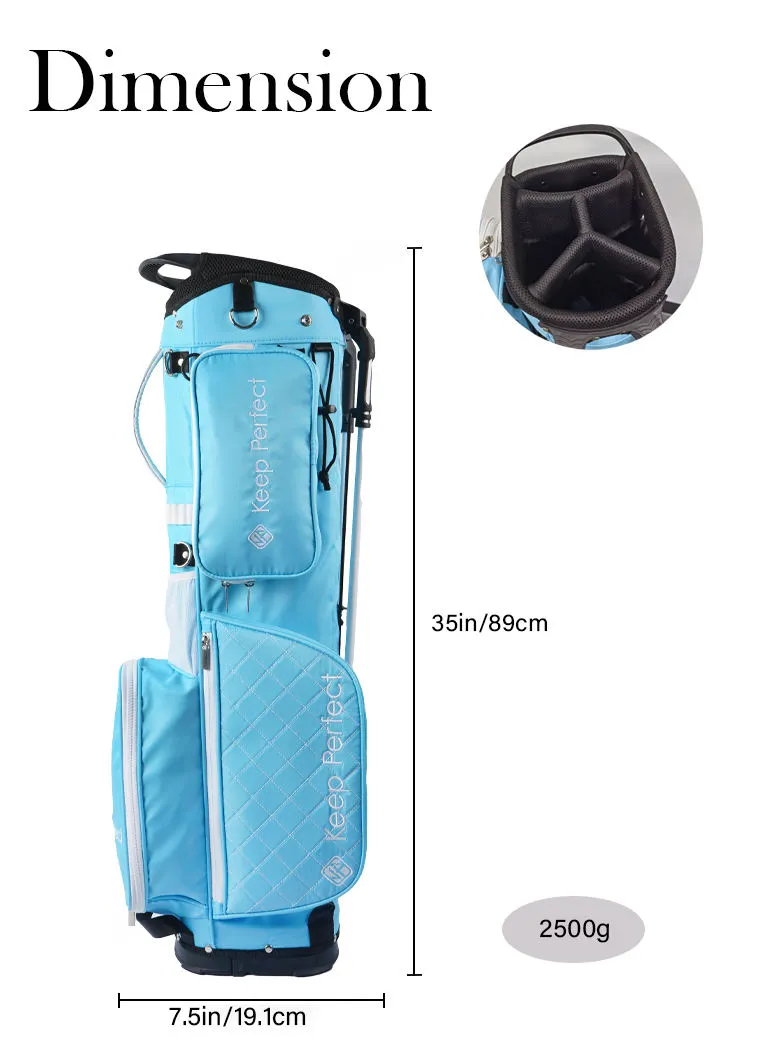
The engineering starting point is a load the child can carry for nine holes without fatigue changing the swing — because it does, measurably, in the age bands that matter. The working standards: the loaded bag (bag plus the junior's 6–9 club inventory, balls, bottle) at or under 15–20 percent of body weight, which puts the empty-bag engineering targets at roughly 1.0–1.4 kg for the 5–8 band, 1.4–1.8 kg for the 7–10 band, and 1.8–2.2 kg for the 10–13 band — with the crossover to a full-lightweight adult chassis (the 1.65–1.9 kg class from the Sunday guide's tier) happening around 12–13 years for most juniors. State the empty weight on the spec sheet and the hangtag both; parents shop the number and programs buy against it.
Where junior grams come from: scaled frames (perimeter wire instead of full cage), fabric at 420–600D instead of 900–1680D (junior duty cycles are lighter — the materials guide's durability ladders scale down honestly here), 4–6 way dividers in molded EVA instead of full-length structural sets, and scaled hardware (nylon-coil zips, compact buckles). The discipline is the same as the adult weight engineering — a sum of 30-gram decisions tracked on the spec sheet — with the difference that the spec sheet's number is a safety-comfort boundary, not a marketing claim.
Height Bands and Adjustable Geometry
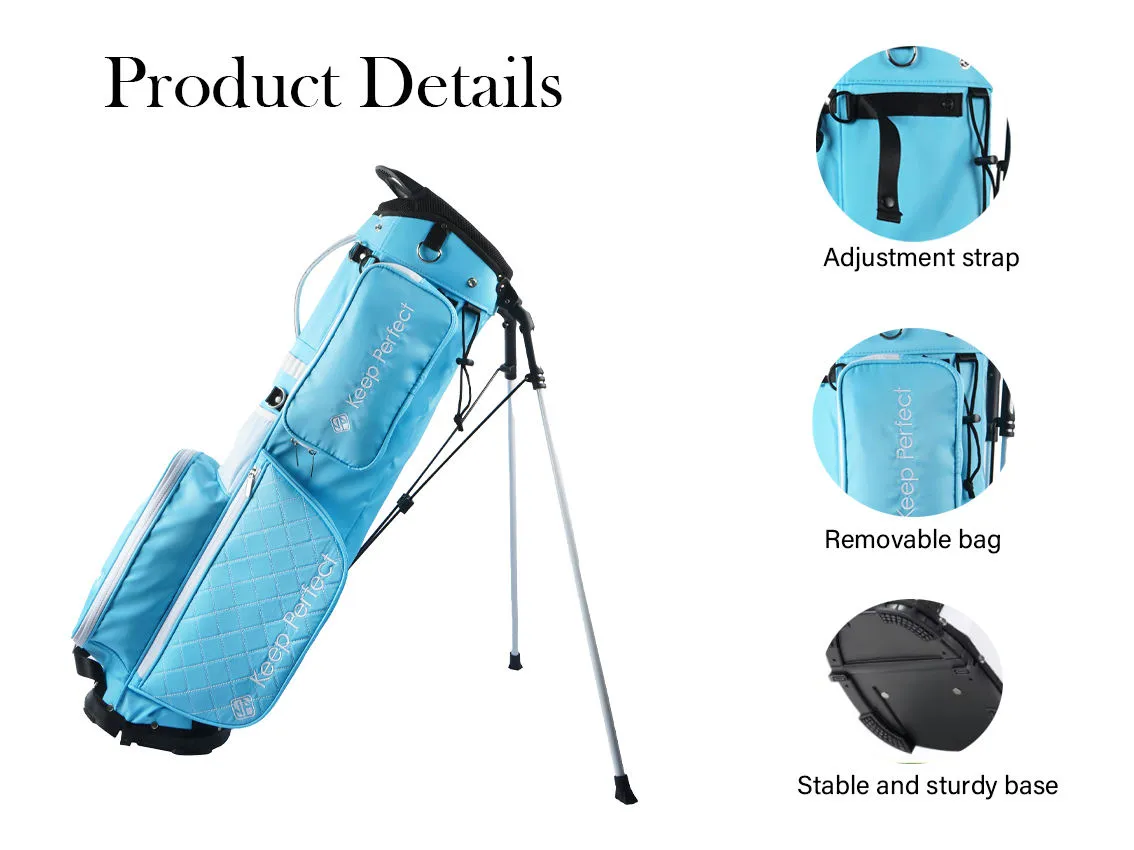
Junior sizing is band engineering, not one-size optimism. The practical bands: 5–8 years (roughly 105–125 cm) at a 24–28 inch scaled chassis; 7–10 (115–135 cm) at 28–32 inches; 10–13 (135–155 cm) at 32–36 inches approaching the junior-adult crossover. The adjustable spans that make one program chassis serve a season's growth: a dual-position stand mechanism (the leg geometry from the stand guide scaled with two locked deployments), a torso harness adjusting 30–42 cm, and a strap system that shortens without folding (folds create pressure points at junior scale faster than adult — the padding-per-area math worsens as surfaces shrink).
The pattern discipline is the adult lesson applied honestly: named measurements in the draft (top opening scaled to junior grips and club diameters, base depth scaled to the stand geometry, collar height scaled to the harness pivot), never a global scale factor on the adult pattern. The scale-factor route produces junior bags that read as toys; the band-engineered route produces the bags programs reorder for each new season of students. The difference is one conversation at the pattern bench, and at MOQ 200 the conversation is free.
Materials Choices for Junior Duty
The honest materials ladder for junior programs trades durability overkill for weight, because the duty cycle is real but different: 420–600D polyester with PVC backing (the value tier — lighter, honest for program seasons, hydrostatic head at the family-usable 2,000–5,000 mm range), 600D double-PVC (the program tier — the academy workhorse that survives a season of car trunks and cart paths), and premium composites only in the flagship band where the weight class demands them. The trap at the other end: program buyers sometimes ask for adult-grade 1680D 'for durability' and receive a bag the 7-year-old cannot carry — durability that defeats the carrying defeats the product.
Two junior-specific material notes belong in the spec. First, cleanability: program bags live in vans, on grass and in mud — interior fabrics that wipe clean and zippers that survive granular dirt are program features worth specifying (the zipper tier from the materials guide's comparison matters more here than waterproofing depth). Second, the compliance interaction: the materials and trims in children's products carry the CPSIA and EN 71 constraints from the compliance section below — the coating, the zipper pulls, the appliqués all enter the testing file, which is why the junior spec sheet names each trim's compliance status instead of leaving it to the adult bill of materials.
Safety and Compliance for Junior Products
Children's products carry a dedicated compliance stack: US CPSIA (lead content limits, phthalate limits, tracking labels, third-party testing for children's products) and EU EN 71 for the European market — the junior program's spec sheet and PO cite the standards and the test files.
The US framework for children's products is CPSIA, and its core demands are specific: total lead content limits in accessible substrates and coatings (the 100 ppm substrate limit and the 90 ppm paint limit are the working numbers), limits on specified phthalates in plasticized components, a tracking label permanently affixed (manufacturer or importer identity, production date and location, batch), and third-party testing through a CPSC-accepted lab for children's products, documented in a Children's Product Certificate. The EU's EN 71 covers the mechanical-physical and flammability equivalents for the European market. None of this is exotic in soft-goods manufacturing — it is documentation discipline: name the standards in the PO, test the trims and coatings through the accredited labs, and file the certificates with the shipment.
The practical translation for a junior bag program: the spec sheet carries a compliance column (each substrate, coating, zipper pull and appliqué with its test status), the PO cites CPSIA and EN 71 as requirements with the certificate files as exhibits, and the tracking label joins the label set from the labeling guide (fiber content, care symbols under ISO 3758, origin — plus the junior-specific tracking label). Programs that run this discipline can sell to academies, school districts and national junior programs without a compliance scramble; programs that skip it discover the scramble at the purchase-order stage, when it costs weeks.
The Academy Channel
Academies are the category's anchor B2B channel: they buy in program volume (30–300 units per season cycle), they buy on spec and compliance rather than fashion, and they reorder on a calendar — the academy year has spring, summer and fall cycles, with the summer camp season the volume peak. The buying brief from the academy side: one chassis in program colors, adjustable across the age bands they teach, compliance documented, priced to equip a season of students at a fee-inclusive economics (the academy's cost per student is a line item in their program pricing — the school programs guide's budget arithmetic applies, with the junior adjustments).
The program features academies pay for, in order: the adjustable spans (one chassis serving mixed-age classes simplifies inventory), the weight-class engineering stated in numbers (their coaching staff evaluates it), the compliance file (their insurers and school partners require it), and the identity layer (program embroidery, student name personalization at kitting — the roster-personalization discipline from the school guide ports directly). The academy sale is a relationship sale on the first order and a reorder sale thereafter; the reorder math from the consistency guide is what makes the second order the profitable one.
The Family Gift Market
The retail side of the category runs on the family calendar: birthday, holiday, and the 'first set' milestone that equipment gifting organizes around. The junior bag is the emotional SKU — clubs are the technical purchase a parent researches; the bag is the gift the junior unwraps and carries — and the presentation economics show it (gift-boxed junior programs with a keepsake-quality box add USD 1.50–2.50 of cost and USD 15–25 of retail, the packaging guide's tiers at their highest ROI in the whole catalog). The color and character story matters most in this channel: the original-character discipline from the kawaii guide (ownable mascots, no royalty, no approval cycles) converts the unwrap into the photograph that sells the next gift.
The family channel's trust bar is the highest in golf retail: parents read compliance claims closely (the tracking label and certificate story belong on the product page, not in the appendix), the reviews that matter are the durability reviews (a bag that survives the second season is the review that converts the next parent), and the sizing guidance must be honest — a height-band chart on the product page (the bands from the geometry section) converts better than age-based guessing because parents know heights, not averages. The channel rewards the same honesty every channel in these guides rewards; it punishes corner-cutting faster, because the customer is someone's kid.
Pricing Bands Parents Accept
The price architecture, stated bluntly: parents accept junior bags at USD 49–89 retail for a serious program-grade chassis, and they resent paying it for a disposable — which is the market's way of saying the quality tier and the price tier must move together. FOB at program volumes: USD 9.50–14.00 for the program workhorse (600D double-PVC, band-engineered, compliant), USD 14.00–19.50 for the family flagship (premium trims, character or color story, gift boxing), against the licensed-character disposable at USD 6.00–8.50 that dominates the bottom shelf. The academy program price sits at the workhorse tier with program personalization; the gift retail sits at the flagship tier with the presentation stack.
The margin math follows the standard soft-goods structure (the launch guide's keystone discipline), with one junior-specific reality: the category's price ceiling is lower than adult golf, so the cost engineering carries the margin — the weight-class discipline that saves grams also saves dollars (lighter fabrics, scaled frames and simpler divider systems are cheaper as well as lighter), and the compliance file is a one-time program cost amortized across every season. The junior program that respects both lines — cost engineering and the price band — prices into the market's acceptance naturally; the one that bolts adult costs onto a junior chassis does not.
Branding Junior Programs
The branding architecture for junior programs runs two identity layers, and they need different spec decisions. The program layer: the academy's or brand's crest, sized and placed for visibility at junior scale (the placement guide's percentage rules apply — logo width at 55–70 percent of the pocket panel, tested on the scaled panel geometry, not assumed from adult placements). The delight layer: the color story, the original character, the personalization — the surfaces that make the junior want to carry the bag, which is the actual engine of the product's use. The two layers share one discipline: embroidery and appliqué must pass the compliance file (substrate testing covers threads and backing), and the character appliqués carry the same needle-and-construction QC as the plush discipline from the plush guide.
Personalization at kitting — the student name on the bag — is the program feature with the highest emotional return per dollar (a USD 0.60–1.20 embroidery add that turns program equipment into a keepsake), and the roster workflow from the school guide ports directly: the academy sends the roster at PO confirmation, the kitting plan batches the names, the QC counts them twice. Programs that run name personalization report the strongest parent-paid conversion — the academy sells the bag into the program fee, and the name is what parents photograph at the season's first event.
Durability: the Hand-Me-Down Test
Junior equipment has a second life the spec should plan for: the hand-me-down (younger siblings, the academy's rental fleet, the resale shelf). The durability engineering that earns a second owner: the structural seams from the standard's red lines (base attachment, strap anchors, top cuff — the AQL guide's critical-defect classes apply at junior scale, where seam allowances are tighter and therefore less forgiving), hardware that survives a season of van life (the zipper tier and buckle class from the materials section), and colorfastness rated for the use pattern (grass, sun, mud, repeated washing — the print durability discipline applies to the color stories).
The field test that predicts the second owner is the program fleet test: academies run 30–100 units through a season and see the failure distribution that retail never sees (retail sees one owner's one season; the academy sees a hundred owners' three seasons). The failure data loops back into the spec through the reorder conversation — the reorder guide's audit questions, asked of a junior fleet, produce the spec revisions that make season three's chassis better than season one's. The hand-me-down test is therefore not sentiment; it is the category's cheapest R&D program.
The Character Crossover
The licensed-character shelf dominates junior golf retail's bottom tier, and the honest alternative is the original-character discipline that the kawaii analysis and the anime guide document: an ownable mascot (no royalty, no approval cycle, no revocation risk — the licensing math from those guides runs 10–15 percent royalty against a USD 300–800 one-time original development), applied with the plush-grade QC (needle detection, seam pull tests at the appliqué anchors) and the compliance file from this guide's safety section. A program mascot that juniors recognize across seasons builds the academy's brand equity instead of the licensor's.
The crossover's strongest structure is the mascot system: the character on the bag, the plush companion head cover (the plush guide's constructions) and the accessory set (the accessories guide maps the small goods) sharing one design language — the gift-boxed trio is the family flagship SKU at the pricing section's top band, and the photographed unboxing is the marketing engine that licensed products rent and original characters own.
Program Case: a 300-Unit Academy Line
One academy, two height-band SKUs, 300 units, one chassis family: roughly USD 7,800 in program cost, compliance-documented, landing at USD 26 per student-equipped with a reorder structure that prices season two.
The worked example: a regional academy equipping its junior school — 180 students across three age classes, buying 300 units (the fleet plus replacement stock) as two band SKUs from one chassis family (the 5–8 band at 1.2 kg, the 7–10 band at 1.6 kg), program colorway with the academy crest, student names kitted from the roster, compliance file with CPSIA certificates and tracking labels archived. The cost: chassis at the program tier (USD 11.80 average across the bands), name personalization USD 0.80, crest embroidery USD 0.90, compliance testing amortized across the program (the one-time file), kitting and program packaging — the program invoice lands near USD 7,800 at the FOB tier, with freight and duty per the incoterms guide's LCL math.
The economics from the academy side: USD 26 per student-equipped against a program fee that prices equipment visibly, a fleet that the hand-me-down test extends across at least two seasons, and a reorder structure (the consistency guide's anchors — the sealed sample, the archived pattern, the written reorder price) that prices season two without a re-quotation cycle. The case that repeats in this category is the one where the academy's staff sees the engineering hold: the weight numbers on the scale, the harness spans on the students, the compliance file on request. Those three sights are the reorder conversation.
Distribution Beyond the Pro Shop
The junior category's channels extend past golf retail, and each wants the same chassis with different wraps. School and community programs (the school guide's structures — fundraising, sponsorship offsets, district purchasing) buy at academy economics with institutional paperwork. League operators scale the team format and buy in uniform cycles — the program colorway with league branding and team personalization. Resort and destination academies buy the premium band (the family flagship) because their customer is paying for a premium week. And the DTC family brand channel — the fastest-growing door — buys the gift-boxed flagship with the character system and the height-band sizing chart on the product page.
The distribution discipline is chassis discipline: one engineering program (the bands, the weight classes, the compliance file) serving every channel with different branding wraps — the models guide's hybrid structure at its cleanest (an ODM-speed chassis family with program-specific configuration layers). Programs that fragment the engineering across channels pay the fragmentation three times — in development, in compliance files and in reorder complexity; programs that keep one chassis family pay once and amortize it everywhere.
Seasonal Calendar for Junior Programs
The junior year, working backwards from the demand moments: spring league sign-ups (January–February purchases), the summer camp volume peak (equipment bought March–May, in place by June), the fall academy season (bought July–August), and holiday gifting (retail bought Q3, on shelf by October — the gift-channel calendar from the womens guide applies at junior scale). The production translation with the timeline guide's 35–50 day bulk math: the summer peak's artwork approval lands in March, the fall season's in July, the holiday's in August — and the compliance file runs ahead of all of them, because testing labs have their own seasonal queues and a certificate chased in April is a June shipment.
The calendar's compounding asset is the reorder structure: the academy that orders in January and July on a frozen spec (the consistency guide's anchors) skips the sampling cycle entirely on season two — production starts on the pattern that exists, and the calendar compresses by the 6–10 sampling days per program. Over three seasons, the disciplined program ships earlier, stocks calmer and spends nothing on re-qualification. The calendar is where program discipline becomes visible money.
Starting a Junior Program
Four decisions price the program: the age bands (one chassis family, two SKUs), the weight-class targets as numbers, the branding layers (crest plus character or color story), and the compliance scope (CPSIA, EN 71 or both) with quantity and season window.
The brief that quotes cleanly: the bands and their weight targets (the spec sheet states them), the colorway and character direction (original mascots from the kawaii discipline or a program color story), the branding layers (crest placement at junior panel scale, name personalization at kitting), the compliance scope (CPSIA for the US, EN 71 for the EU, both for dual-market programs), and the quantity with its season window (the calendar section's dates). The quotation returns itemized by tier with the compliance file as a line item and the certificate lead-times stated; samples in 6–10 working days per band SKU; bulk 35–50 days at program volumes with AQL 2.5 and the junior checkpoint additions.
Junyuan has manufactured junior golf programs for export since 2014 — the weight engineering, band geometry, compliance files and roster kitting in this article are production practice. Four sentences through the quote form (bands, weight targets, branding and compliance scope, quantity and window) start the process; the pattern bench and the testing file do the rest in sequence.
Frequently Asked Questions
How heavy should a junior golf bag be?
By age band, empty: 1.0–1.4 kg for 5–8 years, 1.4–1.8 kg for 7–10, 1.8–2.2 kg for 10–13, crossing to a lightweight adult chassis around 12–13. The governing rule is the ratio: loaded bag (bag plus the 6–9 club junior inventory) at or under 15–20 percent of the child's body weight. State the empty weight on the spec sheet and hangtag — parents shop the number and academies buy against it.
What size golf bag does a junior need?
Band engineering, not one-size: 24–28 inch scaled chassis at 105–125 cm height (5–8 years), 28–32 inches at 115–135 (7–10), 32–36 at 135–155 (10–13). The adjustable spans that let one program chassis serve a season's growth: dual-position stand mechanism, torso harness adjusting 30–42 cm, straps that shorten without folding. Never a global scale factor on the adult pattern — named measurements in the draft or the bag reads as a toy.
Do kids golf bags need special safety compliance?
Yes — children's products carry a dedicated stack. US market: CPSIA (lead content limits in substrates and coatings, phthalate limits, permanent tracking label, third-party testing through a CPSC-accepted lab, documented in a Children's Product Certificate). EU market: EN 71. The practical discipline: name the standards in the PO, test the trims and coatings through accredited labs, file the certificates with the shipment. Programs that run this sell to schools and districts without a scramble; programs that skip it discover the scramble at PO stage.
How much do custom junior golf bags cost?
FOB at program volumes: USD 9.50–14.00 for the program workhorse (600D double-PVC, band-engineered, compliant), USD 14.00–19.50 for the family flagship with gift boxing, against the licensed-character disposable at USD 6.00–8.50. A 300-unit academy program with name personalization and crest embroidery lands near USD 7,800 at the FOB tier. Retail bands: USD 49–89, where parents accept serious quality and resent disposables at the same price.
Can junior golf bags have cartoon characters on them?
Original characters, yes — and they are the better structure: an ownable mascot (USD 300–800 one-time development, no 10–15% royalty, no approval cycles, no revocation risk) with plush-grade QC (needle detection, seam pull tests at appliqué anchors) and the compliance file extended to the threads and backing. Licensed characters are rented equity with a compliance file you do not control. The mascot system — character on the bag, plush head cover, accessory set — is the flagship gift SKU the category rewards.
How many clubs fit in a junior golf bag?
The junior inventory is 6–9 clubs by design (not the 14-way adult monolith) — a scaled 4–6 way divider top sized to junior grips and club diameters carries the actual set a junior plays, and saves the weight that a full divider system would add. The pattern decision is sizing the top opening to the junior club geometry: named measurements in the draft, never the adult opening scaled on assumption.
Do academies buy golf bags in bulk?
They are the category's anchor B2B channel: 30–300 units per season cycle, bought on spec and compliance rather than fashion, reordering on the academy calendar (spring, summer camp peak, fall). The features they pay for, in order: adjustable spans across the age bands they teach, weight-class engineering stated in numbers, the compliance file their insurers require, and the identity layer — crest plus roster name personalization at kitting. The sale is a relationship on the first order and a reorder structure thereafter.
Should junior bags be waterproof?
Weather-resistant honestly, not waterproof theater: the family-usable hydrostatic range (2,000–5,000 mm at the value and program tiers) covers rain rounds and van life; the weight budget matters more than the depth rating at junior scale, because waterproofing overkill is grams a 7-year-old carries on every hole. The zipper tier and cleanable interior fabrics (program bags live in mud) are the weather features that actually matter — wipe-clean liners survive the academy's van in ways premium coatings do not.
How do I size junior golf bags for a team program?
Buy the bands, not the ages: a height-band chart at ordering (the academy knows heights, not averages) routes students to the two program SKUs — the 5–8 band chassis and the 7–10 band chassis from one family. Mixed-age classes run one chassis family with adjustable spans, which is the inventory simplification academies pay for: one program, two SKUs, every student fitted. The height-band chart on the product page is also the family channel's best-converting sizing guide.
What is the difference between a junior bag and a cheap kids bag?
Engineering and documentation. A serious junior chassis: weight classes stated in numbers (1.2 kg, not 'lightweight'), band-engineered geometry that adjusts across growth, structural seams and hardware from the adult critical-defect classes, and the CPSIA/EN 71 compliance file with certificates. The cheap kids bag: a licensed print on a scale-factor chassis with no weight engineering and no test file. The market prices the difference honestly — parents accept USD 49–89 for the former and resent it for the latter.
How long do junior golf bag programs take?
Standard: samples 6–10 working days per band SKU, bulk 35–50 days at program volumes, AQL 2.5 with the junior checkpoint additions. The compliance file runs ahead: testing labs have seasonal queues, so the certificate lead-time (2–4 weeks typical) must land before production balance, not after. Season-two reorders on a frozen spec skip the sampling cycle and compress 6–10 days. The calendar section works the full year backwards from the demand moments.
Can one junior chassis serve multiple age groups?
That is the point of band engineering: one chassis family, two or three band SKUs, adjustable spans (dual-position stand, 30–42 cm torso harness) covering the growth a program season contains. The alternative — a single 'adjustable' SKU spanning everything — produces a bag that fits no band well. Programs that buy the band structure (the 300-unit case study's two-SKU family) simplify inventory and fit every student; the engineering is one pattern family, priced once.
How do I start a junior golf bag program?
Four sentences through the quote form on this site: the age bands and weight targets as numbers, the colorway or original-character direction, the branding layers (crest placement, name personalization) and compliance scope (CPSIA, EN 71 or both), plus quantity and season window. The quotation returns itemized with the compliance file as a line item; samples in 6–10 days per band, bulk in 35–50 days with AQL 2.5. Junyuan has manufactured junior programs for export since 2014.