
How This FAQ Is Organized
Twenty-five questions in the order a real project asks them: what it costs and how few you can buy, how sampling works, how long production takes, how quality is verified, what branding can do, and how the bags reach your warehouse.
Every answer below follows the same discipline as our quotations: numbers first, trade-offs named, and the next step stated plainly. Where a question deserves a deep dive, the answer links to the full guide on this site — the MOQ pricing guide, the sample process walkthrough, the AQL quality manual and the rest of the library. The site-wide FAQ page covers company and policy basics; this article is the project-level edition.
Minimums and Pricing Questions
The first five questions in every inbox concern money and minimums. The short version: MOQ is 200 pieces per design because below that the fixed costs of setup (patterns, screens, embroidery digitizing, line changeover) stop amortizing — the arithmetic is laid out in the MOQ and pricing guide. Unit prices at 200 pieces run USD 6–11 for Sunday bags, USD 14–26 for stand bags, USD 18–30 for cart bags and USD 28–48 for staff bags, FOB Xiamen. The honest paths for quantities under 200 — pooled production, decorated blanks, stock-plus programs — are compared in the low-MOQ guide.
The pricing question buyers forget to ask is what the quote includes: ours include all branding setup, standard packaging, pre-shipment inspection and export documentation. Freight, duty and any third-party testing are quoted separately and explicitly — a quote that does not itemize these is a quote that will grow.
Sampling Questions
Sampling answers in brief: 6–10 working days for a first prototype, sample fee USD 100–300 depending on chassis (refunded against the first production order), revisions inside the same window. The sample is not a formality — it is the physical contract the bulk order is measured against, and the 12-point testing protocol in the sample process guide is what approval should cover before you wire a deposit. Photograph the approved sample from eight angles; that photo set is the quality reference for inspection.
Production and Timeline Questions
Bulk production runs 35–50 days after sample approval and deposit: fabric and materials procurement (days 1–10), cutting and panel branding (days 8–20), sewing and assembly (days 15–40), finishing and inspection (days 38–48), pack-out (days 46–50). Add freight: 14–18 days ocean to the US West Coast, 25–35 to the East Coast or Europe, 3–7 by air. The full phase map with rush-trade-off math is in the timeline guide — the planning rule is event date minus 90 days for a standard program.
Quality and Inspection Questions
Quality verification answers: every order ships after pre-shipment inspection to AQL 2.5 (ISO 2859-1 sampling — 32 bags inspected from a 200-piece lot, 50 from 500), with the 40-checkpoint protocol covering workmanship, measurements, branding, function, materials and packing. Third-party inspection (SGS, TÜV, your own agent) is welcomed and coordinated at no charge from our side. The AQL guide explains the sampling tables and the five PO clauses that make quality enforceable; the quality page shows the system behind them.
Branding and Design Questions
Branding answers: six standard positions (ball pocket, apparel pocket, spine, valuables pocket, hip pad, rain hood), sized by the 55–70% rule detailed in the placement guide. Technique choice — embroidery, heat transfer, screen print, deboss, woven labels — depends on artwork and substrate; the techniques comparison prices each against durability and detail. No design team on your side is normal: ours converts a logo file and a positioning sentence into production artwork inside a week, free at quotation stage. Color matching runs the Pantone protocol (lab dips on actual fabric, approved under D65 lighting) covered in the color matching guide.
Shipping and Logistics Questions
Logistics answers: standard terms are FOB Xiamen; CIF and DDP quoted on request (DDP to the US currently prices the 17.6% HTS 4202.92 duty into the delivered number — no customs surprise at your dock). Ocean freight runs USD 2.40–3.50 per bag at LCL quantities and USD 0.90–1.60 in full containers; the container economics are detailed in the wholesale guide. All export documentation — commercial invoice, packing list, bill of lading, certificate of origin where required — is prepared and reviewed before sailing.
Questions About Working Together Long-Term
The questions that matter after the first order: reorders run 30–45 days at locked pricing (the consistency system — sealed samples, archived dips, version-controlled artwork — is in the reorder guide); payment is T/T 30% deposit, 70% against shipping documents, with L/C available at volume; and new products for your line sample in the same 6–10 day window as your first. Junyuan has manufactured custom bags for export programs since 2014 — the trading company (Quanzhou Junyuan Bags Co., Ltd.) contracts and guarantees your order, with production in our long-partnered, SGS-audited factory running 149 machines across 7 lines.
Questions About Customization Scope
The scope questions have one meta-answer: everything visible is customizable, and the quoting structure tells you what each choice costs. Fabric family and colorway (five families, lab-dipped to your Pantone), trim and lining colors, zipper tape and puller finishes, pocket configuration and divider layout, strap systems, branding across six positions in five techniques, packaging from polybag to rigid gift box with retail-compliance labeling. The two forks that organize all of it: private label (our proven chassis, your complete visual identity — faster, cheaper, the right answer for 90% of programs) and OEM (new construction from your tech pack — the answer when the product itself is the differentiation). The OEM vs private label guide walks the decision with cost and calendar math for both forks.
What is not customizable at standard tiers: chassis-exclusive structures (reserved for OEM volumes), licensed characters without an authorization letter (the licensing guide explains the three structures), and delivery physics (60–80 days door-to-door at ocean freight is the floor for a properly inspected custom order — anyone promising dramatically less is describing a stock product with your logo heat-pressed on, which is a different and legitimate product, but should not be priced or sold as custom manufacturing).
Questions About Working With a China Factory Directly
The practical answers for first-time importers: communication runs in English by email and WhatsApp with same-day responses in overlapping hours; the quotation-to-shipment process needs no agent or middleman (the trading company structure exists precisely to be your single accountable counterparty — contract, invoice, quality guarantee and export documentation in one entity); payments are standard international T/T with the 30/70 structure that keeps leverage on both sides; and third-party inspection (SGS, TÜV, your own agent) is welcomed at the PSI window for any order where you want independent verification.
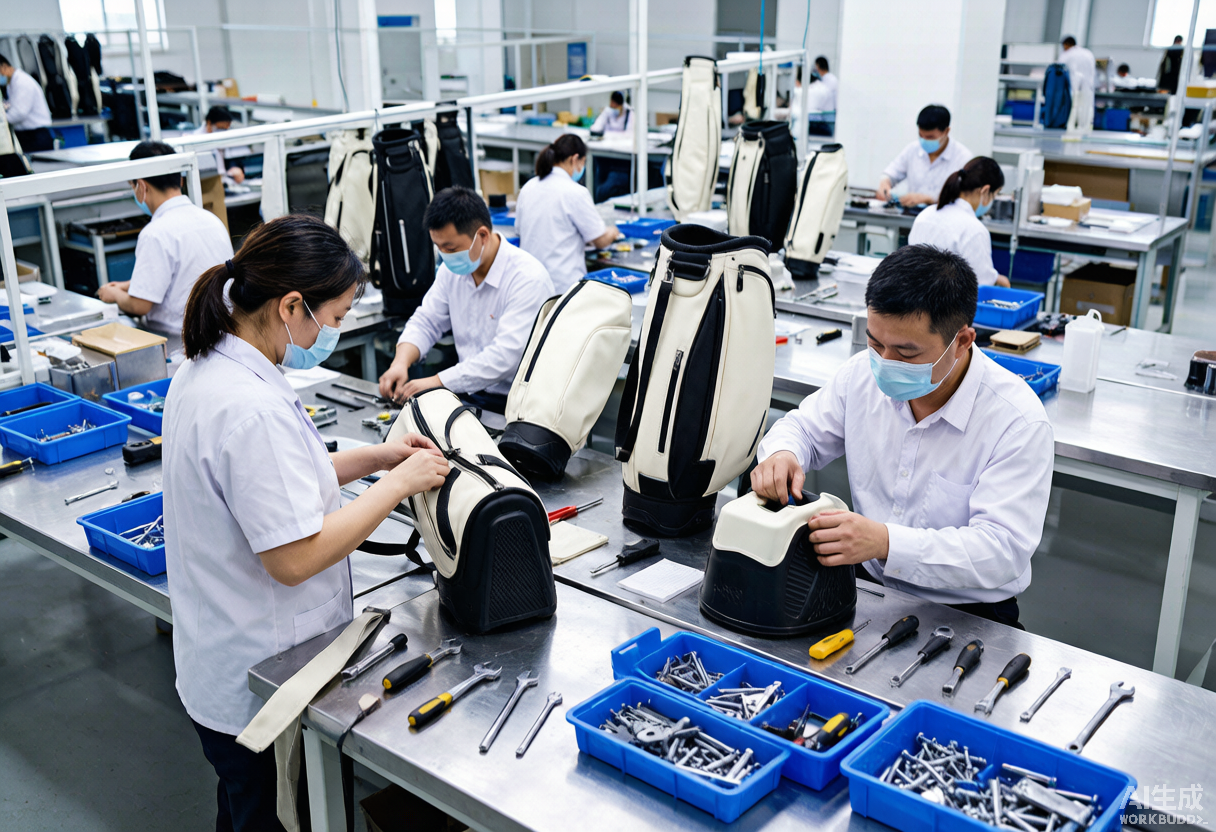
The verification path we recommend before any first order: video factory tour on request, SGS audit report shared under NDA, references from programs in your market category, and above all the physical sample — 6–10 days and a refundable fee puts the manufacturing claim in your hands, which is worth more than any certificate. The manufacturer selection checklist is the complete evaluation framework, written to be used on us as much as on anyone else.
The Question This FAQ Cannot Answer
The only question that needs your specifics: what will your exact project cost? That depends on chassis, quantity, materials and branding — four sentences through the quote form (what you are making, roughly how many, your timeline, your market) and the quotation comes back itemized inside two working days, with a physical sample inside two weeks if you proceed. Everything above is the general truth; the quotation is yours.
Frequently Asked Questions
What is the minimum order for custom golf bags?
200 pieces per design — the quantity where setup costs (patterns, screens, digitizing, line changeover) amortize properly. Below 200, honest alternatives exist: pooled production runs, decorated retail blanks, or stock-plus partial customization. The low-MOQ guide on this site compares all four paths with real numbers.
How much do custom golf bags cost?
At MOQ 200, FOB Xiamen: Sunday bags USD 6–11, stand bags USD 14–26, cart bags USD 18–30, staff bags USD 28–48, travel covers USD 12–22. Quantity is the largest lever — prices fall 15–25% between 200 and 1,000 pieces. Material family, branding complexity and packaging move the number within each range.
What does the quoted price include?
Our quotes include all branding setup (digitizing, screens, molds), standard polybag-and-carton packaging, AQL 2.5 pre-shipment inspection, and export documentation. Freight, import duty and optional third-party testing are quoted separately and itemized — never buried.
How do I pay for a custom golf bag order?
T/T (bank transfer): 30% deposit to start production, 70% balance against shipping documents. Sample fees are paid upfront and refunded against the first production order. L/C is available for orders above USD 50,000. We quote in USD; EUR and GBP invoicing is available for established programs.
Can I order fewer than 200 custom golf bags?
Yes, through four honest paths: pooled production (your branding on a shared run, 50–100 pieces at +15–25% unit cost), decorated retail blanks (fast but generic), stock-plus programs (stock chassis with your branding panels), or accepting a higher unit price on a private run. Each path's math is compared in the low-MOQ guide.
How long does a custom golf bag sample take?
6–10 working days for a first prototype once artwork and specs are confirmed. Revisions run in the same window. The sample fee (USD 100–300 by chassis) is refunded against your first production order. Courier adds 3–5 days door to door.
How many sample rounds does a typical project need?
Private label projects (our chassis, your branding): usually one round, sometimes two. OEM projects (new construction): two to three rounds is normal and healthy — structure changes need physical verification. Each round is 6–10 working days, so budget two to six weeks for the sampling phase.
What should I check on my sample before approving?
The 12-point protocol: branding position and size in millimeters, stitch quality, zipper function under load, stand mechanism cycles, strap comfort with weight, divider function, pocket usability, material hand-feel against spec, color against the approved lab dip, weight against target, pack-out presentation, and the photo set for your records. Approval commits you — test like it.
How long does bulk production take?
35–50 days after sample approval and deposit: materials procurement (days 1–10), cutting and panel branding (days 8–20), sewing and assembly (days 15–40), finishing and inspection (days 38–48), pack-out (days 46–50). Reorders run 30–45 days because setups are archived. Event-date programs should plan backward 90 days from the event.
Can production be rushed for an event deadline?
Partially: rush production compresses to 25–32 days at +10–18% cost by parallel-cutting and priority line scheduling, and air freight (3–7 days) substitutes for ocean at USD 8–15 per bag. What cannot be rushed: fabric dyeing to custom colors and honest quality inspection. Fixed-date programs are planned backward from the date — tell us the date first.
How is quality checked before shipment?
Pre-shipment inspection to AQL 2.5 under ISO 2859-1: 32 bags randomly pulled from a 200-piece lot (50 from 500), checked against 40 points across workmanship, measurements, branding, function, materials and packing, measured against your sealed approval sample. The inspection report with photos goes to you before the balance payment is due.
Can I hire my own inspection company?
Yes — SGS, TÜV, Intertek or your own agent are welcomed and coordinated at no charge from our side. Book them for the PSI window (days 38–48 of production). Third-party inspection is standard practice for retail-chain programs and first orders above 1,000 pieces.
What happens if inspection finds defects?
Within AQL limits, defective units are repaired or replaced before shipment at our cost. A failed inspection (defects above the acceptance number) triggers 100% sorting at our cost, root-cause documentation, and re-inspection before ship — the shipment does not leave until it passes. The five quality clauses in the PO make this enforceable contract language.
How many logo positions can a custom golf bag have?
Six standard positions: ball pocket (the primary, 180–350mm), apparel pocket, spine, valuables pocket, hip pad and rain hood — sized by the 55–70% rule relative to the primary mark. Full branding suites run all six; disciplined programs run three to four. More positions add USD 1.50–3.00 per bag in setup and application.
Which branding technique should I choose?
Embroidery for crests and wordmarks (premium hand, 8–12 color thread work); heat transfer for photographic detail and gradients; screen print for large flat graphics; deboss for tone-on-tone quiet premium on PU; woven labels for the finishing tier. The techniques comparison on this site prices each against durability and detail capability — most programs mix two or three.
Can you match my exact brand colors?
Yes — the Pantone protocol: lab dips produced on the actual production fabric, approved by you under D65 standardized lighting, tolerance Delta E 1.0–1.5 depending on material. Thread, ink, webbing and zipper tape are matched to the same reference. Custom-dyed fabric adds 10–14 days to the materials phase and is worth it for brand-critical colors.
I only have a logo file — can you handle the design?
Yes — that is the normal starting point. Our design team converts your logo file plus a positioning sentence into production artwork: placement layout, colorway proposal, technique recommendation, inside a week at no charge during quotation. You approve digital mockups before sampling and the physical sample before production.
Can I customize beyond the logo — colors, materials, pockets?
Fully: fabric family and colorway, trim and lining colors, zipper and hardware finishes, pocket configuration, divider layout, strap systems, and construction details. Private label programs customize our proven chassis; OEM programs develop new construction from a tech pack. The materials guide on this site compares the five fabric families and their branding compatibility.
What are the shipping options and costs?
FOB Xiamen standard; CIF and DDP quoted on request. Ocean LCL: USD 2.40–3.50 per bag, 14–35 days by destination. Full container (2,200–3,000 bags): USD 0.90–1.60 per bag. Air freight: USD 8–15 per bag, 3–7 days. DDP to the US prices in the 17.6% HTS 4202.92 duty so the delivered number is final.
What import duty applies to golf bags in the US?
HTS 4202.92 (bags with outer surface of textile or plastic sheeting): 17.6% general duty on the declared customs value. Sports bags are not in the duty-free provisions. DDP terms price this into your quote; under FOB or CIF your customs broker handles entry. Country-of-origin marking is sewn in as standard.
Do you handle the export paperwork?
Yes — commercial invoice, packing list, bill of lading, and certificate of origin where your market requires it, all prepared and reviewed before sailing. For DDP shipments we manage the import entry as well. Documents are shared with you or your broker digitally as soon as the vessel departs.
What does a reorder look like?
30–45 days at locked pricing: sealed approval samples, archived lab dips and version-controlled artwork mean season three matches season one by system. Fabric continuity is guaranteed in the first-PO terms. Reorder pricing is honored at the same tier unless material markets move materially — and any change is flagged before you commit.
Can you make products beyond golf bags for my program?
Yes — headcovers, pouches, valuables bags, shoe bags, travel covers, den caddies and cooler bags all run on the same lines with the same branding and color standards, which is why collection programs keep everything visually coherent. The accessories guide on this site maps the full range and its bundle economics.
Who exactly manufactures my order?
Quanzhou Junyuan Bags Co., Ltd. — established 2014 — contracts your order and guarantees delivery, quality and terms. Production runs in our long-partnered SGS-audited factory (149 machines, 7 production lines, roughly 150,000 bags monthly combined capacity). One accountable counterparty, audited manufacturing depth behind it — the structure is described on the manufacturing pages of this site.
How do I start a custom golf bag project?
Four sentences through the quote form on this site: what you are making, roughly how many, your timeline, your market. The itemized quotation returns inside two working days; approve it and a physical sample is in your hands inside two weeks. Production starts on your deposit and ships 35–50 days later, inspected and documented.
What information should my first inquiry include?
Four things decide quotation accuracy: the product and use case (stand bag for a retail line, staff bags for a corporate program), the target quantity (200, 500 and 1,000 price differently), the deadline or event date if one exists, and your market (duty and freight math differ). Artwork can follow later — our design team develops it during sampling from nothing more than a logo file and a positioning sentence. Vague inquiries get vague quotes; specific ones get itemized numbers, material recommendations and a sampling slot inside two working days.