
The Pastel Opportunity, Documented
Pastel is the strongest color story in custom golf because its demand engine is demographic, not seasonal: women at ~28% of US golfers and under-35 cohorts growing (NGF data), East Asian category maturity, social-media photography that rewards color commitment, and 15–30% retail premiums proven across programs — provided the execution commits to the whole bag.
The kawaii trend analysis documents the demand side in full; this playbook is the execution side. The commercial evidence from our order book: pastel programs grew from experiment to repeat business across 2025–2026 — first orders became reorders, reorders became collections — and the 2027 buyer trends name pastel's graduation to planogram status as the season's first trend. The failure mode is equally documented: accent-color half-measures. A navy bag with pink zippers is not a pastel bag, and the market has learned to tell the difference.
Whole-Bag Discipline: the Rule That Decides Everything
One rule above all: the color story covers every surface. Body panels, pocket faces, trim and piping, zipper tape and pulls, webbing, mesh, lining, embroidery threads — and in full-commitment executions, the stand legs color-dipped to match. The customer reads total commitment as design confidence and partial commitment as indecision; there is no middle verdict. This is why pastel programs cost +USD 1–2 per bag in matching discipline and +1–2 weeks in lab-dip loops — the color must be engineered across a dozen materials, not painted on one.
The execution test at sample stage: photograph the bag in daylight and look for the breaks. Black zipper tape against a mint body is a break. Grey mesh against lavender is a break. Silver pulls against sakura is a break. Every break reads as a sourcing accident, and the fix list from that photo review is the program's matching specification. The Pantone protocol governs the dips; the discipline is applying it to every component, not just the showpiece fabric.
Palette Architecture: the Five Proven Families
Family discipline matters as much as whole-bag discipline: one anchor pastel, one neutral partner (cream and white read premium; grey reads sporty), one hardware finish, and at most one deeper accent of the same hue family for depth (rose on blush, ochre on butter). Cross-family mixing — mint body with lavender trim — reads as a sourcing accident, per the 2027 palette map. Programs running seasonal rotations keep the family structure constant and rotate the anchor: spring sakura, summer mint, autumn lavender, holiday cream-and-rose-gold.
| Family | Anchor shades | Pairs with | Market note |
|---|---|---|---|
| Sakura pink | Blush, rose, deep pink accent | Cream, white, rose-gold hardware | The volume pastel — gift and women’s retail |
| Mint | Mint, seafoam, eucalyptus | White, sand, silver hardware | The unisex pastel — strongest crossover |
| Lavender | Lilac, lavender, deep violet accent | Cream, grey, matte silver | The fashion pastel — premium tiers |
| Butter yellow | Butter, lemon, ochre accent | White, tan, brass hardware | The statement pastel — photography-led |
| Sky blue | Baby blue, powder, navy accent | White, navy, silver hardware | The traditional pastel — club-safe |
The Multi-Material Matching Protocol
The pastel challenge is metamerism and substrate variance: the same dye reads differently on polyester fabric, nylon webbing, plastic zipper teeth, mesh and PU — and drifts apart under different light. The protocol that holds the story together: every material lab-dipped to the same Pantone target, approved together (never separately) under D65 standardized lighting, tolerance Delta E 1.0–1.5 depending on substrate, with approved dips archived as the production standard. The color matching guide details the full protocol including the dye-lot discipline that keeps reorders identical.
The components programs forget: zipper tape (dyed to order — +2–3 weeks lead and minimums per color, the calendar item that surprises first-time pastel programs), mesh pocket liners, foam-edge binding, embroidery bobbin thread (the underside shows at seams), and printed linings (custom-printed lining in the pastel story is the interior signature — the detail customers photograph when they open the bag). The matching loop adds one to two weeks; programs briefed with the calendar in mind never notice.
Branding on Light Grounds
Pastel grounds change the branding math: dark marks on light grounds deliver the highest contrast in the line (a deep navy or charcoal crest on mint reads crisper than the same crest on navy), while white and tonal marks need density engineering to avoid washing out. The proven executions: deep-contrast embroidery (navy, charcoal or deep accent-hue thread — the default), white embroidery at increased density (underlay stitching so the ground does not ghost through), metallic thread accents (rose gold on blush — the premium touch that photographs), and tonal deboss on PU panels for the quiet end.
The embroidery density point deserves emphasis: light-ground fabrics show every gap in thread coverage, so pastel programs spec higher stitch density and proper underlay — a USD 0.20–0.40 per-unit detail that decides whether the mark reads embroidered or sketched. The techniques guide covers the full option set; the placement guide's hierarchy applies unchanged — the pastel story changes the ground, not the architecture.
Companion Systems: Pastel Beyond the Bag
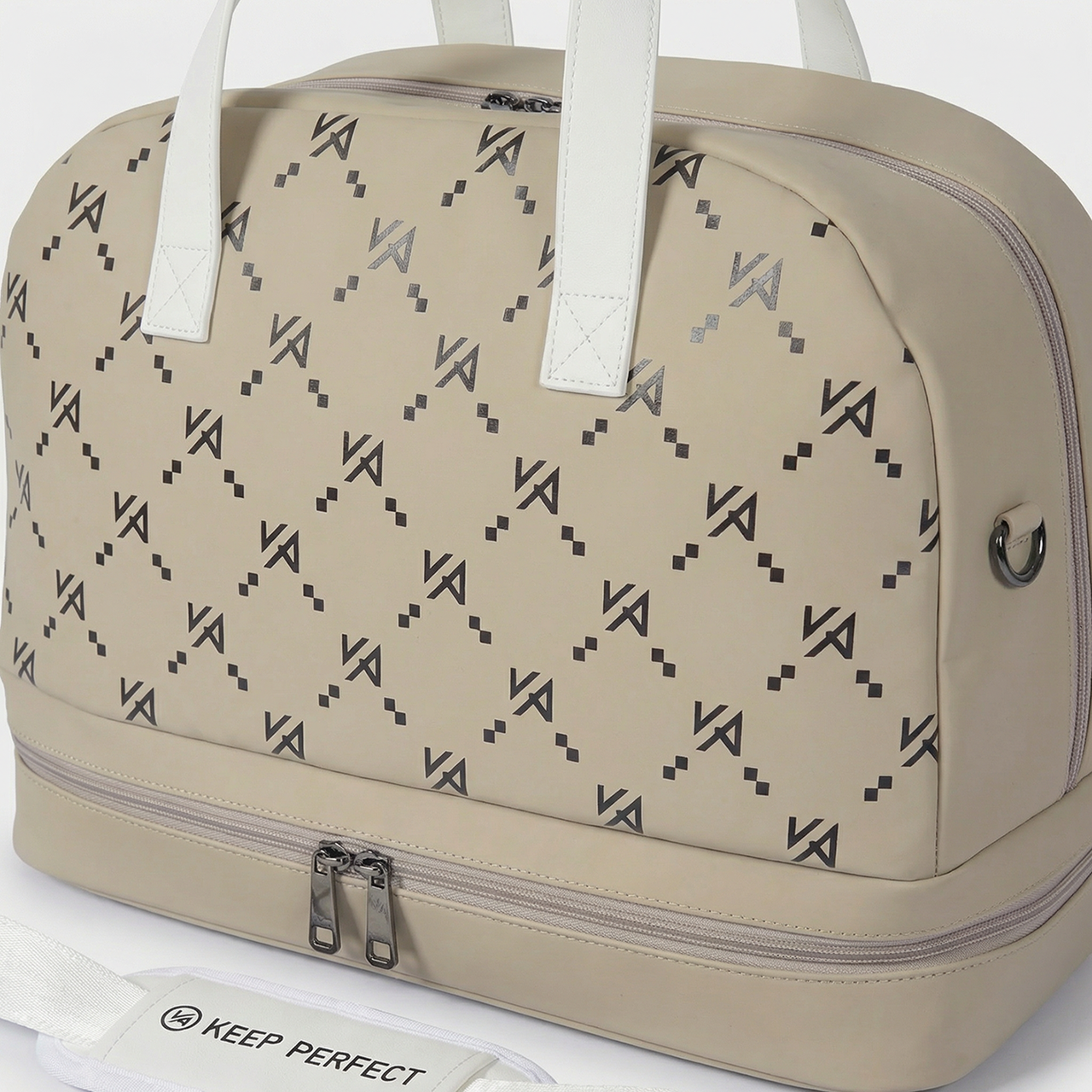
Pastel programs merchandise as systems: the bag anchors, and the companions complete the story — head covers in matching fabric (the cover guide specs the set architecture), plush character companions for the kawaii-adjacent customer, pastel boston bags (the floral and pastel weekender is the strongest lifestyle pairing in the current market, per the boston guide), and pouches in the same lots. A coordinated pastel wall — bag, covers, boston, pouch — is the strongest retail merchandising in the category.
The manufacturing advantage of the system: everything runs on the same lines from the same lab-dipped lots, so the companions match by scheduling, not by luck — request lot-matching explicitly in the brief. The merchandising math rewards it: companions at USD 19–89 lift the pastel customer's basket 40–70% over the bag alone, and the wall effect converts browsers at rates single products cannot.
Seasonal Rotation Strategy
Mature pastel programs run rotations, not one-offs: a spring story (sakura — the gift and Mother's Day window), a summer story (mint or sky — the season's cool read), an autumn story (lavender or butter — the fashion window), and optionally a holiday story (cream with rose-gold — the gift peak). The rotation keeps the collection fresh without redesign: the chassis, branding architecture and family structure stay constant; only the anchor shade rotates.
The production logic that makes rotations affordable: the first story absorbs the development (patterns, dips, artwork); rotations reuse everything except the color targets — new lab dips per material per story, production on archived patterns, reorder-speed calendars (30–45 days). The reorder system holds each story's standard across seasons. Programs planning rotations should say so at first brief — the archived system is built to rotate, and the second story prices closer to a reorder than a development.
Quality Control for Light Colors
Light grounds expose what dark grounds hide, so pastel QC adds three emphases to the AQL 2.5 protocol. Shade uniformity across the bag: every panel, pocket and trim piece compared against the approved dip set under D65 — pastel drift between components is visible where navy drift is not. Soil and mark control in production: light fabrics show handling marks, machine oil traces and dust — pastel lines run heightened cleanliness protocols (gloved handling at finishing, protective film on showcase panels, first-piece inspection for ground contamination). Colorfastness verification: light dyes show crocking and UV fade sooner — rub tests and lightfastness ratings specified per the ISO 105 series, per the materials protocol.
The packing note: pastel bags ship in individual polybags with tissue separation as standard — a scuffed mint bag is a write-off where a scuffed navy bag is a touch-up. The AQL guide covers the sampling system; pastel programs simply enforce its cosmetic clauses at the strict end, because the ground forgives nothing.
MOQ Economics and the Premium Math
Pastel economics at MOQ 200: the same USD 14–26 chassis pricing as any colorway, plus the matching discipline (+USD 1–2 per bag) and the one-time loop costs (extended lab dips, dye-to-order zipper tape minimums). Against 15–30% retail premiums — a pastel stand bag at USD 149–179 beside the same chassis in navy at USD 129 — the color decision returns roughly USD 20–40 of retail price for USD 1–2 of cost. It is the cheapest premium in the category by a wide margin.
The risk economics are equally favorable at MOQ 200: a pastel story tests at USD 5,000–8,000 landed, reads sell-through in one season, and rotates or retires on evidence. The cost breakdown provides the base math; the pastel premium sits on top of it as the highest-ROI line item a color decision can be.
A Worked Program: DTC Pastel Rotation
A DTC brand's 2026 pastel program: three stand-bag stories across the year — spring sakura (launch, 300 units), summer mint (400), autumn lavender (400) — full whole-bag execution (color-dipped legs, matched zipper tape, printed linings), deep-contrast embroidered crest, plush companion cover per story. Landed cost USD 21–24; retail USD 169 with companions at USD 39.
Year reporting: sakura sold through in nine weeks (Mother's Day window), mint in eleven, lavender in eight with the strongest photography engagement of the brand's year; companion attach rate 34%; and the rotation's second-year plan doubled quantities with a butter-yellow fourth story added. The founder's summary: "pastel stopped being a colorway and became the brand." The program's architecture — family discipline, whole-bag execution, companion system, rotation economics — is the playbook this article documents.
Common Pastel Program Mistakes
Six recurring errors. Accent-color half-measures: the navy bag with pink zippers — commitment is the product. Separate dip approvals: materials approved individually, mismatch discovered at assembly — approve the full set together under D65. Forgotten components: black zipper tape, grey mesh, silver pulls breaking the story — the daylight photo review catches every break. Washout branding: white thread without density engineering ghosting into the ground. Cross-family mixing: mint body, lavender trim — one family per story. Reordering without dip archives: season two's pink drifting from season one's — the reorder system exists precisely for this.
The meta-mistake: treating pastel as a colorway instead of a system. It is a color story with engineering requirements — matching discipline, light-ground branding, cleanliness protocols, rotation planning — and the programs that respect the system collect the premium that makes it the highest-ROI color decision in custom golf.
Pastel by Chassis: Where the Story Lands Hardest
The color story performs differently across chassis, and the portfolio sequence matters. Stand bags are the volume canvas — the pastel stand bag is the category's flagship image and the first SKU every program should run. Sunday and pencil bags are the natural second act: the minimalist silhouette carries pastel with fashion confidence, the Sunday economics (USD 6–11) make pastel tests cheap, and the walking-and-lifestyle customer overlaps the pastel base almost completely. Head covers and plush deliver the highest multiples (4×) and the gift attach. Boston bags extend the story into lifestyle luggage — the floral-pastel weekender is the segment's strongest photography. Cart bags take pastel selectively: the riding demographic skews traditional, so pastel cart executions serve resort retail and the women's segment specifically rather than the volume core.
The sequencing rule: prove the story on the stand bag, extend to Sunday and covers in season two (shared dips and lots), add the boston when the lifestyle customer is proven, and spec cart pastel only with channel evidence. Each extension inherits the first story's matching work — the dip archive is the program's appreciating asset.
Starting a Pastel Program
The brief: the anchor family (sakura, mint, lavender, butter, sky), the chassis and quantity, the branding approach on light grounds, companion pieces if any, and whether the program is a single story or a rotation. Through the quote form, the quotation returns with the matching protocol priced and calendared — dips in the first two weeks, samples in 6–10 working days after dip approval, production in 35–50 days.
The gallery shows current pastel executions across families. For programs still choosing the anchor, the recommendation follows the market: sakura for gift-led programs, mint for crossover positioning, lavender for fashion tiers, sky for club-safe channels. Junyuan has matched pastel across a dozen materials per program since the category began — the color story, engineered whole.
Frequently Asked Questions
Why are pastel golf bags so popular?
Demographics plus photography: women at ~28% of US golfers and under-35 cohorts growing (NGF), East Asian category maturity, and social media that rewards color commitment. The commercial proof: 15–30% retail premiums, strong reorder rates, and pastel's graduation from niche to planogram status in 2026–2027 programs. It is a structural shift, not a seasonal trend.
What makes a pastel golf bag look premium instead of cheap?
Whole-bag discipline: the color story executed across every surface — body, trim, zipper tape and pulls, webbing, mesh, lining, embroidery threads, even color-dipped stand legs. A pastel body with black zippers or grey mesh reads as a sourcing accident; total commitment reads as design confidence. The premium is in the matching, not the shade.
How much do custom pastel golf bags cost?
Standard chassis pricing (USD 14–26 at MOQ 200 by tier) plus USD 1–2 per bag in matching discipline and one-time loop costs (extended lab dips, dye-to-order zipper tape). Against 15–30% retail premiums — USD 149–179 beside the same chassis at USD 129 in navy — the color decision returns USD 20–40 of retail price for USD 1–2 of cost.
Which pastel color sells best?
Sakura pink leads volume (gift and women's retail), mint is the strongest unisex crossover, lavender leads fashion tiers, butter yellow wins photography-led programs, and sky blue is the club-safe traditional. Programs running rotations sequence sakura for spring, mint for summer, lavender for autumn, cream-and-rose-gold for holiday.
How do you match color across different bag materials?
The multi-material protocol: every material — fabric, webbing, zipper tape, mesh, PU — lab-dipped to the same Pantone target, approved together (never separately) under D65 standardized lighting, tolerance Delta E 1.0–1.5, approved dips archived as the production standard. Zipper tape dyes to order (+2–3 weeks lead), which is the calendar item that surprises first-time pastel programs.
What branding works on pastel golf bags?
Deep-contrast embroidery (navy or charcoal thread on light grounds — the crispest read in the line), white embroidery at increased density with underlay stitching, metallic thread accents (rose gold on blush), and tonal deboss on PU panels. Light grounds show every stitch gap, so pastel programs spec higher embroidery density — a USD 0.20–0.40 detail that decides the mark's quality read.
Can pastel colors fade or show dirt?
Light grounds are less forgiving, which is managed by spec: ISO 105-series colorfastness ratings (rub and lightfastness) written into the PO, heightened cleanliness protocols in production (gloved finishing, protective film on showcase panels), and individual polybag-plus-tissue packing as standard. Quality pastel programs hold color identically to dark ones — the discipline is specified, not hoped for.
Can I run seasonal pastel rotations?
Yes — mature programs rotate the anchor shade on a constant chassis and branding architecture: spring sakura, summer mint, autumn lavender, holiday cream-and-rose-gold. The first story absorbs development; rotations reuse archived patterns and artwork at reorder pricing and calendars (30–45 days). Declare the rotation at first brief and the system is built to rotate.
What companion products complete a pastel line?
Head covers in matching fabric, plush character companions, pastel boston bags (the strongest lifestyle pairing in the current market), and pouches — all from the same lab-dipped lots for exact matching. Companions at USD 19–89 lift the pastel customer's basket 40–70%, and the coordinated wall (bag, covers, boston, pouch) is the strongest retail merchandising in the category.
What is the minimum order for a pastel golf bag?
200 pieces per color story — USD 5,000–8,000 landed for a stand-bag execution, the ideal test quantity. Pastel's one-time costs (extended dip loops, dye-to-order zipper tape) are story-level, not per-unit, so the second story in a rotation prices closer to a reorder than a new development.
How long does a pastel program take?
Lab dips in the first two weeks (extended loop for multi-material matching), samples in 6–10 working days after dip approval, production in 35–50 days. Spring stories sample by November–December; the dye-to-order zipper tape lead time is the component that sets the calendar edge.
How do I start a custom pastel golf bag program?
Four details through the quote form on this site: anchor family (sakura, mint, lavender, butter, sky), chassis and quantity, branding approach, and single story or rotation. The quotation returns with the matching protocol priced and calendared; dips inside two weeks, samples inside two more — Junyuan has engineered whole-bag pastel since the category began.
Can pastel work for club and resort retail programs?
Yes — with family selection: sky blue is the club-safe pastel (traditional enough for conservative shops, fresh enough to merchandise), and sakura dominates resort gift retail (the Mother's Day and holiday windows are the strongest pastel sales periods on record). Resort programs pair the pastel bag with matched head covers and boston bags for the full gift wall.