
Defining the Golf Boston Bag
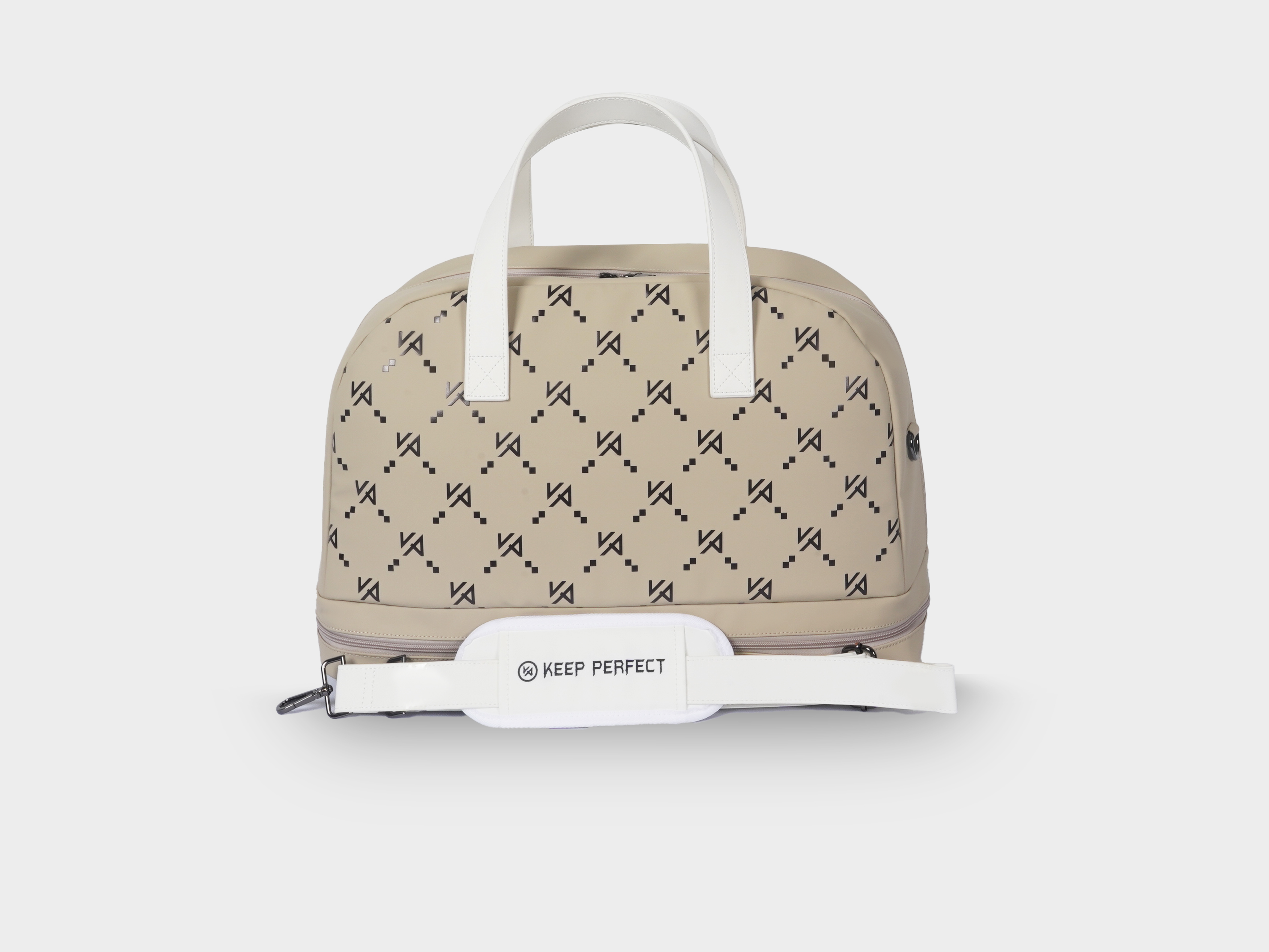
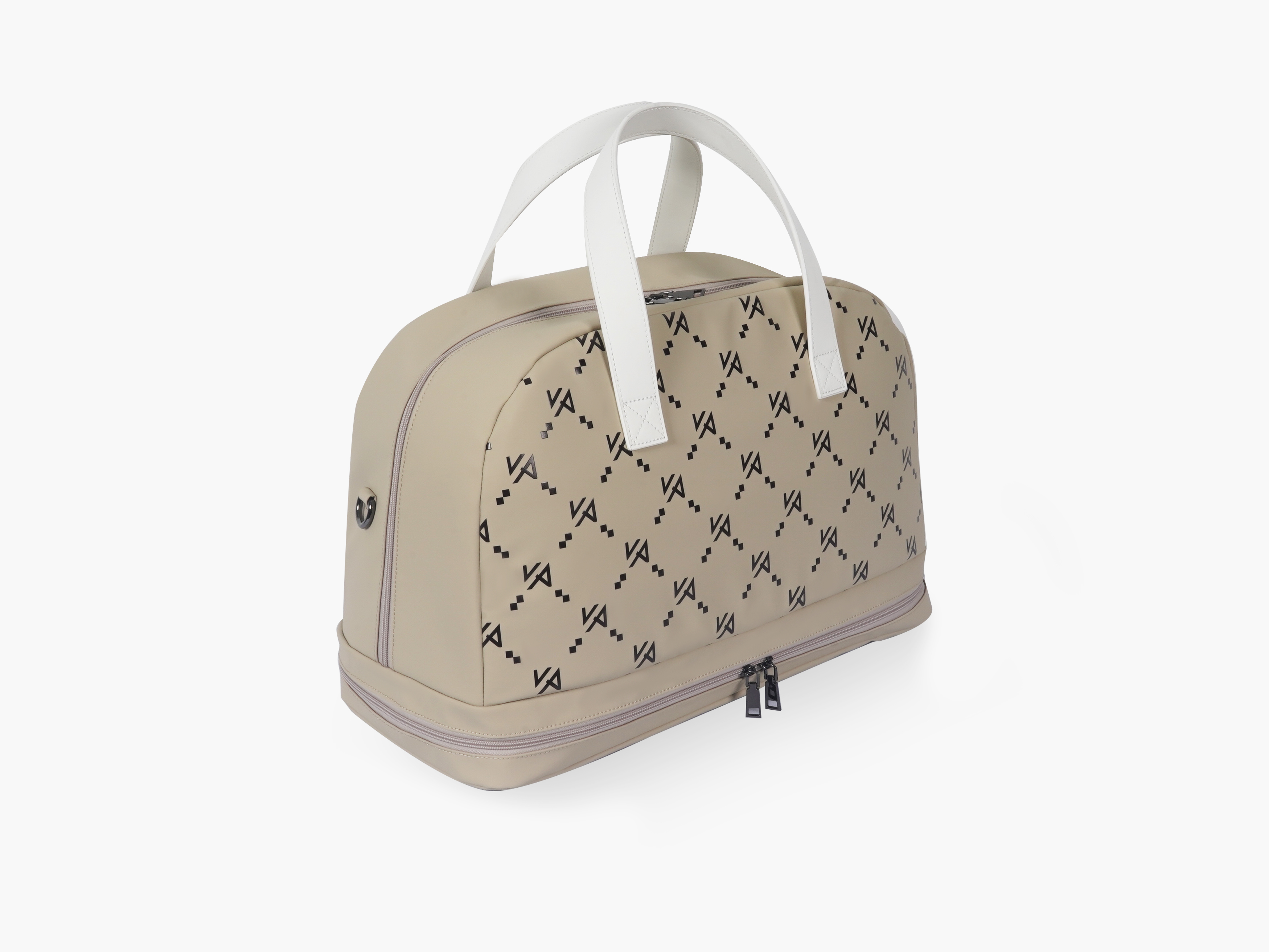
A golf boston bag is a structured weekender duffle — 45–52 cm, 25–40 liters — engineered for the golf trip: ventilated shoe compartment isolating spikes from clothing, two-day apparel capacity, accessory pockets for gloves and valuables, and styling deliberately closer to fashion luggage than golf equipment. It carries the weekend, not the clubs.
The category confuses buyers who expect golf bags to hold clubs. The boston holds everything except clubs — and that is precisely its market: the golfer driving to a weekend member-guest needs shoes, two outfits, toiletries and accessories moved cleanly from house to car to locker room. The travel cover moves clubs; the boston moves the golfer. Programs that understand this spec the boston as lifestyle luggage with golf engineering (the shoe garage, the glove pocket, the spike-friendly base fabric), and it outsells every expectation — particularly in the women's market, where the boston silhouette is already a fashion staple.
Why the Category Is Growing
Three currents converge. Golf's lifestyle crossover: the sport's fashion moment (documented across the 2027 design directions) created demand for products that work at the club and the gym and the airport — the boston is that product's natural form. The women's market: with women at ~28% of US golfers (NGF) and the pastel/color-story category maturing per the kawaii analysis, the boston — already a women's fashion silhouette — is the golf accessory with the lowest adoption friction. Collection merchandising: brands discovered the boston completes a line's lifestyle tier, capturing spend that previously went to fashion duffles.
The demand evidence from our order book: boston programs grew from occasional add-ons to planned line items across 2025–2026, with reorders concentrating in color-story executions — the floral and pastel runs that match the season's bag collections. The buyers winning the category treat it as fashion with golf function, not golf equipment with fashion color.
Construction Anatomy
The construction priorities differ from golf bags in one key way: this bag is judged by luggage standards. It will be lifted by its handles at full clothing weight (8–12 kg packed), set down on locker-room floors, and compared in the hand to fashion weekender bags. Handle anchor stitching (boxed-X patterns), base structure (a padded board that keeps the silhouette under load), and zipper quality are the three places cheap bostons fail visibly. Premium tiers add the trolley sleeve — the back panel that slides over rolling luggage handles — which converts the boston into the golf traveler's complete non-club system alongside the travel cover.
| Component | Standard spec | Premium spec |
|---|---|---|
| Dimensions | 45–50 × 25 × 28 cm (~30 L) | 48–52 cm (~38–40 L) |
| Shoe compartment | End garage, ventilated, wipeable lining | Same + antimicrobial treatment |
| Structure | Padded base board, soft walls | Semi-rigid panels, piped seams |
| Carry | Twin handles + detachable shoulder strap | Same + trolley sleeve |
| Materials | 600–900D polyester | 1680D ballistic, waxed canvas, PU trim |
| Hardware | Standard coil zips, plastic fittings | YKK-grade zips, metal fittings |
| Factory price (MOQ 200) | USD 9–13 | USD 13–18 |
The Shoe Garage: the Category’s Defining Feature
Every golf boston's engineering signature is the shoe compartment: a separate end garage, sized for golf shoes to US 13 / EU 47, ventilated (mesh panels or eyelets — wet spikes need airflow), lined in wipeable material (grass and sand are the job), and structurally isolated so shoe weight does not crush clothing. The garage is what separates a golf boston from a fashion duffle — and what justifies the category's price premium at retail.
Spec details that matter: the garage opening should be zippered on the end face (top-loading garages dump shoes into the main cavity when the bag tips), the dividing wall should be padded (shoes are hard; silk polos are soft), and the ventilation should be real (two mesh panels minimum — a single eyelet row is decoration). Premium executions add a shoe bag insert — a drawstring pouch inside the garage — which reads as a gift-with-purchase at negligible cost.
Materials: From Ballistic to Floral
The boston's material map runs wider than golf bags because its contexts do. Ballistic 1680D for the travel-and-club workhorse tier (the luggage-standard read). Waxed canvas with leather trim for heritage programs — the clubhouse-romantic tier that photographs like nothing else and ages beautifully (the materials guide details the canvas spec). PU and hybrid constructions for quiet-premium executions. Printed polyesters — including full floral and color-story prints — for the women's and pastel market, where the boston is the collection's fashion flagship.
Print execution is where bostons outperform bags technically: the large, flat body panels take repeat prints and placement florals cleanly, and the repeat-engineering discipline (scale, placement, seam decisions at quotation) applies directly. A floral boston matched to a pastel stand bag is the strongest two-SKU lifestyle statement in the current market — the combination appears in our sample room more than any other pairing this season.
Branding the Weekender
Boston branding follows luggage logic rather than equipment logic: restraint reads premium. The standard architecture is one primary mark (embroidery or deboss on the front panel or end pocket, 100–150 mm), a woven label at the handle base, and interior branding (printed lining, woven care label) that rewards the owner privately. The placement guide's discipline scales directly — the boston's ball-pocket equivalent is the front zip pocket face.
The category-specific note: club crests and event marks outperform brand wordmarks on bostons. The product's contexts (gym, airport, office) are places where a club crest signals membership — desirable — while a commercial wordmark reads as merchandise. Retail programs should spec the crest-forward architecture for club channels and reserve brand-forward layouts for their own DTC lines, where the boston carries the collection identity.
Program Use-Cases: Four Buyers
Clubs and resorts retail bostons at USD 79–129 in the pro shop — the highest-ring accessory after travel covers — and gift them in member-guest and captain's-prize tiers. Retail and DTC brands run the boston as the lifestyle tier of the collection: the SKU that captures the customer's non-golf spend and completes the color-story wall. Corporate programs gift premium bostons (canvas or hybrid, USD 13–18 cost) as executive-tier recognition — the tier above the cooler and den caddie in the gifting hierarchy. Tournament and event buyers use the boston as the prize-table headline — winner's prizes that photograph like luxury goods at USD 9–13 cost.
The use-case decides materials and price tier more directly than in any other category: pro-shop retail wants ballistic and canvas at the premium tiers; event prizes want print and color at the value tiers; corporate wants heritage materials with quiet branding; DTC wants whatever the collection's color story dictates. One chassis library, four correct answers — the spec conversation is about context, not construction.
MOQ Economics and the Margin Ladder
Boston economics at MOQ 200: USD 9–13 for standard constructions (900D polyester, standard hardware), USD 13–18 for premium (ballistic, canvas, leather trim, YKK-grade zippers). Price drivers in order: material family, hardware tier, construction complexity (semi-rigid panels add USD 1.50–2.50), print development (repeat-engineered florals add USD 300–800 one-time, per the pattern development economics), and extras (trolley sleeve USD 0.60–0.90, shoe-bag insert USD 0.40–0.70).
The margin ladder is the category's headline: USD 11–16 landed against USD 59–129 retail sustains 4–6× multiples — after plush headcovers, the strongest in golf soft goods. The reason is the fashion comparison set: customers anchor boston prices against fashion weekender bags (USD 80–200), not golf accessories. Programs pricing bostons like golf gear leave the ladder's best rungs empty; the cost breakdown shows how the landed-cost math supports the premium tiers.
Quality Control for Luggage-Grade Soft Goods
Boston QC adds luggage-standard checkpoints to the AQL 2.5 protocol: handle anchor pull tests (the bag lifts 8–12 kg packed — anchors are the failure point), loaded carry cycles (straps and handles under rated weight), base-board integrity after drop tests, shoe-garage isolation (pack the garage, compress, verify the main cavity), and zipper cycles under load. Color-critical prints add the standard lab-dip and dye-lot discipline — a floral that drifts between batches is visible across a retail wall.
The inspection runs to the same ISO 2859-1 sampling as bags — 32 units from a 200-piece lot — against the sealed approval sample, per the AQL guide. The boston-specific warning: this product is compared to fashion luggage in the customer's hand, so cosmetic standards (thread tails, glue marks, print registration) run tighter than equipment norms. Spec the cosmetic grade explicitly; the inspection enforces what the spec states.
A Worked Program: Resort Retail Collection
A resort group's 2026 retail program: 400 bostons across two colorways — a waxed-canvas heritage edition with leather trim for the flagship shop (USD 16.80 cost, USD 119 retail) and a floral print edition matched to the season's pastel collection for the women's boutique (USD 11.20, USD 89). Both with the resort crest embroidered on the end pocket, woven handle labels, printed linings, trolley sleeves. Sampled in 10 days (two print rounds on the floral), produced in 42 days, on shelf for the season opening.
Season reporting: the heritage edition sold through in eleven weeks at full price (the canvas-and-crest combination read as resort memorabilia, not merchandise), the floral held a 70% sell-through with the balance moving in the end-of-season event, and the boston became the shop's highest-ring soft good — ahead of headcovers for the first time. The 2027 order doubled the floral allocation and added a third colorway. The boston's career in resort retail follows this arc whenever the materials match the setting.
Common Boston Program Mistakes
Five recurring errors. Skimping handle anchors: the first fully-packed lift is the test — boxed-X anchor stitching or failures at the hotel lobby. Top-loading shoe garages: shoes migrate into the clothing cavity when the bag tips; end-face zippered garages only. Equipment-grade branding: six-position logo suites on a fashion silhouette read as team-gear; luggage restraint wins. Ignoring the women's market: value-tier navy bostons for everyone misses the segment driving category growth — the floral and pastel executions are the volume. Pricing like golf gear: the comparison set is fashion luggage; USD 49 retail on a USD 12 cost is underpricing the anchor.
The meta-mistake is speccing the boston as a small golf bag. It is luggage with a shoe garage — judged by luggage standards, carried in luggage contexts, priced against luggage alternatives. Spec it that way and it returns fashion margins on golf-order economics.
Sizing, Carry-On and the Airline Question
The dimension decision that defines the boston's usefulness: airline carry-on compliance. The common cabin ceiling (roughly 55 × 40 × 23 cm across the major carriers) comfortably contains the standard 45–50 cm boston — the premium 52 cm variant approaches the limit on length and should be spec'd with soft, compressible end walls so it squishes into the sizer when challenged. For programs targeting the golf-travel customer (the buyer pairing the boston with a travel cover), carry-on compliance is a selling feature worth printing on the hangtag: clubs checked in the travel cover, everything else overhead.
Capacity planning follows the two-day rule: 30 liters covers a summer golf weekend (two polos, shorts, evening layer, toiletries, accessories); 38–40 liters adds a rain suit and a second shoe pair or extends to three days. Beyond 40 liters the silhouette tips from weekender to duffel and the fashion read suffers — programs needing more volume should spec a second SKU rather than stretch the chassis. The travel guide covers the full trip system the boston completes.
Starting a Boston Program
The brief: use context (club retail, DTC collection, corporate, event prizes), material direction (ballistic, canvas, print), quantity and colorways, and whether it pairs with a bag collection for lot-matching. Through the quote form, the quotation returns with construction specs and branding architecture at your volume — samples in 6–10 working days, production in 35–45 days.
For collection builders, the boston's role is settled alongside the den caddie and cooler: the lifestyle tier that captures the customer's week, not just their round. The accessories guide maps the full small-goods range; the gallery shows current executions. Junyuan has manufactured golf luggage for export programs since 2014.
Frequently Asked Questions
What is a golf boston bag?
Golf's weekender duffle: a structured soft bag (45–52 cm, 25–40 liters) with a ventilated shoe garage, two-day apparel capacity and luggage-grade styling — it carries the golfer's weekend (shoes, clothing, accessories) while the travel cover carries the clubs. Fashion silhouette outside, golf engineering inside.
How much do custom golf boston bags cost?
At MOQ 200, FOB Xiamen: standard constructions USD 9–13 (900D polyester, standard hardware), premium USD 13–18 (1680D ballistic, waxed canvas with leather trim, YKK-grade zippers). Landed cost against USD 59–129 retail sustains 4–6× multiples — the strongest margin ladder in golf soft goods after plush headcovers.
What is the minimum order for custom boston bags?
200 pieces per design — roughly USD 1,800–3,600 total depending on tier. Repeat-print development (florals, custom patterns) adds USD 300–800 one-time. Boston bags paired with a bag collection share fabric lots, production runs and container freight.
What fits inside a golf boston bag?
A two-day golf trip: one pair of golf shoes in the ventilated end garage (to US 13 / EU 47), two outfits plus rain layer in the 30–40 liter main cavity, toiletries, gloves and accessories in organizer pockets, valuables in the fleece-lined pocket. It is sized as airline carry-on for most carriers — check your market's dimensions at spec stage.
What is the shoe compartment specification?
An end-face zippered garage (top-loading designs dump shoes into clothing), sized to US 13 / EU 47, ventilated with two mesh panels, lined in wipeable material, with a padded dividing wall isolating shoe weight from clothing. Premium executions add antimicrobial lining treatment and a drawstring shoe-bag insert.
What materials work for custom boston bags?
Four families: 1680D ballistic (travel workhorse), waxed canvas with leather trim (heritage, +USD 3–6, ages beautifully), PU hybrid constructions (quiet premium), and printed polyesters including full florals (the women's and pastel market's volume driver). The materials guide on this site details each family's branding compatibility and durability.
Can boston bags match my golf bag collection?
Yes — same fabric lots, thread, lab dips and print patterns as the bags, scheduled at production planning. A floral boston matched to a pastel stand bag is the strongest two-SKU lifestyle statement in the current market; lot-matching is requested at brief and costs nothing beyond planning.
What branding suits a boston bag?
Luggage restraint: one primary mark (embroidery or deboss, 100–150 mm on the front or end pocket), a woven handle label, and interior branding (printed lining, care labels). Club crests outperform commercial wordmarks because the bag travels to gyms, airports and offices — membership signals read better than merchandise there.
Who buys custom boston bag programs?
Four buyers: clubs and resorts (pro-shop retail at USD 79–129, member-guest prize tiers), retail and DTC brands (the collection's lifestyle tier), corporate programs (executive-tier gifting at USD 13–18 cost), and tournament buyers (prize-table headlines that photograph like luxury goods). Each use-case has its correct material tier.
How are boston bags quality-tested?
AQL 2.5 sampling (ISO 2859-1) plus luggage-standard checkpoints: handle-anchor pull tests under 8–12 kg packed weight, loaded carry cycles, base-board drop tests, shoe-garage isolation checks, and zipper cycles under load. Cosmetic standards run tighter than equipment norms — the customer compares this product to fashion luggage.
Does a boston bag work as a corporate gift?
At the executive tier, yes — canvas or hybrid constructions (USD 13–18) with quiet crest branding read as recognition gifts, not merchandise, and the product's daily-use contexts (gym, travel, office) accumulate brand impressions for years. It sits above the cooler and den caddie in the gifting hierarchy for the twenty names that matter most.
How long does custom boston bag production take?
Samples in 6–10 working days (print programs may need two graphic rounds); bulk production 35–45 days after approval; ocean freight 14–35 days by destination. Collection-paired programs run on the parent order's calendar and container.
How do I start a custom boston bag program?
Four details through the quote form on this site: use context (club retail, DTC, corporate, events), material direction, quantity and colorways, and any collection pairing. The quotation returns with specs and branding architecture at your volume; samples inside two weeks — Junyuan has manufactured golf luggage for export programs since 2014.
Is a golf boston bag carry-on compliant?
The standard 45–50 cm chassis fits the common cabin ceiling (roughly 55 × 40 × 23 cm) comfortably. The premium 52 cm variant approaches the length limit and is spec'd with compressible soft end walls so it passes the sizer when challenged. For golf-travel programs, carry-on compliance is a hangtag feature: clubs checked in the travel cover, everything else overhead.