
Why Travel Product Is Its Own Discipline
Because the enemy is different: a golf bag's job is organization and identity, a travel cover's job is surviving baggage handling — drops, throws, stacking loads and conveyor machinery. Every spec decision follows from that one fact.
Travel covers are the most liability-exposed product in the golf softgoods family: a failed bag inconveniences a round, a failed cover destroys a USD 1,500 club set 3,000 miles from home. The customer's claim lands on the brand on the cover — which is why travel product spec is defensive engineering: padding where impacts land, structure where loads stack, materials where abrasion happens. Done right, travel covers are also the highest-visibility branding in golf — a covered bag crosses an airport seen by thousands. The travel covers page shows the constructions; this guide is the spec discipline.
The Three Constructions Compared
Soft covers dominate volume because they fold flat (retail shelf efficiency, home storage) and price accessibly; hybrids own the protection-premium segment (the rigid top cap answers the #1 damage mode — club heads crushed under stack loads); wheeled bags sell the airport experience (a 30 lb bag on wheels versus on shoulders is the difference between arriving and arriving annoyed). Full hard cases exist but sit outside softgoods manufacturing — we advise on them and produce the three soft constructions.
| Type | Cost at 200 pcs | Protection | Best for |
|---|---|---|---|
| Padded soft cover | USD 14–24 | Good — foam-padded, folds flat | Volume retail, car + occasional air |
| Hybrid (rigid top shell) | USD 22–36 | Best soft-sided — hard cap protects club heads | Frequent flyers, premium retail |
| Wheeled travel bag | USD 18–32 | Good to best (padding varies) | Convenience buyers, senior and travel-heavy market |
Spec One: Padding Where Impacts Land
Padding spec is zoned, not uniform: 10–15 mm foam in the club-head zone (the top third, where shafts snap under point loads), 5–8 mm through the body, and reinforced impact panels at the base corners (the drop zones). Uniform thin padding reads well in photos and fails in the hold; zoned padding adds cost where physics demands it. The internal stabilization matters equally: a compression strap that locks the bag inside the cover prevents the shifting that transmits impact energy to shafts.
The test protocol buyers should ask about: loaded drop tests (packed cover dropped on corners and face from conveyor height), stack tests (loaded cover under sustained top load), and abrasion cycles on base corners. Our sample-stage testing runs all three; the AQL guide covers how testing feeds the inspection regime that watches bulk production.
Spec Two: Wheels and Base Engineering
Wheels are the #1 warranty item on wheeled travel gear, and the spec hierarchy is clear: inline-skate-style polyurethane wheels on sealed bearings (smooth, durable, replaceable) over cheap plastic casters (loud, brittle, doomed). The wheel housing is the failure multiplier — housings must be recessed and reinforced, because a wheel sheared off in transit is a total loss of the product's promise. Load rating matters: the assembly should be rated for 50+ kg, double the working load.
The base is the cover's foundation: rigid or semi-rigid base panels (PE board) distribute loads and protect against drag abrasion; base rails or skid strips take the conveyor wear; and the standing stability of a loaded cover (does it tip in the check-in line?) is a design detail customers feel without naming. These are the specs that separate USD 18 wheeled covers from USD 32 ones — and the reason both exist honestly in the market.
Spec Three: Fabric at Abrasion Points
Travel covers live a different abrasion life than golf bags: conveyor belts, cargo holds, van floors, drag lifts. The material spec zones accordingly: 1680D ballistic polyester minimum at base, corners and wheel housings (the drag zones), 600–900D acceptable on upper panels (the display zones), and waterproof coatings throughout (tarmac rain is real). Hypalon or reinforced vinyl patches at the highest-wear points are the premium tell — visible reinforcement where luggage dies.
Zippers on travel covers take loads bag zippers never see: a fully packed cover's main zipper holds tension across the whole structure. The spec is #8 or #10 heavy-duty coil with lockable pulls (TSA-accepted locks being the customer's add), self-repairing coil preferred. A zipper failure mid-journey is the second-worst travel outcome after shaft damage, and it is prevented at the spec sheet, not the complaint desk.
Spec Four: Airline Sizing and Weight Discipline
Airline reality shapes the product: standard golf bag policies allow one golf bag as checked baggage (typically counting as one standard bag, some carriers waiving oversize fees for golf), but weight limits (50 lb / 23 kg standard) are enforced — and a heavy cover plus a full bag plus shoes approaches the line. Cover empty-weight therefore matters: soft covers at 2.5–4 kg leave room; wheeled rigid constructions at 5–7 kg demand discipline. Dimensionally, designs should keep the packed unit as compact as the clubs allow — every inch beyond necessity is conveyor risk.
For buyers, the sizing conversation belongs in the spec: which airlines dominate your market (US carriers' golf policies differ from European budget carriers'), whether your customer checks or gate-checks (regional jets force gate-check — a rougher journey), and how the cover stores between trips (fold-flat soft covers win the closet argument, a real purchase factor for apartment-dwelling golfers). The market pages (from USA to Europe) carry the destination-specific notes.
Spec Five: Branding for the Carousel
Travel cover branding plays by airport rules: the surfaces seen in transit are the hood top and the side panels (on the carousel) and the base end (when stacked). Primary branding goes large on the main body panel — readable at ten meters across a carousel hall — with secondary marks on the hood. This is print territory: large-format screen print or heat transfer graphics outperform embroidery on big flexible panels, and the branding must survive the same abrasion regime as the fabric (print positioned off the drag zones, or executed in abrasion-resistant methods).
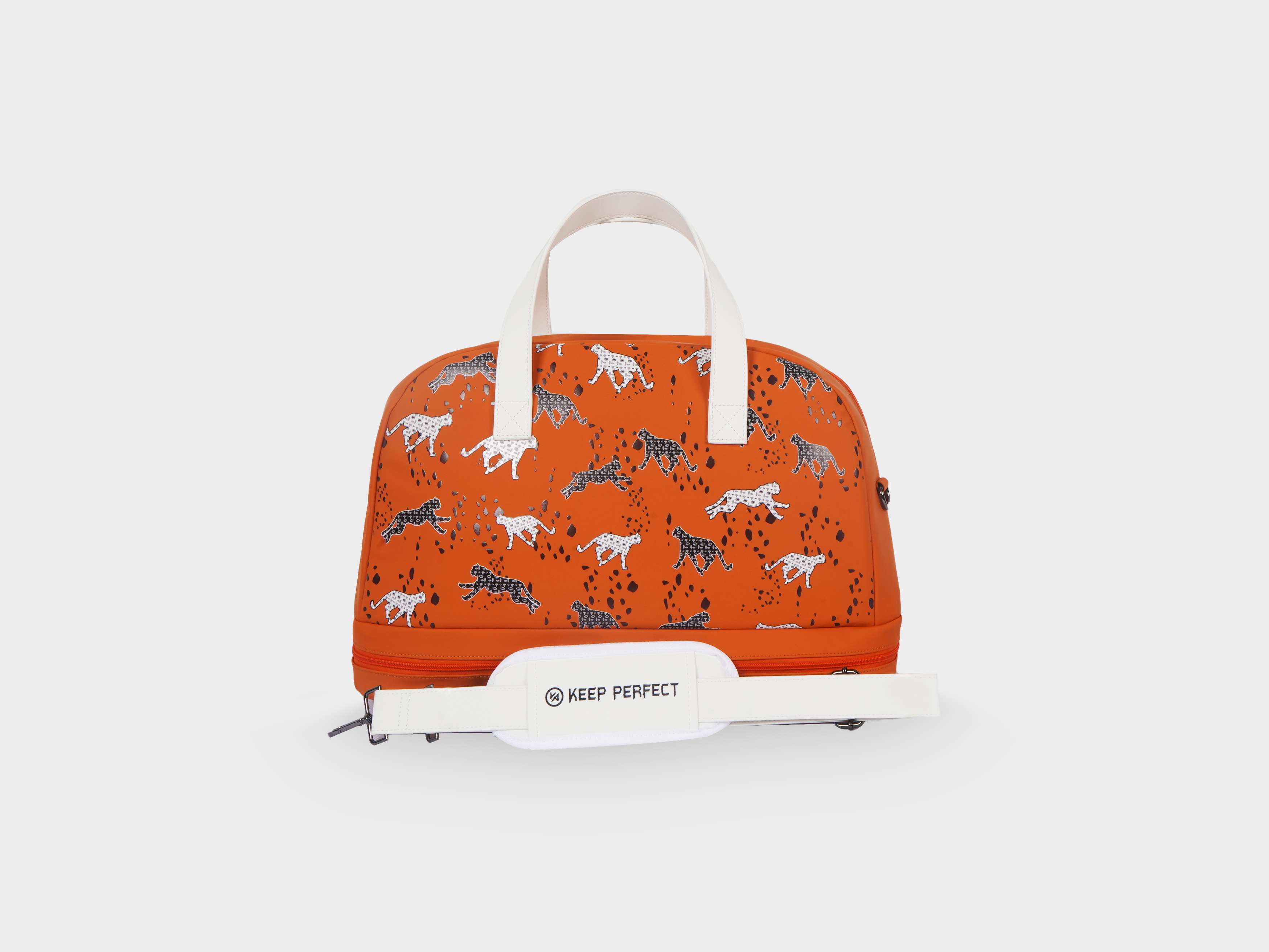
The clever branding mechanics unique to travel product: high-visibility colorways (a distinctive cover is found faster on the carousel — visibility is a feature customers feel), ID windows and address card pockets (spec'd, not improvised), and the ID panel as a secondary branding surface. Corporate travel programs (company-logo covers for executive travel, tournament team travel) are the bulk-buying segment here — the corporate guide's kept-rate logic applies: a cover crosses more eyes per year than any desk item.
Program Structures for Travel Product
Travel covers fit three program types. Retail line extension: the travel cover matched to your bag line's materials and colorway — the collection logic from the accessories guide at a bigger ticket (USD 14–24 cost retailing at USD 59–129). Corporate and team travel: branded covers for traveling squads and executive programs — team travel covers in matching colorways are the strongest team-identity product in transit. Airline and travel-industry promotional: co-branded programs (golf destination resorts, airlines' golf promotions, tour operators) — the cover as the physical artifact of a golf-travel package.
All three run the standard calendar (MOQ 200, sampling 6–10 days, bulk 35–50 days) with travel-specific sampling notes: the sample evaluation should include a loaded carry test (pack a bag, wheel it, lift it, check the strap anchors) and a fit check against your target bag models — covers spec'd to "fits most" occasionally fit poorly, and the sample is where that is discovered.
Worked Example: the Resort Travel Program
A golf resort group ordered 400 hybrid covers (rigid top cap, wheeled, 1680D base) in their signature green with large-format print: unit cost USD 31.20 landed, sold in the pro shop at USD 119 and bundled into premium stay-and-play packages at a USD 89 value line. The covers crossed every airport their guests flew home through — the marketing value computed separately: the resort's guest survey showed the cover as the third-most-remembered item of the stay, ahead of the logo ball they gave away free.
The repeat mechanics: year two reordered 600 (proven sell-through plus two sister resorts joining the program), same spec, 30-day turnaround, and the cover became the package's physical signature — guests photographing their matching covers at carousel became the resort's most reliable social content. Travel product done right is advertising that pays for itself at retail before it advertises.
Where Travel Programs Fail
- Uniform thin padding. Photographs well, fails in the hold. Zone the foam: 10–15 mm in the club-head third.
- Cheap wheel assemblies. The #1 warranty item on wheeled covers; recessed, reinforced, load-rated, replaceable.
- Drag-zone branding. Beautiful print positioned where conveyors eat it. Branding placement follows the abrasion map.
- "Fits most" without the fit check. Sample against your actual bag models, packed, zipped, lifted.
- Weight indiscipline. A 7 kg empty cover plus a full bag meets the 50 lb airline line quickly. Empty weight is a spec.
- Undersized zippers. The main closure holds structural tension on a packed cover; #8–#10 heavy-duty or accept the claims.
The Warranty Math Behind Travel Specs
Travel product carries the highest warranty exposure in the softgoods family, and the exposure prices the spec honestly. A soft cover with uniform 5 mm padding might save USD 1.40 in foam and fabric versus the zoned spec — and one crushed driver shaft claim costs the brand USD 250–600 in goodwill replacement plus a customer relationship. At a 2% claim rate (industry-typical for under-specified covers) the cheap spec costs USD 5–12 per unit sold in claims; the zoned spec's claim rate runs a tenth of that. The USD 1.40 saving is the most expensive foam in the catalog.
This is why the sample-stage testing matters commercially, not just technically: drop tests, stack tests and abrasion cycles are claim prevention measured before the first unit ships. Brands offering travel-cover warranties (a strong retail differentiator) should spec and test to make the warranty cheap to honor — the promise is only as good as the foam behind it, and customers learn which brands meant it exactly once.
Starting a Travel Program
The brief: construction type (or describe the customer and we recommend), quantity, branding assets, target bag models to fit, destination market. The quotation returns with construction options priced, padding and wheel specs itemized, and the sampling calendar. MOQ 200, 6–10 day sampling with loaded-carry evaluation, AQL 2.5 inspection with drop-test documentation. Junyuan has built travel product since 2014 — the quote form starts the spec conversation, and the airports do the rest.
Frequently Asked Questions
What types of custom golf travel bags can be manufactured?
Three constructions: padded soft covers (USD 14–24 at MOQ 200, fold flat, the volume seller), hybrid covers with rigid top shells (USD 22–36, best soft-sided protection against club-head crushing), and wheeled travel bags (USD 18–32, the convenience leader). All carry your full branding; full hard cases sit outside softgoods manufacturing.
What padding should a golf travel cover have?
Zoned, not uniform: 10–15 mm foam in the club-head zone (the top third where shafts snap under point loads), 5–8 mm through the body, reinforced impact panels at base corners, plus an internal compression strap that locks the bag against shifting. Uniform thin padding photographs well and fails in the hold; zoned padding costs where physics demands.
What wheels are best on a golf travel bag?
Inline-skate-style polyurethane wheels on sealed bearings — smooth, durable, replaceable — in recessed, reinforced housings, with the assembly load-rated to 50+ kg (double the working load). Cheap plastic casters in exposed housings are the #1 warranty item on wheeled travel gear; the wheel spec is where USD 18 covers and USD 32 covers honestly diverge.
What is the MOQ for custom golf travel covers?
200 pieces per style and colorway, with 6–10 day sampling (including a loaded-carry and fit evaluation) and 35–50 day bulk production. Travel covers also join collection programs — matched to your bag line's materials and colorway in a shared production visit.
How should branding be placed on a travel cover?
For the carousel: large-format print on the main body panel (readable at ten meters) with secondary marks on the hood and base end — the surfaces transit actually shows. Keep branding off the drag zones (base corners, wheel housings) or use abrasion-resistant methods there. High-visibility colorways double as a customer feature: a distinctive cover is found faster.
Do golf travel bags meet airline requirements?
Designed to: most carriers accept one golf bag as standard checked baggage, but the 50 lb / 23 kg weight limit is enforced — so empty-cover weight is a spec (soft covers 2.5–4 kg leave margin; rigid wheeled constructions 5–7 kg demand discipline). Compact dimensions reduce both oversize risk and conveyor damage exposure.
What fabric weight should a travel cover use?
Zoned: 1680D ballistic polyester minimum at base, corners and wheel housings (the drag zones), 600–900D acceptable on upper display panels, waterproof coatings throughout. Reinforced patches (Hypalon or vinyl) at the highest-wear points are the premium tell — visible reinforcement where luggage dies.
How are travel covers quality-tested?
Loaded drop tests (packed cover dropped on corners and face from conveyor height), stack tests (sustained top load), abrasion cycles on base corners, zipper cycle tests under tension, and wheel-load verification — at sample stage, then the standard AQL 2.5 inspection with travel-specific checkpoints through bulk production.
What do custom travel covers retail for?
Soft covers at USD 14–24 cost retail at USD 59–89; hybrids at USD 22–36 retail at USD 99–149; wheeled premium constructions at USD 18–32 retail at USD 89–139. Travel product carries strong multiples because the customer is buying insurance for a USD 1,500 club set — the value reference is protection, not fabric.
Who buys branded travel covers in bulk?
Three program types: retail line extensions (covers matched to your bag collection), team and corporate travel programs (matching covers as team identity in transit — the strongest traveling brand artifact in golf), and travel-industry promotions (resorts, airlines, tour operators bundling covers into golf-travel packages).
What zippers should a travel cover have?
#8 or #10 heavy-duty coil zippers with lockable pulls (TSA-accepted locks as the customer's add), self-repairing coil preferred. A packed cover's main zipper holds structural tension across the whole unit — the failure mode is mid-journey, far from help, and it is prevented at the spec sheet rather than handled at the complaint desk.
How long does a custom travel cover order take?
The standard calendar: 6–10 day sampling (with loaded-carry and fit evaluation against your bag models), 35–50 day bulk production, AQL 2.5 inspection, 14–35 days ocean freight. MOQ 200; reorders on proven specs run 30–45 days. Travel-season peaks (spring breaks, winter golf trips) should be planned 90 days out.
Can travel covers match my existing bag line?
Yes — the collection logic: covers cut from your bag line's fabric lots and trim codes, so the travel cover's navy is your stand bag's navy exactly. Branding setups (digitizing, screens) transfer directly. A matched cover at USD 14–24 cost completes the collection story and retails at USD 59–129 — the strongest line-extension economics in the softgoods family.
What fits inside a standard travel cover?
A full-size cart or stand bag with a 14-club set, plus shoes and soft goods in the dead space around the bag — internal compression straps keep the load from shifting. Oversize staff bags need the fit confirmed at sampling (bring your largest target model to the fit check); covers spec'd to "fits most" occasionally fit poorly, and the sample is where that is discovered, not the airport.
How do travel covers ship and store for retailers?
Compressed and cartonized — soft covers fold flat (excellent shelf and warehouse efficiency), hybrids and wheeled models pack semi-rigid with larger cartons. Retail display favors hanging or upright presentation; the PSI pack-out photos document carton specs, and container-matched carton dimensions keep freight honest at volume.
Do you make travel covers for junior or women’s golf bags?
Yes — scaled constructions for smaller bag formats, spec'd at sampling with the same padding-zone and wheel rules in reduced geometry. Junior travel covers are a growing niche (academy travel teams, junior tournament circuits) and price below full-size covers; the spec conversation is identical, the pattern is smaller.
Can corporate logos be printed large on travel covers?
That is the travel cover's native branding mode: large-format screen print or heat transfer on the main body panel, readable across a carousel hall. Corporate travel programs (executive teams, client golf trips, company tournaments with travel) order covers precisely because no other branded product crosses as many eyes per year — the cover is a billboard the recipient pays to carry.
What is the warranty on custom travel covers?
Manufacturing defects are covered by the claims discipline in your PO (documented within 48 hours of discovery, replaced or credited), and brands building retail warranties on top should spec to the zoned-padding and load-rated-wheel standards this guide details — the warranty is cheap to honor when the engineering behind it is honest. Airline damage itself sits with the carrier; well-specified covers are built to make that conversation rare.
How do I start a custom travel bag program with your factory?
Send construction type (or describe the customer for a recommendation), quantity, branding assets, target bag models to fit, and destination market through the quote form on this site. The quotation returns with constructions priced, padding and wheel specs itemized, and the sampling calendar — the airports do the rest.