
How to Use This Idea Book
Twelve design directions, each with its complete recipe: palette, materials, branding technique, customer and cost impact. Pick the one that fits your buyer — not the one that photographs best — and brief it as a positioning sentence. Every recipe here is producible at MOQ 200 with samples in 6–10 working days.
Design ideas fail in two ways: chosen by taste instead of customer (the founder's favorite palette, the market's indifference), or specced without a manufacturing path (the appliqué that costs USD 4 a unit, the color that cannot be matched across materials). These twelve avoid both — each is drawn from programs that reordered, each is priced honestly, and each links to the deeper guide on this site. The 2027 design directions cover the season-level trends behind several of these; this article is the recipe-level companion.
Idea 1: Heritage Waxed Canvas
The recipe: earth palette (tan, forest, oxblood) in waxed canvas with leather trim and brass-finish hardware; small embroidered crest at chest height; tartan or madras lining moment. Customer: the walking romantic, club traditionalists, gift buyers at USD 129–249. Cost impact: +USD 3–6 per bag versus ballistic polyester. The material story (patina, care ritual) must be told on the hangtag — the heritage customer buys the narrative as much as the object. Full spec in the materials guide.
Idea 2: Quiet Premium Tone-on-Tone
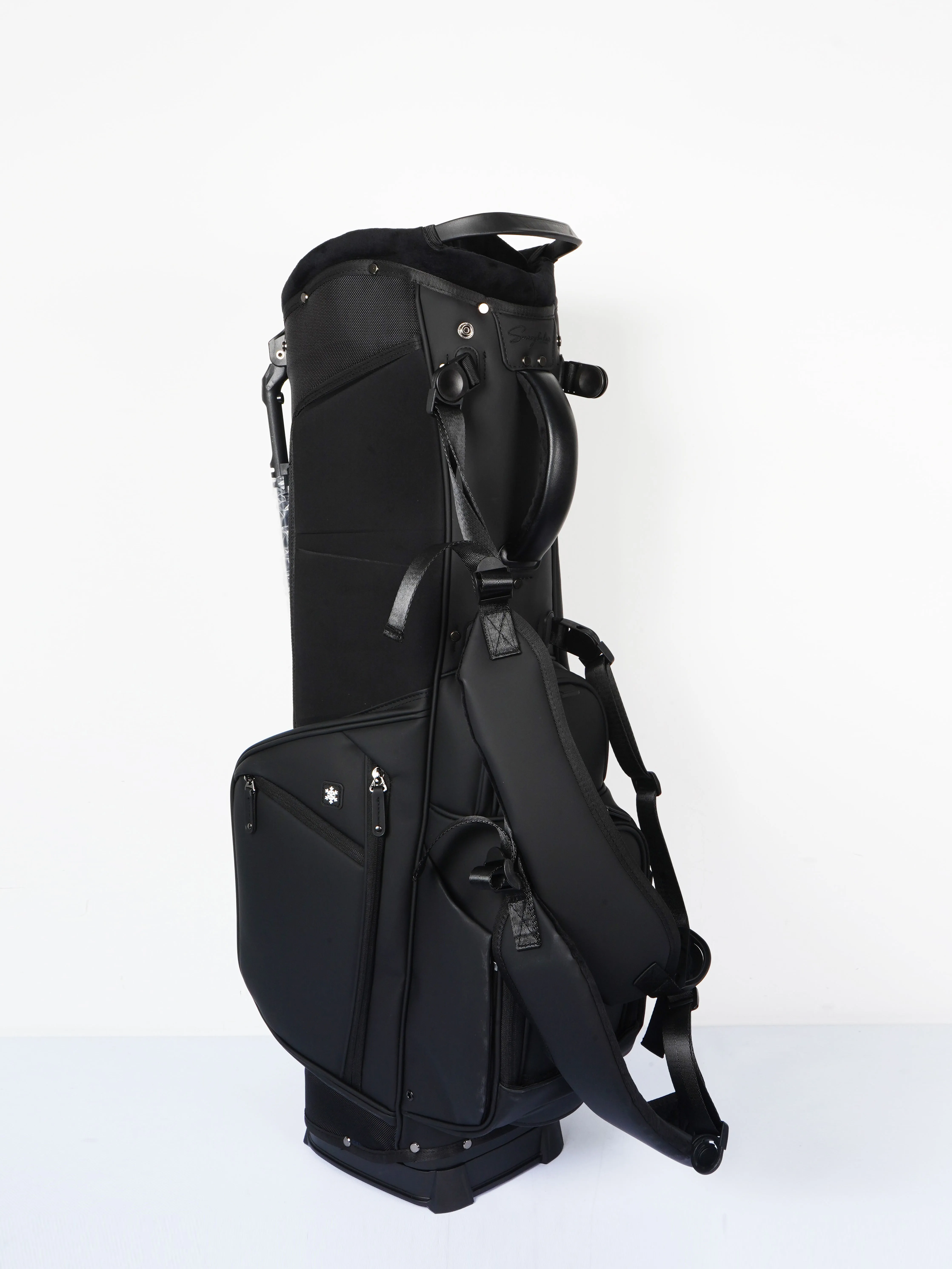
The recipe: muted jewel tones (deep teal, midnight plum, forest) in quality 1680D or hybrid PU; debossed tone-on-tone crest; matte hardware; contrast stitching as the only decoration. Customer: the minimalist professional, premium mid-tier retail (USD 149–199). Cost impact: roughly neutral — budget moves from decoration to materials. The discipline: tone-on-tone lives or dies on fabric quality, and debossing requires PU or coated substrates. The placement guide covers the tonal execution.
Idea 3: Full-Color Pastel Story
The recipe: one pastel (sakura pink, mint, lavender, butter yellow) executed across every surface — body, trim, zipper pulls, lining, stand legs color-dipped to match. Customer: the fastest-growing demographic in golf (women ~28% of US golfers per NGF, under-35 cohorts), the gift market, USD 119–179 retail. Cost impact: +USD 1–2 per bag in matching discipline, +1–2 weeks of lab-dip loop. The whole-bag commitment is the idea — a navy bag with a pink zipper is not a pastel bag. The pastel playbook details the system.
Idea 4: Classic Club-Crest Traditional
The recipe: navy, hunter or black body; cream or gold contrast trim; the club crest embroidered large on the ball pocket; woven labels; no other decoration. Customer: private clubs, member-guest committees, traditional pro shops at USD 99–169. Cost impact: baseline — this is the reference execution. The discipline is restraint: the crest is the design, and everything else serves it. Programs that add patterns, slogans and secondary logos dilute the one thing members actually want — their crest, done beautifully.
Idea 5: Modern Color-Blocking
The recipe: two-tone or three-tone geometric blocking (navy/white/red, black/grey/volt) mapped to the bag's panel structure — never random; blocks follow seams. Customer: athletic-positioned brands, junior and academy programs, team identities at USD 89–149. Cost impact: baseline to +USD 1 (blocking is a cutting-layout decision, not a material one — the panels exist anyway). The 2027 caution from the design forecast: maximal contrast blocking is aging out in favor of restraint — keep blocks large and few.
Idea 6: Camo and Pattern Drops
The recipe: original camo or pattern (USD 300–800 development, no royalty) printed full-body, branding embroidered over-quiet for legibility, numbered hangtags for drop editions. Customer: fashion-forward golfers, outdoor-crossover audiences, DTC drop programs at USD 129–189. Cost impact: +USD 1.50–4.00 per unit in development amortization and print setup. Original beats licensed for most buyers — full exclusivity, no royalty, no approval cycles. The camo playbook covers repeat engineering and drop mechanics.
Idea 7: Character and Kawaii Executions
The recipe: original character (mascot, animal, illustrated friend) applied via print and embroidery, plush companion covers, pastel or candy palettes, charm hardware. Customer: the cute category's documented base — women golfers, junior programs, East Asian markets, gift buyers at USD 99–169 (plush companions at 4× multiples). Cost impact: character development USD 300–800; plush QC adds the needle-detection and fill-weight protocols. Original characters are ownable assets; licensed ones (10–15% royalty) only with proven audience pull. The kawaii analysis has the demand data.
Idea 8: Retro-Vintage Throwback
The recipe: 1970s–90s visual language (retro stripes, period typography, faded-primary palettes) on modern constructions; vintage-style woven patches; antique-finish zippers. Customer: nostalgia-driven golfers, retro-apparel crossover audiences, USD 109–169. Cost impact: baseline materials; the value is design work (period-accurate typography and stripes are a design-team exercise, included at quotation). The caution: retro reads intentional only when executed completely — one vintage stripe on a modern bag reads as a mistake, not a reference.
Idea 9: Premium Hybrid Materials
The recipe: PU showcase panels (ball pocket, spine) on a ballistic body; deboss or metal-plate branding on the PU; the material contrast as the design statement. Customer: premium mid-tier retail (USD 149–229), corporate executive gifting. Cost impact: +USD 4–6 per bag supporting USD 15–25 of retail premium — the material leverage math behind 2027's mid-tier premiumization. The materials matrix prices the combinations and their branding compatibility.
Idea 10: Destination and Travel Themes
The recipe: resort or destination identity executed as travel gear — course-map prints, coordinate embroidery, destination palettes (links-land greens and stone, desert rust, tropical brights); matched travel covers and boston bags completing the system. Customer: resort retail, destination-wedding and buddy-trip markets, USD 99–199. Cost impact: print development USD 300–800 if custom cartography; otherwise baseline. The merchandising multiplier: destination themes merchandise as systems (bag + cover + boston), tripling the basket. The travel guide specs the companion pieces.
Idea 11: Documented Sustainability
The recipe: GRS-certified recycled polyester (certificates travel with the shipment), solution-dyed fabrics, natural-fiber accents (cork trims, cotton webbing), recycled kraft packaging with the story printed inside the lid. Customer: values-led brands, European markets, gift corporate buyers with ESG mandates at USD 119–189. Cost impact: +USD 1.50–3.00 per bag for certified materials. The discipline: documentation or nothing — unverified green claims are 2027 liabilities, and the woven eco-label is the design element, not fine print.
Idea 12: The Numbered Limited Drop
The recipe: one original colorway or pattern, deliberately non-reordered; "1 of 200" numbered hangtags (literally true at MOQ 200); compressed calendar (sampling booked around the drop date); scarcity marketing run by the brand. Customer: DTC audiences, collector communities, resale-aware segments at USD 149–249. Cost impact: +USD 1.50–4.00 per unit in development amortization. The discipline is calendar and restraint — a late drop is not a drop, and a reordered limited edition is a destroyed reputation. The drop-model trend analysis has the sell-through evidence.
Matching Ideas to Channels
The same idea performs differently by channel, and the channel fit is the second filter after the customer fit. Pro shops and green grass: club-crest traditional, heritage canvas, destination themes — channels where trust and membership identity sell. Off-course and big-box retail: pastel stories, modern color-blocking, premium hybrids — channels where the wall photograph and the comparison shop decide. DTC and social-led: camo drops, character executions, numbered limiteds, retro throwbacks — channels where the product must earn its own distribution through photography. Corporate and events: quiet premium, crest traditional, documented sustainability — channels where the gift's message about the giver matters most.
The mismatch pattern to avoid: drop mechanics in channels without scarcity audiences (a numbered limited in a traditional pro shop confuses members), and conservative crests in channels that buy photography (a navy traditional on a DTC Instagram feed disappears). Brief the channel alongside the customer and the direction shortlists itself.
The Cost Map of the Twelve Ideas
Read the map as ROI, not cost: the right-hand column is what the direction supports at retail, and every row returns multiples of its delta. The two free premiums stand out — quiet premium (budget reshuffle, USD 20–40 supported) and color discipline (baseline cost, premium read) — which is why they anchor so many 2027 programs. The development-fee rows (camo, character, destination, drops) amortize at USD 1.50–4.00 per unit across MOQ 200 and become permanent assets at reorder.
| Direction | One-time dev | Per-unit delta | Retail premium supported |
|---|---|---|---|
| Heritage canvas | — | +USD 3–6 | USD 30–80 |
| Quiet premium | — | Neutral | USD 20–40 |
| Full-color pastel | Dip loop | +USD 1–2 | USD 20–40 |
| Club-crest traditional | — | Baseline | Baseline |
| Color-blocking | — | Baseline–1 | Baseline–20 |
| Camo / pattern drop | USD 300–800 | +USD 1.50–4 | USD 30–60 |
| Character / kawaii | USD 300–800 | Plush QC | USD 30–60 + 4× plush |
| Retro throwback | Design work incl. | Baseline | USD 20–40 |
| Premium hybrid | — | +USD 4–6 | USD 15–25 |
| Destination theme | USD 300–800 | Baseline | USD 20–50 |
| Documented sustainability | Certs incl. | +USD 1.50–3 | USD 15–35 |
| Numbered limited drop | USD 300–800 | +USD 1.50–4 | USD 40–80 |
Testing an Idea Before Betting the Line
The test protocol that de-risks any direction: one chassis (the stand bag — the market's volume core, per the stand guide), one colorway, MOQ 200, one selling season. Total exposure USD 5,000–8,000 landed; read sell-through, attach rate and photography engagement; then formalize the winner (seasonal rotations, companion pieces, collection expansion) or retire the loser at known cost. The protocol works because MOQ 200 is both the manufacturing floor and a statistically meaningful retail test.
What to measure beyond sell-through: photography engagement (does the execution earn social distribution — the DTC channels live on this metric), gift versus self purchase split (tells you which channel to scale), and reorder requests from retail partners (the B2B signal that precedes program expansion). The launch guide builds this test into the three-SKU ladder as standard practice.
Design Mistakes That Kill Good Ideas
Five execution failures recur across programs with sound direction choices. Half-committed color: the pastel body with black zippers, the heritage build with nylon webbing — every material break reads as a sourcing accident, and the daylight photo review at sample stage is the catch. Artwork stretched across surfaces: one crest file scaled from ball pocket to den caddie — artwork redraws per size or distorts. Hardware anachronism: bright nickel on quiet premium, plastic pulls on heritage — the detail layer must speak the direction's language, per the 2027 detail discipline. Feature-led dilution: adding pockets and gadgets to a design-led product — the customer buying a pastel story or a heritage romance is not counting pockets. Mood-board drift: the approved sample quietly drifting from the brief across revisions — the sealed sample and archived dips exist to end the argument, per the reorder system.
The pattern beneath all five: ideas die in execution discipline, not in selection. The twelve directions all work; what separates reordered programs from one-season experiments is the unglamorous machinery — dip approvals, redraw discipline, hardware specs, sealed samples — that this site's guides exist to systematize.
From Idea to Spec: the Briefing Template
Every recipe above compresses into the four-sentence brief our design team works from: one, the customer (who buys this and why); two, the direction (name it from this list or describe the reference); three, the constraints (price point, quantity, date); four, the must-haves (crest embroidery, specific palette, matched accessories). Through the quote form, the brief returns as a spec — materials, branding techniques, color standards, itemized pricing — with digital mockups inside a week and a physical sample inside two.
The gallery test before briefing: the gallery shows these directions as executed products. Find the execution closest to your idea, note what you would change, and include that sentence — "like the forest heritage execution, but in oxblood with a quieter crest" is a complete design brief. Junyuan's design team has translated sentences like that into reordered products since 2014.
Frequently Asked Questions
What are the best custom golf bag design ideas for 2027?
Twelve proven directions: heritage waxed canvas, quiet-premium tone-on-tone, full-color pastel stories, classic club-crest traditional, modern color-blocking, original camo and pattern drops, character and kawaii executions, retro-vintage throwbacks, premium hybrid materials, destination themes, documented sustainability, and the numbered limited drop. Each carries reorder evidence from real programs, each is producible at MOQ 200, and each comes with its palette, material, branding and cost recipe in this guide.
How do I choose a design direction for my customer?
Match the direction to the buyer, not your taste: club members want their crest done beautifully (traditional), the women's and under-35 market buys full-color pastel and character executions, minimalists buy quiet premium, fashion audiences buy camo drops and retro throwbacks, resort guests buy destination themes. The four-sentence brief (customer, direction, constraints, must-haves) turns the choice into a spec.
What colors sell best on custom golf bags?
Navy and black remain the volume core; the growth is in full-commitment color stories — pastels (sakura, mint, lavender), muted jewel tones (deep teal, oxblood, forest), and heritage earth palettes. The 2027 discipline: color executed across every surface reads as design confidence; accent-color thinking reads as indecision.
How much does a custom design cost to develop?
Most directions cost nothing beyond the product: color blocking and tonal executions are layout decisions; embroidery digitizing and mockups are included at quotation. Original patterns and characters add USD 300–800 one-time; premium materials add USD 3–6 per bag; pastel matching adds USD 1–2. MOQ stays 200 and sampling stays 6–10 working days across all twelve directions.
Can I mix design ideas into one bag?
One direction per line, executed completely — the discipline that separates collections from noise. Combinations that work as a single identity (quiet premium + hybrid materials; pastel + character; heritage + documented sustainability) are really one direction with a recipe, not two directions competing. Sampling from the whole list on one bag produces clutter.
What design idea works for a golf club or resort?
Club-crest traditional for member programs (navy, cream trim, crest embroidered large — restraint is the design) and destination themes for resort retail (course-map prints, coordinate embroidery, destination palettes, merchandised as bag + travel cover + boston systems). Both are baseline-cost executions with the highest kept-rates in gifting.
What design idea works for a new DTC brand?
The ones with built-in audiences and ownable assets: original camo or pattern drops (full exclusivity, no royalty), character and illustration-led designs (ownable mascots that build recognition equity), or the numbered limited drop (MOQ 200 makes "1 of 200" literally true). All three convert social attention into sellout economics at testable quantities.
How do pastel and cute designs perform commercially?
Structurally, not seasonally: 15–30% retail premiums, 4× multiples on plush companions, and the strongest reorder signal in our 2025–2026 order book — first orders became collections. The demand engine (women ~28% of US golfers, under-35 cohorts growing, East Asian category maturity) is demographic, which is why the kawaii analysis calls it a planogram shift rather than a trend.
What branding technique suits each design idea?
Embroidery for crests, heritage and traditional directions; deboss on PU for quiet premium and hybrid materials; heat transfer and screen print for pastels, camo, characters and destination prints; woven labels as the finishing tier everywhere. The branding-techniques comparison on this site prices each against durability and detail — most directions mix two techniques.
Can design ideas be tested before committing to a full line?
Yes — MOQ 200 is the test: one colorway or direction, USD 5,000–8,000 landed for a stand-bag execution, sell-through read in one season. Digital mockups arrive inside a week at quotation stage; the physical sample inside two weeks. Test the direction, then formalize the winner into seasonal rotations and collections.
What makes a custom golf bag design look cheap?
Five tells: accent-color half-measures (a pink zipper on navy), shrunken branding suites on small surfaces, bright-nickel hardware on premium builds, random color-blocking that ignores panel seams, and tone-on-tone executed on low-quality fabric (cheap base reads cheap twice). The fix in every case is commitment — one direction, executed completely.
How do I brief a custom golf bag design?
Four sentences through the quote form on this site: the customer, the direction (named from this list or referenced from the gallery), the constraints (price, quantity, date), and the must-haves. The design team returns mockups inside a week and the quotation with materials and techniques priced; a physical sample follows inside two.
Which design idea has the lowest execution risk?
Club-crest traditional and quiet premium: baseline cost, no development fees, no licensing, no matching loops — and both read as premium when the underlying fabric and stitching are quality. They are the default recommendations for first-time programs and corporate buyers; the bolder directions (camo, character, drops) reward programs with proven audiences and photography-led channels.
Can I get design help if I only have a rough idea?
Yes — that is the normal starting point. A reference photo, a competitor's bag you admire, a palette from your brand guide, or one sentence ("heritage but lighter", "pastel but club-safe") is enough: the design team translates it into a full spec with digital mockups inside a week at quotation stage, free of charge, and a physical sample inside two weeks if you proceed. The twelve directions in this article work as a shared vocabulary — naming the closest one halves the briefing loop.