
How a Factory Builds a Golf Bag Price
Every FOB quotation is five stacks: bill of materials (35–50% of price), direct labor (18–28%), decoration and trims (8–15%), overhead allocation (10–15%), and margin (8–12%). Knowing the stack you are pulling from is the whole game.
A custom stand bag quoted at USD 29.57 FOB Xiamen is not one number — it is a ledger. Body fabric and frame, divider set, strap system, hardware and zippers, lining: roughly 42% of it. Sewing and assembly labor at piece rates: about 24%. Your embroidery, woven labels and printing: 11%. The factory's machine depreciation, QC staff, building and power apportioned per unit: 12%. Margin: the rest. When you negotiate, you are always pulling one of these five levers, and a factory that agrees to 'just make it cheaper' without a spec change is pulling from the only stack with give — the materials — silently.
This anatomy is why the 2026 cost guide publishes the stacks instead of single totals. Buyers who see the stacks make one strong ask instead of five weak ones; buyers who do not, make the same ask five times and get a smile. The honest factory position is symmetric: we can show you where every dollar of the 29.57 sits, because a quotation we can defend is a quotation we can hold through a reorder.
Anatomy of a Quotation: the FOB Line by Line
A program-grade quotation is itemized or it is fiction. The columns that matter: unit price by quantity tier (200 / 500 / 1,000 / 2,500), the spec sheet it prices (fabric denier and backing, foam type, divider count, strap tier, hardware finish), decoration priced per position with stitch-count assumptions, packaging level per unit, and the commercial terms — Incoterm under Incoterms 2020 (ICC publication 723), payment (T/T 30% deposit, 70% against documents is the category standard), validity window (30 days is honest; 90 means the factory is hedging cotton), and what the sample costs and how it credits against the first order.
Three quotation habits predict the relationship. A quote with one total and no tiers hides where the volume breakpoints are. A quote whose validity is 'subject to confirmation' prices the factory's fear, not your bag. A quote that prices the sample at zero hides it inside a padded unit price — you will pay for it twice at 200 units. We quote all three honestly: tiers, 30-day validity, sample fee credited in full at first production. The sample guide shows why the credit structure is fair to both sides.
| Quotation Element | Honest Form | Warning Form |
|---|---|---|
| Price | Tiered by 200/500/1K/2.5K | One number, no tiers |
| Spec | Denier, foam, dividers, strap tier named | "Same as sample" without spec sheet |
| Decoration | Per position, stitch count assumed | Lump sum "branding included" |
| Validity | 30 days, dated | "Subject to confirmation" |
| Sample | Fee stated, credited at first PO | "Free" (padded into unit price) |
The Levers That Genuinely Move Unit Price
Six levers, in descending order of power per ask: quantity tier (the biggest — moving from 200 to 500 units typically opens 8–12% because setup costs amortize), material substitution (5–10% when you swap inside a performance family, more when you drop a tier), decoration count (3–8% — every removed position saves labor, materials and a QC checkpoint), packaging level (2–6% — polybag vs printed boxes vs kitted retail sets), lead time (2–5% — a factory prices rush compression as overtime), and payment structure (1–3% — cash speed is worth a small real discount). Every honest negotiation moves one or two of these and names them.
The seventh 'lever' — asking for the same spec at a lower number — moves nothing; it only relocates cost. A factory that says yes to it has chosen between thinner lining, lighter webbing, fewer stitches per centimeter and a skipped mid-line inspection, and you will meet the choice at the season's far end, in returns. The three sections after this one cover the legitimate big levers in turn; the red-lines section covers what never gets traded.
Tier Jumping: How Quantity Brackets Really Work
Factories do not price 437 units smoothly — they price the bracket you occupy, because setup costs (pattern work, cutting layouts, embroidery digitizing, line changeover) amortize in steps. The honest brackets: 200–299, 300–499, 500–999, 1,000–2,499, 2,500+. The 500 tier is usually the sweet spot for first orders: setup amortizes across enough units that the per-unit saving (typically 8–12% against the 200 tier) is real, without the inventory risk of four-digit commitments on an unproven product.
Two tier tactics that work honestly. The step order: quote 200 and 500, then order 500 if the bracket saving clears the extra inventory's carrying cost — at a USD 2.80 saving on a USD 28 bag, 300 extra units pay their own way in one reorder you were going to make anyway. The split PO: 500 units with a documented option for +500 at the same tier inside 90 days, exercised by production slot rather than calendar — factories can often grant the tier pricing on the option because the pattern work is already amortized. Both tactics appear in the PO as written commitments, which is the point: a tier jump is a promise with a number attached, and it prices better than a hope.
Material Substitution Without Downgrades
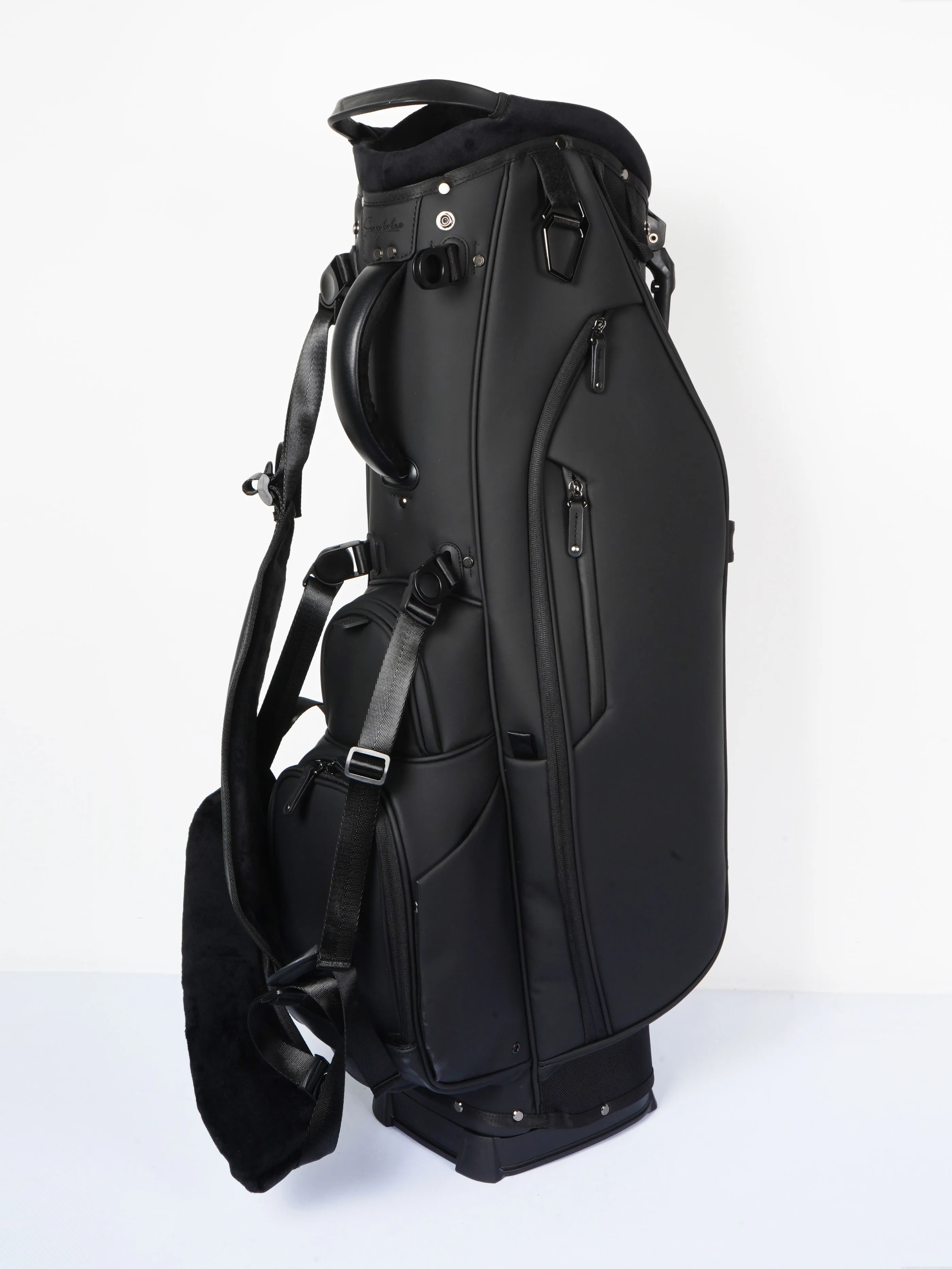
The honest material lever swaps inside a performance family, never down a customer-visible tier. Working examples from 2026 quotations: 1680D ballistic to 900D double-PVC backing saves USD 1.40–2.20 per stand bag with the same hydrostatic head and most of the abrasion life; molded EVA dividers to high-impact PE board saves USD 0.60–1.10 with identical perceived quality (invisible inside the bag); metal zipper heads to nylon-coiled with metal-effect pulls saves USD 0.30–0.50 and the customer never touches the difference. These three swaps alone commonly move a quotation 5–8% with no marketing consequence.
The dishonest version swaps what the customer feels: lining denier down 30%, webbing from seatbelt weave to flat polypropylene, foam density from 45 to 28 kg/m³. The savings are similar and the consequence is a product that reads cheaper in hand at exactly the moment of evaluation — the retail shelf or the corporate unboxing. The rule we quote by: substitution is allowed where the spec sheet stays true and the customer's hand stays impressed; every swap outside that rule is a discount you pay for later, with interest.
The Three Lines You Never Cross
Three cost lines never enter a negotiation at our quotation desk, and we tell buyers which lines they are before they ask. Line one: QC sampling under AQL 2.5 (ISO 2859-1). Cutting inspection from a 500-unit lot saves about USD 0.35 per unit — and 30 skipped checkpoints are where a 2% defect rate becomes a 12% one. Line two: structural seams. The base attachment, the strap anchors and the top-cuff seam carry the product's safety load; reducing stitch density or seam width there saves dimes and returns whole batches. Line three: anything the customer touches in the first ten seconds — zipper feel, handle grip, lining hand, hardware finish.
Why publish the red lines instead of hiding them? Because a buyer who knows where give ends stops digging for it, and the negotiation moves to the real levers — tiers, swaps, decoration — where both sides win. A factory's red lines are its quality policy wearing a commercial hat. The AQL guide gives buyers the inspection tables to write into any PO so line one is contractually protected, not just promised.
Lead Time as Currency
Time is a priced input. Standard bulk runs 35–50 days from approved sample to inspected goods; a 30-day compression requires overtime or line priority and prices 2–5% higher honestly; a 21-day compression requires re-cutting the schedule around your order and prices as a rush premium of 8–15% plus possible expedited freight. The mirror lever works too: a buyer with calendar flexibility — accepting production in the factory's quieter slot rather than peak season — can earn 2–3% for patience, because the factory is buying schedule smoothness, which is a real cost it will share.
The honest move is to state the real deadline and let the factory price it. Buyers who fake urgency ('we need it in three weeks' for a date six weeks out) get rush pricing quoted back and then discover the 'discount' for delivery-on-time-because-it-was-never-tight was never available — trust in stated dates is itself a commercial term. State the event date, the buffer you actually need, and let the timeline guide's milestones frame the conversation.
The 30/70 Lever: Trading Cash Speed for Price
Payment terms are the quietest real lever. The category standard is T/T 30% deposit, 70% against shipping documents after inspection; it balances the buyer's protection (nothing final until goods are inspected and en route) with the factory's cash cycle (materials bought against deposit, labor financed against the balance). A buyer offering faster balance settlement — 70% against the B/L copy rather than 30 days after arrival, or an L/C at sight for large programs — is genuinely worth 1–3% to the factory, because it prices the factory's working capital cost, and a portion of that value comes back in unit price.
The reverse is also true and less discussed: stretched payment terms (60–90 day balances) are a loan the factory extends, and honest factories price it — either visibly as a terms surcharge, or invisibly in unit price. Programs that need extended terms should negotiate them openly as a financing decision with a stated cost, not pretend the money is free. Our desk quotes both structures side by side when asked: 30/70 at the standard price, 30-day terms at the surcharge price. The transparency costs nothing and prevents the slow sourness of an unpriced favor.
Annual Commitments, Rebates and Price Locks
Beyond the single PO, three structures move money honestly. The annual volume commitment: '2,000 units across the year, shipped in four releases, priced at the 2,000 tier' — the factory gains planning certainty and the buyer gains tier pricing at 500-unit releases, a genuine 5–8% advantage over release-by-release quoting. The volume rebate: a stated 1.5–2.5% rebate on the year's invoiced value if the committed total ships, paid at year end — it aligns both sides on the same number. The price lock: agreed validity on a specification, typically 6–12 months with cotton and hardware indexes as the only re-opening clauses — because a factory that cannot buy its inputs at the quoted price cannot honor the quote, and a lock without index clauses is a promise one side must break.
The structure that beats them all for stable programs is the program PO: a running order with a fixed specification, tiered pricing, a release schedule and reorder pricing pre-agreed. The reorder guide covers why the second order is where programs actually make money; the commercial version of that truth is that reorder pricing agreed in advance is worth more than any single-PO discount negotiated twice.
Currency, Tariff and Adjustment Clauses
Two external numbers sit inside every cross-border quotation and a professional PO addresses both. Currency: quotations in USD (the category default) hold; quotations that a buyer insists on in RMB or EUR carry the factory's hedge, visible or not. Adjustment clauses: a 12-month price lock that names its re-opening triggers — cotton index moves beyond ±10%, hardware or zipper commodity swings, or a change in US tariff treatment — protects both sides from breaking a promise the market broke first. The US tariff line for this category is HTS 4202.92 (17.6% as of 2026); tariff changes are the one clause no factory can absorb, and an honest PO says so explicitly rather than discovering it in a dispute.
The buyer's own landed-cost math uses the same numbers: FOB plus freight, plus duty at the HTS rate, plus inland — the cost guide walks three full worked examples. The negotiation point is narrower: agree which external numbers each side carries. Factory carries fabric and labor; buyer carries freight, duty and their market's retail weather; both carry the risk they priced. That division, written down, is what separates a program from a transaction.
Red Flags That a Price Is Too Low
A quotation 25–40% below the market band is not a find; it is a plan to recover the difference somewhere you will not see it. The recovery menu is short and reliable: fabric denier quietly dropped one grade, foam density halved, stitching counts reduced on load-bearing seams, the 'free' sample padded into unit price twice, mid-line inspection skipped entirely (AQL only at final, or not at all), or the classic — a real first order at the quoted price, then a reorder 15% higher 'because of material costs'. Any one of these recovers more than the discount gave.
Three verification moves before believing a low number, all cheap. Ask for the itemized stack — a real quotation shows BOM, labor, decoration and overhead lines, and a fake one quotes a total with a smile. Ask which QC standard the price includes — AQL 2.5 with a 40-point checklist is a cost line, and its absence from the quote is the tell. And ask for the tier table — a factory with real tiers has real setup-cost math, and one without tiers is pricing by eye, which means your reorder is priced by mood. The manufacturer checklist packages these asks into a supplier evaluation; the low price that survives all three is rare and worth signing fast.
Negotiating With Chinese Factories: the Etiquette
The commercial culture is high-context and long-memory, and it prices behavior. The moves that work: bring volume and calendar honesty (the two things a factory can actually plan), negotiate one or two real levers rather than five small ones (which reads as either unserious or exhausting), let the factory propose the structure (a factory that structures the deal defends the deal), and close small before closing big — a 200-unit first PO executed cleanly buys more pricing flexibility than any negotiation technique at the second PO. The moves that backfire: public ultimatums, renegotiating after agreement, quoting a competitor's price as leverage without being willing to sign it, and the western habit of 'test low, expecting to move' — it reads as bad faith and prices your next three quotations.
One structural fact sets the tone: the factory's margin band at program volumes (8–12%) is thinner than most buyers assume, and the honest response to 'sharpen your pencil' is the cost stack, not a discount. A buyer who negotiates the stack — tiers, swaps, decoration, packaging — exits with a durable number and a factory that answers emails. The relationship premium is real and compounding: priority in the production schedule, attention in the sample room, and reorder pricing quoted before the market moves are all quietly allocated to the buyers who negotiated honestly the first time.
When to Walk Away From a Deal
Four situations end negotiations honestly. The spec you want cannot be made at the price you have: walk rather than accept the silent downgrade, because the downgrade ships to your customers. The factory will not itemize: walk, because you cannot verify what you cannot see, and unverified savings are deferred defects. The red lines are for sale: a factory offering to skip AQL inspection for USD 0.35 per unit is showing you how it treats every other promise too. And the schedule math is fiction: a 25-day bulk promise on a 35–50-day process is not optimism, it is a different product arriving late — the timeline guide gives the honest calendar.
Walking away professionally is not a burned bridge — a written 'the spec exceeds our budget at this volume; we will return at 1,000 units' keeps the door priced and open. Factories remember good walkaways as seriousness. The deal that survives is the one where both sides can show their math, and the walk that pays is the one that comes back with volume.
Writing the Price Into the PO
Everything negotiated collapses into four PO clauses, and the clause list is the last negotiation: tier and price per unit with validity dates; the specification sheet with revision number, attached as an exhibit (the price is only valid for that revision); the quality terms — AQL 2.5 per ISO 2859-1, the inspection checklist, third-party inspection rights before shipment; and the commercial terms — Incoterm, payment structure, sample credit, reorder pricing if agreed, and the adjustment clauses for cotton and tariff. A PO with those four exhibits is a program; a PO with a total and a date is a conversation someone will remember differently.
The discipline that makes the price durable is change control: every post-PO change (a color, a pocket, a label) priced as a written revision before work starts. The reorder guide covers the engineering side of staying consistent; change control is its commercial twin. Programs that run change control quote their reorders in minutes; programs that run on goodwill re-negotiate their reorders every time, and goodwill is not a currency at volume.
Starting a Negotiated Program
Send four decisions and receive an itemized, tiered quotation inside two working days: product and spec tier, target quantity, decoration plan, and your real deadline.
The strongest opening brief is short: the product (stand, cart, staff, travel — the design guide if the direction is open), the quantity you can honestly commit, the decoration plan, and the true deadline. The quotation returns itemized by tier with the sample fee and credit structure, AQL terms and a 30-day validity — the same anatomy this article teaches you to read. Then negotiate the one or two real levers: the tier jump, the material family, the decoration count.
Junyuan has quoted and held export program pricing since 2014 — tiered, itemized, with the red lines published on the first page. Four sentences through the quote form start the process; the anatomy you read here is the anatomy the quotation will arrive in.
Frequently Asked Questions
How much can I negotiate off a custom golf bag quote?
Honestly: 8–12% by moving the quantity tier (200 to 500 units), another 5–8% through inside-family material substitution, and 3–8% by reducing decoration positions — with packaging and lead-time flexibility worth 2–6% more. Those spec levers total a legitimate 15–25% between a padded first draft and a tightened program. Pushing the same spec for a lower number moves nothing except which corners get cut silently.
Do factories quote different prices for 200 vs 500 units?
Yes — setup costs (patterns, digitizing, cutting layouts, line changeover) amortize in brackets, so 500 units typically prices 8–12% below 200, and 1,000 another 5–8% below that. Ask for the tier table; a factory with real tiers has real setup math, and it shows you where your volume sits. The 500 tier is the classic first-order sweet spot: real savings without four-digit inventory risk.
What should a golf bag quotation include?
Five elements, itemized: unit price by quantity tier (200/500/1,000/2,500), the full specification sheet it prices, decoration priced per position, packaging level per unit, and commercial terms — Incoterm, T/T 30/70 payment, dated validity (30 days is honest), and the sample fee with its first-order credit. A quotation missing the tiers or the spec sheet is a number, not a quotation.
Is it rude to negotiate with Chinese manufacturers?
Negotiating is expected; haggling theatrics are priced. The moves that work: state honest volume and real deadlines, negotiate one or two real levers (tier, material, decoration) rather than five small ones, let the factory propose structure, and execute the first PO cleanly — performance buys more pricing flexibility at the reorder than any technique at the first table. Public ultimatums and post-agreement renegotiation backfire and stay in the memory.
Why did my reorder price go up after the first order?
Three honest causes: the first price was a new-customer or market-testing price without foundation; cotton, hardware or tariff indexes moved (see your PO's adjustment clauses); or the spec drifted between orders without change control. The dishonest cause: no cause was ever written down. The cure is the same — reorder pricing agreed in the first PO, with a specification revision attached. The reorder guide covers the engineering side.
Should I ask for free samples before committing?
Ask for a priced sample with a written credit — it is the structure that respects both sides. 'Free' samples are padded into unit prices (you pay for the sample twice at 200 units), and a sample fee fully credited at the first production order makes the sample free only if you proceed. Expect USD 80–180 including courier for a decorated stand-bag sample; production-grade samples with artwork are real work, not brochures.
Can I get a lower price by paying faster?
Yes — payment structure is a real lever worth 1–3%. The category standard T/T 30/70 prices the factory's cash cycle; offering 70% against B/L copy instead of against arrival, or an L/C at sight on large programs, genuinely reduces the factory's working capital cost, and part of that value returns in unit price. The mirror also prices: 60–90 day balances are a loan the factory will charge for, visibly or invisibly — negotiate financing openly as financing.
What payment terms are standard for custom golf bag orders?
T/T 30% deposit, 70% balance against shipping documents after passed inspection — the category's balance between buyer protection and factory cash cycle. Large programs sometimes run L/C at sight; long-term partners graduate to 30/70 with the balance at B/L copy or monthly settlement. Whatever the structure, the inspection-before-balance sequencing is the part that protects you: nothing final ships unexamined.
How do I know if a golf bag factory quote is too good to be true?
Run the three cheap verifications: ask for the itemized cost stack (real quotations show BOM, labor, decoration, overhead lines), ask which AQL standard the price includes (2.5 with a written checklist is a cost line; its absence is the tell), and ask for the tier table (no tiers means pricing by eye). A quote 25–40% under the market band that survives all three is rare and worth signing immediately; one that fails any is a plan to recover the difference in your blind spots.
What does FOB price include and not include?
FOB (Incoterms 2020) includes the finished goods, export packaging and delivery onto the vessel at the named port — Xiamen for our programs — with export clearance. It excludes ocean freight, destination duty (US HTS 4202.92 at 17.6% as of 2026), inland delivery and insurance, which the buyer carries; CIF adds freight and insurance; DDP delivers duty-paid to your door at a price that transparently bundles all of it. The buyer's landed-cost math is FOB plus those extras — the cost guide works three full examples.
Can I lock prices for a full year?
Yes, with the honest structure: a 6–12 month price lock on a frozen specification revision, with re-opening clauses only for cotton index moves beyond ±10%, hardware commodity swings, or tariff changes. The lock is a promise the market can break, so the clauses protect both sides from breaking it at each other. Annual volume commitments (2,000+ units across scheduled releases) earn the top tier pricing at each release — the structure that beats negotiating every PO twice.
Should I negotiate with multiple factories at once?
Compare quotes, yes — three quotations on the same spec sheet teach you the market band in a week. But shopping one factory's number to another as public leverage backfires: factories price the buyer's behavior, and 'will sign for less elsewhere' without signing reads as bad faith. The professional pattern is parallel evaluation, then serious negotiation with the chosen one — the manufacturer checklist gives the evaluation dimensions.
How do I start a negotiated golf bag program?
Four sentences through the quote form on this site: product and spec tier, the quantity you can honestly commit, decoration plan, and true deadline. The itemized, tiered quotation returns inside two working days with the red lines published — then negotiate the real levers: tier jump, material family, decoration count. Junyuan has quoted and held export pricing since 2014; the anatomy in this article is the anatomy the quotation arrives in.