
- Use a pre-production checklist to reduce late-stage changes.
- Specify tolerances and inspection criteria so bulk output matches the approved sample.
- Define a QC test plan (cycle/pull/abrasion) instead of relying on visual checks.
- Document revisions with photos and a defect taxonomy for faster corrections.
- Plan packaging early to prevent transit damage and returns.
- Turn “nice-to-have” ideas into measurable requirements before sampling.
- Lock logo method by panel material to avoid rework and distortion.
- Protect reorders with material lot continuity and BOM discipline.
Executive summary
This article turns How to Build a QC Checklist for Contract Manufacturing into a procurement-ready manufacturing brief for Stand Golf Bags programs targeting USA. It is written for B2B buyers using a Private Label sourcing model.
It goes beyond generic “tips” by defining measurable requirements, acceptance criteria, and QC gates—so your approved sample and bulk production match.
Scope and audience
Use this guide if you are building an RFQ, reviewing a sample, or setting QC standards for bulk production. If you already have a complete tech pack, treat the checklists below as a gap audit.
Market differences usually show up in labeling expectations, packaging requirements, and compliance screening priorities. Confirm final compliance details with your own compliance team for your channel.
Engineering focus
Stand Golf Bags programs succeed when engineering decisions match real use: load paths, wear zones, and pocket geometry. These are the typical focus points for this category.
- Stand system angles and leg stability
- Dual-strap comfort and balance
- Base plate durability and noise control
- Leg wobble from loose hub tolerance
- Base plate cracking from thin material
- Strap anchor pull-out from weak reinforcement
Specification checklist
This is the minimum checklist that turns “premium” into buildable parameters and keeps revision cycles under control.
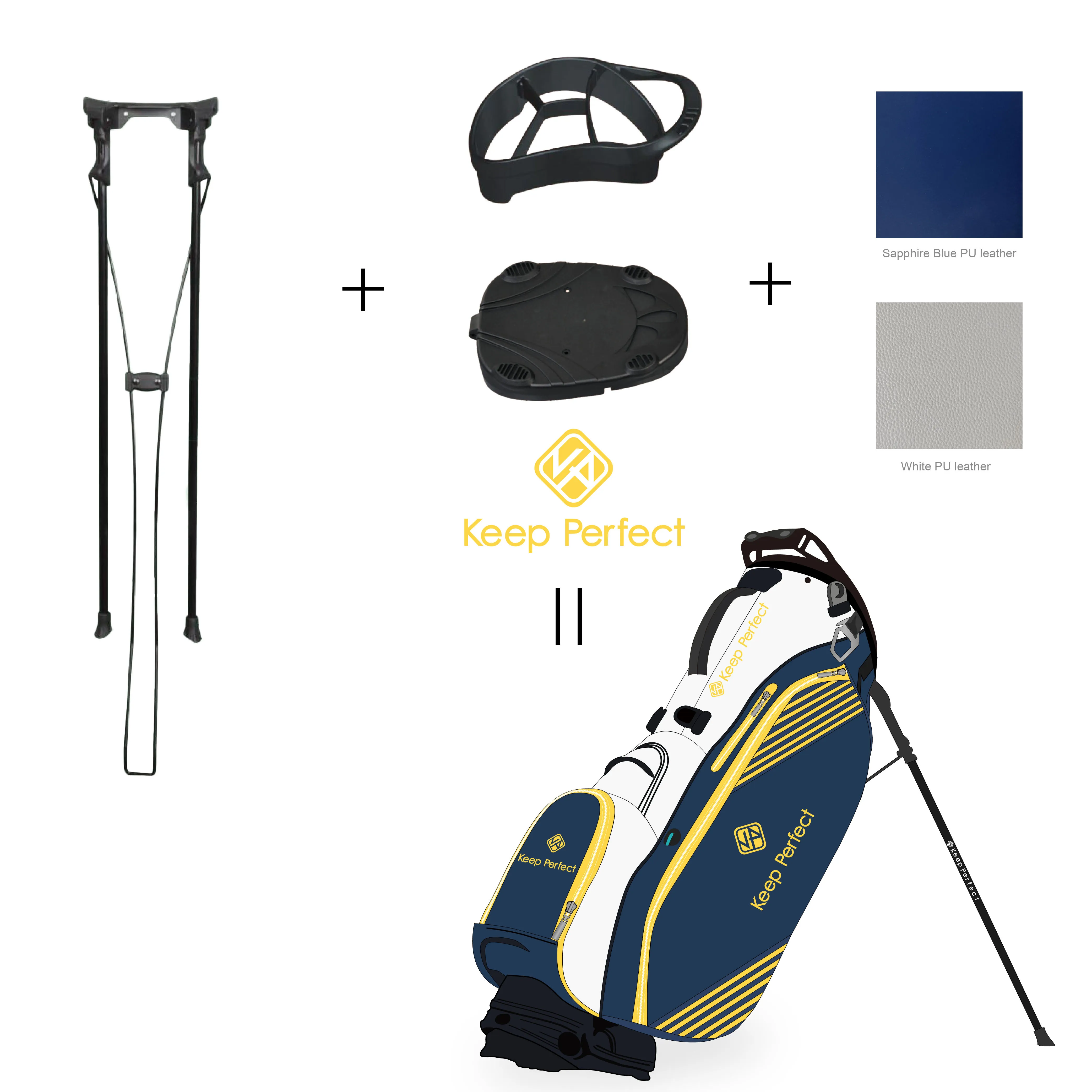
- Weight target and structure targets (foam, stays, base plate)
- Material spec by panel + reinforcement zones
- Strap geometry and carry comfort target
- Pocket list with dimensions + intent (rangefinder, apparel, valuables)
- Hardware finish requirements (corrosion expectations)
- Top opening size and divider format
- Packaging spec (polybag, hangtag, inserts, carton label)
- Color references (Pantone) + acceptable delta tolerance
- Stand/cart compatibility requirements (if applicable)
- Logo placements (location, size, method) + artwork files
Specification baseline
Baselines align teams quickly. Lock final values in sample approval to prevent rework and late-stage changes.
| Parameter | Baseline | Why it matters | Common mistake |
|---|---|---|---|
| MOQ baseline | MOQ baseline: 300 pcs / style | Start smaller with fewer colorways to protect consistency. | Mixing many materials at low volume increases variation. |
| Sampling timeline | Sampling: 10–18 days (typical 2–3 rounds) | Expect multiple iterations for fit + branding. | Approving without a checklist creates rework later. |
| Bulk lead time | Bulk production: 45–75 days (depends on materials and capacity) | Lead time depends on materials and capacity planning. | Ignoring peak season buffers risks delivery slip. |
| Final inspection | Final inspection: AQL 2.5 (defined defect taxonomy required) | Define defect taxonomy so checks are consistent. | AQL without defect definitions is not actionable. |
Materials and trims
Perceived quality is built from touchpoints: handles, zipper pulls, pocket edges, and reinforcement zones. Consistency across these areas matters more than a single “hero” material.
| Option | Material / component | Selection note |
|---|---|---|
| Option 1 | PVC-Free Coatings (Water & Stain Resistance) | Good balance of durability and consistent appearance. |
| Option 2 | PU Microfiber (Consistent Grain + Easy Care) | Best when you need stable color across repeat orders. |
| Option 3 | RPET Fabrics (Recycled Content Lines) | Consider for sustainability lines with documentation. |
| Option 4 | TPU Films (Welded Pocket Windows & Details) | Best when you need stable color across repeat orders. |
| Option 5 | 420D/840D Nylon (High Abrasion Grades) | Useful for abrasion zones and high-touch points. |
Quality plan
AQL becomes meaningful only when paired with defect definitions and a test plan. Use the table below to define what you accept and how you verify it.
| Check / test | Target | Practical guidance |
|---|---|---|
| Zipper cycle test | Target cycles + smoothness | Run cycles on representative pocket angles and curvature. |
| Pull test (handles/strap anchors) | Defined pull force + duration | Validate reinforcement layers and stitch density at stress points. |
| Abrasion test (high-wear zones) | Defined cycles + appearance criteria | Focus on base, pocket corners, and cart-contact areas. |
| Measurement sampling | Tolerances by key dimensions | Top opening, pocket sizes, and overall height are common disputes. |
| Visual + functional check | Appearance + pocket function | Confirm magnets/closures, stand system behavior, and rattle control. |
Final inspection: AQL 2.5 (defined defect taxonomy required) is recommended only when you have defined defect taxonomy and aligned checkpoints across incoming / in-line / final inspection.
| Defect category | Examples | How to make it actionable |
|---|---|---|
| Appearance | Stains, wrinkles, logo misalignment, print distortion | Define “acceptable vs unacceptable” with photos. |
| Function | Zipper snagging, pocket access issues, stand/cart fit failures | Verify using real-use scenarios (cart strap on, clubs loaded). |
| Measurements | Top opening, pocket dimensions, overall height | Define tolerance for each key dimension. |
| Construction | Loose stitching, reinforcement missing, hardware pull-out | Focus on stress-point reinforcement and stitch density. |
| Packaging | Carton crush, missing labels, damaged trim | Lock packaging spec and verify cartons before release. |
Timeline and milestones
Most delays come from late requirement changes. A professional timeline uses milestones that lock parameters before bulk production starts.
RFQ template
Copy/paste this into an email to receive a quote that matches the final build:
- Category: Stand Golf Bags (topic: How to Build a QC Checklist for Contract Manufacturing)
- Intent: Private Label · Target market: USA
- MOQ baseline: 300 pcs / style
- Target quantity + colorways (start with fewer for consistency)
- Reference images + must-have features
- Branding: placements, methods, and artwork files
- Material preferences + Pantone references (if known)
- Packaging requirements + labeling expectations
- Timeline + preferred Incoterms (FOB/CIF/DDP)
Industry Insights and Market Trends for Stand Golf Bags
The global custom golf bag market has experienced steady growth, with the total addressable market valued at approximately USD 2.1 billion in 2024 and projected to reach USD 3.2 billion by 2030, growing at a CAGR of 7.2 percent. This growth is driven by increasing golf participation in emerging markets, rising demand for personalized equipment among amateur players, and the expansion of golf tourism in regions like the Middle East and Southeast Asia.
For Stand Golf Bags specifically, several trends are shaping procurement decisions. First, sustainability requirements have intensified: over 60 percent of European brand owners now request recycled or RPET materials as a baseline specification. Second, the shift toward direct-to-consumer models means smaller batch sizes with more SKU variations, pushing manufacturers to offer flexible MOQ structures. Third, customization expectations have evolved from simple logo embroidery to full-panel sublimation, mixed-material constructions, and integrated technology pockets for rangefinders and GPS devices.
In the USA market, demand patterns differ notably from other regions. Buyers in USA tend to prioritize premium finish quality, consistent color matching across production runs, and compliance with local labeling regulations. Brand owners targeting this market should plan for additional pre-production validation steps and budget for higher inspection standards. According to industry data, Stand Golf Bags orders for the USA market show a 15 to 20 percent price premium over standard specifications due to these elevated requirements.
Manufacturing capacity in China remains the dominant supply base for custom golf bags globally. Facilities like Junyuan Bags, established in 2004 with over 15,000 square meters of production space and 8 dedicated assembly lines, demonstrate the scale available to serious buyers. Annual capacity exceeding 200,000 units across multiple bag categories means that even large programs can be accommodated without capacity constraints. For buyers exploring custom golf bag manufacturing in China, understanding these capacity dynamics helps in planning realistic timelines.
Step-by-Step Guide: Implementing How To Build A Qc Checklist For Contract Manufacturing in Your Procurement Process
Implementing effective how to build a qc checklist for contract manufacturing practices requires a systematic approach. Below is a step-by-step framework used by professional procurement teams managing Stand Golf Bags programs from Chinese manufacturers.
Step 1: Define Your Requirements Document
Before contacting any manufacturer, prepare a detailed requirements document that covers: bag category (Stand Golf Bags), target quantity per SKU, target market (USA), branding specifications including logo method and placement, material preferences with Pantone references, and packaging requirements. This document becomes the foundation for accurate quoting and reduces revision cycles by up to 40 percent.
Step 2: Request and Compare Samples
Send your requirements to at least two qualified manufacturers and request samples with a structured evaluation checklist. For Stand Golf Bags, critical evaluation points include panel construction quality, zipper smoothness and alignment, reinforcement at stress points, stand system integration (where applicable), and branding execution accuracy. Allow 10 to 18 days per sampling round, and plan for 2 to 3 rounds before final approval.
Step 3: Lock Specifications with a Pre-Production Meeting
Once the sample is approved, hold a formal pre-production meeting (virtual or on-site) to lock every specification: bill of materials, color tolerances with delta-E values, logo placement coordinates, stitching density requirements, and inspection criteria. Document everything with photographs and written sign-off from both parties. This step prevents the most common cause of bulk production disputes.
Step 4: Establish In-Line Quality Checkpoints
During bulk production, schedule in-line inspections at three critical stages: after cutting and marking (verify panel dimensions and material correctness), after assembly but before closing (check internal construction, reinforcement placement, and pocket alignment), and after finishing (test zippers, closures, and overall appearance). Each checkpoint should reference the locked specifications from Step 3.
Step 5: Final Inspection and Release
Conduct a final inspection using AQL 2.5 standards with a pre-agreed defect taxonomy. Test a statistically valid sample from each production lot. Verify packaging integrity, labeling accuracy, and shipping mark compliance before authorizing release. For Stand Golf Bags programs targeting USA, include market-specific compliance checks at this stage.
Following this structured process reduces defects, prevents costly rework, and builds a productive long-term relationship with your manufacturing partner. For additional guidance on managing the full manufacturing lifecycle, explore the complete custom golf bag manufacturing guide.
Common Mistakes to Avoid When Sourcing Stand Golf Bags
After reviewing hundreds of Stand Golf Bags procurement programs, several recurring mistakes consistently cause delays, cost overruns, and quality disputes. Understanding these pitfalls helps buyers avoid expensive lessons.
Mistake 1: Insufficient Specification Detail at RFQ Stage
The single most costly mistake is sending vague RFQs that lack measurable specifications. Requests like "premium quality" or "good materials" mean nothing without defined parameters. Instead, specify exact denier ratings for fabrics, foam thickness and density for padding, zipper brand and gauge, and acceptable color delta values. A well-prepared RFQ reduces sampling rounds from 3 or 4 down to 1 or 2, saving weeks of lead time and thousands of dollars in sample costs.
Mistake 2: Approving Samples Without a Checklist
Many buyers approve samples based on visual inspection alone, without systematically testing every functional element. For Stand Golf Bags, this means you must verify: all zipper cycles under load, stand mechanism deployment and retraction (if applicable), pocket access with actual golf equipment, strap comfort under weight, and base plate stability. A structured sample approval checklist catches issues that casual inspection misses.
Mistake 3: Ignoring Material Lot Continuity
When reordering Stand Golf Bags, material lot variation is the primary cause of "it looked different last time" complaints. Colors shift between dye lots, fabric hand-feel varies between production runs, and hardware finishes can differ between supplier batches. The solution is to lock material lot numbers during initial approval and require the factory to reserve matching lots for reorder programs, or to define acceptable visual deviation ranges with signed reference samples.
Mistake 4: Underestimating Packaging Requirements
Golf bags are large, structured items that face significant transit stress during international shipping. Skipping proper packaging specifications leads to crushed cartons, scuffed panels, and compressed foam that never recovers. Specify poly bag individual wrapping, foam or cardboard inserts for structure protection, and carton burst strength ratings appropriate for your shipping mode. For USA market shipments, factor in humidity considerations that may require additional moisture barriers.
Mistake 5: Treating QC as an Afterthought
Quality control cannot be bolted on at the end of production. Effective QC for Stand Golf Bags starts at incoming material inspection, continues through in-line checkpoints at critical assembly stages, and culminates in a final random inspection. Buyers who skip in-line checks discover problems only after production is complete, when corrections require tearing down finished bags at enormous cost.
Expert Tips and Best Practices for Stand Golf Bags Procurement
Experienced procurement professionals follow best practices that go beyond basic specifications. These expert-level insights help buyers achieve superior outcomes in their Stand Golf Bags programs.
Always request a pre-production sample (PP sample) made from actual bulk materials before authorizing full production. PP samples reveal material-handling issues that prototype samples with hand-selected materials cannot show. The additional 5 to 7 days for a PP sample saves far more time in reduced corrections during bulk production.
Tip 1: Build Relationships, Not Transactions
The best-performing brands treat their manufacturing partners as strategic allies rather than disposable vendors. When you invest in relationship building, you gain priority during peak seasons, access to new material developments first, and more flexibility when unexpected challenges arise. Junyuan Bags, with over 20 years of manufacturing experience since 2004, exemplifies the type of long-term partner that delivers consistent results across multiple product categories including Stand Golf Bags, Cart Golf Bags, and Tour Golf Bags.
Tip 2: Invest in Detailed Artwork Files
Branding quality is only as good as the artwork files you provide. Supply vector-format logos (AI or EPS) with explicit Pantone color references, placement dimensions, and clear instructions for each logo position. For embroidered logos, provide stitch-direction guidance and backing specifications. For heat transfers, specify temperature and pressure parameters validated for your chosen panel material. This investment in artwork precision eliminates the most visible and embarrassing quality failures.
Tip 3: Plan for Seasonality
Golf bag manufacturing follows seasonal demand patterns. Chinese New Year (January or February) shuts down production for 3 to 4 weeks. Peak season for golf equipment orders runs from August through November, when factory capacity is tightest. Smart buyers plan their procurement calendar around these constraints: place orders for spring collections by September of the prior year, and avoid requesting samples during the pre-CNY rush. Building a 12-month procurement calendar with your factory contact prevents avoidable delays.
Tip 4: Document Everything with Photographs
Photographs are the single most effective tool for preventing disputes. Take reference photos at every critical stage: incoming material inspection, cutting layout, assembly in progress, finished sample from multiple angles, and packaging before sealing. Store these with timestamps and lot numbers. When problems arise, photographic evidence resolves disagreements in hours rather than weeks.
Tip 5: Test with Real Equipment
Functional testing with actual golf clubs, shoes, or accessories reveals issues that empty-bag inspection cannot. Load the bag with regulation equipment, walk 100 meters with the strap system, test pocket access with gloved hands, and verify stand deployment on various surface types. This real-world testing catches ergonomic and functional problems before they reach end consumers.
For buyers seeking comprehensive manufacturing support, the team at Junyuan Bags offers end-to-end services from design consultation through final delivery. With BSCI and ISO 9001:2015 certifications, 200+ trained employees, and a 100-piece minimum order quantity, the facility accommodates both emerging brands and established programs. Visit the contact page to start a conversation about your next Stand Golf Bags project.
Regional Considerations for USA Market
Selling Stand Golf Bags in USA requires attention to specific regulatory, cultural, and logistical factors that differ from other markets. Understanding these nuances prevents compliance failures and market entry missteps.
Labeling and Compliance Requirements
Every market has unique labeling requirements that affect golf bag packaging and product markings. For USA, common requirements include: country-of-origin labeling in the local language, material composition disclosures, care instruction symbols meeting local standards, and any applicable import compliance declarations. These requirements should be confirmed with your compliance team before finalizing packaging specifications, as changes after production begins are costly and time-consuming.
Packaging Adaptation for Climate and Logistics
USA may present specific climate challenges during shipping and storage. High-humidity environments require moisture-barrier packaging to prevent mold growth on fabric and leather components. Temperature fluctuations during transit can affect adhesive bonds on patches and heat-transfer logos. Work with your manufacturer to specify packaging materials rated for the expected environmental conditions along your shipping route.
Consumer Preferences and Price Positioning
Consumer expectations for Stand Golf Bags vary significantly by market. Buyers in USA may prioritize different features than those in North America or Europe: color preferences, bag weight targets, pocket configurations, and brand perception all influence product specifications. Research your target retail segment thoroughly and translate those preferences into measurable manufacturing specifications before approaching your factory.
Navigating these regional requirements is a core competency of experienced contract manufacturers. For a deeper exploration of how these factors integrate into the overall manufacturing process, refer to the custom golf bag manufacturing pillar page and connect with the team via service@junyuanbags.com for market-specific guidance.